Add to that NYC's dense leasing conventions, wide variation in lease structures, and neighborhood-by-neighborhood pricing differences, and you have a market that genuinely requires expertise to navigate well.
This guide covers everything tenants need to know: what office leasing actually means, how costs break down, which neighborhoods suit which companies, what to watch for in lease terms, and how to structure your process so you don't leave money on the table.
Key Takeaways
- NYC office leases are almost always modified gross/base-year structures — ask rent is never the full cost
- Asking rents range from $47/SF in Brooklyn to over $100/SF in SoHo; always evaluate effective rent, not just base rent
- Factor in operating expense pass-throughs, buildout costs, legal fees, and IT infrastructure — these routinely push total occupancy costs well above base rent
- Direct leases typically run 5–10 years; subleases and flex offices offer shorter terms, each with real trade-offs
- Start your search at least 12 months before you need to be in space — underestimating lead time is the most common and costly mistake
What Does "Office Space for Lease" Mean in NYC?
Leasing office space means paying for the right to occupy a commercial space for a defined term — without taking ownership of the property. For most NYC businesses, this is the only practical path. Purchasing commercial real estate in Manhattan requires enormous capital and limits flexibility as headcount and business needs change.
The Three Lease Structures You'll Encounter
NAIOP's commercial real estate definitions clarify the three core structures:
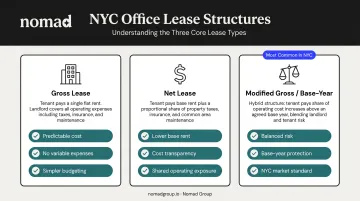
- Gross lease — Tenant pays flat rent; landlord covers operating expenses and taxes
- Net lease — Tenant pays base rent plus a share of operating costs (taxes, insurance, maintenance)
- Modified gross / base-year lease — A hybrid: some costs are baked into rent, and tenants pay their proportionate share of increases in taxes or operating expenses above a base year
According to Practical Law's NYC office lease documentation, the modified gross/base-year model is the most common structure in New York multi-tenant office buildings. That means your rent isn't a single fixed figure — operating expense pass-throughs can increase your real cost year over year, so understand your exposure before signing.
Asking Rent vs. Effective Rent
Landlords quote base rent, but that figure doesn't reflect what you'll actually pay once concessions enter the picture. Effective rent accounts for concessions: free rent periods and tenant improvement allowances (TIAs) reduce the true cost of occupancy over the lease term. Avison Young defines net effective rent as base rent discounted by those concessions. Always ask your broker for both figures before comparing deals — a higher asking rent with strong concessions can be cheaper than a lower asking rent with none.
Types of Office Spaces Available for Lease in NYC
Not all lease options solve the same problem. Here's how the main categories differ:
Traditional Direct Lease
Tenant signs directly with the landlord for a private, dedicated floor or suite. Terms typically run 5–10 years, with more customization and negotiating leverage on TIA (Tenant Improvement Allowance) and rent structure. It's the right fit for companies with stable headcount and a clear sense of how they want to express their brand through the space.
Sublease Space
A current tenant re-leases their unexpired space — often at below-market rates and already built out. The trade-offs are real: shorter remaining terms, less negotiating leverage, "as-is" condition, and exposure to the original tenant's financial health.
Worth knowing: Manhattan sublease supply fell for the fifth consecutive quarter to just under 15.0M SF in Q3 2025, down nearly 7.0M SF year-over-year. Sublease options still exist, but the discount window is narrowing.
Coworking and Shared Space
Month-to-month memberships in shared environments work well for early-stage teams or satellite offices. The downside at scale: higher per-seat cost and limited ability to express brand identity. Coworking represents roughly 2.28% of total U.S. office inventory as of Q1 2026, and the premium pricing relative to dedicated space becomes harder to justify as headcount grows.
Managed/Flex Office Space
A step above coworking — private, fully furnished, turnkey offices with flexible lease terms and operational services included. Nomad Group's Flex by Nomad model sits in this category: private offices with services bundled in — IT, furniture, ops support — priced through in-house infrastructure rather than the markup layers typical of national coworking chains.
Once you understand the trade-offs between each type, the decision usually comes down to five variables:
How to Choose
| Factor | Points Toward Direct Lease | Points Toward Flex/Sublease |
|---|---|---|
| Headcount stability | Stable/predictable | Uncertain/growing |
| Budget certainty | Prefer fixed costs | Need flexibility |
| Brand investment | High priority | Lower priority |
| Growth horizon | 3+ years clear | 12–18 months unclear |
| Capital for buildout | Available | Limited |
How Much Does It Cost to Lease Office Space in NYC?
Costs vary enormously by neighborhood and building class. Here are current asking rents across key submarkets:
Asking Rent by Submarket (Q3 2025)
| Submarket | Asking Rent ($/SF/year) | Vacancy |
|---|---|---|
| NoHo/SoHo | $100.04 | 14.3% availability |
| Flatiron/Union Square | $84.00 | 18.5% availability |
| Midtown (Class A) | $84.10 | 21.1% |
| Midtown (overall) | $75.58 | 21.1% |
| Manhattan overall | $72.81 | 22.0% |
| Grand Central | $67.26 | 21.5% |
| Downtown (Class A) | $61.28 | 22.5% |
| Brooklyn | $47.74 | — |
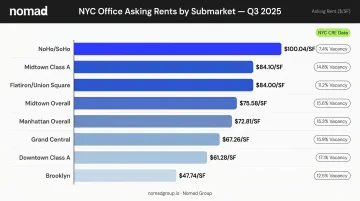
Sources: Cushman & Wakefield Q3 2025 Manhattan Office Report; Newmark 3Q25 Manhattan Market Overview
All NYC rents are quoted annually per square foot. A 3,000 SF space at $75/SF costs $225,000/year, or $18,750/month — before operating expense pass-throughs.
Those base-rent figures are just the starting point. Several additional cost layers determine what you'll actually pay.
Operating Expense Pass-Throughs
On a modified gross/base-year lease, tenants pay their proportionate share of any increases in property taxes, insurance, and building operating costs above the base year. Escalations are estimated throughout the year and reconciled annually.
For multi-floor tenancies in older Midtown buildings with rising tax assessments, pass-throughs can add $5–$15/SF annually to total occupancy cost — a material number on a 10,000 SF lease.
Tenant Improvement Allowance (TIA)
Landlords offer TIA — a per-square-foot contribution toward your buildout — as a concession to attract tenants. Nationally, CBRE reported average TIA at $87.51/SF in 2024, down from $97.55/SF in 2023 as concessions pull back at better buildings.
Push hard on TIA during negotiations. On a long-term lease with strong allowance terms, buildout costs can approach zero — leaving capital for furniture, AV systems, and equipment instead.
Free Rent and Other Concessions
In competitive submarkets, landlords often offer several months of free rent at lease commencement. Model this carefully: six months free on a 7-year lease sounds attractive, but spread across 84 months, it's a smaller discount than it appears. Always calculate total cost of occupancy over the full lease term — year-one math is misleading.
Hidden Costs Tenants Overlook
Beyond rent, budget for:
- Legal fees for lease review — a commercial real estate attorney is essential in NYC
- Furniture and fixtures — not covered by TIA in most cases
- IT infrastructure — cabling, server rooms, AV systems
- Moving costs — logistics, freight, and temporary storage
- Ongoing facilities and maintenance — cleaning, HVAC servicing, and repairs
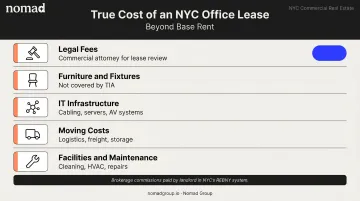
Brokerage commissions are paid by the landlord in NYC's REBNY system — tenants don't pay their broker directly.
Key NYC Neighborhoods for Office Space
Midtown and Grand Central
The traditional corporate hub, with premium Class A towers and unmatched transit access. Grand Central asking rent is currently $67.26/SF — lower than many expect given the prestige — with 21.5% vacancy. Best for companies that need large block availability, proximity to enterprise clients, or a prestigious address to attract institutional relationships.
NoMad, Flatiron, and Union Square
This corridor — what Nomad Group calls "Unicorn Lane" — is the sweet spot for high-growth tech companies and scaling startups. Flatiron/Union Square asking rents of $84.00/SF reflect genuine demand from talent-driven businesses, not just prestige pricing. Transit access is excellent, the neighborhood feel is mixed-use and vibrant, and the density of VC-backed companies creates a talent ecosystem that matters for hiring.
Nomad Group has placed companies like Authentic Insurance (Flatiron), Nirvana Health (Union Square), and Extend AI (NoMad) across this corridor — and that concentration translates to specific building knowledge, direct landlord relationships, and sublease inventory that rarely surfaces on public listings.
SoHo, Lower Manhattan, and Brooklyn
Each of these three markets serves a distinct tenant profile:
| Neighborhood | Asking Rent | Vacancy | Best For |
|---|---|---|---|
| SoHo / NoHo | $100.04/SF | 14.3% | Media, design, and brand-forward companies that need loft character and high ceilings |
| Downtown Manhattan | $61.28/SF | 22.5% | Companies needing Class A quality at a meaningful discount to Midtown |
| Brooklyn (Williamsburg) | $47.74/SF | — | Teams with Brooklyn-based staff or a lifestyle-forward culture |
Brooklyn's leasing market is thinner than Manhattan's — fewer competing tenants means more negotiating room, but also fewer move-in-ready options and shallower amenity depth.
What to Know Before Signing: Lease Terms and Red Flags
Lease Length and Flexibility
Direct leases in NYC typically run 5–10 years. For startups, this tension is real: too long locks in liability before you know your growth trajectory; too short limits your leverage on TIA and free rent.
Two provisions worth fighting for:
- Termination clause: allows exit at a defined point (typically year 5 of a 10-year lease) with advance notice and a fee
- Expansion rights: first right of refusal on adjacent space as you grow
Personal Guarantees and Good Guy Clauses
Landlords routinely require founders of smaller or early-stage companies to personally guarantee the lease. This means personal assets are on the line if the business can't pay rent.
A good guy clause limits that exposure: personal liability ends if the tenant vacates the space properly, provides advance written notice, pays rent current through vacatur, and returns the keys. The New York Court of Appeals ruled in 2025 that (unless expressly required in the lease) liability ends on vacatur and surrender without needing the landlord's written acceptance.
The wording of your good guy clause matters. It's a material lease risk — have your attorney review it before you sign.
Annual Rent Escalations
Most NYC leases include fixed annual escalations of 2–3% or a step-up schedule. At 3% annually, a $100,000/month base rent grows to roughly $123,000/month by year 7. Model this out before signing — the compounding effect on a 7-year lease is significant.
Work Letter and Delivery Condition
The work letter specifies what condition the space will be delivered in and what the landlord will contribute toward buildout. A thorough work letter should address:
- TIA amount and landlord versus tenant scope
- Permit approval processes and substantial completion standards
- Supplemental cooling and riser access
- Soft costs
A vague work letter is a red flag. Push for specifics before executing the lease, because ambiguity here creates disputes over cost and move-in timing.
Red Flags to Bring to Your Attorney
- Unrestricted landlord access clauses (landlord can enter with minimal notice)
- Ambiguous or overly restrictive subletting provisions
- Missing or weak renewal options
- Undefined "building standard" definitions for operating expense calculations
- Escalation clauses that lack a cap on pass-through increases
Navigating the NYC Office Leasing Process
Realistic Timeline
Colliers recommends beginning office market exploration no later than 12 months before lease expiration for most office occupiers — and larger or more complex requirements need even more time. The typical sequence for a direct lease:
- Months 1–2: Define requirements, engage broker, begin market tour
- Months 2–4: Tour spaces, issue LOIs, negotiate business terms
- Months 4–6: Lease negotiation, legal review, and execution
- Months 6–9+: Buildout, permits, furniture, IT, move-in
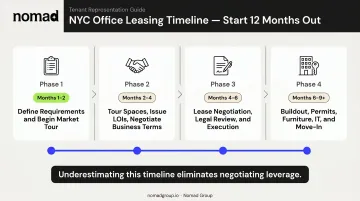
Underestimating this timeline is one of the most common and costly mistakes tenants make. It eliminates negotiating leverage and forces rushed decisions.
The Role of a Tenant Rep Broker
In NYC's REBNY brokerage system, the landlord pays the brokerage commission — tenants get professional representation at no direct out-of-pocket cost. A tenant rep broker handles market analysis, property tours, LOI drafting, lease negotiation, financial evaluation, and due diligence. Going into negotiations without one puts you at a structural disadvantage: the landlord's broker works for the landlord.
Working with Nomad Group
Nomad Group functions as a tenant rep — and then some. Where most brokers hand off after lease signing, Nomad's model covers the full real estate lifecycle under one roof:
- Space identification and market analysis
- Lease negotiation and financial evaluation
- Construction management with a 90-day buildout turnaround
- Ongoing facilities management post-move-in
The team has leased over 2M square feet and completed 300+ tenant buildouts across NYC's highest-demand neighborhoods. For companies that want a single point of accountability from search through move-in — without coordinating separate brokers, contractors, and facilities vendors — that integrated model makes a practical difference.
Frequently Asked Questions
What does office space for lease mean?
Leasing office space means paying for the right to occupy a commercial property for a defined term without purchasing it. In NYC, most office leases use a modified gross/base-year structure where tenants pay base rent plus their share of increases in operating expenses and taxes above the base year.
Should I lease or buy office space?
For most NYC businesses — especially high-growth and scaling companies — leasing is more practical. Purchasing commercial real estate in Manhattan requires significant capital and limits flexibility as headcount and needs evolve.
How much does it cost to lease office space in NYC?
Costs vary significantly by neighborhood and building class, from roughly $47/SF annually in Brooklyn to over $100/SF in SoHo. Tenants should budget beyond base rent for operating expense pass-throughs, buildout costs (partially offset by TIA), and legal fees.
How long is a typical office lease in NYC?
Direct leases typically run 5–10 years, though shorter terms are sometimes available in subleases or flex/managed office arrangements. Lease length directly affects negotiating power — longer commitments generally unlock better TIA, lower base rent, and more favorable concessions.
What is a tenant improvement allowance?
A TIA is a landlord contribution (per square foot) toward the cost of building out the space to your specifications. It's one of the most important financial terms in any NYC office lease — a well-negotiated TIA can substantially reduce or eliminate upfront buildout costs.
Do I need a tenant broker to lease office space in NYC?
Not legally, but working with a tenant rep broker is strongly advisable. In NYC's REBNY system, the landlord pays the commission — so tenants get expert representation and negotiation support at no direct cost. Going unrepresented means the landlord's broker is the only professional at the table.