For retail tenants especially, signing a percentage lease without fully understanding its mechanics is one of the more expensive mistakes you can make. A base rent figure that looks reasonable on paper can balloon quickly once overage rent kicks in — and whether it kicks in at $800,000 in sales or $1.5 million often comes down to a single negotiated number in the lease.
This article covers how percentage leases work, how rent is actually calculated, which clauses carry the most financial weight, and when this structure makes sense compared to alternatives.
Key Takeaways
- A percentage lease combines a fixed base rent with overage rent — a percentage of gross sales above a defined sales threshold called the breakpoint.
- This structure is primarily used in retail settings: malls, shopping centers, and high-foot-traffic corridors.
- The breakpoint (natural or artificial) determines when overage rent kicks in — and its placement often matters more than the percentage rate itself.
- Landlords benefit from tenant upside; tenants get lower base rents but share revenue during strong periods.
- Key lease clauses — including gross sales definitions, audit rights, and go-dark provisions — define the true risk profile of any percentage lease deal.
What Is a Percentage Lease in Commercial Real Estate?
A percentage lease is a commercial lease structure where rent has two components: a fixed base rent (sometimes called minimum rent) plus additional overage rent calculated as a percentage of the tenant's gross sales once those sales exceed a defined threshold.
The base rent works as an income floor — the landlord collects it regardless of how the business performs. Overage rent is the performance-linked premium on top of that floor, paid only when the tenant crosses a sales breakpoint.
Where Percentage Leases Are Used
This structure is primarily a retail leasing tool. According to Northmarq, percentage rent is most common in properties like shopping centers and malls where foot traffic directly drives tenant revenue. You'll find it in:
- Regional and super-regional malls
- Grocery-anchored neighborhood centers
- High-pedestrian retail corridors
- Restaurant and food court tenancies
Office and industrial leases almost never use this structure. The reason is practical: a software company's revenue isn't generated by the office itself, so tying rent to sales volume makes no logical sense. Retail is different — location directly produces the revenue.
How It Differs from Other Lease Types
| Lease Type | How Rent Is Set | Operating Expenses |
|---|---|---|
| Gross / Full-Service | Fixed, all-inclusive | Landlord pays |
| Triple Net (NNN) | Fixed base rent | Tenant pays taxes, insurance, CAM |
| Modified Gross | Fixed, partial pass-throughs | Split between parties |
| Percentage | Base + % of gross sales | Varies; often NNN structure |
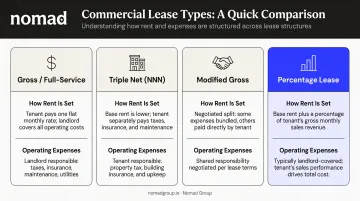
A single lease can include both elements — an NNN structure with a percentage rent clause layered on top is common in retail. NNN terms govern who pays operating expenses; percentage rent terms govern revenue sharing. They address different things.
Anchor Tenant Dynamics
One factor many retail tenants underestimate: their own sales performance is partly driven by who else is in the center. A peer-reviewed study found that non-anchor tenant rents declined approximately 25% following anchor tenant loss — the departure of a major grocery chain or department store erodes the foot traffic that generates gross sales.
In a percentage lease, that lost traffic hits twice. Overage rent drops (or disappears entirely) as sales fall below the breakpoint. The base rent, however, stays fixed no matter what.
How Percentage Rent Is Calculated: Base Rent, Breakpoints, and Overage
This is the most mechanically complex part of any percentage lease. Getting it wrong (even by negotiating one number without considering its relationship to the others) can produce a lease that costs far more than anticipated.
The Natural Breakpoint
The natural breakpoint is the sales level at which the percentage rent calculation mathematically equals the base rent. It's derived directly from the lease economics:
Natural Breakpoint = Annual Base Rent ÷ Percentage Rate
Example: $120,000 annual base rent ÷ 6% = $2,000,000 natural breakpoint
Below $2,000,000 in gross sales, the tenant pays only base rent. Above $2,000,000, overage rent kicks in. The term "natural" reflects the fact that this threshold emerges from the math — not from negotiation.
The Artificial Breakpoint
Unlike the natural breakpoint, an artificial breakpoint is a negotiated number that deliberately sets the threshold higher or lower than the natural figure.
- Lower than natural — benefits the landlord (overage kicks in sooner)
- Higher than natural — benefits the tenant (more room before overage applies)
This is where many tenants make a costly mistake. Focusing on negotiating the percentage rate down while accepting an artificially low breakpoint often produces worse economics. Consider:
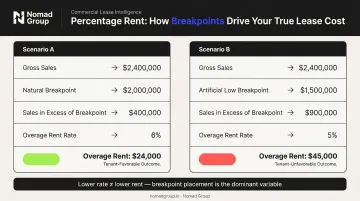
- Scenario A: 6% rate, $2,000,000 breakpoint (natural). At $2,400,000 in sales, overage = $24,000.
- Scenario B: 5% rate, $1,500,000 breakpoint (artificial low). At $2,400,000 in sales, overage = $45,000.
A lower percentage rate didn't help. The breakpoint placement was the dominant variable.
Calculating Overage Rent
Once you have the inputs, the formula works as follows:
(Gross Sales − Breakpoint) × Percentage Rate = Overage Rent
Using Scenario A above: ($2,400,000 − $2,000,000) × 6% = $24,000 in overage rent
That $24,000 gets added to the $120,000 base rent, bringing total annual rent to $144,000.
Typical Percentage Rates by Category
Rates vary by retail category because operating margins differ across business types. Based on American Bar Association retail lease guidance:
- Food court tenants: 10%–15% of annual sales
- Fast casual and table-service restaurants: 5%–7% of annual sales
Authoritative benchmarks for apparel, grocery, specialty retail, and electronics are not publicly standardized — rates in those categories are negotiated deal-by-deal, and any figure you encounter reflects a specific transaction rather than an industry norm. That variability is precisely why understanding the breakpoint math matters more than anchoring to a target percentage rate.
Key Components of a Percentage Lease Agreement
Beyond the breakpoint and rate, several other clauses define the true risk profile of a percentage lease. Overlooking them is where tenants most often leave money on the table.
The Gross Sales Definition Clause
Holland & Knight describes the definition of gross sales as the heart of the percentage rent formula — and it's the most heavily negotiated element in any percentage lease.
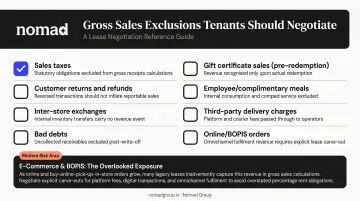
Landlords want a broad definition (more revenue included = larger overage base). Tenants want a narrower one. Key exclusions tenants should push to include:
- Sales taxes collected and remitted to government
- Customer returns and refunds
- Inter-store merchandise exchanges
- Bad debts (with add-back provisions if later collected)
- Gift certificate sales (excluded until redemption)
- Employee and complimentary meals (restaurant-specific)
- Third-party delivery service charges
E-commerce and BOPIS (buy online, pick up in store) deserve particular attention. Modern leases need explicit language addressing whether online orders fulfilled from the store location count toward gross sales — because click-and-collect transactions can materially skew percentage rent calculations and this language is frequently absent from older lease templates.
Sales Reporting and Audit Rights
Tenants are typically required to report gross sales monthly or annually. The landlord retains the right to audit those records, usually with a defined window — ICSC's model retail lease uses a three-year retention and audit period as a standard structure. Key provisions to understand:
- Under-reporting penalties (including what constitutes a "material" discrepancy)
- Frequency and notice requirements for audits
- What records qualify as documentation (POS reports, sales tax filings, etc.)
Inaccurate reporting can trigger default provisions. This isn't just a paperwork obligation — it has direct lease compliance implications.
Go-Dark and Co-Tenancy Provisions
Go-dark clauses address a specific tension in percentage leases. Because the landlord's overage income depends on the tenant operating and generating sales, leases often include operating covenants that prevent tenants from closing or significantly reducing operations during the lease term.
A tenant who goes dark — keeps the space but stops operating — can eliminate the landlord's percentage rent income while still technically occupying the premises.
Where go-dark clauses protect landlord income, co-tenancy clauses flip the dynamic — protecting tenants. If an anchor tenant leaves and foot traffic declines, co-tenancy provisions can entitle the remaining tenant to a rent reduction or even an early termination right. These clauses can be tied to named anchor tenants, occupancy thresholds for the center as a whole, or both.
Understanding these mechanics matters beyond retail contexts. Commercial tenants of all kinds can encounter analogous operating and co-occupancy obligations in their leases. Nomad Group's tenant representation team helps clients across NYC parse these clauses before signing — so the terms of occupancy align with how a business actually operates, not just how it was operating at the time of negotiation.
Pros and Cons of Percentage Leases
A percentage lease is a risk-sharing structure — and how well it works depends entirely on whether both parties' interests stay aligned. Here's how the tradeoffs break down for each side.
For Tenants
Pros:
- Lower base rent provides cash flow relief during slow periods — particularly valuable for seasonal businesses
- Rent scales with revenue, making the structure survivable during a genuine downturn
Cons:
- High performers effectively pay a premium for their own success — overage rent grows as the business grows
- Monthly or annual sales reporting adds administrative burden and reduces financial privacy
For Landlords
Pros:
- Participation in tenant upside generates income growth beyond fixed rent
- Lower base rent attracts tenants who couldn't afford flat-rate occupancy costs
Cons:
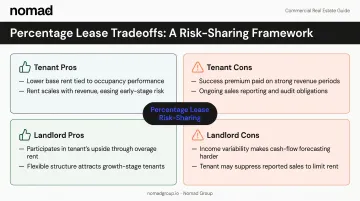
- Income is variable and harder to underwrite for financing or valuation purposes
- Exposure to operational decisions that suppress reported gross sales — protective clauses like radius restrictions and BOPIS allocation provisions exist specifically to address this risk
Common Misconceptions About Percentage Leases
Misconception 1: "The percentage rate is the dominant cost driver"
Many tenants spend negotiating energy on getting the rate from 6% to 5% while accepting an artificially low breakpoint. As shown in the calculation section above, the breakpoint placement — not the rate — typically determines total overage exposure at realistic sales volumes. A lower rate applied to a much larger overage base produces higher rent, not lower.
Misconception 2: "Gross sales means total revenue"
The number used for overage calculations often doesn't match a tenant's top-line sales figure. A lease with no carveouts for taxes, returns, e-commerce, or delivery fees can produce an overage base that's significantly higher than actual net revenue from in-store sales. Missing even two or three key exclusions adds up fast at scale.
Misconception 3: "Percentage leases and NNN leases are interchangeable in retail"
They address completely different economic issues. A NNN lease determines who pays property taxes, insurance, and common area maintenance costs. A percentage lease determines how revenue upside is shared. These two structures frequently coexist in the same document — a NNN lease with a percentage rent clause is standard in many retail settings. A tenant who negotiates only the NNN terms can still face substantial overage rent exposure they never modeled — because the percentage clause was sitting in the same document, unaddressed.
Frequently Asked Questions
What is a percentage lease in commercial real estate?
A percentage lease is a commercial lease where rent includes a fixed base rent plus an additional amount equal to a percentage of the tenant's gross sales above a defined threshold. It's most common in retail settings where a tenant's revenue is directly tied to their physical location.
How is the breakpoint calculated in a percentage lease?
The natural breakpoint equals annual base rent divided by the percentage rate — for example, $120,000 ÷ 6% = $2,000,000. Sales above this level trigger overage rent. An artificial breakpoint is separately negotiated and can be set higher or lower than this figure.
What types of businesses typically use percentage leases?
Percentage leases are most common among retail tenants in high-traffic locations — mall-based retailers, restaurants, food court operators, grocery stores, and specialty shops. The structure fits businesses where location directly generates the revenue used to calculate rent.
What is the difference between a natural and artificial breakpoint?
A natural breakpoint is mathematically derived from the base rent and percentage rate. An artificial breakpoint is negotiated directly between landlord and tenant, shifting the threshold higher or lower to favor one party's position on when overage rent kicks in.
Are percentage leases negotiable?
All core terms are negotiable — the breakpoint, percentage rate, gross sales definition, and audit rights. Working with a tenant representation advisor strengthens your position on the provisions that drive the most financial exposure.
Can a landlord audit a tenant's gross sales in a percentage lease?
Yes. Most percentage leases include audit rights allowing the landlord to verify reported sales figures, typically once per year. Tenants should review the audit scope carefully — overly broad provisions can create administrative burden and expose internal financial data beyond what's necessary.