This guide covers what you actually need to know: how commercial leases work, the four primary lease structures, the step-by-step leasing process, which terms to negotiate, and the most costly mistakes to avoid.
Key Takeaways
- Commercial leases are fully negotiable — every clause, from rent escalation to subletting rights, is on the table
- Four lease structures exist: gross, net, modified gross, and percentage — each splits costs differently between tenant and landlord
- The leasing process follows clear stages: defining requirements, selecting a broker, touring spaces, negotiating terms, and managing buildout
- Total occupancy cost (not just base rent) is what actually determines affordability
- Tenant broker representation is standard in NYC, and the landlord covers the cost
How Commercial Leasing Works
A commercial lease is a contract between a business (tenant) and a property owner (landlord) for the right to occupy a space — and beyond that basic definition, almost nothing is standard.
Unlike residential leases, commercial leases have no standard template, no tenant protection minimums, and no implied warranties about habitability or condition. Every economic and legal variable — rent, term, operating expenses, buildout obligations, renewal rights — is negotiated between the parties.
Who's Involved
A typical commercial lease transaction involves:
- The tenant — the business leasing the space, responsible for evaluating fit, negotiating terms, and signing the lease
- The landlord — the property owner or their management company, motivated to fill vacancies and maximize lease value
- The landlord's broker — represents the building's interests, not yours
- The tenant's broker — represents the tenant exclusively, with no conflicting obligations to the landlord
- Legal counsel — reviews the lease document, flags unfavorable clauses, and negotiates language before execution
The tenant broker is the most important party many first-time commercial tenants overlook. In standard NYC office transactions, their fee is paid by the landlord — meaning you get dedicated representation at no direct cost. Once you understand who's at the table, the next question is how long you'll be sitting there.
Lease Lengths and Why They Matter
Commercial lease terms vary widely — from short-term deals of one to two years up to 10-year commitments for larger, established occupiers. For growing companies, term length is a strategic decision:
- Too short: Lack of stability, frequent disruption, limited leverage on rent
- Too long: Locked into space that no longer fits the business in year four or five
- The sweet spot for most growth-stage companies: 3–5 years with built-in flexibility provisions
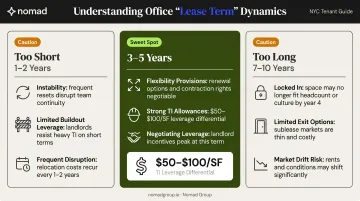
Lease term also directly affects your negotiating leverage on buildout allowances and rent concessions. A 5-year deal in NYC can yield $50–$100 per square foot in tenant improvement allowances; a 2-year deal may offer little to nothing. That gap matters before you sign.
The Four Types of Commercial Leases
Understanding lease structure is the foundation for evaluating any space. The type of lease determines who pays what — and how predictable your monthly costs will be.
Gross Lease (Full-Service Lease)
In a gross lease, the tenant pays one all-inclusive rent figure. The landlord covers operating expenses: property taxes, insurance, utilities, and maintenance. This is the easiest structure for budgeting because your monthly cost is fixed.
Manhattan office buildings commonly quote rents on a full-service gross basis. Avison Young's Q1 2026 Manhattan report listed direct asking rents at $91.52/SF full service — a figure that includes operating costs within the quoted number.
One important nuance: most full-service gross leases include a "base year" provision. The landlord covers operating expenses up to the level in your lease's base year. Any increases above that threshold get passed through to the tenant annually. This can add meaningful cost over time and should be reviewed carefully.
Net Lease
In a net lease, the tenant pays a lower base rent but contributes directly to building operating expenses. There are three sub-types:
| Lease Type | Tenant Pays |
|---|---|
| Single Net (N) | Base rent + property taxes |
| Double Net (NN) | Base rent + taxes + insurance |
| Triple Net (NNN) | Base rent + taxes + insurance + maintenance |
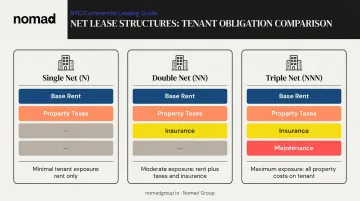
NNN leases are among the most common structures in commercial real estate broadly, though they are less prevalent in Manhattan multi-tenant office buildings than in retail or single-tenant assets. The advantage for tenants: full transparency into building expenses. The risk: exposure to cost fluctuations outside your control.
Modified Gross Lease
The modified gross is a negotiated middle ground. The tenant pays base rent plus a specified portion of operating costs, with the exact split determined during lease negotiations.
This structure requires careful line-by-line review. What looks like a favorable base rent can change materially once the operating expense contributions are modeled out.
Percentage Lease
Percentage leases require tenants to pay base rent plus a percentage of gross sales once revenue exceeds a set threshold (the "breakpoint"). This structure is almost exclusively used in retail environments and rarely appears in office leasing contexts.
The Commercial Leasing Process, Step by Step
Step 1: Define Your Requirements and Budget
Before you look at a single space, get clear on what you actually need:
- Square footage — How many people will occupy the space, and what density makes sense for your team's work style?
- Neighborhood — Proximity to transit, talent, and clients all affect retention and recruitment
- Must-have infrastructure — Dedicated conference rooms, reception, server capacity, private offices
- All-in budget — Base rent is one number. Total occupancy cost includes operating expenses, buildout, furniture, and ongoing utilities
Modeling 2–3 year growth scenarios at this stage avoids leasing a space that fits today but constrains the business in 18 months.
Step 2: Engage a Tenant Broker
A tenant broker works exclusively on your behalf — not the landlord's. In NYC office leasing, their commission is paid by the landlord, which means tenants receive full advocacy at no direct cost.
What a good tenant broker brings:
- Access to off-market and pre-market listings before they're publicly available
- Comparable transaction data to benchmark pricing
- Negotiating leverage from market knowledge and landlord relationships
- Coordination of the full process, from tours through lease execution
Nomad Group takes this model further than traditional brokerage. As a full-service commercial real estate firm focused on high-growth companies across Flatiron, NoMad, Union Square, SoHo, and Williamsburg, they guide clients from initial search through lease execution and buildout, acting as a long-term partner rather than a transaction facilitator.
That distinction matters in practice. When Extend AI was set back months by a prior broker, Nomad stepped in, identified the right space, and had the office built out and occupied in five weeks.
Step 3: Tour Spaces and Conduct Due Diligence
Touring is more than finding a space that looks right. NYC-specific diligence should include:
- Certificate of Occupancy (CO) — Confirms the legal use and permitted occupancy via NYC DOB
- Zoning verification — Use ZoLa, NYC Planning's zoning and land-use map, to confirm the space can accommodate your intended use
- Building permits and records — Available through DOB NOW, NYC's public permit portal
- Infrastructure — HVAC capacity, electrical load, ADA compliance, and internet connectivity
- Landlord financial stability — Buildings in receivership or with ownership disputes create execution risk
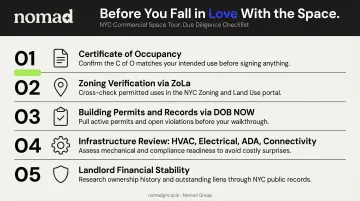
A space can look right and still fail due diligence. Verify infrastructure before you fall in love with the finish.
Step 4: Review and Negotiate the Lease
Once you've identified the right space, the lease document itself requires serious attention. Commercial leases are long-form contracts, often 40–80 pages, and every clause carries financial or operational consequence.
Bring a tenant broker and a commercial real estate attorney to this stage. Key areas to negotiate include:
- Rent and annual escalation caps
- Tenant improvement (TI) allowances
- Subletting and assignment rights
- Early termination options
One principle applies across every lease: everything is negotiable. Landlords present leases as if they're fixed. They're not.
Step 5: Plan for Buildout and Move-In
Most commercial spaces require customization before they're functional. After lease execution, the buildout phase covers design, permitting, construction, and delivery. Without tight coordination, that process can stretch well beyond the timelines tenants expect.
Nomad Group's in-house construction team has completed 300+ tenant buildouts across NYC with a typical 90-day turnaround. Having one firm manage both the lease and the buildout eliminates the handoff risk between brokers and contractors, a common source of delays and budget overruns for first-time tenants.
Key Lease Terms Every Tenant Should Negotiate
Rent Escalation and Base Year
Most commercial leases include annual rent increases tied either to a fixed percentage or to the Consumer Price Index (CPI). Negotiating a cap on annual escalations (commonly 2–3%) protects against runaway rent growth over a 5-year term.
In full-service gross leases, the base year concept creates a second layer of cost exposure. Operating expenses above the base year level get passed through to the tenant. Negotiate the base year carefully — a landlord may propose a year with artificially low expenses, which creates a steep pass-through from year two onward.
Tenant Improvement Allowance (TI)
A TI allowance is a landlord contribution toward the cost of customizing the space for your use. It is negotiated, not guaranteed, and varies significantly by building class, lease term, and market conditions.
For context: Bisnow, citing CompStak data, reported that NYC TI allowances average approximately $120/SF, while Midtown trophy TI allowances fell from $162/SF to $133/SF in recent market cycles. Modern buildout costs in NYC can run $150–$300/SF, meaning the TI allowance often won't cover the full cost of a high-quality buildout.
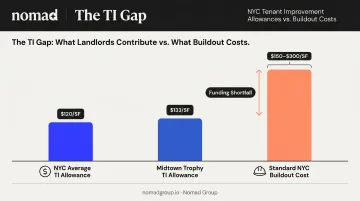
Clarify the following before signing:
- What expenses the allowance can be applied to
- Disbursement timing (lump sum at signing vs. reimbursement after completion)
- Whether unused allowance carries forward or reverts to the landlord
- Restoration obligations at lease end
Subletting, Assignment, and Expansion Rights
For any growing company, flexibility clauses are essential protection against unpredictable growth:
- Subletting rights — Ability to lease unused space to a third party if headcount contracts
- Assignment rights — Ability to transfer the lease if the company is acquired (critical for venture-backed companies)
- Right of first refusal on adjacent space — Option to expand into neighboring space before it goes to market
- Contraction rights — Ability to reduce the footprint under specified conditions
Landlords often restrict these clauses. Negotiate them before signing, not after.
Lease Flexibility: Termination and Renewal Options
Early termination rights (typically exercisable after year two or three, with a pre-agreed penalty) give growing companies an exit if business conditions change materially. Renewal options at predetermined rents prevent the loss of a built-out space to market rent increases at expiration.
Both provisions should be clearly defined with specific exercise dates, notice requirements, and economics. Vague language here creates real disputes later.
Common Mistakes to Avoid When Leasing Commercial Space
Underestimating Total Cost of Occupancy
Base rent is the starting point, not the total. CAM fees, property tax contributions, insurance, utilities, and buildout capital all contribute to what the space actually costs per month. In NYC, the gap between asking rent and net effective rent can be substantial — Avison Young's Q1 2026 data showed trophy Class A spaces at $89/SF base but $67/SF net effective after concessions. Model the full picture before comparing spaces.
Skipping Legal Review
Commercial leases routinely contain clauses that most tenants don't catch until it's too late. Before signing, have a commercial real estate attorney review the full document for:
- Restoration clauses — require tenants to demolish improvements at lease end
- Subletting restrictions — consent requirements that limit your ability to sublet
- Operating expense definitions — language that expands the landlord's pass-through rights
None of these appear on a summary sheet. Every tenant needs a commercial real estate attorney reviewing the full document before signing.
Leasing Only for Current Headcount
A space that fits your team today may not fit it in 18 months. High-growth companies frequently underestimate how fast they'll grow — and by the time it's obvious, they're stuck mid-term with no leverage.
Model headcount scenarios at the 1-year, 2-year, and 3-year marks before signing. Build flexibility in upfront through expansion options or sublease rights, rather than trying to renegotiate from a weak position later.
Frequently Asked Questions
How does commercial leasing work?
Commercial leasing is a contractual agreement where a business pays rent to occupy space. The key terms — duration, rent, operating expenses, and responsibilities — are all negotiated between tenant and landlord. The process typically involves a tenant broker, legal counsel, and multiple negotiation rounds before a lease is signed.
What are the four types of commercial leases?
The four main types are gross (full-service), net (single, double, or triple), modified gross, and percentage lease. Each differs in how operating costs are divided between tenant and landlord, with gross leases being most common in NYC multi-tenant office buildings.
What is the difference between a gross lease and a net lease?
In a gross lease, the landlord covers operating expenses within the all-in rent. In a net lease, the tenant pays a lower base rent but takes on some or all operating costs — taxes, insurance, and maintenance — directly.
What is a tenant improvement allowance?
A TI allowance is a landlord contribution toward customizing the space for your needs. The amount, scope, and disbursement timing are all negotiated as part of the lease. Note that the allowance often doesn't cover the full cost of a complete buildout.
How long are commercial leases typically?
Commercial leases can range from one year to 10+ years depending on deal size and tenant profile. Most growth-stage companies target 3–5 year terms, balancing stability with flexibility. Longer terms typically unlock better TI allowances and rent concessions.
Do I need a broker to lease commercial space in NYC?
Not legally — but practically, yes. NYC's office market moves quickly, landlord brokers represent the building's interests, and a tenant broker provides deal access and negotiating leverage at no direct cost to the tenant. Their commission is paid by the landlord in standard NYC office transactions.