Introduction
Signing an office lease involves a lot more than agreeing on rent per square foot. One of the most valuable — and consistently misunderstood — negotiating levers is the tenant improvement allowance (TIA). Negotiate it well, and the landlord funds a significant portion of your buildout. Miss it, and you're writing large checks out of pocket before your first employee walks through the door.
Many tenants — especially first-time leasers and fast-growing startups — leave real money on the table. The most common mistakes:
- Accepting the landlord's initial TIA offer without pushing back
- Signing a lease before understanding what the allowance actually covers
- Committing to a short term that makes any meaningful buildout contribution nearly impossible to secure
This guide covers how TIAs work, what they cover, how lease term affects the numbers, and how to negotiate a better package — with specific benchmarks from the NYC office market.
Key Takeaways
- TIAs are landlord-funded contributions toward building out or renovating your leased space, expressed as a dollar amount per square foot
- NYC's 2024 average TIA was $132.57/SF for new deals and expansions — well above national averages
- Longer lease terms unlock larger allowances; short-term deals typically yield minimal TI
- TIAs cover hard construction costs by default; soft costs and FF&E require explicit negotiation
- Tenants who understand TIA structure negotiate higher per-SF allowances and broader cost coverage — including soft costs landlords don't offer by default
What Is a Tenant Improvement Allowance?
A tenant improvement allowance is a sum of money the landlord agrees to contribute toward the cost of building out or renovating a commercial space for your specific use. It's not a discount on rent — it's a construction budget, funded by the landlord, that gets spent on turning raw or previously occupied space into your office.
TIA vs. Turnkey Buildout
These two terms get confused, but the distinction matters:
- TIA model: The landlord provides a dollar budget (per SF). You hire contractors, manage the process, and spend the allowance. Any costs above the TIA are yours to cover.
- Turnkey model: The landlord delivers the space fully built to agreed specifications. They manage construction and bear the cost overrun risk — but you typically have less control over design and finishes.
Neither is universally better. Turnkey limits your financial exposure when the scope is tight and well-defined. A TIA trades that certainty for control — over quality, finishes, and how closely the space reflects your actual needs. Which works in your favor depends on the deal structure, your timeline, and how specific your buildout requirements are.
TIA Is Negotiated, Not Standard
TIA is not an automatic feature of every commercial lease. Whether you receive one — and how large it is — depends on:
- Current market vacancy rates
- Lease term length
- Your creditworthiness as a tenant
- The landlord's specific situation (carrying costs, repositioning goals, vacancy on that floor)
Each of those factors shifts the landlord's willingness to contribute. In a tight market with low vacancy, there's less incentive to offer generous allowances. With Manhattan office vacancy still at 23.9% as of Q4 2025 (per Cushman & Wakefield's Manhattan MarketBeat), tenants currently have real negotiating leverage — though that number is improving from the 25.8% seen in 2024.
How TIA Is Expressed and Paid
TIA is quoted as a dollar amount per square foot — for example, "$100/SF." On a 5,000 SF lease, that's $500,000 in landlord-funded construction budget.
Payment typically flows one of three ways:
- Reimbursement after the tenant completes construction (submit invoices, receive payment)
- Draws during construction (landlord releases funds at project milestones)
- Landlord manages construction and simply delivers a built space
Beyond the payment structure, one more factor determines how far a TIA actually stretches: the condition of the base space. A warm shell (with operational HVAC and basic infrastructure in place) requires far less work than a cold or gray shell (bare concrete, exposed structure, no mechanical systems). The same $100/SF can get you a finished office in a warm shell — or barely cover MEP rough-in costs in a cold one.
How Tenant Improvement Allowances Are Structured
TIAs are delivered through one of two models, and which one you negotiate matters as much as the dollar amount.
With a landlord-managed buildout, the landlord controls construction, selects contractors, and delivers a finished space. You get reduced administrative burden but limited influence over execution quality and timeline.
With a tenant-managed buildout, you hire your own general contractor, manage the project, and submit invoices for reimbursement against the TIA. More control, more responsibility — including managing timelines, lien waivers, and documentation.
For most startups with specific design requirements, the tenant-managed model is worth the extra work. It does require upfront capital (or draw agreements), strong project management, and a contractor familiar with reimbursement documentation requirements.
How Landlords Calculate TIA Offers
Landlords don't pull TIA numbers out of thin air — their offer reflects a real financial calculation tied to how much risk they're taking on:
- Lease term: A longer term gives the landlord more rent payments over which to recover the TI investment
- Tenant credit: A well-capitalized company with strong financials gets better terms than a pre-revenue startup
- Vacancy pressure: A landlord sitting on 30% vacancy in a building is more motivated than one with a waitlist
- Market comparables: What other landlords in the submarket are offering sets an informal ceiling
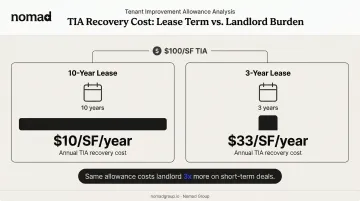
The underlying logic is straightforward: landlords don't "give" you TIA money — they invest it and recoup it through rent over the lease term. The table below shows why lease length changes the math so dramatically:
| Scenario | TIA | Lease Term | Effective Landlord Recovery Per Year |
|---|---|---|---|
| 10-year lease | $100/SF | 10 years | $10/SF/year |
| 3-year lease | $100/SF | 3 years | $33/SF/year |
The same $100/SF allowance is roughly 3x more expensive for the landlord on a short term. That's why landlords increasingly tie large incentive packages to longer lease commitments — and why your negotiating position changes dramatically based on how many years you're willing to commit.
The Reimbursement Process
Understanding the landlord's economics sets up the practical question: how does the money actually move? In a tenant-managed TIA, the draw process typically works like this:
- Tenant pays contractor invoices (or contractor bills directly to escrow)
- Tenant submits invoices plus lien waivers to the landlord
- Landlord reviews and releases reimbursement (typically within 20-30 days, as specified in the lease)
- Process repeats until the allowance is fully drawn
One important detail: most leases include a deadline for using the TIA — often tied to the lease commencement date or a fixed period after. Unused allowance typically does not carry over or get credited to rent. Don't leave money on the table by missing that window.
Managing TIA Overages
Even with a smooth draw process, buildout costs can exceed what the allowance covers — and when they do, the tenant pays the difference. Strategies to manage this risk:
- Negotiate a higher TIA before signing (the most effective approach)
- Scope the buildout precisely before the LOI stage
- Phase improvements — do the essentials at move-in, defer nice-to-haves
- Ask for an "above-allowance" loan provision, where the landlord fronts additional funds repaid through a rent add-on
What Does a Tenant Improvement Allowance Typically Cover?
What TIAs Commonly Cover
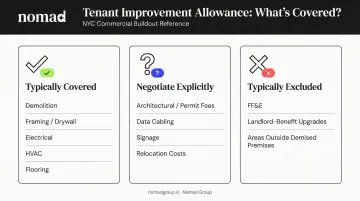
Most TIA funds are intended for hard construction costs — the physical work of transforming the space:
- Demolition of existing walls and fixtures
- Framing and drywall for new office layouts
- Electrical upgrades (panels, outlets, lighting circuits)
- Plumbing modifications
- HVAC modifications and diffuser repositioning
- Flooring (carpet, hardwood, tile)
- Ceilings and lighting fixtures
- Glass-front offices and conference rooms
- Paint and millwork
If you're fitting out a raw space, these line items will consume the majority of any TIA.
What Requires Explicit Negotiation
Several cost categories sit in a gray zone — they can be included, but you have to ask:
- Architectural and engineering fees, permit costs, and expediter fees (soft costs)
- Data cabling, AV systems, and access control wiring
- Relocation expenses — sometimes negotiable into the allowance
- Building directory listings and interior signage
Push for these categories to be explicitly included during lease negotiations. What's not specified in the lease is typically excluded by default.
What TIAs Do Not Cover
As a rule, TIA funds cannot be used for:
- FF&E (furniture, fixtures, and equipment not permanently attached to the premises) — desks, chairs, and loose equipment are almost always excluded
- Landlord-benefit improvements — building infrastructure upgrades that outlast your lease term
- Anything outside the demised premises (common areas, lobby improvements)
Have a real estate attorney review the lease's definition of "permitted uses" for TIA funds before you sign. The exact language in the lease — not the broker's verbal description — determines what you can actually spend the money on.
Real-World Examples of Tenant Improvement Allowances in NYC Office Leases
Scenario 1: A 7-Year Midtown Lease
A 50-person startup signs a 7-year lease on 5,000 SF in Midtown Manhattan. The landlord offers $100/SF TIA, putting $500,000 in the buildout budget.
A rough allocation of that budget across typical line items:
| Construction Category | Estimated Cost |
|---|---|
| Demolition & disposal | $30,000–$50,000 |
| Framing, drywall, doors | $80,000–$100,000 |
| Electrical (lighting, panels, circuits) | $60,000–$80,000 |
| HVAC modifications | $50,000–$70,000 |
| Flooring | $40,000–$60,000 |
| Glass-front offices / conference rooms | $40,000–$60,000 |
| Ceilings and lighting fixtures | $40,000–$50,000 |
| Architectural/permit fees (if negotiated in) | $30,000–$50,000 |
That's a realistic range of $370,000–$520,000 for a clean, functional buildout — roughly matching the $500,000 allowance if scoped carefully. Note that NYC construction costs are among the highest in the country, so precise pre-lease scoping is essential.
Scenario 2: A 3-Year Deal on the Same Space
The same 5,000 SF, but now the tenant commits to only 3 years. The landlord's TIA offer drops to $30–$40/SF — a total pool of $150,000–$200,000.
That budget covers cosmetic work: paint, carpet, minor reconfiguration. It does not fund a ground-up buildout. At this allowance level, tenants are typically looking at pre-built spaces or lightly used second-generation offices that need minimal work to become functional.
This gap illustrates why lease term decisions and buildout ambitions have to be evaluated together. A tenant who wants a custom-designed headquarters but negotiates a 3-year term to preserve flexibility is likely to face a six-figure out-of-pocket bill before day one.
What Above-Market TIA Looks Like
When landlords are highly motivated — high floor vacancy, a building in repositioning mode, or a large block of space sitting idle — TIA offers can reach well above the average. Bisnow reported office TI allowances peaking at $212/SF in gateway markets, with Savills reporting weighted TIAs rose 112% from 2016 through 2025. These aren't typical deals. But the conditions that produce them are recognizable, and knowing what to look for determines whether you capture that leverage or leave it on the table.
How Pre-Lease Cost Scoping Changes the TIA Negotiation
Having a construction management team embedded in the same firm that negotiates your lease changes the dynamic. Nomad Group's in-house construction team — which has completed 300+ tenant buildouts in NYC with a 90-day turnaround — can scope a buildout before the LOI is signed. That means the TIA number you negotiate is grounded in actual cost data, not a guess.
Fewer overages, no mid-construction surprises, and a TIA figure calibrated to what the buildout actually costs — that's what pre-lease scoping delivers.

How Lease Term Length Affects Your TI Allowance
The relationship between lease term and TIA generosity is one of the most consistent dynamics in NYC office leasing. Longer terms allow landlords to amortize their TI investment over more rent payments — so they're willing to offer more.
Practical guidance by term length:
- Under 3 years: Minimal allowance — mostly cosmetic work, if anything
- 5 years: Mid-range allowances; works well for second-generation spaces that don't need heavy renovation
- 7–10 years: The most generous packages available, especially in buildings with high vacancy
For high-growth companies, this creates a real trade-off. A 10-year commitment unlocks the best TIA, but it also locks you into a fixed footprint during a period when headcount may double or triple.
Model headcount projections against multiple term scenarios, and build flexibility into whichever length you choose — through expansion rights, early termination options, or sublease rights.
Lease term and TIA aren't separate decisions. Run the math on both together before you commit.
How to Negotiate a Better Tenant Improvement Allowance
Start at the LOI Stage
TIA negotiation should happen before the lease is drafted — specifically during the Letter of Intent (LOI) stage. SquareFoot's commercial LOI guidance is clear: the LOI should specify the TIA amount, permitted uses, and payment timing before lease drafting begins. If TIA isn't addressed in the LOI, you're negotiating from a weaker position once attorneys are engaged and momentum is pushing toward close.
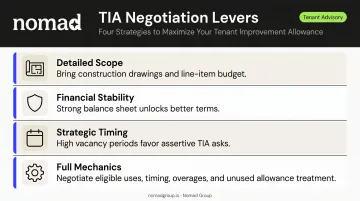
Key Negotiation Levers
- Come with a detailed scope: A tenant who arrives with actual construction drawings and a line-item budget signals credibility. The landlord can see exactly where funds will go and is more likely to meet a specific ask than an open-ended request.
- Demonstrate financial stability: Strong balance sheets and creditworthy tenants get better terms. For funded startups, having the right financial documentation ready matters.
- Time the deal strategically: High vacancy periods favor tenants. With Manhattan vacancy still near 24%, the market supports assertive TIA asks — especially in buildings that haven't filled recently.
- Negotiate all TIA mechanics, not just the dollar amount: Eligible uses, payment timing, overage responsibility, unused allowance treatment, and administrative fees the landlord may deduct all belong in the LOI.
Working With a Tenant Rep Broker
A tenant representation broker brings two things that change the outcome: market intelligence and deal experience.
Nomad Group's team has completed over 2 million square feet of leased transactions across NYC's core neighborhoods — Flatiron, NoMad, SoHo, Union Square, Bryant Park, and beyond. That transaction volume gives the team a direct read on what TIA is realistic for a given building, what landlords will and won't move on, and how to frame the ask so it lands.
That matters because the difference between a credible TIA request and one a landlord dismisses often comes down to framing — not the number itself. A rep who knows the building, the market, and the landlord's recent deal history turns a negotiation into a calibrated ask.
Tenant rep brokers work exclusively for you. Every TIA dollar, favorable mechanic, and lease protection they secure goes to your side of the deal — not the landlord's.
Frequently Asked Questions
What is the shortest commercial lease available?
There is no legal minimum for a commercial office lease. While some Manhattan tenants have signed terms as short as one year or even month-to-month, these arrangements are uncommon for traditional office space, typically come with minimal or no tenant improvement allowances, and tend to carry higher effective rents.
How much is a typical tenant improvement allowance per square foot in NYC?
NYC averages ran at $132.57/SF for new deals and expansions in 2024, per Rosenberg Estis's NYC market update (down from $138.30/SF in 2023). Nationally, CBRE reported an H1 2024 average of $94.69/SF across top markets. Submarket and building-class breakdowns are not reliably available publicly — actual figures depend on the specific building, lease term, and current vacancy.
Who owns the tenant improvements after the lease ends?
Your improvements generally become the landlord's property at lease expiration. Some leases also require you to restore the space to its original condition — meaning you may need to remove what you built. Negotiate restoration obligations carefully before signing; removing glass offices and custom millwork is expensive.
What happens if my buildout costs exceed the tenant improvement allowance?
Anything above the TIA is the tenant's responsibility. Manage this risk by scoping the buildout precisely before signing, negotiating a higher TIA, or asking for an "above-allowance" loan provision in the lease where the landlord fronts additional funds repaid as a rent add-on over the term.
Can I use tenant improvement allowance for furniture and equipment?
FF&E is typically excluded by default. Desks, chairs, and equipment not permanently attached to the premises generally fall outside standard TIA eligibility. Push to include FF&E coverage — or a specific dollar cap for it — during LOI negotiations.
Is tenant improvement allowance taxable income?
It can be, depending on the structure. IRC Section 110 offers a narrow safe harbor for qualifying short-term retail leases, but it generally does not protect office tenants — some structures may still result in the allowance being treated as taxable income. Consult a tax advisor before assuming your TIA is non-taxable.