On a 5,000 SF lease at $60/RSF, a TIA represents $300,000 toward your build-out. In Manhattan, where construction labor costs average $39.34/hour — well above the $30.73/hour national average — that number matters.
This guide covers everything you need to know: what a TIA is, how the reimbursement flow actually works, what it covers, what NYC ranges look like, and how to negotiate a stronger one.
Key Takeaways
- A TIA is a per-square-foot allowance the landlord contributes toward customizing your space — one of the most negotiable terms in any lease
- It's almost always a reimbursement, so plan your cash flow before construction starts
- Manhattan TIAs in large, long-term deals have averaged $127–$147/SF, well above the national average of $87.51/SF
- Lease term is your single most powerful negotiating lever for unlocking more TIA
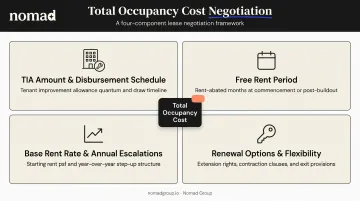
- The goal isn't to maximize TIA alone — it's to minimize total occupancy cost across rent, free rent, and TIA combined
What Is a Tenant Improvement Allowance?
A tenant improvement allowance is a pre-negotiated sum of money a landlord contributes toward customizing a leased commercial space for the tenant. It's typically expressed as a dollar amount per rentable square foot — so a $60/RSF TIA on a 5,000 SF lease gives you $300,000 toward the build-out.
TIA as One Lever in a Larger Deal
A TIA doesn't exist in isolation. It sits alongside base rent, free rent periods, annual escalations, and lease term as interconnected deal variables. Raising your TIA often requires giving ground somewhere else: accepting a slightly higher base rent, committing to a longer term, or offering a larger security deposit.
Understanding this trade-off is critical. As industry research from Cresa confirms, the TIA a landlord will agree to depends directly on the overall lease economics — a $50/RSF allowance on a $25/RSF five-year lease simply doesn't pencil for most landlords.
Why Landlords Offer TIAs
Landlords offer TIAs for practical reasons:
- Customized spaces attract creditworthy, long-term tenants
- Improvements become part of the building at lease end, increasing long-term asset value
- Longer lease commitments justify the upfront capital outlay
- High vacancy creates competitive pressure to win tenants with concessions
When structured well, it's a genuine win for both sides — the tenant gets a functional space, the landlord gets a committed occupant and improved asset.
Why TIAs Matter Most for Scaling Companies
For startups and growth-stage companies, every dollar has competing uses: hiring, product, operations, runway. A well-structured TIA lets a company customize a space without draining working capital on construction costs.
In NYC specifically, where second-generation spaces often need significant reconfiguration and white-box deliveries require full fit-outs, the gap between what a TIA covers and what you'd otherwise pay out of pocket can reach six figures on a mid-size lease. That makes TIA negotiation one of the highest-leverage points in the entire deal.
How Does a TIA Actually Work? The Reimbursement Flow
Here's the single most important thing most tenants don't know: a TIA is almost always a reimbursement, not an upfront deposit.
The Standard Draw Process
- Tenant contracts and pays the general contractor — you're funding construction as it progresses
- Tenant submits a draw package — paid invoices, lien waivers, proof of completion for each phase
- Landlord reviews the submission — timing should be specified in your work letter; don't assume a standard window
- Landlord issues reimbursement — for approved, documented costs up to the allowance cap
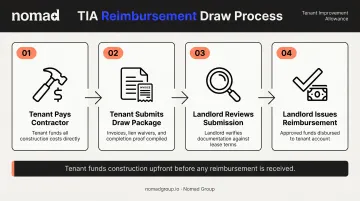
This means you need to front construction costs before seeing any reimbursement. On a meaningful build-out, that could be $200K–$1M+ in working capital. Plan for this before you sign.
If cash flow is a concern, negotiate progress payments or direct landlord-to-contractor payment structures into the lease. Both are achievable — they're just not offered by default.
Amortized TIAs: When the Landlord Lends More
In some deals, landlords will offer an additional allowance above the standard amount — but finance it through the lease rather than grant it outright. This is an amortized TIA: the extra allowance is effectively a loan, repaid through a higher monthly rent at an agreed interest rate.
Illustrative example: An extra $20/SF amortized over 5 years at 8% annual interest works out to roughly $0.41/SF/month — or approximately $4.87/SF/year added to your effective rent. The headline rent may look the same; the economics are different.
Amortized TIAs are useful when you need more build-out capital than the standard allowance covers. Before agreeing to one, calculate the full annualized cost — not just the monthly delta — and compare it against your actual cost of capital.
TIA Timing and Accounting
The lease language on when TIA is paid matters — both operationally and on your balance sheet. The three structures you'll encounter each carry different implications:
- Paid at commencement — funds available immediately, simplest for cash planning
- Payable after commencement — common but can create a timing gap if build-out starts day one
- Milestone-contingent — disbursement tied to inspections or sign-offs, which can delay access
All three affect how the TIA is accounted for under ASC 842. Review the specific language with your counsel before signing.
What a TIA Covers — and What It Doesn't
Covered: Hard Costs
These are the core of TIA eligibility — structural and permanent improvements that stay with the building:
- Framing, walls, and demising walls
- Doors and hardware
- Flooring and ceilings
- Lighting and electrical work
- HVAC distribution
- Basic plumbing
Often Covered: Soft Costs
Architectural drawings, engineering fees, and permitting costs are frequently eligible — but the lease must explicitly allow them. Don't assume soft costs are covered — it's a common negotiation point, and you need it in writing.
Typically Excluded
These items generally fall outside TIA and must be paid by the tenant:
- Furniture, fixtures, and equipment (FF&E)
- IT cabling and AV systems
- Security systems
- Signage and branding
- Moving expenses
- Any removable alterations
Specialized Equipment and Custom Buildouts
Specialized equipment — extra HVAC tonnage for data-dense offices, server room infrastructure, custom millwork — sits in ambiguous territory. These items may be TIA-eligible if the lease expressly states they remain with the building at expiration. Don't assume. Address them directly in the work letter before signing.
Tenant Improvements vs. Building Improvements
A tenant improvement modifies space within your lease for your benefit — and eventually the landlord's, since it stays. A building improvement (lobby upgrades, elevator replacement, exterior work) is entirely the landlord's responsibility and cannot be charged against your TIA. Knowing the distinction protects you from misallocated costs when negotiating your work letter.
How Much Is a Typical TIA? NYC Office Ranges to Know
Manhattan is expensive to build in, and TIA figures reflect that reality.
Verified NYC Benchmarks
| Deal Set | Period | Average TIA |
|---|---|---|
| Manhattan direct deals >25,000 SF, >10-year terms | 2022 | $147/SF |
| Manhattan direct deals >25,000 SF, >10-year terms | Q1 2023 | $145/SF |
| Top 10 Manhattan office leases by value | 2024 | $127.70/SF |
| National U.S. office average (CBRE) | 2024 | $87.51/SF |
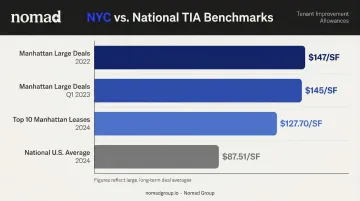
According to Commercial Observer's analysis of Manhattan office deals, Midtown averaged $148/SF, Midtown South $143/SF, and Downtown $125/SF in 2023 for large, long-term transactions. High-end financial district buildings saw some deals reach $165–$170/SF.
These are deal-set averages from large, long-term leases — not universal market rates for every tenant. Smaller leases and shorter terms will typically see lower allowances. Understanding what drives those differences is the more useful question.
What Drives Your TIA Amount
Five factors shape what a landlord will actually offer:
- Lease term — longer commitments unlock more TIA; landlords amortize the investment over the revenue base
- Tenant creditworthiness — strong financials, established revenue, or institutional backing give landlords confidence to offer more
- Market vacancy — Manhattan availability sat at 13.9% in Q4 2025, down from nearly 19.5% a year prior; tenant leverage still exists but has narrowed from peak vacancy levels
- Nature of improvements — infrastructure upgrades that benefit the building long-term (HVAC, electrical upgrades) are more fundable than highly custom finishes
- Building class and ownership — institutional landlords in Class A buildings have different TIA budgets than boutique owners in Class B properties
How to Negotiate a Stronger TIA
Lease Term Is Your Most Powerful Lever
Extending from a 3-year to a 7-year term changes the math for the landlord significantly. A longer lease gives them more time to amortize the TIA, which translates directly into a larger allowance they can justify offering. If your headcount and space needs are stable for the next 5+ years, a longer lease commitment is the most reliable way to unlock more build-out capital.
The LOI Sequencing Strategy
Don't lead with TIA in the letter of intent. Lead with the rent rate the landlord wants, get them committed to the deal, then introduce TIA as the secondary negotiation. Walking in with an aggressive TIA demand upfront can anchor the conversation poorly and put landlords on the defensive before a relationship is established.
The goal is to negotiate the full package with an eye toward total occupancy cost over the lease term, not any single concession in isolation. That package typically includes:
- TIA amount and disbursement schedule
- Free rent period (particularly valuable in the first months)
- Base rent rate and annual escalations
- Renewal options and flexibility provisions
Bring the Right Expertise
Engaging a tenant rep before you tour spaces — not after you've already expressed interest — preserves negotiating leverage and ensures the TIA conversation is positioned correctly from the start. Once a landlord knows you're drawn to a space, your ability to push on allowances weakens.
Tenant reps who work NYC daily know what landlords in specific submarkets are willing to offer and what comparable deals look like. Nomad Group's team has completed over 300 tenant buildouts across Flatiron, NoMad, SoHo, and Union Square — that deal history means submarket-level TIA benchmarks and building-specific landlord flexibility, not just general market color.
TIA Alternatives Worth Knowing
TIA isn't the only way to fund a build-out. Knowing both before you sit down to negotiate gives you more leverage.
Turn-Key Build-Outs
Instead of a TIA, the landlord delivers the space fully built to an agreed spec — taking on construction management and cost risk themselves. The trade-off: you give up control over finishes, contractor selection, and timeline.
Turn-key tends to work best when:
- Moving into a second-generation space that needs only modest reconfiguration
- Your company doesn't want to manage an active construction process
Nomad Group's construction management team handles this for tenants who'd rather hand off the build-out entirely — the firm has completed 300+ tenant build-outs, with a typical 90-day turnaround from white-box to move-in ready.

Free Rent as a Financial Complement
Rent abatement — months of free rent granted by the landlord, typically during construction — works alongside or instead of a TIA. Rather than reimbursing construction costs directly, the landlord covers the build-out period by waiving occupancy charges while work is underway.
Strong deals in Manhattan routinely blend both. CompStak's analysis of top-10 Manhattan office leases in 2024 showed an average of 14.6 months of free rent alongside $127.70/SF in work value. The combination matters more than either figure alone — the goal is to minimize what you actually spend to occupy the space over the full lease term.
Frequently Asked Questions
How does a tenant improvement allowance work?
A TIA is a per-square-foot dollar amount the landlord contributes toward customizing your leased space. It's paid as a reimbursement after you pay the contractor and submit documentation — not as an upfront deposit. You fund construction first, then recover the allowance from the landlord.
Do you have to pay back a tenant improvement allowance?
Standard TIAs don't need to be repaid — they're a landlord concession built into the lease economics. Amortized TIAs are different: the landlord effectively loans you additional allowance above the standard amount, and you repay it with interest rolled into monthly rent over the lease term.
How do you negotiate a tenant improvement allowance?
A longer lease term and strong financials move the needle most. Don't lead with TIA in your LOI — package it alongside free rent and rent rate so landlords evaluate the full deal, not just one line item. A tenant rep with local market comp data will know what's achievable before you ask.
What is an example of a tenant improvement?
A company leasing a white-box space in Flatiron might use a $75/SF TIA to build out private offices, conference rooms, a reception area, updated HVAC distribution, and new flooring — everything needed to go from raw shell to a functioning office.
What is a typical tenant improvement allowance per square foot in NYC?
Verified data from large Manhattan deals shows averages of $145–$147/SF in 2022–2023 and $127.70/SF for top-10 deals in 2024 — well above the national average of $87.51/SF. Smaller leases and shorter terms typically see lower figures. Lease term and tenant credit are the biggest variables.
Who owns tenant improvements after the lease ends?
In most commercial leases, improvements become the landlord's property at lease expiration — even when the tenant funded them entirely. Some leases include removal obligations for specific alterations. Review ownership and restoration terms carefully before signing.