Introduction
Picture this: you're sitting across a conference table negotiating a 5-year office lease in Flatiron. On the other side are a landlord and their listing broker — professionals who have executed hundreds of these transactions. You've done zero.
This is the starting position for most companies entering commercial leasing for the first time. The paperwork compounds the disadvantage. Two documents sit in front of nearly every tenant before a search begins — a tenant representation agreement and a broker compensation agreement — and most sign them without fully understanding what they've agreed to.
Manhattan's overall office availability rate dropped to 16.4% in Q2 2025 — the lowest in over four years — meaning competition for quality space is tightening fast. In that environment, who represents you and under what terms has direct financial consequences.
Understanding these agreements before you sign is how you close that gap. This article covers what each document does, how broker compensation actually flows in NYC, which clauses to scrutinize, and what red flags to watch for.
Key Takeaways
- A tenant representation agreement formally hires a broker to act in exclusively your interest, not the landlord's
- In NYC commercial leasing, landlords almost always cover commissions on both sides — your agreement defines what happens when they don't
- The agreement sets the broker's scope, engagement term, geographic limits, and compensation structure
- Exclusivity is standard — signing means working with that broker only during the term
- Tail clauses, vague termination language, and undisclosed dual-agency relationships are the three biggest risks to watch for
What Is a Tenant Representation & Broker Compensation Agreement?
The Core Definitions
A tenant representation agreement is a written contract between a commercial tenant and a broker that formally authorizes the broker to act as the tenant's exclusive agent in finding and negotiating a lease for commercial space. Like retaining outside counsel, it creates a fiduciary relationship and gives the broker legal standing to collect a fee.
A broker compensation agreement — sometimes a separate document, sometimes embedded within the tenant rep agreement — specifies how and when the broker gets paid. This includes the commission rate, the trigger for earning the fee, and who is ultimately responsible for payment.
These two agreements are distinct but tightly connected. The tenant rep agreement defines scope of services, duties, and the broker-client relationship. The compensation agreement handles the financial terms of that relationship. Together, they determine who represents you, what they're obligated to do, and how they get paid.
Why This Differs from a Listing Agreement
The listing broker works for the landlord. Their fiduciary duty runs to the building owner. A tenant rep broker's duty runs entirely to the tenant.
The problem arises when one broker tries to serve both sides. That's dual agency — and under NY DOS Legal Memorandum LI12, dual agency is legal in New York only with the informed written consent of both parties. By consenting to dual agency, you're explicitly giving up the right to your broker's undivided loyalty. That's a significant trade-off most tenants don't realize they're making.
What New York Law Does (and Doesn't) Require
New York State does not require written tenant representation agreements for commercial transactions. NY Real Property Law Section 443 disclosure mandates apply only to residential properties (1-4 family dwellings, condos, co-ops). The NAR settlement that introduced written buyer agreement requirements in August 2024 also applies exclusively to residential MLS transactions.
The absence of a legal mandate makes a written agreement more important, not less — not less. The NYC Bar Association's 2022 Model Brokerage Agreement explicitly warns: "A broker should not be permitted to show space...unless and until a brokerage agreement is fully executed."
Without a signed agreement, you're exposed to commission disputes under New York's default "ready, willing, and able" standard. That means a broker could claim they're owed a fee simply by producing a tenant who meets the criteria — even if you never formally retained them.
Key risks of proceeding without a written agreement:
- No clear definition of the broker's duties or scope of services
- No agreed commission rate, creating post-deal fee disputes
- No protection against dual agency without your knowledge
- No exclusivity period, meaning multiple brokers may claim a commission on the same deal
Why These Agreements Matter in NYC Commercial Leasing
The Market You're Entering
The numbers frame the stakes clearly. H1 2025 leasing activity hit 20.6 million square feet in Manhattan — 17.2% above H1 2024 — with 21 transactions over 100,000 square feet in the first half alone, the highest first-half total since 2019. Class A Midtown asking rents range from $70–$90 per square foot annually. For most companies entering this market, it's their first time negotiating at this scale.
Without dedicated representation, you're relying on whoever picks up the phone when you call a building. That person's obligation runs to the landlord, not you.
What's Actually at Stake
A commercial office lease in NYC is not a simple transaction. A 5-year lease on 3,000 square feet at $75/SF is a $1.35 million commitment. What gets negotiated — or left unaddressed — matters enormously:
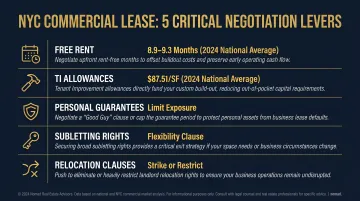
- Free rent periods — the national average in 2024 was 8.9 months; in higher-cost markets, 9.3 months
- Tenant improvement (TI) allowances — averaged $87.51/SF nationally in 2024, roughly 30% above pre-pandemic levels
- Personal guarantees — how much of your company's assets are on the hook if you break the lease
- Subletting and assignment rights — your ability to exit or restructure if the business changes
- Relocation clauses — a landlord's right to move you within the building
An experienced tenant rep broker knows what concessions the market is offering and which landlords have a history of granting them. That knowledge has direct dollar value — and in standard NYC commercial leasing, you don't pay for it out of pocket.
Who Pays the Broker
In standard NYC commercial office leasing, the landlord pays both broker commissions — the listing broker's and the tenant rep broker's. This is market custom, not a legal requirement.
The standard NYC commission structure follows a sliding-scale percentage of base rent:
| Lease Year | Commission Rate |
|---|---|
| Year 1 | 5% |
| Year 2 | 4% |
| Years 3–4 | 3–4% |
| Years 5 | 3% |
| Years 6–10 | 2.5% each |
The tenant rep broker typically receives one full commission (100%) and the listing broker receives a half commission (50%), with the landlord covering the total. In sublease scenarios, however, the tenant/sublessor typically bears the commission cost — an important distinction that your representation agreement should address explicitly.
Nomad Group works exclusively with tenants across NYC neighborhoods including Flatiron, NoMad, SoHo, and Williamsburg. Every engagement is structured around upfront transparency on compensation, so tenants understand the full fee picture before signing anything.
How the Tenant Representation Process Works
Step 1: Signing the Tenant Representation Agreement
Before any property search begins, the broker and tenant execute the representation agreement. This document:
- Establishes the broker-client relationship and the broker's legal right to a fee
- Sets the retainer period (how long the engagement lasts)
- Defines the geographic scope and property type covered
- Documents the compensation structure and what happens if the landlord won't pay
The NYC Bar Association's Model Agreement is clear: this agreement should be fully executed before any space is shown. Proceeding informally exposes tenants to commission disputes and brokers to fee-collection risk.
Step 2: Property Search, Tours, and Negotiation
Once engaged, the tenant rep broker runs a market search across public databases and subscription-only platforms, identifies properties matching the tenant's size, budget, and location requirements, then coordinates tours.
The less visible — but often most valuable — work happens after those tours. The broker draws on comparable transaction data and landlord concession history to structure a competitive offer. They know which buildings have been offering 9 months of free rent and which landlords are flexible on TI allowances.
Tenants going direct simply don't have access to that context.
Extend AI came to Nomad Group after months of frustration with a prior broker. Nomad identified a space at 135 West 29th Street and coordinated a buildout from white-box to fully furnished in five weeks. That office helped position Extend for their subsequent $17 million Series A raise.
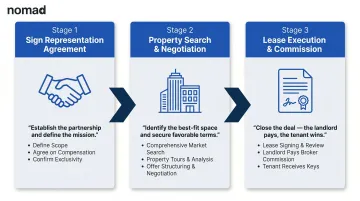
Step 3: Lease Execution and Broker Compensation
Once a lease is signed, the broker's fee becomes payable. The landlord pays both commissions; the tenant typically receives no invoice.
Two important distinctions tenants should understand:
- When a commission is earned vs. when it's payable: Under New York common law, a commission is earned once the broker produces a tenant ready, willing, and able to sign. It becomes payable when specific contractual conditions are met — usually lease execution. This distinction matters if a deal falls through after an offer is accepted.
- If the landlord won't pay: The three common outcomes are (1) the tenant pays directly, (2) the broker absorbs reduced or no compensation, or (3) the commission is negotiated into the transaction structure. The written agreement must spell out which outcome applies before the search begins.
What to Expect in Your Agreement
Commission Rate and Calculation
Two formulas are common in NYC commercial leasing:
- Sliding-scale percentage of total base rent over the lease term (the NYC standard, as shown in the table above)
- Per-square-foot amount multiplied by the number of months in the lease term
Commission is calculated on base rent only: escalations, electric charges, and construction allowances are excluded from the calculation.
The Protection Period (Tail Clause)
This is the clause most tenants overlook and later regret. A tail clause preserves the broker's right to a commission if the tenant signs a lease — without the broker's involvement — on a property shown or introduced during the engagement.
Typical durations:
- 6 to 12 months: considered the reasonable, standard range
- Up to 24 months: possible but aggressive from a tenant's perspective
- Under 60 days: rarely sufficient to protect the broker's commission rights
The NYC Bar Model Agreement requires the broker to submit a "Pending List" of prospects within 10 business days of termination — the tail clause applies only to properties specifically identified on that list. Tenants should ensure this requirement is in their agreement: it limits tail clause exposure to actual introductions, not vague categories.
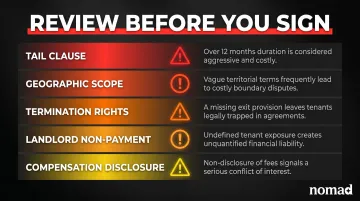
Red Flags to Review Before Signing
| Clause | What to Watch For |
|---|---|
| Tail/protection period | Anything beyond 12 months is aggressive |
| Geographic scope | Vague definitions ("all of NYC") can create disputes |
| Termination rights | Absence of a clear exit provision is a problem |
| Landlord non-payment | If it's not addressed, the tenant may be liable |
| Compensation disclosure | If the broker won't tell you what they earn on specific listings, that's a signal |
Common Misconceptions and Red Flags
"Tenant Rep Is Free, So It Doesn't Matter Who I Work With"
The tenant typically doesn't write a check. But compensation still shapes the advice you receive.
A broker earning double the commission on a specific building has a financial incentive to steer you there — even if better options exist elsewhere. A dedicated tenant rep broker should proactively disclose when their compensation differs materially across listings. If a broker is reluctant to have that conversation, ask directly.
"Any Broker Can Represent Me"
There's a meaningful difference between a tenant-exclusive rep broker and a dual-agency broker who also represents landlords. The fiduciary duties are different.
Before committing to anyone, ask these questions directly:
- Do you represent any landlords whose buildings we might tour?
- If yes, how do you handle that conflict?
- Will any dual-agency arrangement be disclosed in writing?
Dual agency isn't automatically disqualifying — but it requires informed written consent. Evasive answers to any of these questions tell you something important.
The Three Biggest Agreement Red Flags
- Tail clause longer than 12 months with a broad or undefined prospect list
- No explicit termination clause — making it difficult to exit if the broker relationship isn't working
- Silence on landlord non-payment — leaving the tenant's financial exposure undefined if the landlord refuses the commission
A trustworthy broker welcomes scrutiny of these clauses. If a broker discourages you from reviewing the agreement carefully, treat that as a red flag in itself — and probably the most telling one.
Frequently Asked Questions
What is tenant brokerage compensation?
Tenant brokerage compensation is the fee paid to a broker for successfully securing a lease on behalf of a tenant. In NYC commercial leasing, it's typically calculated as a sliding-scale percentage of total base rent and paid by the landlord — though the tenant representation agreement defines what happens if the landlord won't pay.
How do broker agreements work?
A broker agreement (or tenant representation agreement) is a written contract that formally hires a broker, defines the engagement scope and compensation structure, and establishes the broker's legal right to collect a fee. Sign it before the broker begins any property search — otherwise it may not be enforceable.
What can a broker representing a tenant do?
A tenant rep broker handles the full search and negotiation process on your behalf — market searches, property tours, subscription-only database access, and lease term negotiations covering rent, free rent, TI allowances, and termination options. They act solely in your interest, with no obligations to the landlord.
What not to say to a landlord?
Don't disclose your budget ceiling, move-in deadline, or how much you love a specific space — each of those weakens your negotiating position. A tenant rep broker handles all landlord communications specifically to prevent these missteps.
What are common broker red flags?
Watch for these warning signs before signing with any broker:
- Represents landlords in the same neighborhoods they're searching for you
- Unwilling to disclose compensation differences across listings
- Pushes tail clauses longer than 12 months
- Discourages you from reviewing the representation agreement carefully
What is the typical lease term for NYC office space?
Commercial office leases in NYC typically run 3 to 10 years, with 5 years being the most common starting point for growing companies. Shorter terms tend to cost more per square foot; longer terms usually unlock stronger concession packages like free rent and higher TI allowances.