Yet most founders approach this process without understanding the legal framework that governs how brokers actually work. Specifically, the exclusive tenant representation agreement — the document that formally puts a broker in your corner — rarely gets explained in plain terms before someone is asked to sign it.
This guide is for early-stage to Series A/B NYC startups actively searching for commercial office space. It covers what the agreement is, what's in it, how the process unfolds, and what to review carefully before signing.
Key Takeaways
- An exclusive tenant representation agreement formally assigns one broker to find, negotiate, and secure office space on your behalf
- In most NYC commercial transactions, the landlord pays the broker's commission — not the startup
- The agreement triggers fiduciary protections: loyalty, confidentiality, and full conflict-of-interest disclosure
- Key clauses to scrutinize: scope of services, agreement duration, geographic scope, commission structure, and carve-outs for previously toured properties
- Working with multiple brokers simultaneously doesn't expand your options — it reduces the quality of representation you receive
What Is an Exclusive Tenant Representation Agreement?
An exclusive tenant representation agreement is a written contract between your startup and a commercial real estate broker. It establishes that the broker will represent your interests — and only your interests — throughout an office search.
That distinction matters. Every landlord you'll encounter has a listing broker whose legal obligation runs to the building owner. Without your own representation, you're negotiating against a professional whose job is to get the best deal for the other side.
Exclusive vs. Non-Exclusive Arrangements
The word "exclusive" has a specific operational meaning here:
- You channel all property inquiries and tours through your designated broker during the agreement period
- The broker commits full resources, market access, and fiduciary duty to your search
- Both parties are contractually accountable — there's no ambiguity about who represents whom
A non-exclusive or open arrangement sounds more flexible, but in practice it means the broker has no contractual obligation to prioritize your search. Brokers working without formal engagement often share fewer off-market listings, come less prepared to negotiations, and may have undisclosed conflicts of interest.
The exclusive agreement is what converts a broker from a passive referral source into an active advocate working on your behalf.
Why Startups Need an Exclusive Tenant Representation Agreement
The Commission Is Already Built In
Here's a fact most founders don't know until after they've signed a lease: in NYC commercial transactions, the landlord pays all broker commissions — whether or not the tenant has representation. If you walk in unrepresented, the entire commission goes to the landlord's agent, who has a fiduciary duty to the landlord. Engaging your own broker doesn't change the total commission paid; it determines who advocates for you.
The standard NYC commission schedule runs roughly 5% of base rent for year one, decreasing over the lease term, with the tenant's broker typically receiving the full co-broke amount from that pool.
Fiduciary Protections the Agreement Triggers
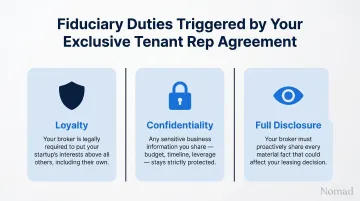
Once an exclusive representation agreement is signed, your broker owes you three specific duties:
- Loyalty: Your broker acts solely in your interest — not the landlord's
- Confidentiality: Sensitive details like your maximum budget cannot be shared with the other side
- Full disclosure: Any conflicts of interest must be surfaced, including if the broker also represents the landlord on the same property
Without a formal agreement, none of these obligations exist in writing.
What the Agreement Unlocks
A committed tenant rep brings tools an unrepresented founder can't access independently:
- Off-market listings and direct landlord relationships (as Nomad Group demonstrated by securing a sublease from Lazard Asset Management for one client — a deal that never hit public listings)
- Non-public comparable deal data to benchmark rent and concessions
- Startup-specific protections in negotiations, such as "good guy" guarantees and business interruption clauses that most founders don't know to request
Brokers who specialize in high-growth companies bring a different lens to the search. Nomad Group — which has leased over 2 million square feet and completed 300+ tenant buildouts for companies including Snappy, dbt Labs, and Argyle — treats flexible lease structures, fast buildout timelines, and scalable space design as baseline requirements, not negotiation afterthoughts.
Key Clauses Every Startup Should Review Before Signing
Scope of Services
This clause defines what the broker will actually do: property identification, tour coordination, market analysis, lease negotiation, and due diligence review. It also defines your obligation — primarily, routing all inquiries through your broker.
Verify the scope covers your full lifecycle needs through lease execution and beyond. A scope that ends at "finding a space" leaves negotiation and due diligence uncovered.
Agreement Duration
NYC commercial office searches range from 3–4 weeks for simple plug-and-play spaces to 9–12 months for complex buildouts. Most tenant rep agreements run 3–12 months depending on search complexity.
Before signing:
- Align the term to your realistic timeline — not the broker's preferred window
- Confirm there are defined extension terms if the search runs long
- Clarify conditions for early termination if your requirements change materially
Geographic and Property Scope
The agreement should name the neighborhoods and submarkets your broker will cover. If Flatiron, NoMad, SoHo, Williamsburg, or Bryant Park are viable options, they should appear explicitly. Omitting a neighborhood creates more than a gap in coverage — it sets up a commission dispute if a deal closes there.
Commission Structure
In NYC, the standard co-broke structure has the landlord paying the tenant's broker from a commission pool calculated on base rent. Key things to confirm in writing:
- How the fee is calculated (percentage of total lease value vs. per-square-foot)
- When it is considered "earned"
- What happens if a landlord does not offer a co-broke fee — this creates direct cost exposure for your startup and must be addressed in writing
Carve-Out Exceptions
List every property you've already toured or been introduced to by another broker before the agreement is executed. These should be named as carve-outs in the agreement. Without them, closing a deal on a previously-visited property could result in a double-commission claim.
How the Exclusive Tenant Rep Process Works, Step by Step
Once the agreement is signed, the process follows a predictable sequence. Your obligations throughout are straightforward: give timely feedback, keep your broker informed on financials (not the landlord), and move decisively when the right space surfaces.
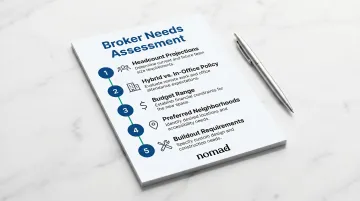
Step 1: Needs Assessment
The broker conducts a thorough intake covering:
- Headcount projections over 12–24 months
- Hybrid vs. in-office policies
- Budget range (hard ceiling and target)
- Preferred neighborhoods and non-negotiables
- Buildout requirements — server rooms, private offices, event space, specific infrastructure
Be specific here. Vague briefs produce misaligned shortlists and wasted tour time.
Step 2: Property Search, Touring, and Shortlisting
The broker runs a full market canvass — on-market listings, off-market opportunities, and direct landlord outreach — then coordinates tours against your brief.
Two rules for touring:
- Always have your broker present. Never tour independently, even if a landlord invites you directly.
- Never disclose your budget, urgency, or top-choice status to a landlord or listing broker. These disclosures weaken your negotiating position immediately. All such conversations run through your broker.
Give structured feedback after each tour. The faster you narrow the shortlist, the faster the broker can escalate the best opportunities.
Step 3: LOI Negotiation and Lease Execution
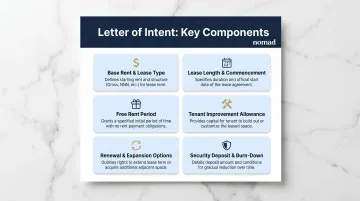
When the shortlist narrows to a winner, your broker prepares a Letter of Intent covering:
- Base rent and lease type (gross, modified gross, NNN)
- Lease length and commencement date
- Free rent period
- Tenant improvement (TI) allowance
- Renewal and expansion options
- Security deposit amount and burn-down conditions
According to CBRE's 2024 market data, free rent averaged 9.6 months per lease nationally and TI allowances averaged $52.78 per square foot — though these figures vary considerably by market and building class. Having a broker with current comparable data is how you know what to ask for.
The broker negotiates directly with the landlord's broker. Your job at this stage: flag any operational constraints and bring in legal counsel once business terms are finalized.
Common Misconceptions and Red Flags
Misconception: Working With Multiple Brokers Gets Better Options
The opposite tends to be true. Listing brokers quickly identify tenants who are working with multiple reps — and they deprioritize them. Off-market listings go to committed clients first. Landlords take seriously tenants who show up with a dedicated advocate, not those who appear to be shopping without direction.
Misconception: The Agreement Locks You In With No Recourse
Any solid agreement includes termination clauses and carve-outs. Reputable brokers don't want to force a startup into a deal they're not satisfied with. The agreement should specify clear conditions under which either party can exit.
Red Flags to Watch For
Be cautious if a broker presents an agreement with any of the following:
- No defined termination clause — this protects the broker, not you
- Exclusivity window beyond 12 months for an early-stage startup with a focused search
- Unusually broad geographic scope that extends well beyond your actual target neighborhoods
- Vague language about what happens if no deal closes — who owes what if the search doesn't result in a signed lease?
- Commission structure language that could expose the startup if a landlord doesn't offer co-broke
Ask about any clause you don't understand before signing. A broker who can't explain their own agreement clearly isn't someone you want negotiating your lease.
Frequently Asked Questions
Who pays the broker fee under an exclusive tenant representation agreement?
In most NYC commercial lease transactions, the landlord pays both the listing broker's commission and the tenant's broker's commission from a pool calculated on base rent. The tenant typically owes nothing out of pocket. However, the agreement should explicitly address what happens if the landlord offers no co-broke fee — that scenario can shift cost exposure to the startup.
What is an exclusive representation clause in a tenant representation agreement?
This clause requires the tenant to work solely through the designated broker for the search defined in the agreement. In exchange, the broker commits full fiduciary duty, market access, and negotiating effort exclusively to that client. The clause defines both the geographic scope and the property types covered.
What does a tenant representation broker do?
A tenant rep broker manages your full office search — from identifying properties and coordinating tours to running market analysis and negotiating the LOI. A tenant rep broker manages your full office search — from identifying properties and coordinating tours to running market analysis and negotiating the LOI. They advise through to lease execution, working in the tenant's interest, not the landlord's.
What should tenants avoid saying to a landlord?
Never disclose your maximum budget, how urgently you need to move, or that a particular space is your top choice. Any of these disclosures weakens your negotiating position. Route all such discussions through your broker.
What are the common types of commercial lease agreements?
The three main structures are:
- Gross/full-service — tenant pays base rent; landlord covers operating expenses
- Modified gross — costs split between tenant and landlord after a base year
- Triple net (NNN) — tenant pays base rent plus taxes, insurance, and maintenance
In NYC, gross and modified gross leases are most common. A tenant rep broker evaluates total occupancy cost across all three — not just the headline rent.