Introduction
Picture this: your team has found the perfect office. The listing says 3,000 square feet, the price works, everyone's ready to sign. Then your architect tells you they can only design for 2,500 square feet.
Nobody made a mistake. What happened is simpler, and far more common than most tenants expect: the listing showed rentable square footage, your architect works with usable square footage, and nobody flagged the gap before you got excited.
That's one of dozens of structural advantages built into commercial leases that favor landlords over tenants. In NYC, where Class A asking rents averaged $81.19/SF as of Q4 2024, going into a lease negotiation without an advocate on your side isn't just risky — it's expensive.
Tenant representation exists to close that gap. This article covers what it actually means, what a tenant rep broker does for you, and why scaling companies in NYC treat it as a non-negotiable part of any office search.
Key Takeaways
- Tenant representation means having a broker who works exclusively for you — not the landlord
- The landlord's agent always has a signed agreement to protect the landlord's interests; you need someone protecting yours
- Tenant reps handle market search, lease negotiation, and buildout coordination — typically at no cost to you (landlord pays the fee)
- Without representation, you're negotiating a multi-year, multi-million dollar commitment against a party with far more market data
- For scaling companies, a tenant rep also brings off-market access and neighborhood expertise that most in-house teams simply don't have
What Is Usable Square Footage (USF)?
USF is the space your company exclusively occupies — the area inside your suite where your team sets up desks, holds meetings, and runs daily operations.
Your USF includes:
- Private offices, open work areas, and conference rooms within your suite
- Internal hallways and corridors inside the leased boundary
- Private storage areas and private restrooms within the suite
- Structural elements like columns that fall within the leased perimeter
USF excludes any shared or common areas:
- Shared building lobbies and common corridors
- Communal restrooms shared by multiple tenants
- Elevator shafts, stairwells, and mechanical rooms
- Any area accessible to or shared with other tenants
Partial Floor vs. Full Floor Tenants
The distinction matters depending on how much of a floor you occupy.
A partial floor tenant USF is limited to the specific suite they lease. A full floor tenant has a larger USF that can include floor-level amenities — kitchenettes, reception areas, or server rooms dedicated solely to that floor — while still excluding building-wide elements like the main lobby or shared elevator banks.
In NYC, the Real Estate Board of New York (REBNY) maintains measurement rules that differ from national BOMA standards, particularly in how common areas and mechanical spaces are allocated across tenants. Always confirm which method a landlord used before comparing spaces across buildings.
What Is Rentable Square Footage (RSF)?
RSF is the number that appears in lease documents and determines your monthly rent. It equals your USF plus your proportional share of the building's common areas.
BOMA International's ANSI/BOMA Z65.1-2024 standard — the current benchmark for office building measurement — identifies Rentable Area as "a crucial metric in office leasing." RSF is the financial basis of your entire lease.
How Pro-Rata Share Works
If your suite represents 10% of a building's total usable space, you're allocated 10% of the common area square footage in your RSF calculation. This doesn't restrict your access to shared spaces — it just determines how building costs are distributed across all tenants.
Building amenities affect the size of that common area pool directly. A fitness center, conference facility, or rooftop terrace adds square footage to the shared total — which raises every tenant's RSF relative to their actual workspace.
Rent is calculated on RSF, not USF. A tenant who budgets based on usable square footage will underestimate their actual cost every time.
The Load Factor: How RSF Is Calculated
The load factor (also called the common area factor, core factor, or R/U ratio) is the multiplier that expresses the relationship between RSF and USF.
The formula: RSF = USF × Load Factor
What a Typical Load Factor Looks Like
According to Cresa's office leasing research, multi-tenant tenants rent more square feet than they use — typically by as much as 7% to 20%. That translates to a load factor range of roughly 1.07 to 1.20.
A load factor of 1.15 means you're paying rent on 15% more space than your team physically occupies.
A Concrete Example
| Variable | Figure |
|---|---|
| Space your team needs | 3,000 USF |
| Building load factor | 1.20 |
| Rentable square footage | 3,600 RSF |
| Extra square footage you're paying for | 600 SF |
The math: 3,000 × 1.20 = 3,600 RSF. That 600-square-foot difference shows up in your rent every month.
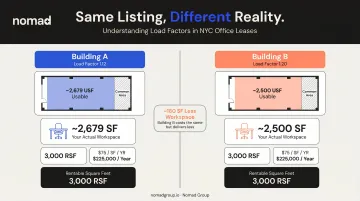
Comparing Two Buildings Side by Side
Load factors make identical-looking spaces very different in practice:
| Building A | Building B | |
|---|---|---|
| Listed RSF | 3,000 | 3,000 |
| Load factor | 1.12 | 1.20 |
| Actual USF | ~2,679 | ~2,500 |
| Rent rate | $75/SF/YR | $75/SF/YR |
| Annual rent | $225,000 | $225,000 |
Same listed size, same rate — but Building A gives you roughly 180 more square feet of actual workspace. Building B's higher load factor costs you that workspace at no discount — so if amenities don't justify the gap, you're simply paying more for less usable space.
If a landlord discloses both figures, you can verify the math yourself: Load Factor = RSF ÷ USF.
What Does "$X SF/YR" Mean in a Commercial Lease?
SF/YR stands for dollars per square foot per year — the standard format for quoting office lease rates in NYC and across the US.
$75.00 SF/YR on a 3,000 RSF space:
- Annual rent: 3,000 × $75 = $225,000/year
- Monthly rent: $18,750/month
That rate always applies to rentable square footage (RSF), not usable square footage. A tenant calculating from USF will consistently underestimate their actual rent — sometimes by 15–20%.
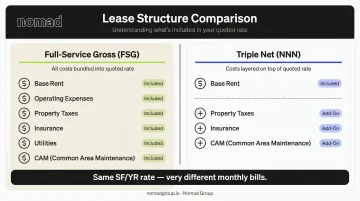
Lease structure determines how much of the total occupancy cost that SF/YR figure actually captures. Two spaces priced identically can carry very different monthly bills:
- Full-Service Gross (FSG): The quoted rate includes base rent plus operating expenses — taxes, insurance, utilities, and common area maintenance. Most multi-tenant Manhattan office buildings use this structure.
- Triple Net (NNN): The rate covers base rent only. Property taxes, insurance, and CAM are billed separately on top.
A tenant rep broker will flag this distinction immediately during any space comparison — it's one of the first questions that separates an accurate budget from a costly miscalculation.
Common Mistakes Tenants Make When Evaluating Office Space
Most mistakes in office searches don't happen at the negotiating table. They happen earlier — when a company sets its square footage target.
Searching in RSF When the Requirement Is in USF
An architect or space planner typically works in usable square footage. They'll tell a company: "You need 2,500 buildable square feet for your team."
A common mistake: the tenant searches for a 2,500 RSF listing. But a 2,500 RSF space with a 1.20 load factor only yields about 2,080 USF — roughly 420 square feet less than the architect specified. The space looks right on paper and fails in practice.
The fix is straightforward: convert your USF requirement to RSF before you search. If you need 2,500 USF and the target building has a 1.15 load factor, you should be looking at spaces listed at approximately 2,875 RSF.
Ignoring Load Factor When Comparing Buildings
Two spaces with identical listed square footage and the same rent rate can have meaningfully different costs and different amounts of actual workspace. Without checking each building's load factor, a side-by-side comparison tells you almost nothing useful.
What to Ask Before Touring Any Space
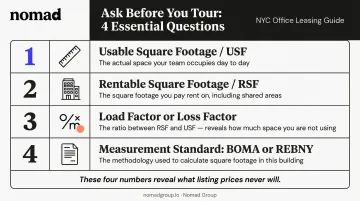
Before you book a tour, request these four figures from the landlord:
- Usable square footage (USF)
- Rentable square footage (RSF)
- Load factor (or loss factor)
- Measurement standard used (BOMA or REBNY)
These four numbers tell you what a listing price never will. Nomad Group's team has leased over 2 million square feet across NYC and runs these calculations as a standard part of every tenant search — so the space that looks right on a listing actually works when your architect draws it up.
Frequently Asked Questions
How do you calculate rentable square footage?
Multiply your usable square footage by the load factor: RSF = USF × Load Factor. The load factor itself is derived by dividing the building's total RSF by its total USF — a figure landlords can provide upon request.
What does $75.00 SF/YR mean?
It means you pay $75.00 per rentable square foot per year. A 3,000 RSF space at that rate costs $225,000 annually, or $18,750 per month. This rate always applies to rentable square footage, not the usable space your team physically occupies.
What is the difference between usable and rentable square footage?
USF is the space your company controls and works in. RSF adds your proportional share of building common areas — lobbies, corridors, restrooms, amenity spaces. Rent is calculated on RSF, which is always larger than USF in a multi-tenant building.
What is the load factor in commercial real estate?
The load factor is the multiplier representing the ratio of RSF to USF — typically between 1.07 and 1.20 for multi-tenant office buildings. A higher load factor means more of your rent covers shared common areas rather than space your team directly uses.
Does rentable square footage include common areas?
Yes. RSF includes your pro-rata share of all building common areas: lobbies, shared hallways, communal restrooms, and amenity spaces. That's why RSF is always larger than USF in any building with multiple tenants.
What is a good load factor for NYC office space?
In NYC multi-tenant office buildings, load factors typically fall between 1.07 and 1.20 — lower is better, all else being equal. Always ask landlords to disclose both USF and RSF for any space you're seriously considering so you can compare load factors across options.
Ready to search for office space with the right numbers from the start? Get in touch with Nomad Group to work with a team that handles the math — and the negotiations — on your behalf.