Introduction
For high-growth companies searching for commercial office space in NYC, the tenant representation agreement is often the first formal document they'll encounter. Most founders and operations leads sign it without fully understanding what it governs.
That's a real risk. This agreement controls the entire broker-client relationship — from how long your broker works exclusively for you to how they get paid. Misreading its terms can cost leverage and money at exactly the wrong moment.
The challenge is particularly acute in competitive markets like Manhattan. Realtors represent tenants in more than 90% of NYC's commercial real estate transactions, making this agreement a practical necessity rather than an optional safeguard. What follows covers exactly what's inside one, how each clause affects your position, and the specific terms worth negotiating before you put pen to paper.
Key Takeaways
- A tenant representation agreement locks in your broker's exclusive duty to you — scope, compensation, and timeline defined before the search starts
- In most NYC commercial deals, the landlord pays the broker's commission, so professional representation costs you nothing out of pocket
- Exclusive agreements give your broker real negotiating leverage; non-exclusive ones offer flexibility but less of it
- The agreement covers retainer period, services, compensation structure, conflict-of-interest disclosures, and property criteria
- Knowing what you're signing protects you from hidden fees and brokers who are quietly working both sides of the table
What Is a Tenant Representation Agreement?
A tenant representation agreement is a written contract that formally employs a commercial real estate broker to act as the tenant's sole representative in locating, evaluating, and negotiating space for lease. It documents the scope of the relationship, duration, and fee structure before work begins.
The agreement aligns the broker's financial and professional incentives entirely with the tenant's goals, rather than the landlord's — establishing a fiduciary duty of advocacy from the outset.
Under New York law, that broker-principal relationship is fiduciary in nature, grounded in "trust, confidence, integrity, and fidelity," with duties including good faith, undivided loyalty, and full disclosure.
Those duties set it apart from other real estate documents. A standard listing agreement serves the landlord; a commercial tenancy agreement is the lease itself. A tenant representation agreement governs the broker-tenant relationship before and during the space search — it is the foundation for the search, not the outcome of it.
What's Actually Inside a Tenant Representation Agreement
Retainer Period
The agreement specifies a defined start and end date during which the broker is engaged. Most tenant representation agreements range from 3 to 12 months, depending on the complexity of the search and whether the client is an individual or a business entity.
Securing commercial office space typically takes 3 to 9 months from search initiation to move-in. Unlike residential transactions in New York, commercial leases are governed by the written agreement rather than statute — meaning retainer length is fully negotiable.
The agreement should clearly state:
- Start and end dates
- Conditions for early termination
- Whether the agreement auto-renews
- Any "procuring cause" clauses (which protect the broker's commission rights on deals that close after the agreement ends)
Broker Obligations and Conflict-of-Interest Disclosure
The agreement requires the broker to act with diligence and to disclose any situations where they have competing relationships. Brokers who simultaneously hold listings for landlords in your target market represent a conflict of interest that should disqualify them.
Dual agency is common at large full-service firms such as JLL and CBRE, which simultaneously represent landlords and occupiers within the same markets. In dual agency, the broker must remain neutral and cannot provide exclusive advocacy. The practical risks for tenants include:
- Reduced negotiation leverage (the broker can't push hard for your side)
- Restricted information sharing about landlord flexibility or competing offers
- Economic disadvantage on rent concessions and tenant improvement allowances
A dedicated tenant-only representation model eliminates this conflict entirely.
Scope of Services
The broker commits to specific deliverables under the agreement:
- Market research and property identification
- Site tours and space evaluation
- Financial analysis of lease terms
- Negotiation strategy and execution
- Coordination through lease signing
Full-service firms like Nomad Group extend this scope into construction management and buildout oversight — covering the journey from initial search through move-in day.
Compensation and Fee Structure
Understanding how your broker gets paid matters — it tells you where their incentives lie. In standard commercial real estate, the landlord pays the tenant broker's commission, typically calculated as a percentage of total lease value. The NYC.gov Small Business Services Commercial Lease Guide confirms that "the landlord usually pays a commission to the broker that is a percentage of the rent."
NYC commission schedules typically follow this structure:
- Year 1: 5% of base rent
- Year 2: 4%
- Year 3: 4%
- Year 4: 3%
- Year 5: 3%
- Years 6-10: 2.5% each

For a five-year lease, this equals approximately 19% of one year's base rent for the tenant broker. The tenant's broker receives one full commission; the landlord's broker receives half.
Important exceptions:
- In sublease transactions, the overtenant (not the building landlord) typically pays the full brokerage commission
- In off-market deals, commission structures are negotiated case-by-case
The agreement should specify what happens in these edge cases where no standard landlord commission is available.
Property Parameters
The agreement documents the type, size, location, and budget parameters of the space being sought. Clear parameters prevent scope creep and give both parties a shared definition of what constitutes a qualifying deal.
Typical parameters include:
- Square footage range
- Target neighborhoods or submarkets
- Budget range (per square foot annually)
- Required amenities or building features
- Timeline for occupancy
How the Tenant Representation Agreement Process Works
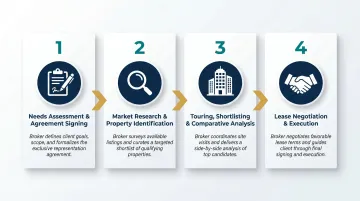
Once signed, the agreement activates a structured process in which the broker acts as the tenant's dedicated advocate from initial requirements-gathering through to executed lease. Understanding this end-to-end flow helps companies know what to expect at each stage.
Step 1: Needs Assessment and Agreement Signing
The process begins with a detailed intake conversation in which the broker helps the tenant define their space requirements, timeline, budget, and preferred submarkets. The tenant representation agreement is typically signed at or immediately after this stage, before any formal property search begins, formalizing the broker's engagement.
During intake, the broker gathers information about:
- Current and projected headcount
- Growth trajectory over the lease term
- Team dynamics and workspace culture
- Budget constraints and financial parameters
- Preferred neighborhoods and commute patterns
Step 2: Market Research and Property Identification
A full market survey follows — covering available listings and off-market opportunities. In competitive markets like NYC, off-market access is often the difference between finding a great space and settling.
Experienced tenant representation firms maintain direct landlord relationships that surface listings that never hit public platforms. For example, Nomad Group's relationships with landlords like Kaufman Organizations and Justin Management provide access to premium subleases and architecturally distinct spaces before they hit the broader market.
Step 3: Touring, Shortlisting, and Comparative Analysis
Tours are coordinated across shortlisted properties, followed by a side-by-side financial and operational comparison. Keeping multiple options in play simultaneously — rather than pursuing spaces one at a time — creates competitive pressure that consistently improves final terms.
Comparative analysis typically includes:
- Effective rent calculations (factoring in free rent periods and tenant improvement allowances)
- Total occupancy costs over the lease term
- Buildout requirements and timelines
- Commute accessibility and neighborhood amenities
- Lease flexibility and exit provisions
Step 4: Lease Negotiation and Execution
Negotiation covers both economic and non-economic lease terms, with the broker working in coordination with the tenant's attorney, who handles legal review. Key items on the table include:
- Base rent and annual escalation clauses
- Tenant improvement allowances and free rent periods
- Lease flexibility provisions (contraction, expansion, termination rights)
- Exit provisions and holdover terms
Once the lease is executed, the landlord pays the broker's commission directly. In standard transactions, tenants get full professional representation at no direct cost.
Exclusive vs. Non-Exclusive Tenant Representation Agreements
What Exclusive Means
Under an exclusive tenant representation agreement, the tenant commits to working solely with one broker for the duration of the retainer period. If a lease is signed during that window — regardless of how the property was found — the broker earns their commission.
This protects the broker's investment of time during the search. Exclusivity is the standard structure in tenant representation agreements, with the client agreeing not to work with other brokerages during the contract term.
The Tenant's Perspective on Exclusivity
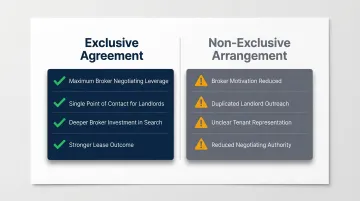
Exclusive agreements give the broker maximum negotiating leverage because they can approach landlords with authority and commitment. Landlords take exclusive mandates more seriously, knowing they're dealing with a committed tenant and a single point of contact.
SquareFoot advises against engaging multiple brokers, noting that "landlords are typically unmotivated to move forward if a tenant employs multiple brokers, as the landlord does not want to pay commission to more than one broker."
It's also worth noting that all brokers generally access the same listings through industry databases and shared relationships — so working with multiple brokers rarely expands your coverage in any meaningful way.
Non-Exclusive Arrangements and Their Trade-Offs
The appeal of non-exclusive arrangements is flexibility — but that flexibility comes at a cost. Working with multiple brokers simultaneously may seem to expand your options, yet in practice it often creates:
- Confusion about who represents the tenant
- Duplicated outreach to landlords
- A broker who is less financially motivated to invest deeply in the search
- Reduced negotiating authority with landlords
Practical Guidance for Companies
For most commercial tenants — particularly scaling companies with defined needs and timelines — an exclusive agreement with a reputable tenant-only representation firm delivers better outcomes.
Non-exclusive arrangements may make sense when:
- The search is highly exploratory with a long or undefined horizon
- Space requirements haven't been clearly established yet
- Maximum flexibility matters more than negotiating leverage
In most NYC office searches, the trade-offs of going non-exclusive outweigh the perceived upside. Choosing the right broker from the start — and committing to that relationship — is typically the move that produces stronger lease terms.
Common Misconceptions About Tenant Representation Agreements
"I'll Get a Better Deal by Going Directly to the Landlord"
In standard commercial real estate, the landlord has already priced the broker commission into the deal structure. If a tenant approaches without representation, that commission typically goes back to the landlord or to their listing broker — the tenant receives no discount.
The tenant then negotiates without expertise or market data against a professional who does this every day. The approximately 10% of NYC commercial transactions without broker involvement are usually the smallest deals, not sophisticated office leases.
"My Broker Has a Listing in the Building I Like — That's Fine, Right?"
It's not fine — it's a conflict of interest that directly compromises your representation. When a broker holds landlord listings in your target market, they're financially incentivized to steer you toward those listings. They can't simultaneously maximize your concessions and the landlord's return.
New York State Legal Memorandum LI12 confirms that in dual agency, the principal must "give up the right to the agent's undivided loyalty." The broker must prove full disclosure was provided before consent was obtained.
When evaluating brokers, ask directly whether they hold any landlord listings in your target submarkets. A broker who represents only tenants eliminates this conflict entirely.
"Signing the Agreement Locks Me In No Matter What"
Well-drafted tenant representation agreements include termination clauses and dispute resolution provisions. Tenants should review these carefully before signing and understand what circumstances allow early exit.
For legitimate, active searches, the retainer period is designed to protect both parties' investment of time, not to trap the tenant. The agreement should clearly specify:
- Conditions under which either party can terminate
- Notice requirements for termination
- What happens to deals in progress at termination
- Any post-termination obligations
Frequently Asked Questions
What is a tenant representation agreement?
A tenant representation agreement is a written contract between a commercial tenant and a broker that formalizes the broker's role as the tenant's dedicated advocate. It defines the scope of work, retainer period, exclusivity terms, and how the broker gets paid — all before the property search begins.
What does a tenant rep broker do?
A tenant rep broker conducts market research, identifies available and off-market spaces, coordinates tours, runs financial comparisons, and leads lease negotiations. Their sole obligation is to the tenant — from initial search through lease execution.
Do I pay the broker fee if the broker is a tenant rep?
In the vast majority of commercial real estate transactions, the landlord pays the tenant rep broker's commission — meaning the tenant receives professional representation at no direct cost. Exceptions may apply in certain off-market or sublease scenarios, which should be addressed in the agreement itself.
What is an exclusive tenant representation agreement?
An exclusive agreement means the tenant commits to working with one broker for a defined period. In exchange, the broker invests fully in the search and carries stronger negotiating authority with landlords — which typically produces more favorable lease terms.
What is tenant representation in commercial real estate?
Tenant representation is a brokerage service where a commercial real estate professional acts solely on behalf of the tenant. Their job is to find, evaluate, and negotiate office space that fits the tenant's operational and financial goals — with no obligation to the landlord.
What is the purpose of a buyer's representation agreement?
A buyer's representation agreement serves the same fundamental purpose as a tenant representation agreement but for property purchases rather than leases. It formalizes the broker's duty to act in the buyer's interest and establishes compensation terms before the search begins.
Ready to navigate your NYC office search with expert tenant representation? Nomad Group specializes in helping high-growth companies find, build, and manage office space across Manhattan neighborhoods like Flatiron, NoMad, SoHo, and Bryant Park. Contact our team to discuss your requirements and learn how our tenant-only representation model protects your interests throughout the entire leasing journey.