Tenant representation solves this fundamental imbalance by providing businesses with their own dedicated advocate — a commercial real estate professional who works exclusively for the tenant throughout the entire leasing process.
This guide covers what tenant representation is, what a tenant rep broker does, the specific benefits they deliver, how much it costs, and how to choose the right partner in competitive markets like NYC.
Key Takeaways
- Tenant representation provides businesses with a commercial broker who represents only the tenant's interests, not the landlord's
- These brokers handle needs assessment, market research, lease negotiation, and post-signing support
- Commission is almost always paid by the landlord — expert advocacy typically costs tenants nothing
- In NYC, choose a broker with neighborhood-level market knowledge and full-service capabilities — not one chasing deal volume
What Is Tenant Representation?
Tenant representation is the practice of engaging a licensed commercial real estate professional — a tenant rep broker — who is legally and ethically obligated to act in the tenant's best interests throughout a leasing transaction, not the landlord's. Under New York Real Property Law Section 443, these agents owe six specific fiduciary duties to their clients:
- Reasonable care
- Undivided loyalty
- Confidentiality
- Full disclosure
- Obedience
- Duty to account
This service applies exclusively to commercial real estate — office, retail, or industrial space — not residential leasing. Tenant representation is designed for businesses at every stage: startups securing their first dedicated office, scaling companies outgrowing their current space, and established enterprises managing renewals or relocations.
The service goes by several names: tenant advisory (used by firms like Cushman & Wakefield), occupier services (common at CBRE and Colliers), or simply tenant representation. All refer to the same core concept: dedicated representation for the tenant.
What Does a Tenant Rep Broker Do?
Needs Assessment and Strategy
A tenant rep begins by understanding your company's current and future space requirements before searching a single listing. This includes headcount projections, culture priorities, budget constraints, preferred neighborhoods, and growth trajectory. The output is a clear brief that shapes every search and negotiation that follows — built around where your business is going, not just where it stands today.
Market Research and Site Selection
Tenant reps maintain access to comprehensive listing databases like CoStar, which covers more than 6 million properties and 11 million lease comps. They also have established relationships with listing brokers and landlords that unlock off-market intelligence — spaces that never hit public listings.
Key advantages include:
- Early access to new availabilities before public marketing
- Direct connections to sublease opportunities
- Knowledge of which landlords are motivated to negotiate
- Market intelligence on comparable deals and pricing trends
Lease Negotiation
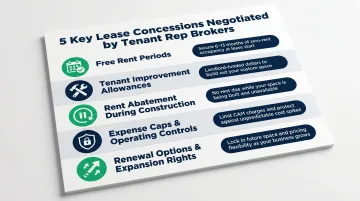
Beyond finding space, tenant reps lead all lease negotiations. According to CBRE's 2024 national office leasing report, average concession packages now include tenant improvement allowances of $87.51/sf and free rent periods averaging 8.9 months. In NYC's tech sector, those numbers climb even higher — Colliers reports that tech tenants secured average TI allowances of $131.70/sf and rent abatement averaging 13.3 months in Q1 2026.
A skilled tenant rep negotiates concessions including:
- Free rent periods (typically 6-13 months)
- Tenant improvement allowances to fund buildouts
- Rent abatement during construction
- Expense caps and operating expense controls
- Flexible renewal options and expansion rights
Vendor Coordination
Once the lease is signed, execution becomes the priority. Experienced tenant reps maintain vetted rosters of architects, general contractors, and project managers so tenants aren't locked into landlord-preferred vendors. Nomad Group goes further with in-house construction management, delivering typical buildouts in 90 days — with a single team accountable from permit to punch-list.
Ongoing Support Beyond Signing
The relationship doesn't end when you sign the lease. Tenant reps provide ongoing support for subleasing unused space, managing lease renewals, negotiating expansions, and advising on real estate strategy as the business evolves. For example, when FloraFauna AI doubled their office footprint within a month of moving into their Williamsburg space, Nomad Group coordinated furniture vendors, cleaning services, and operational setup to ensure a seamless expansion.
Key Benefits of Tenant Representation
Fully Aligned Interests
Unlike a listing broker who represents the landlord, a tenant rep has one client in the transaction — you. According to Cushman & Wakefield, if a tenant chooses not to use a broker, the landlord doesn't reduce costs — the budgeted commission is simply reallocated to the owner's agent or property manager. By hiring your own representation, you ensure that expertise works for you, not against you.
Access to More (and Better) Options
Searching on your own limits you to publicly listed spaces. A tenant rep unlocks off-market opportunities, early-access listings, and sublease deals through industry relationships. Industry reports indicate that a notable share of commercial real estate transactions involve off-market or broker-to-broker inventory — inventory that never hits the public listings at all.
Stronger Negotiating Power
Tenant reps know what comparable tenants in the same market are paying and where landlords have room to negotiate. For example, when Nomad Group represented Authentic Insurance in their move to 30 West 21st Street in Flatiron, they secured a full-floor office delivered at 30% below comparable coworking costs while negotiating favorable terms that allowed infrastructure for up to 40 desks.
Significant Time Savings
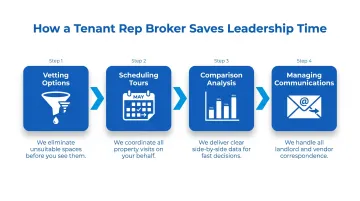
Finding, touring, and negotiating commercial space is effectively a full-time job. A tenant rep handles the entire process so leadership can stay focused on the business:
- Vetting options against your requirements and budget
- Scheduling and coordinating property tours
- Delivering side-by-side comparison analyses
- Managing all landlord and broker communications through to signing
Typically Free to the Tenant
In the vast majority of commercial lease transactions, the tenant rep's commission is paid by the landlord upon deal completion. According to Rokos Advisors, commissions are "most commonly paid by the building owner who is leasing or selling the building." The tenant receives expert advocacy at no direct cost.
Tenant Rep vs. Listing Broker: Know the Difference
The Listing Broker's Role
A listing broker is hired and paid by the landlord to market the property, attract tenants, and negotiate the highest possible rent and most favorable terms for the building owner. Even when helpful and professional, their loyalty lies with the landlord. Their job is to maximize the landlord's financial outcome, not yours.
The Dual Agency Problem
Some brokers offer to represent both sides of a transaction — a practice called dual agency. According to Keyser, "dual agency occurs when the same brokerage, and in some cases the same agent, represents both the landlord and the tenant." This structure is common at large full-service firms like JLL and CBRE.
The problem is a direct conflict of interest. Under New York law, dual agency is permitted only with written informed consent, and the agent "cannot provide the full range of fiduciary duties (specifically undivided loyalty)." In competitive markets like NYC, tenants are far better protected by exclusive, dedicated representation.
Why Exclusive Representation Matters in NYC
If you walk into a deal without your own broker, the only advocate in the room is working for the landlord. In NYC — where lease terms routinely run 5 to 10 years and free rent concessions can be worth hundreds of thousands of dollars — that imbalance has real financial consequences. A dedicated tenant rep negotiates solely on your behalf, with no competing obligation to the other side.
How Much Does Tenant Representation Cost?
In most commercial lease transactions, the tenant rep broker is compensated through a commission paid by the landlord at the close of the deal. That commission is typically calculated one of two ways:
- Percentage of total lease value: Usually 4–8% of the total transaction value
- Per-square-foot fee: A flat rate applied to the square footage leased, common in larger NYC deals
This means the tenant pays nothing directly out of pocket.
Exceptions are rare — very small transactions or unusual landlord arrangements — but the no-cost-to-tenant model is the standard in commercial office leasing. Before engaging any broker, confirm their compensation structure upfront. A good tenant rep broker will tell you exactly how they're paid without hesitation.
How to Choose the Right Tenant Rep Broker in NYC
Deep Local Market Knowledge
In a market as dynamic and neighborhood-specific as NYC, a tenant rep's value is tied to how well they know submarkets like Flatiron, NoMad, SoHo, and Williamsburg. They should understand where rents are trending, which landlords are motivated, and which blocks attract the talent and culture a growing company wants to build.
For example, Nomad Group helped Optimove secure a flagship office at 1407 Broadway in Bryant Park, complete with a rare 3,000+ sq. ft. private rooftop terrace — the kind of find that only comes from knowing the market block by block.
Track Record with Companies Like Yours
Look for a broker with demonstrated experience representing high-growth startups, tech companies, or other fast-scaling organizations. They'll already understand the unique space needs — flexibility for headcount changes, culture-forward design, fast timelines — that define this type of client.
Nomad Group's portfolio includes companies like Extend (Series A), FloraFauna AI, and dbt Labs, all of which required strategic space solutions tailored to rapid growth.
End-to-End Support Beyond the Lease
Signing a lease is just the beginning. The right partner helps manage construction, design, and move-in — not just hand you a signed lease and disappear.
Nomad Group covers the full scope: in-house construction management, facilities management, and their Flex by Nomad service model — so clients have a single partner from search through ongoing operations.
When Nomad Group represented Extend, they transformed a white-box space into a fully functional office in just five weeks, managing HVAC installation, design, and buildout under one roof.
Relationship-Driven, Not Volume-Driven
Some brokers at large national firms are incentivized by transaction quotas. A better partner prioritizes your long-term success over closing the next deal.
When vetting brokers, ask:
- What percentage of your deals come from repeat clients or referrals?
- How do you stay involved after a lease is signed?
- Do you have volume targets or quotas that influence which deals you prioritize?
- Can you share examples of clients you've worked with across multiple transactions?
Nomad Group operates without shareholder pressure or volume quotas. When Authentic Insurance moved into their Flatiron office, they were already working to bring a sister company into the same building within the month — a signal of what genuine service looks like.
When to Start
Timing matters in commercial real estate. According to AQUILA Commercial's benchmarks:
- Over 25,000 sq ft: Start 18-24 months before lease expiration
- 10,000-25,000 sq ft: Start 12 months before expiration
- Under 10,000 sq ft: Start 6-12 months before expiration
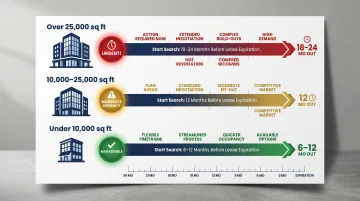
The earlier you engage a tenant rep, the more leverage you create in negotiation and the wider your range of options.
Frequently Asked Questions
What does tenant representation mean?
Tenant representation is a commercial real estate service where a licensed broker works exclusively on behalf of the tenant — not the landlord — to find space, negotiate lease terms, and protect the tenant's interests throughout the transaction.
What is a tenant rep fee?
A tenant rep fee (or commission) is the compensation paid to the tenant's broker. In most commercial lease deals, this fee is funded by the landlord — not the tenant — upon successful completion of the transaction.
How much does it cost to hire a commercial real estate broker?
For tenants, hiring a commercial real estate broker is typically free. The landlord pays the broker's commission, usually calculated as a percentage of total lease value or a per-square-foot fee.
What is a tenant brokerage agreement?
A tenant brokerage agreement is a contract between a tenant and their chosen broker that establishes the broker's exclusive right to represent the tenant in their commercial space search and outlines the terms of that representation.
Is agency leasing the same as tenant rep?
No. Agency leasing (also called landlord or listing representation) refers to brokers hired by building owners to lease their properties. Tenant rep brokers work solely for the tenant's benefit — they are not the same.
Is it better to hire a broker or agent?
In commercial real estate, what matters most is whose interests the professional represents, not their specific title. A tenant rep broker works exclusively for the tenant — so for any business searching for or negotiating office space, that dedicated advocacy is what you want on your side.