Introduction
Most companies sign their first office lease focused on the present: square footage, location, monthly rent. The renewal option gets a quick scan and a nod. That's a mistake that can cost significantly more to fix later.
A renewal option is often the most financially consequential clause in an office lease, yet it's also the most frequently mishandled. Tenants who don't negotiate one upfront can face forced relocation when the lease expires — often at the worst possible time. Those who do have one sometimes lose it by missing the notice deadline or failing to follow the exercise procedure to the letter.
This article breaks down exactly what commercial lease renewal options are, how each component works, how to negotiate favorable terms, and the specific steps required to exercise the right correctly. For growing companies in competitive markets like Manhattan, getting this right is a core part of long-term real estate strategy — one that pays off well before the lease expiration date arrives.
Key Takeaways
- A renewal option gives the tenant the right—not the obligation—to extend the lease for a defined additional term at predetermined or negotiated rent
- Renewal options must be explicitly negotiated and written into the original lease; they don't arise automatically
- Notice windows commonly range from 6 to 12 months before lease expiration, and missing the deadline can void the option entirely
- Renewal rent uses one of three structures — fixed rate, fair market value (FMV), or CPI-based escalation — each with a different risk profile
- High-growth companies should pair renewal options with expansion and contraction rights to build real estate flexibility
What Is a Commercial Lease Renewal Option?
A renewal option is a contractual right granted to the tenant in the original lease. It gives the tenant the unilateral ability to extend the lease for one or more additional terms, without renegotiating the entire agreement from scratch.
This is a tenant-favorable right, not a mutual obligation. As long as the tenant satisfies the specified conditions, the landlord cannot revoke it. The landlord has no legal basis to refuse a validly exercised option.
Renewal Option vs. Holdover Tenancy
These two concepts are frequently confused—and the confusion is costly.
- A renewal option requires the tenant to actively exercise the right within a defined notice window
- A holdover tenancy arises when a tenant stays after lease expiration without a formal agreement, typically triggering month-to-month terms at a significantly higher rent rate
A renewal option protects you. A holdover situation exposes you to penalty rates and uncertainty, with no guaranteed right to stay.
Why Renewal Options Matter for Companies That Have Built Out Space
Relocation carries a real price tag. Custom tenant improvements, culture built around a location, and operational disruption all make moving a material cost. For any company that has invested in buildout, the renewal option is a direct financial asset: the right to protect that investment by staying.
Renewal Option vs. Right of First Refusal vs. Right of First Offer
These are distinct rights, often confused:
| Right | What It Does | Best For |
|---|---|---|
| Renewal option | Guarantees the right to extend on pre-agreed terms | Protecting continuity in your current space |
| Right of first offer (ROFO) | Landlord must offer you the space before marketing it to others | Early access to adjacent space for expansion |
| Right of first refusal (ROFR) | You can match any third-party offer the landlord receives | Protection against losing strategic space to a competitor |
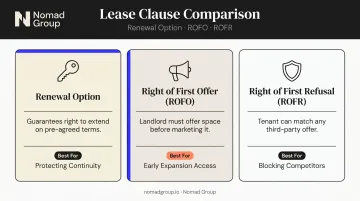
For growing companies in competitive submarkets—Flatiron, NoMad, Union Square—understanding which combination of these rights to request can meaningfully affect long-term flexibility.
Key Components of a Renewal Option Clause
Not all renewal options are created equal. The specific drafting of each component determines how protective the option actually is. Here's what to scrutinize.
Notice Period and Deadline
The notice period defines how far in advance of lease expiration the tenant must formally notify the landlord of their intent to renew. According to legal and bar journal sources, commercial lease notice windows typically range from 3 to 9 months, while many office leases require 6 to 12 months. The lease controls—always read the exact language.
The notice window serves both parties. The tenant needs time to evaluate whether renewing or relocating serves the business better. The landlord needs time to plan re-leasing if the option isn't exercised. And practically, both sides need time to involve counsel before any deadline passes.
The notice requirement is typically strict and non-waivable. New York courts have consistently treated timely notice as a condition of the renewal right. Missing the deadline—even by a day—can void the option entirely. New York courts may grant equitable relief in limited forfeiture situations, but as the Court of Appeals clarified in Baygold Assoc., Inc. v. Congregation Yetev Lev, that relief is narrow and fact-specific—not a reliable backstop. Don't count on it.
Rent Determination Method
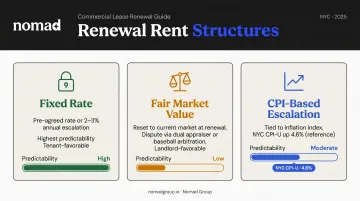
There are three primary structures for setting renewal rent:
- Fixed rate: A pre-agreed amount or escalation schedule written into the original lease. For tenants, it's the most predictable structure—no surprises, easier forecasting.
- Fair market value (FMV): Rent is reset to current market conditions at renewal, typically through negotiation or appraisal. Landlords favor this structure; tenants inherit the uncertainty of wherever the market lands.
- CPI-based escalation: Rent adjusts according to a specified inflation index. The BLS reported national CPI-U up 3.8% for the 12 months ending April 2026, and New York-area CPI-U up 4.6% for the same period—worth factoring into long-term cost modeling.
If FMV applies, the lease must define how disputes get resolved—"then-current market rent" without mechanics is a drafting trap. Two common structures handle this:
- Dual appraiser: Each party selects an appraiser; if valuations diverge, they jointly appoint a third to decide
- Baseball arbitration: Each party submits an FMV figure; an arbitrator picks one outright, without splitting the difference
Requiring a defined process up front is far less painful than litigating it at renewal.
Conditions and Qualifications
Most renewal options include conditions the tenant must satisfy:
- No material default at the time of notice and at the start of the renewal term
- Personal to the original tenant entity—may not transfer to a subtenant or assignee
Negotiate these carefully. Push to ensure a cured default doesn't disqualify the option. If your company may restructure or assign the lease to an affiliate, confirm the option survives that assignment. Standard landlord language often doesn't.
Types of Renewal Option Rent Structures
The rent structure governing your renewal term is, without question, the clause that matters most. A wrong assumption here can produce a substantial unplanned cost increase at exactly the wrong moment in a company's growth cycle.
Fixed-Rate and Escalation-Based Structures
Fixed renewal rent is the most straightforward: the lease spells out exactly what you'll pay during the renewal term, either as a flat rate or with pre-agreed annual increases—often 2% to 3% per year. You know your costs before you exercise the option. That predictability makes multi-year financial planning considerably easier.
This structure requires negotiation upfront — landlords generally prefer FMV because it gives them more upside. Fixed-rate renewals are most achievable when:
- Vacancy in the submarket is meaningfully elevated
- The tenant has a strong credit profile and operating history
- The initial lease term is long enough to justify landlord concessions
These conditions exist in pockets of the Manhattan market, even as overall availability tightens. The right broker can identify where landlord flexibility remains.
Fair Market Value Renewal Structures
Where fixed-rate structures offer certainty, FMV structures introduce negotiation risk — and in Manhattan, that risk is material right now. Colliers reported Manhattan average asking rent at $77.55/SF in Q1 2026—the highest since August 2020—while Newmark recorded $78.25/SF with availability falling from 19.5% to 14.6% over the prior eight quarters. Tenants entering FMV renewal negotiations using pandemic-era benchmarks as their reference point will be at a disadvantage.
The FMV process works like this:
- Tenant exercises the option within the notice window
- Both parties attempt to agree on current market rent for comparable space
- If agreement fails, the appraisal or arbitration mechanism kicks in
One provision worth negotiating upfront: a "kick-out" right allowing the tenant to rescind the renewal notice if FMV comes in above a defined threshold. Not all landlords accept it, but it's worth asking for during the original deal.
How to Negotiate a Strong Renewal Option
Renewal option negotiation happens during the original lease deal. Once the lease is signed, your leverage largely disappears. Tenants who think about renewal at year eight of a ten-year lease are negotiating from a weak position.
What to Push For During Initial Negotiations
- Multiple option periods: Two options of three years each creates more decision points than one five-year block — you can reassess space needs at each interval.
- Push for fixed-rate renewal over FMV: Manhattan's overall availability was still 14.6% in Q1 2026, with Midtown South sitting at 16.9% — tenants have more leverage than they often realize in markets like these.
- Cap any FMV escalations: If FMV is unavoidable, negotiate a floor/ceiling structure that limits how far the renewal rate can deviate from initial rent.
- Secure transferability to affiliates: The option should survive assignment to a parent company, subsidiary, or successor entity in a merger or acquisition.
- Negotiate the shortest notice period the landlord will accept — this preserves optionality. Work with counsel to find the right balance.
Pairing Renewal Options with Other Rights
For high-growth companies, a renewal option on the same footprint gets you continuity — but not flexibility. Consider building in:
- Expansion rights (ROFR on adjacent space) for when headcount grows
- Contraction rights or sublease provisions for downside scenarios
- Termination options tied to funding milestones or business triggers
The combination creates a real estate structure that can flex with the business — not just one that locks in continuity. Nomad Group's tenant representation team negotiates these provisions daily across Manhattan's high-growth neighborhoods — from Flatiron to SoHo — and can help you identify which levers matter most for your specific deal.
How to Properly Exercise a Renewal Option
Exercising a renewal option is a formal legal act. Getting the substance right isn't enough—the procedure must be followed precisely.
The Exercise Process
Most renewal clauses require:
- Written notice (not an email or phone call)
- Delivered via certified mail or overnight courier
- To a specific address stated in the lease
- Within the exact window specified (not before, not after)
Missing any of these requirements—sending to the wrong address, using the wrong delivery method—can void the option even if the notice arrives on time.
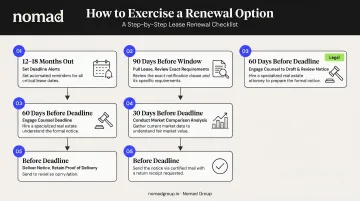
Recommended Internal Process
Start tracking this date well before the window opens:
- 12–18 months out: Set calendar alerts for the notice deadline
- 90 days before the window opens: Pull the lease and review the exact exercise requirements
- 60 days before the deadline: Engage legal counsel or your tenant representative to draft and review the notice
- 30 days before the deadline: Conduct market comparison analysis—comparable rents, availability, relocation costs—to confirm renewal is the right business decision
- Before the deadline: Deliver notice via the method specified, and retain proof of delivery
After Notice Is Delivered
Once notice is submitted, the focus shifts from procedure to negotiation. If rent is set by FMV, the appraisal or negotiation process begins immediately. Bring current market data to the table: Manhattan asking rents, concession packages, comparable transactions. Going into FMV negotiations without up-to-date comps puts you at a real disadvantage.
Common Renewal Option Mistakes That Cost Tenants
Three mistakes account for most of the avoidable problems in renewal option situations.
Missing or Misreading the Notice Deadline
This is the most common and most irreversible error. Tenants assume they can exercise the option at any point before lease expiration—but the window may close 9 or 12 months prior. By the time the tenant realizes the option has lapsed, they have no contractual right to renew.
New York courts may grant equitable relief in narrow circumstances, but that relief is uncertain, expensive to pursue, and not available to tenants who don't fit the fact-specific criteria. Treat the notice deadline like a wire transfer cutoff: there is no exception.
Assuming FMV Will Be Reasonable Without Doing Research
Tenants who exercise under an FMV clause without first benchmarking current market rents tend to negotiate from a reactive position. The landlord submits an aggressive opening number; the tenant has no independent data to counter it.
With Manhattan asking rents at $77–$78/SF heading into 2026 renewals, that gap can easily translate to $50,000+ in avoidable annual rent costs.
Treating the Option as a Passive Right
Many tenants assume the landlord will send a reminder as the notice window approaches. Landlords have no obligation to do this—and no incentive to. If you don't renew, they may be able to re-let the space at a higher rate.
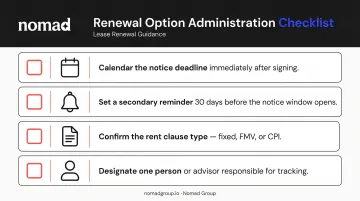
The option is entirely the tenant's responsibility to monitor and exercise. Build that into your lease administration process from day one:
- Calendar the notice deadline immediately after signing — work backward from lease expiration
- Set a secondary reminder 30 days before the notice window opens
- Confirm the current rent clause type (fixed, FMV, or CPI) so you're not caught off guard
- Designate one person or advisor responsible for tracking it — not "the team"
Missing any of these steps is how a contractual right quietly disappears.
Frequently Asked Questions
What is an option to renew in a commercial lease?
A renewal option is a contractual right in the original lease allowing the tenant to extend the lease for a defined additional term. It must be actively exercised within a specified notice window—it is not automatic, and the landlord cannot revoke it if the tenant satisfies all conditions.
How much notice do I need to give to exercise a renewal option?
Notice periods vary by lease, but many commercial office leases require 6 to 12 months' advance notice before expiration. The lease also specifies the delivery method and address—both must be followed precisely, or the notice may be invalid.
Can a landlord refuse to honor a commercial lease renewal option?
If the tenant has satisfied all conditions—timely notice, not in default, correct delivery method—the landlord is legally bound to honor the option. A validly exercised renewal option cannot be unilaterally refused by the landlord.
What is the difference between a renewal option and an automatic lease renewal?
A renewal option requires the tenant to take affirmative action within a set window. An automatic renewal (or holdover tenancy) occurs when a tenant remains in the space after expiration without a formal agreement—typically triggering month-to-month tenancy at a higher, often penalty, rate.
How is rent determined when I exercise my commercial lease renewal option?
Renewal rent follows one of three methods set in the original lease: a fixed pre-agreed rate, fair market value at the time of renewal, or a CPI-based escalation formula. The method is locked in at signing, making it one of the most important terms to negotiate upfront.
What does a letter of intent mean in commercial real estate?
As defined by NAIOP, a letter of intent (LOI) is a preliminary, typically non-binding document that outlines proposed lease terms before a formal lease is drafted. It is the right place to establish renewal option terms—notice periods, rent method, and FMV mechanics—before those terms become harder to negotiate.