
Introduction
Picture this: a Series B SaaS company signs a 7-year lease for 8,000 square feet in Flatiron. Two years in, the company shifts to a hybrid model, cuts headcount by 40%, and suddenly has far more office than it needs. Or the acquisition offer comes in, and the acquiring company already has its own NYC headquarters.
Breaking the lease is rarely the right move — it's typically the most expensive one. Lease assignment offers a structured, landlord-approved alternative: exit the obligation entirely by transferring it to a new tenant.
This guide covers what every NYC commercial tenant should understand before pursuing an assignment:
- What a commercial lease assignment actually is
- How it differs from a sublease
- When assignment makes more sense than other exit strategies
- The specific lease clauses that govern the process
- How the assignment process works, step by step
- The risks involved for both the assignor and assignee
Disclaimer: Lease assignments are legally complex transactions. This guide is informational only — not legal advice. All parties should engage qualified real estate counsel before proceeding.
Key Takeaways
- A lease assignment transfers your entire leasehold interest — all obligations and rights — to a new tenant
- Unlike a sublease, an assignment creates a direct relationship between the incoming tenant and the landlord
- The original tenant typically remains secondarily liable unless the landlord formally releases them
- Landlord consent is almost always required, and the consent standard in your lease — discretionary vs. "not unreasonably withheld" — shapes your negotiating position
- Review your lease for recapture rights, profit-sharing provisions, permitted transfers, and change-of-control language before starting
What Is a Commercial Lease Assignment?
A commercial lease assignment is the full legal transfer of a tenant's leasehold interest — every right, obligation, and responsibility under the original lease — to a new tenant. No new lease is created. The original rent schedule, remaining term, permitted use restrictions, and all other covenants carry over exactly as written.
Three parties are involved:
- Assignor — the original tenant transferring the lease
- Assignee — the incoming tenant assuming it
- Landlord — whose consent is almost always required and who gains a direct relationship with the assignee
Once the assignment is executed, the assignee steps entirely into the assignor's position. Rent payments, maintenance obligations, build-out responsibilities, and every covenant in the original lease now belong to the assignee for the remaining term. Once the assignment is executed, the assignee takes on every obligation in the original lease — rent payments, maintenance, build-out responsibilities, and all remaining covenants — for the full remaining term.
That transfer of liability is precisely why landlord consent exists.
Why Landlord Consent Matters
Landlord consent is nearly universal in commercial office leases — and skipping it can be catastrophic. Proceeding without required consent can:
- Constitute a material breach of the lease
- Trigger the landlord's right to terminate
- Render the assignment entirely void
Once consent is granted, the landlord typically records it through a formal document — often called a "license to assign" — that acknowledges and approves the transfer. Per NYC Bar guidance, if a commercial lease is entirely silent on assignment, New York courts generally allow it because courts disfavor restraints on alienation (the ability to freely transfer property interests) — but most well-drafted NYC office leases include explicit consent requirements, making this a narrow exception rather than a reliable fallback.
Commercial Lease Assignment vs. Sublease: Key Differences
These two mechanisms are often confused, and the distinction matters more than most tenants expect. Choosing the wrong structure for a given situation can leave you on the hook for obligations you thought you'd escaped.
How a Sublease Works
In a sublease, the original tenant becomes a "sublandlord." They retain full primary liability to the landlord and create a separate tenancy with a subtenant. The subtenant pays rent to the original tenant, not the landlord. The original tenant never exits the lease relationship; they remain responsible regardless of what the subtenant does.
How an Assignment Works
In an assignment, the assignee steps into a direct relationship with the landlord. The assignor's primary role ends — though secondary liability typically survives unless the landlord formally releases the assignor. If the assignee later misses rent, the landlord may still pursue the original tenant unless a formal release was negotiated upfront.
Choosing Between Them: Key Practical Differences
| Factor | Assignment | Sublease |
|---|---|---|
| Scope | Must cover entire premises | Can cover part of the space |
| Primary liability | Shifts to assignee | Stays with original tenant |
| Landlord relationship | Assignee deals directly with landlord | Subtenant deals with original tenant |
| Consent required | Almost always | Almost always |
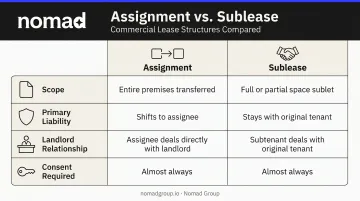
One rule of thumb: if a tenant wants to offload only part of their floor — say, 3,000 of 10,000 square feet — a sublease is typically the only available mechanism. A full space transfer points toward assignment.
When Does Assigning a Commercial Lease Make Sense?
Lease assignment tends to come up in three distinct situations — each with its own urgency and logic:
Business relocation or downsizing. When hybrid work or headcount reductions leave a company with more space than it needs, assignment lets the tenant exit cleanly without paying early termination penalties. PFNYC's 2024 survey of major Manhattan employers found 60% of companies operating on hybrid schedules and 11% expecting to reduce their footprint over five years — the pressure to reduce space is real and ongoing.
Business sale or acquisition. When a company is acquired or merged, the commercial lease is often a core operational asset. Assignment transfers it to the acquiring entity without requiring them to negotiate new terms from scratch. For startups, this is worth thinking about at lease signing — not after the term sheet arrives.
When the space no longer fits the business. A change in business model, a sharp reduction in headcount, or a shift to fully remote work can make existing space unsustainable. Assignment provides a structured, landlord-approved exit that limits ongoing financial exposure — better than defaulting or walking away.
Key Clauses and Legal Considerations Every Tenant Should Know
Reading the assignment clause before taking any other step isn't optional. These are the provisions that will either open the door or close it.
The Assignment Clause and Consent Standard
The assignment clause specifies whether a transfer is permitted, what consent is required, what documentation the landlord can demand, and what fees apply.
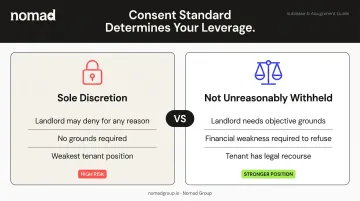
The consent standard determines your leverage:
- "Sole discretion" — the landlord can deny for any reason, or no reason at all
- "Not unreasonably withheld, conditioned, or delayed" — the landlord must have objective, fact-based grounds (typically financial weakness of the proposed assignee) to refuse
The gap between these two standards is enormous in practice. Tenants with a "sole discretion" clause are negotiating from a weaker position; those with the "not unreasonably withheld" standard have legal recourse if the landlord stonewalls without cause.
Permitted Transfers
Many well-negotiated leases include carve-outs that allow assignment without landlord consent. Common examples:
- Transfers to affiliates, parent companies, or wholly owned subsidiaries
- Assignments in connection with mergers, acquisitions, or corporate reorganizations
For startups anticipating a fundraising round or acquisition, these carve-outs are worth fighting for at lease signing. The NYC Bar flags explicitly that assignment provisions can derail M&A transactions, and recommends negotiating transfer flexibility for corporate events upfront.
Recapture Clauses
A recapture right allows the landlord to take back the premises entirely when a tenant requests assignment consent — effectively terminating the lease rather than approving the transfer. That can be a relief (no more rent liability) or a problem (the tenant loses any financial value from the assignment, particularly if the lease is being transferred as part of a business sale).
Well-negotiated leases give the tenant the right to rescind the assignment request if the landlord exercises recapture — preserving the option to stay put.
Profit-Sharing Provisions
If an assignee is willing to pay above the contracted rent, many leases entitle the landlord to a share of that profit — sometimes up to 50%. Tenants can negotiate to:
- Deduct unamortized tenant improvement costs, broker commissions, and legal fees before the profit calculation applies
- Exclude business goodwill from the definition of "profit"
These deductions can substantially reduce or eliminate the landlord's share in practice.
Continuing Liability After Assignment
The financial terms above are only part of the picture. Once the assignment closes, the original tenant typically remains secondarily liable. If the assignee defaults, the landlord can pursue the assignor for unpaid rent or damages — a risk New York courts have consistently enforced. The NYC Bar's standard office lease form explicitly preserves assignor liability unless the landlord grants a formal release.
Releases are rare and typically require the assignee to demonstrate strong financial credentials. Working with a broker who has established relationships with NYC landlords — the kind that Nomad Group has built across Flatiron, NoMad, and SoHo — can help open conversations about consent timelines and liability terms that would otherwise stall.
Change-of-Control Provisions
Many NYC office leases — including the REBNY standard form — treat a transfer of 50% or more of tenant ownership interests as a deemed assignment, and it's the clause startup tenants most often miss. That means a fundraising round or acquisition could inadvertently trigger the assignment clause, requiring landlord consent for what the company considers an internal corporate event.
Under New York law, a mere change in ownership of the tenant entity isn't automatically an assignment absent a specific contractual provision — but most institutional leases include exactly that provision. Startups should identify and, where possible, carve out equity events from the change-of-control definition at the time of lease signing.
How to Assign a Commercial Lease: A Step-by-Step Overview
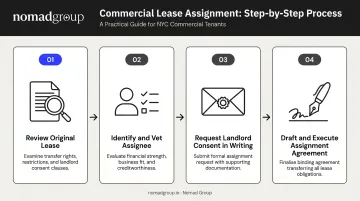
Step 1 — Review the Original Lease
Before approaching potential assignees or the landlord, read the assignment clause in full. Map out the key provisions that will govern the process:
- The consent standard (discretionary vs. reasonableness)
- Required documentation and fee obligations
- Notice periods and response deadlines
- Any recapture or profit-sharing language
Step 2 — Identify and Vet a Qualified Assignee
Assemble a complete assignee package before submitting to the landlord — landlords scrutinize this closely:
- Recent financial statements (typically 2-3 years)
- Credit history and references
- Business plan or company overview
- Evidence of operational stability
A well-documented package accelerates approval and reduces the assignor's secondary liability exposure when the assignee's financials hold up under scrutiny.
Step 3 — Request Landlord Consent in Writing
Submit a formal written consent request with the full assignee documentation package. Keep all communications documented. If the lease specifies a response timeframe, track it carefully — some leases treat unreasonable delay as constructive consent, or as a landlord breach in its own right.
Step 4 — Draft and Execute the Assignment Agreement
Once written consent is in hand, have qualified legal counsel draft or review the assignment agreement. The document should include:
- Identification of all three parties
- Effective transfer date
- Reference to the original lease
- Assignee's assumption of all obligations
- Any agreed terms between assignor and assignee (payment for improvements, indemnification)
- Liability provisions
All three parties — assignor, assignee, and landlord — must all sign.
Risks to Watch Out For
For the Assignor
The core risk is secondary liability. If the assignee defaults, the landlord can come back to the original tenant for unpaid rent or damages.
Protect yourself by:
- Vetting the assignee's financials thoroughly before submitting the consent request
- Negotiating a release of liability where possible (more achievable with a financially strong assignee)
- Requiring the assignee to provide a security deposit or indemnification agreement
For the Assignee
The main risk is inheriting an unfavorable lease: rent above current market, restrictive permitted use language, or a term so short that renewal options won't apply.
Market data makes this tangible. Manhattan sublease asking rents averaged $57.81 per square foot in Q1 2026, while overall Class A asking rents sat at $83.25 per square foot. An assignee stepping into below-market space benefits. One inheriting above-market rent faces a real financial burden from day one.
Assignees should:
- Review every provision of the original lease (not just rent and term)
- Confirm whether renewal and expansion options extend to assignees — many don't
- Conduct a full property inspection
- Negotiate with the assignor for concessions if any terms are unfavorable
For Both Parties
Proceeding without landlord consent, or substituting a documented assignment agreement with an informal arrangement, can trigger a lease default and expose the assignor to termination claims. Bring in experienced real estate counsel and a knowledgeable commercial broker early. Assignment clauses carry more legal weight than most tenants expect, and the negotiating leverage available at the outset disappears once the process is already underway.

Frequently Asked Questions
What is a commercial lease assignment?
A commercial lease assignment is the full legal transfer of a tenant's rights and obligations to a new tenant (the assignee). The assignee takes direct responsibility for rent, maintenance, and all lease obligations for the remaining term — no new lease is created, and the existing terms carry over in full.
What happens when you assign a commercial lease?
The assignee steps into the original tenant's role and forms a direct relationship with the landlord. The original tenant typically remains secondarily liable unless formally released, and all parties must sign a formal assignment agreement after the landlord grants consent.
How is a lease assignment different from a sublease?
An assignment transfers the entire lease to a new tenant who deals directly with the landlord, while a sublease allows the original tenant to rent out all or part of the space while remaining primarily responsible to the landlord. Subleases can cover partial spaces; assignments generally cannot.
Can a landlord refuse to approve a commercial lease assignment?
It depends on the lease language. If the lease grants "sole discretion," the landlord can deny without giving reasons. If it requires consent "not unreasonably withheld," the landlord must have objective grounds — such as the assignee's financial weakness — to refuse.
Does the original tenant remain liable after a lease assignment?
In most cases, yes. The original tenant retains secondary liability unless the landlord formally grants a release. New York courts have consistently enforced this exposure — meaning a landlord can still pursue the original tenant if the assignee defaults on rent or other obligations.
What is a recapture clause in a commercial lease?
A recapture clause gives the landlord the right to take back the premises when a tenant requests assignment consent, effectively terminating the lease rather than approving the transfer. This eliminates the tenant's rent obligation but may also eliminate any financial value the tenant hoped to extract from the assignment.