Introduction
Commercial leases in NYC typically run 3 to 10 years — designed for stability, not flexibility. Yet business needs shift constantly: headcount changes, hybrid work reshapes space requirements, M&A creates redundant locations, and funding fluctuations force cost cuts. For the 8,750 funded tech startups across New York — double the number from a decade ago — and the thousands of scaling companies locked into long-term commitments, those shifts often happen long before the lease expires.
Exiting a commercial lease early isn't about "breaking" a contract — it's about managing liability, protecting your capital, and keeping your landlord relationship intact. Tenants who plan ahead have far more options than those who wait until the final hour.
With 55 million square feet of Manhattan office leases expiring by 2027 and average new lease sizes down 32% from pre-pandemic levels, the market has shifted. This guide breaks down the exit strategies available to NYC tenants — and how to use them.
Key Takeaways
- Commercial leases are binding, but tenants have legitimate exit strategies: early termination clauses, subleasing, assignment, negotiated buyouts, and hand-back provisions
- Each path differs in cost, liability release, and landlord involvement; the right choice depends on market conditions, lease language, and remaining term
- Under New York law, landlords have no duty to mitigate damages when tenants vacate early, making proactive strategy critical
- The best exit is negotiated before you sign; favorable lease language upfront can save hundreds of thousands in exposure later
- Working with a tenant advisor early dramatically increases negotiating leverage and outcome quality
Why NYC Commercial Tenants Exit Leases Early
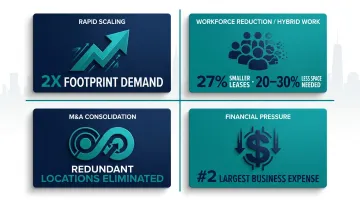
Several business triggers prompt early exit decisions:
- Rapid scaling requiring larger space — Companies like FloraFauna AI needed to double their footprint within 30 days of moving in
- Workforce reduction or hybrid work — Average lease sizes are now 27% smaller than pre-pandemic, with companies taking 20-30% less space overall
- Mergers or acquisitions — Redundant office locations post-M&A create immediate consolidation needs
- Financial pressure — Funding shifts or market downturns demand cost cuts, and real estate is often the second-largest expense
Early exits are especially complex in NYC for three reasons:
Legacy lease lengths don't match today's footprint. AI firms now average just 3.5 years, and most tenants under 10,000 sf prefer five years or less. Yet leases signed in Flatiron, NoMad, and SoHo before 2020 commonly run 7-10 years — a structural mismatch that leaves tenants trapped in space they've already outgrown or abandoned.
New York law doesn't require landlords to find a replacement. Under the landmark Holy Properties Ltd. v. Kenneth Cole Productions decision, commercial landlords in New York have no legal obligation to re-let a vacated space. They can do nothing and collect full rent for the entire remaining term. That's not a negotiating tactic — it's settled law.
Personal guarantees keep founders on the hook. Many NYC commercial leases require founders or principals to personally guarantee rent. The business vacating the space doesn't end that obligation — your personal assets stay at risk until the lease is resolved.
The window to negotiate a favorable exit narrows quickly. Once rent arrears accumulate or the landlord relationship sours, most of the strategies below become harder — and more expensive — to execute.
Best Tenant Exit Strategies for Commercial Leases
Five primary exit paths exist for commercial tenants. Viability depends on lease language, market conditions, and your financial position.
Early Termination Clause (Break Clause)
A break clause is a pre-negotiated contractual right to exit the lease on a specified date. It's the cleanest exit option, provided your lease includes one.
Required conditions typically include:
- Advance written notice (commonly 6-12 months)
- Full payment of rent and additional charges through the break date
- Surrender of space in agreed condition
- Reimbursement of unamortized landlord expenses (TI allowances, brokerage commissions)
Execution must be flawless. The notice letter must reference the correct lease provisions, be delivered via the exact method specified in the contract (certified mail, hand delivery, or other contractually specified method), and meet all preconditions. Missing a notice deadline by even one day can eliminate the right entirely.
Before exercising a break clause, have legal counsel review your notice letter and confirm all conditions are satisfied.
Sublease
Subleasing allows you to rent all or part of your space to a subtenant while remaining liable to the landlord for all primary lease obligations — including rent, property damage, and lease compliance.
Key characteristics:
- Most commercial leases require landlord consent to sublease
- You remain "on the hook" if the subtenant defaults or damages the property
- Sublease agreements must mirror the master lease terms
- Recovery rates typically fall below 100% of your rent obligation
Manhattan sublease space currently sits at 12.1 million square feet (down from nearly 15 MSF in Q3 2025), creating pricing pressure. Sublease asking rents in Midtown range from $50-70/sf annually vs. $80-100+/sf for direct leases, so expect to absorb a loss. How much depends on building class, submarket, remaining lease term, and space condition.
Lease Assignment
A full assignment transfers your entire interest in the lease to a new party, who steps into your position. Unlike a sublease, assignment can result in a full release of liability if properly negotiated.
Critical elements:
- Landlord consent is almost always required
- Approval depends on the incoming tenant's financial strength and compatibility with permitted uses
- Assignment works best when your lease rate is at or below current market rent
- The original guarantor may also be released through a novation agreement
Assignment is most achievable when the replacement tenant is equally or more creditworthy than you, and when market conditions favor landlords (low vacancy, strong demand).
In tight markets like Midtown South, where availability sits at just 13.7% and leasing demand is up 30.9% year-over-year, landlords are more willing to consider qualified replacement tenants.
Negotiated Lease Buyout or Surrender
A buyout is a negotiated settlement where you pay the landlord a lump sum (or structured payments) to be fully released from remaining obligations. It's often the most expensive option, but the cleanest from a liability standpoint.
Factors influencing what landlords will accept:
- Remaining lease term
- Unamortized tenant improvement allowances and leasing commissions
- Current market rent vs. your lease rent
- Projected re-letting downtime
- The landlord's own financial position and development plans
Tenant advisory firm Cresa reports landlords have accepted 20-60% of remaining lease obligations for negotiated terminations. In one case, Cresa negotiated a settlement where the landlord accepted $300,000 on a $6 million remaining obligation, an effective 5% settlement rate.
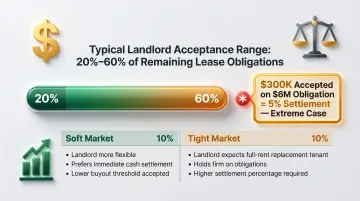
Outcomes vary widely. In soft markets with high vacancy, landlords prefer cash now over years of litigation risk. In tight markets with strong demand, they hold firm expecting full-rent replacements.
The gap between asking and net effective rents signals how much flexibility landlords actually have: trophy space shows a $41/sf gap, while Class A space shows a $17/sf gap, indicating meaningful concession capacity even when headline rents hold firm.
Space Hand-Back (Partial Surrender) Provision
A hand-back clause allows tenants to return a defined portion of their space at a set point in the lease term — for example, giving back one floor after 36 months.
Key benefits:
- Provides a built-in downsizing mechanism without fully exiting or subleasing
- Particularly useful for high-growth companies that may over-lease in anticipation of headcount growth
- Eliminates ongoing liability for the returned portion
This is an uncommon but highly valuable provision that must be negotiated at lease execution. It's especially relevant for NYC startups and scaling tech companies with unpredictable headcount growth.
Given that 67% of Manhattan office deals in the first half of 2025 were for spaces between 5,000 and 14,999 sf, reflecting dramatic downsizing, hand-back provisions provide crucial flexibility for companies that initially commit to larger footprints.
How to Choose the Right Exit Strategy for Your Business
Start with the numbers. Calculate your total remaining lease exposure: base rent + operating expenses + restoration/make-good costs. Compare that against the projected cost of each exit option.
Market timing matters significantly:
In tight markets (low vacancy): Landlords accept buyout terms or consent to assignment quickly because they can re-let space at higher rates. Manhattan's overall availability rate dropped 540 basis points from 20.0% in Q3 2024 to 14.6% in Q1 2026 — signaling a tightening market.
In soft markets (high vacancy): Expect to make greater financial concessions. However, distressed landlords facing long vacancy periods may settle at lower percentages to avoid litigation costs.
Your lease document is the starting point. Study:
- Early termination rights and notice requirements
- Assignment/sublease consent language (reasonable vs. arbitrary)
- Personal guarantee exposure and burn-down provisions
- Restoration and surrender conditions
Missing a notice deadline by even one day can eliminate an exit option entirely. That risk is especially acute in New York. Because NYC courts generally do not require landlords to mitigate damages, tenants who vacate without a formal agreement may remain liable for the full remaining term. Under Holy Properties Ltd. v. Kenneth Cole Productions, a landlord can legally do nothing and collect rent as it comes due — making informal exits one of the costliest mistakes a tenant can make.
The role of a tenant-side advisor: Nomad Group's team regularly helps clients assess market conditions, uncover landlord motivations, and structure exit negotiations that protect capital and preserve relationships. With over 300 tenant buildouts completed and active deal flow across Flatiron, NoMad, SoHo, and Williamsburg, the team brings market-specific context — who's re-leasing, at what rates, and how quickly — that shapes smarter negotiating positions.
Build Your Exit Before You Sign: Lease Provisions That Protect You Later
The single most effective exit strategy is one negotiated before the lease is signed.
Insist on:
- Break clauses with exact termination penalties defined as liquidated damages — for example, 3 months' rent plus unamortized TI allowances — rather than vague "negotiated" terms
- Hand-back provisions tied to business milestones, allowing partial surrender at 24 or 36 months if headcount falls below a threshold or funding targets aren't met
- Tenant-friendly assignment and sublease language, including:
- "Deemed consent" provisions (if landlord doesn't respond within 30 days, consent is automatic)
- Pre-approved "permitted transfers" for mergers, acquisitions, or affiliate assignments
- A reasonableness standard: "Landlord consent shall not be unreasonably withheld, conditioned, or delayed"
- Burn-down personal guarantees that reduce over the lease term — full exposure in years 1-2, 50% in years 3-4, zero thereafter — rather than locking in full-term liability
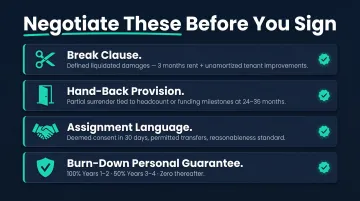
Landlords in competitive submarkets like Flatiron and NoMad will push back on some of these provisions — but not all equally. "Deemed consent" language and reasonableness standards are increasingly standard in Manhattan; burn-down guarantees typically require harder negotiation. Knowing the difference is where a knowledgeable tenant advisor earns their fee. A well-structured lease today can save hundreds of thousands of dollars in exit costs later.
With Manhattan leasing activity of 10.4 MSF in Q1 2026 — 41% above the 2020-2024 average — the market has shifted from stabilization to growth-driven demand. This creates negotiating leverage for tenants willing to commit, but only if exit provisions are negotiated at signing.
Conclusion
Exiting a commercial lease in NYC is never simple, but tenants who act early, understand their lease, and work with the right advisor have real options. From break clauses and subleasing to structured buyouts, each strategy offers a path forward — but only when you plan ahead.
The strategies outlined here are not equally available to every tenant. The right path depends on lease language, market conditions, remaining term, and financial capacity. Tenants who move without a clear plan often end up absorbing penalties or liability that a structured approach could have avoided.
If you're evaluating a lease exit in NYC, Nomad Group's team has navigated this process across every stage of the commercial lease lifecycle — from negotiation and buildout through transitions and exits. With 2M+ square feet leased across Manhattan's most competitive neighborhoods, we can help you assess your options, approach your landlord strategically, and protect your capital through the process.
Frequently Asked Questions
Here are answers to the questions commercial tenants in NYC most commonly ask when looking to exit a lease early.
What are the best tenant exit strategies for a commercial lease?
The five main options are early termination (break) clauses, subleasing, lease assignment, negotiated buyouts, and hand-back provisions. The best strategy depends on what your lease allows, NYC's current leasing market, and how much time and money you're willing to invest.
How can a tenant terminate a commercial lease early?
The two primary paths are exercising a contractual break clause (if one exists) or negotiating a surrender/buyout directly with the landlord. Both require strict procedural compliance — including proper notice, full rent payment through the exit date, and formal documentation.
How can I terminate my commercial lease early without penalty?
True penalty-free exits are rare. The closest options are a well-negotiated break clause with minimal liquidated damages, or exiting because the landlord materially defaulted on lease obligations (meaning the landlord made the space unusable or violated key lease terms). Sublease or assignment can offset costs but rarely eliminate them entirely.
What's the most common way for a commercial lease to terminate?
Natural expiration at the end of the lease term is most common, followed by negotiated early termination or buyout. Premature walkaway without agreement is the least common outcome because of the significant financial liability it creates under New York law.
Can a commercial lease be broken before it starts?
Pre-commencement termination is possible but rare, typically requiring mutual agreement with the landlord. Tenants usually forfeit any pre-payment, deposits, or early work already completed. Your liability depends entirely on what the signed lease says about pre-occupancy termination rights.
What are valid reasons to break a commercial lease?
Commercial leases rarely list "valid reasons" for early exit the way residential leases might. Most exits are business-driven — downsizing, relocation, financial hardship, M&A — and tenants typically resolve them through negotiation rather than legal grounds, unless the landlord has materially breached the lease.