Introduction: What Does a Commercial Real Estate Agent Actually Do?
Picture this: your company just hit 40 employees, and the lease on your current space expires in eight months. Suddenly you're fielding calls from landlord brokers, drowning in listings that all look the same, and staring at a 75-page lease document that reads like a legal deposition. You don't know if the asking rent is fair, whether the building can support your IT infrastructure, or what "escalation clause" actually means for your budget three years from now.
This is exactly where a commercial real estate (CRE) agent steps in.
Unlike residential agents, CRE agents work exclusively with commercial office properties. The transactions they manage are different in almost every way: longer leases, larger footprints, multiple decision-makers, and legal complexity that can span hundreds of pages.
The financial stakes are also much higher. A single negotiating misstep on a 5-year Manhattan lease can cost a company hundreds of thousands of dollars.
What follows breaks down exactly what NYC CRE agents do, why this market is uniquely complex, how representation works, and what to look for when choosing one.
TLDR: Key Takeaways
- NYC CRE agents do far more than find listings — they advise on market conditions, negotiate terms, and manage deals through buildout
- The NYC market is fragmented: asking rents ranged from $58/SF in Williamsburg to $128/SF near Hudson Yards in 2024, making neighborhood expertise essential
- Most tenants work with a tenant rep whose fee is typically paid by the landlord (often at no direct cost to you)
- Starting your search 9–18 months before your lease expires gives your agent the most negotiating leverage
- Not all CRE agents are equal — prioritize neighborhood expertise, stage-relevant experience, and full-service capabilities beyond lease signing
Core Responsibilities of a NYC Commercial Real Estate Agent
A good CRE agent does five distinct things — and most companies only realize the value of each after experiencing what happens without them.
Market Analysis and Needs Assessment
Before any search begins, a skilled agent conducts a detailed intake. This means understanding your headcount, growth projections, culture, budget ceiling, and neighborhood preferences — then mapping those against current market conditions.
For high-growth companies especially, this step matters more than most expect. A 30-person team today might need space for 60 in two years. An agent who doesn't account for that will find you the wrong space.
Property Search and Shortlisting
Agents use proprietary databases, direct landlord relationships, and portfolio access to surface spaces that match your criteria. In NYC, many quality spaces — particularly premium subleases and off-market opportunities — never appear on public listing platforms.
Nomad Group, for example, manages over 2 million square feet across Manhattan and Brooklyn, which gives their team visibility into spaces that aren't accessible through a standard CoStar search.
Tour Coordination and Space Evaluation
Agents don't just schedule tours. They evaluate each space against criteria most tenants wouldn't think to assess:
- HVAC capacity and existing infrastructure
- Ceiling heights and natural light for the intended use
- Landlord reputation and responsiveness
- Existing buildout condition and reuse potential
- Lease flexibility — expansion rights, termination options
A space that looks great on a floor plan can have serious operational problems. An experienced agent flags those before you fall in love with the exposed brick.
Lease Negotiation
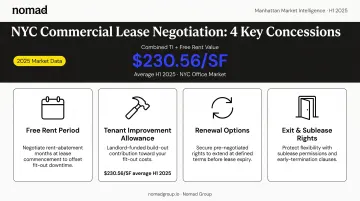
Agents negotiate rent, free rent periods, tenant improvement (TI) allowances, lease length, renewal options, sublease rights, and exit clauses — and the financial stakes are significant.
Colliers reported that the combined average weighted value of TI allowances plus free rent for new Manhattan deals reached $230.56/SF in H1 2025 — a figure most tenants would leave on the table without representation. Even modest improvements to a single concession can translate to significant savings across a multi-year lease.
Transaction Management Through Closing
Once a deal is agreed in principle, the work isn't done. Agents coordinate with attorneys, architects, and landlord representatives to manage the Letter of Intent (LOI), lease review, and final execution, keeping the deal on track and preventing it from unraveling over paperwork or slow response times.
Speed at this stage matters. One of Nomad Group's clients, Extend AI, lost months waiting on a previous broker before switching to Nomad Group — a reminder that the post-LOI phase requires as much attention as the search itself.
How NYC's Market Makes Commercial Real Estate Uniquely Complex
NYC isn't one commercial real estate market. It's dozens of micro-markets with dramatically different dynamics, price points, and landlord behaviors.
Building Class Distinctions
The Class A, B, and C system affects everything from rent expectations to negotiating leverage.
| Class | Q4 2024 Avg. Asking Rent (Manhattan) | Typical Tenant Profile |
|---|---|---|
| Class A | $81.94/SF | Finance, law, enterprise tech |
| Class B | $62.54/SF | Growth-stage startups, creative firms |
| Overall | $73.42/SF | Mixed |
Source: Colliers NYC Q4 2024 Manhattan Office Report
Class A assets accounted for 79.7% of Midtown leasing activity in Q3 2024, per Newmark — reflecting strong demand at the top of the market. High-growth startups consistently find better value and culture fit in Class B buildings in neighborhoods like Flatiron, NoMad, and SoHo, where landlords are more willing to negotiate on terms.
Neighborhood Micro-Markets Behave Independently
Asking rents in 2024 varied dramatically across Manhattan's submarkets:
- Far West Side / Hudson Yards: $128.73/SF
- NoHo / SoHo: $102.37/SF
- Midtown: $80.50/SF
- Flatiron / Union Square: $79.19/SF
- Williamsburg / Greenpoint: $58.01/SF
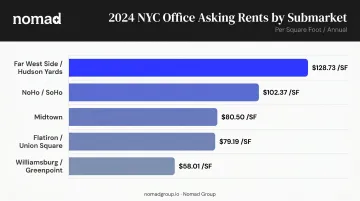
A CRE agent with hyperlocal expertise knows which neighborhoods favor tenants versus landlords at any given moment, and that balance shifts quarter to quarter. Manhattan's overall availability rate ended 2024 at 16.5%, but that average masks significant variation between submarkets.
Lease Structures and Legal Complexity
NYC commercial leases are notoriously landlord-favorable by default. They're long, dense documents with provisions that can significantly affect your costs and flexibility:
- Escalation clauses — annual rent increases tied to operating costs or fixed percentages
- Work letter agreements — defining exactly what the landlord will build and what you're responsible for
- Personal guarantees — exposing founders or executives to personal liability
- Holdover provisions — dramatically increasing rent if you stay past lease expiration
The NYC Department of Small Business Services notes that commercial tenants have far fewer automatic protections than residential tenants. The written lease controls nearly everything.
An experienced agent works alongside real estate attorneys to ensure the final lease actually works in your favor.
Speed and Competition
Desirable spaces in high-demand neighborhoods move fast. Companies that spend too long evaluating options (or stalling on internal approvals) routinely lose the right space to faster-moving competitors. A skilled agent keeps the process moving — helping you structure a competitive LOI and make decisions before the opportunity disappears.
Tenant Rep vs. Landlord Rep: What's the Difference?
Every commercial lease transaction has two sides. Understanding which side your agent is on is the first thing to establish.
Tenant representative: Works exclusively on behalf of the company leasing space. Their fiduciary obligation — defined under New York Real Property Law Section 443 — is to the tenant. They negotiate to get you better rent, more free rent, higher TI allowances, and favorable exit terms.
Landlord representative (listing broker): Works for the building owner. Their job is to maximize rent and secure terms favorable to the landlord. They're not your advocate, even if they're friendly and responsive.
The Dual Agency Risk
In some situations, a single broker represents both parties — known as dual agency under NY law. This arrangement inherently limits how hard they can fight for either side. Tenants in NYC should always confirm exclusive representation before signing anything. The landlord's broker is not legally required to protect your interests — and in a competitive market, that gap matters.
For startups and scaling tech companies, the stakes of getting this wrong are high — misaligned representation can cost you six figures in above-market rent over a five-year term. Nomad Group works exclusively on the tenant side, with no landlord representation assignments that could create competing obligations.
How Commercial Real Estate Agents Get Paid in NYC
Fee structure is one of the most commonly misunderstood aspects of CRE brokerage — and that confusion stops many companies from engaging an agent at all.
In the vast majority of NYC commercial transactions, the landlord pays the agent's commission. It's typically calculated as a percentage of the total lease value or on a per-square-foot basis, paid by the building owner rather than the tenant. Tenant representation often costs the tenant nothing out of pocket.
When both a tenant rep and a landlord rep are involved, they split the commission. That split is baked into the landlord's economics — it doesn't inflate your rent or change the terms you're negotiating.
Fee structures can differ in off-market deals, subleases, and other atypical transactions. A reputable agent discloses their compensation arrangement before the engagement begins. At Nomad Group, that disclosure is standard practice from the first conversation.
What to Look for When Hiring a NYC Commercial Real Estate Agent
Neighborhood-Specific Expertise
Ask for a demonstrated track record in the neighborhoods you're targeting — not just familiarity, but recent closed deals. The right agent knows which buildings have flexible landlords, which have infrastructure that works for tech companies, and what realistic concessions look like right now.
Experience with Companies at Your Stage
An agent who works primarily with large corporations may not understand the pace, flexibility needs, or budget realities of a Series A company. Look for someone who has handled deals similar to yours in size, sector, and complexity.
For context on what stage-matched experience looks like: Nomad Group focuses specifically on high-growth companies across tech, fintech, and adjacent sectors, with clients ranging from 20-person startups to established enterprises like M&C Saatchi Group — and over 300 tenant buildouts completed across NYC's top neighborhoods.
Full-Service Capabilities Beyond the Lease
For a scaling company, the real work often starts after the lease signing: buildout coordination, construction management, space operations. Firms that handle all of this in-house save time and eliminate the coordination headaches that come with managing multiple vendors post-deal.
Nomad's construction team has completed buildouts in as little as five weeks — their standard target is 90 days — a difference that can determine whether a company meets its move-in date or pays double rent during the gap.

Questions to Ask Before Committing
Before signing a representation agreement, ask:
- What deals have you closed in my target neighborhoods in the last 12 months?
- Have you worked with companies at my headcount and funding stage?
- How do you handle competing offers — and what's your process for moving fast?
- How are you compensated, and when will you disclose that?
- What's your current client load, and how much bandwidth do you have?
Starting the search 9–18 months before your lease expires — as major brokerage firms consistently recommend — gives your agent maximum leverage and preserves your options. Waiting until six months out limits what any agent can do for you.
Frequently Asked Questions
How do commercial real estate agents get paid in NYC?
In most NYC transactions, the landlord pays the agent's commission — calculated as a percentage of total lease value or on a per-square-foot basis. That means tenants typically receive professional representation at no direct cost to them.
What's the difference between a tenant rep and a landlord rep?
A tenant rep works exclusively on behalf of the company leasing space and negotiates to secure the best possible terms for the tenant. A landlord rep works for the building owner. Tenants should always have their own dedicated representative rather than relying on the building's listing broker for guidance.
Do I really need a commercial real estate agent to lease office space in NYC?
Technically no — but NYC leases are complex, the market moves fast, and the financial stakes are high. Since tenant rep services typically cost the tenant nothing directly, skipping representation is a risk with little upside.
How long does leasing office space in NYC typically take?
Plan for 6–18 months from initial search to move-in, depending on size and complexity. That covers the search phase, LOI negotiation, lease execution, and buildout. Starting early gives your agent room to walk away from unfavorable deals rather than settling under time pressure.
What's the difference between a commercial and residential real estate agent?
Commercial agents specialize in business properties, handle far more complex lease structures, and work in a B2B environment where legal frameworks, negotiating dynamics, and deal timelines differ entirely from residential transactions.
What questions should I ask a commercial real estate agent before hiring them?
Ask about recent deals in your target neighborhoods, their experience with companies at your stage and size, their compensation structure, and how they handle landlord pressure to close quickly. Specific, detailed answers to those questions tell you more than any pitch deck.