
Broker selection is where this all starts. The person you hire to find and negotiate your space will determine what you're offered, what you pay, and how much leverage you actually have at the table.
This guide covers what a commercial real estate broker actually does in the NYC context, the factors that separate effective tenant advocates from everyone else, and the specific questions to ask before signing a representation agreement.
Key Takeaways
- In NYC's complex office market, a dedicated tenant rep broker handles your search, negotiations, and lease execution.
- Not all brokers represent your interests; knowing the difference between tenant reps, landlord brokers, and dual agents matters before you engage anyone.
- The right NYC broker brings sub-market expertise (Flatiron, NoMad, SoHo, Williamsburg), a verified deal track record, and no landlord-side conflicts.
- In most NYC office transactions, the landlord pays the broker's commission, so tenant representation costs you nothing directly.
- Asking the right questions upfront about recent deals, conflicts of interest, and process will protect you from costly mistakes.
What Is a Commercial Real Estate Broker?
Under New York State law, a real estate broker is any person or entity that, for another and for compensation, negotiates or executes real estate transactions — including leasing commercial office space. A real estate salesperson, by contrast, works under a licensed broker's supervision and cannot operate independently.
In practice, the broker is the professional you hire to identify spaces, coordinate tours, manage negotiations with landlords, and guide your company from initial search through lease execution.
Types of Commercial Real Estate Brokers
Three types of brokers operate in the NYC office market, and they are not interchangeable:
- Tenant Rep Brokers — Represent the tenant exclusively. Their job is to secure the best possible terms, price, and concessions on your behalf.
- Landlord Brokers (Listing Brokers) — Represent the building owner. They are incentivized to fill space at favorable landlord terms, not yours.
- Dual Agents — Represent both sides in the same transaction. New York requires informed consent and written disclosure for dual agency, and both parties explicitly give up the right to undivided loyalty.
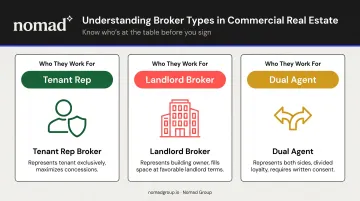
As a tenant, you want a broker who is solely in your corner.
How Broker Compensation Works
In most NYC office leasing transactions, the landlord pays the broker's commission. The NYC Bar's model office lease brokerage agreement confirms this structure directly. When a tenant has their own broker, the landlord typically funds both the listing broker and the tenant's broker through a split arrangement.
That means tenant representation costs you nothing out of pocket — yet you get a dedicated advocate whose entire incentive is to lower your rent, shorten your commitment, and maximize your concessions.
Why Hiring the Right Broker Matters More in NYC
The NYC commercial office market is not one market — it's dozens of them stacked on top of each other.
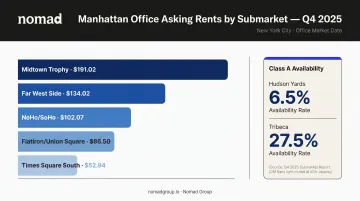
According to Newmark's Q4 2025 Manhattan Office Market Report, Manhattan alone contains three primary office markets and 19 distinct submarkets, with asking rents ranging from $52.94 per square foot in Times Square South to $134.02 per square foot on the Far West Side. Flatiron/Union Square came in at $86.50 per square foot, while NoHo/SoHo reached $102.07 per square foot — a meaningful gap across what feels like the same neighborhood on a map.
Savills' Q4 2025 data adds further context: Midtown trophy asking rents hit $191.02 per square foot, while Class A availability varied from 6.5% in Hudson Yards to 27.5% in Tribeca — a range that completely changes your negotiating position depending on where you're looking.
What You Miss Without Dedicated Representation
The best spaces in NYC — particularly for high-growth companies with specific requirements — often surface through broker relationships before they ever appear on CoStar or LoopNet. A well-connected tenant rep broker with genuine submarket roots brings intelligence you can't Google:
- Which landlords are currently flexible on terms
- Which buildings have space coming available before it's listed
- What concession packages have been won in comparable deals recently
That intelligence matters because without your own broker, you're negotiating against a landlord team that does this every day.
Concessions like tenant improvement (TI) allowances and free rent periods remain available in the current market. Rosenberg Estis reported that Q2 2024 TI allowances stabilized at $132 per square foot for trophy and Class A properties, with 12 and 11 months of free rent respectively. Capturing those requires knowing what's standard, what's negotiable, and how to ask for it.
Key Factors When Hiring a Commercial Real Estate Broker in NYC
Any licensed broker can technically show you office space. These are the factors that separate brokers who will genuinely advocate for you from those who will push the path of least resistance.
Tenant-Only Representation
Ask directly: "Do you or anyone in your firm have any landlord listings in the neighborhoods we're targeting?"
At large NYC firms, it's common for one team member to hold a listing while another represents you as a tenant. That's a dual-agency situation (legally permitted, but the broker cannot give you undivided loyalty). A broker with landlord-side conflicts, even if unintentional, will steer deals in directions that serve multiple masters.
The cleanest arrangement is a broker who works exclusively for tenants, or who can clearly demonstrate they have no competing assignments in your target sub-markets. Before signing anything, ask:
- What are your firm's landlord-side relationships in our target neighborhoods?
- What happens if we want to tour a building where your firm holds the listing?
- How do you handle that internally?
A reputable broker should answer this without defensiveness and with a clear explanation of their firm's policy.
NYC Sub-Market Expertise
The difference between Flatiron and two blocks north in Midtown South isn't just aesthetic : it can mean measurably different rent levels, entirely different building classes, and landlords with very different negotiating cultures. A broker who has closed multiple deals in your target neighborhoods brings:
- Access to off-market listings through landlord relationships
- Neighborhood-specific lease benchmarks (what comparable tenants actually paid)
- Knowledge of which buildings have favorable TI policies vs. which landlords rarely budge
Generalist brokers who cover the whole city don't carry this depth — and in a market where lease terms can swing $20–$40 PSF based on negotiation leverage, that gap is expensive.
Track Record with Companies Like Yours
A broker who has worked with Series A startups understands that flexible lease terms, sublease options, and room to expand aren't nice-to-haves : they're requirements. A broker whose experience is primarily with large enterprises may push you toward longer commitments and bigger spaces that don't fit where you are.
Ask for specific comparable transactions: building name, neighborhood, approximate square footage, and tenant profile. Not total career volume , recent, relevant deals.
Full-Service Capabilities Beyond Brokerage
For high-growth companies, the lease is the beginning, not the end. Buildout, construction management, furniture coordination, and facilities oversight all follow — and managing multiple disconnected vendors while trying to scale your business is a reliable path to timeline slips and cost overruns.
Firms like Nomad Group operate as an end-to-end commercial real estate partner, handling brokerage, construction management, and facilities through a single integrated team. Their in-house construction team has completed 300+ tenant buildouts with a 90-day turnaround capability, which matters when your lease start date is fixed and your previous space is expiring.
When Optimove's coworking agreement expired three months before their new Flatiron space was ready, Nomad relocated them into temporary swing space and coordinated furniture, Wi-Fi, and cleaning until the permanent space was ready. That continuity only happens when your broker and your operations team are the same group.

Transparency and Communication Style
NYC lease transactions move fast and have real deadlines. A broker who communicates proactively, explains trade-offs in plain language, and is reachable when something changes is not a luxury : it directly affects deal outcomes.
Watch how quickly a broker responds during the evaluation process itself. That's your preview of what they'll be like when you're under a letter of intent deadline.
Conflict-of-Interest Awareness
Some of the largest NYC commercial real estate firms carry significant landlord-side revenue alongside tenant rep work. This doesn't automatically disqualify them, but it requires a direct conversation — ask the questions listed under Tenant-Only Representation above. The key is getting clear, specific answers before you commit to working together.
Questions to Ask a Commercial Real Estate Broker Before Hiring Them
These questions surface competence, alignment, and potential conflicts before you sign a representation agreement.
What recent transactions have you completed for tenants like us in NYC?
This confirms both deal experience and specialization. The answer should include specific transactions — building names, neighborhoods, approximate square footage, and tenant profile. A broker who points to three recent closed leases for similar-stage companies in your target neighborhoods is far more valuable than one who leads with career totals.
Which NYC sub-markets do you know best, and do you have access to off-market listings?
This tests neighborhood depth. A broker with genuine sub-market roots will name specific landlord contacts, buildings they've recently toured, and deals they've heard about through their network. Vague answers about "strong relationships across all of Manhattan" are a red flag.
How does your firm handle conflicts of interest?
Reputable brokers answer this clearly and without defensiveness. The response should cover their firm's internal policy, whether a separation exists between landlord and tenant teams, and what happens specifically if you want to tour a building where their firm holds the listing. Deflection here tells you what you need to know.
What does your full process look like from our first meeting to move-in day?
This question reveals whether the broker operates transactionally — search, negotiate, disappear — or as a true partner. A strong answer covers each phase of the engagement:
- Needs assessment and market survey
- Tour coordination and shortlist development
- Proposal, counter-proposal, and lease negotiation
- Buildout coordination and post-move support
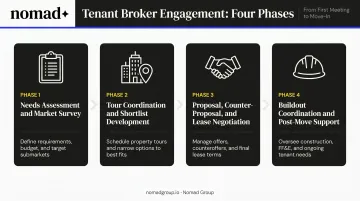
If a broker can't explain what happens after lease execution, that's where you'll be on your own.
How are you compensated, and who pays your fee?
In most NYC commercial leasing transactions, the landlord pays the broker commission — meaning tenant representation costs you nothing directly. Still, ask whether any scenario might require tenant-side payment, and whether the broker receives referral fees from vendors like furniture suppliers or contractors they recommend.
The answer matters for understanding whose interests they're optimizing for throughout the process.
How Nomad Group Can Help
Nomad Group is a full-service commercial real estate firm built specifically for high-growth companies navigating the NYC office market. Their services span brokerage, construction management, asset management, and facilities management through a single integrated team — so clients aren't managing multiple disconnected vendors while trying to scale.
Key differentiators for startups and scaling companies:
- Deep sub-market knowledge across NoMad, Flatiron, Union Square, SoHo, Williamsburg, and Grand Central
- Completed 2M+ square feet leased and 300+ tenant buildouts across NYC's high-growth neighborhoods
- Delivers 90-day buildout turnarounds using an in-house construction team
- Not driven by volume quotas or shareholder pressure — clients get focused, relationship-first service
- Flex by Nomad, an integrated service model that extends support well beyond lease signing with on-the-ground operational help throughout the real estate lifecycle
Those differentiators translate directly into a smoother process for growing teams. Whether you're 30 people coming out of coworking or 100 people outgrowing your current floor, Nomad Group runs a structured process from initial needs assessment through move-in day.
Connect with the Nomad Group team for an initial consultation.
Frequently Asked Questions
How much do agents charge for commercial property?
In most commercial real estate transactions, the landlord pays the broker's commission. When both parties have their own brokers, that commission is split between both brokers. Tenants in the majority of NYC office transactions pay nothing directly for broker representation.
Do I need my own broker, or can I use the landlord's broker?
The landlord's broker can show you the space, but they are legally obligated to represent the landlord's best interests. Your own tenant rep broker is solely focused on securing the best terms, price, and concessions for you — and since the landlord funds both brokers anyway, there's no financial reason not to have your own.
How long does it take to find and lease office space in NYC?
The search-to-lease-execution process typically spans several months depending on space size and market conditions. Buildout adds more time — straightforward Manhattan office renovations commonly run 6 to 12 months from planning through certificate of occupancy, according to Facilitate's 2025 NYC renovation guide, so starting earlier than you think necessary is always the right call.
What's the difference between a commercial real estate broker and a commercial real estate agent?
In New York, a broker holds a higher-level license than a salesperson (the more precise term under NY law), allowing them to operate independently and supervise others. In commercial real estate, "broker" and "agent" are often used interchangeably, but when hiring, the relevant question is whether the individual specializes in commercial properties and tenant representation specifically.
What questions should I ask before signing a broker representation agreement?
Confirm the agreement type (exclusive vs. non-exclusive), its duration, how conflicts of interest will be handled, and what happens if you find a space independently. Have an attorney review the agreement before signing.
Is an exclusive or non-exclusive broker agreement better for tenants?
A non-exclusive agreement means the broker only earns a fee if they are directly responsible for the deal, offering more flexibility. An exclusive agreement commits you to paying the broker no matter how the space is found. Non-exclusive agreements are harder to negotiate but offer more protection — discuss both options with any broker you're seriously considering.