Office building classifications are the commercial real estate industry's shorthand for a building's overall quality, location, amenities, and market positioning. They're not official certifications issued by any government body. They're market conventions — and understanding them will help you filter your search, set realistic expectations, and negotiate smarter.
This guide breaks down what each class actually means in a competitive market like New York City, where the stakes are high and the rent gaps between tiers can exceed $30 per square foot.
Key Takeaways
- A letter of intent (LOI) is a non-binding document that outlines the key terms before a formal lease is drafted
- LOIs typically cover rent, lease term, tenant improvement allowances, free rent periods, and renewal options
- Most LOIs are non-binding, but certain clauses (like exclusivity) can carry legal weight — read carefully
- Negotiating at the LOI stage is faster and cheaper than negotiating inside the full lease
- A well-drafted LOI protects your position and sets the tone for the entire landlord relationship
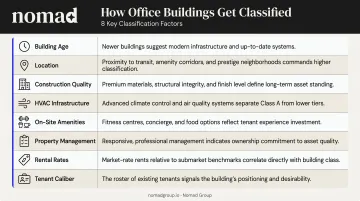
What Determines a Building's Class?
There is no official grading body that certifies office buildings. BOMA International describes the A/B/C system as a "subjective quality rating" and explicitly states it does not recommend publishing individual property ratings because classifications are inherently relative.
In practice, brokers, landlords, and market participants assign classes based on a building's competitive position within its submarket — not against some universal standard.
The Key Criteria
| Factor | What It Signals |
|---|---|
| Building age and renovation history | Modernity of systems and finishes |
| Location and transit access | Proximity to major transit hubs and CBDs |
| Construction quality and finishes | Lobby, common areas, floor plate condition |
| HVAC and mechanical infrastructure | Air quality, reliability, efficiency |
| On-site amenities | Fitness centers, dining, concierge, outdoor space |
| Property management quality | Responsiveness, building maintenance standards |
| Rental rates vs. submarket average | Above, at, or below market pricing |
| Caliber of existing tenants | Reflects building's market positioning |
The Market-Relative Rule
This is the most misunderstood part of the system. A Class A building in a secondary U.S. market might not meet Class A standards in Manhattan. More importantly, classifications can vary across NYC neighborhoods — a Class A building in one submarket may only qualify as Class B where inventory is newer and more competitive.
Always evaluate a building's classification within the context of its specific neighborhood, not the city as a whole. That local context also shapes what terms you can realistically negotiate in a letter of intent — from asking rent to tenant improvement allowances.
Class A Office Buildings
Class A represents the most prestigious, highest-quality buildings in a given market — competing for premier tenants with rents above the area average. These buildings are designed to make an impression from the lobby to the top floor.
Physical and Location Characteristics
- Prime locations on major avenues or in central business districts with excellent subway access
- New construction or significant recent renovation
- Modern building automation systems with upgraded HVAC and electrical controls
- Floor-to-ceiling windows, high-quality finishes, superior curb appeal
- Professional, attended lobbies with 24/7 security
Amenity Profile
- On-site property management and concierge services
- Fitness centers, dining options, and bike storage
- Private outdoor terraces or rooftop access
- In trophy buildings: private clubs, chef-curated restaurants, premium conference facilities
Who Leases Class A
The typical Class A tenant includes law firms, financial services companies, and investment banks. Financial services accounted for 64% of top-tier Manhattan leases in 2024, according to JLL. However, high-growth Series B+ startups and scale-ups increasingly target Class A to signal success and attract top talent — particularly in Midtown South.
NYC Pricing Context
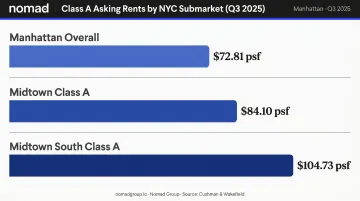
According to Cushman & Wakefield's Q3 2025 Manhattan report, Class A asking rents vary significantly by submarket. Neighborhood context matters as much as class designation — particularly for companies targeting NoMad, Flatiron, or SoHo.
| Submarket | Avg. Class A Asking Rent (Q3 2025) |
|---|---|
| Manhattan Overall | $72.81 psf |
| Midtown Class A | $84.10 psf |
| Midtown South Class A | $104.73 psf |
That pricing reality shapes how tenants approach these spaces — and what they need to justify the cost internally. Nomad Group placed Optimove at a premium Class A address at 1407 Broadway, securing a full-floor sublease with a 3,000+ sq. ft. private rooftop terrace. The driver wasn't just square footage — it was creating a headquarters compelling enough to bring employees back post-remote work.
When writing an LOI for Class A space, that kind of strategic rationale matters. Class A landlords typically have more leverage, so tenants benefit from entering negotiations with clear justification for concessions — whether that's free rent, tenant improvement allowances, or flexible lease terms that reflect the premium being paid.
Class B Office Buildings
Class B buildings compete for a wide range of tenants with rents in the average range for the market. They sit below Class A in finishes and prestige, but deliver comparable functionality and work environment quality.
Key Characteristics
- Typically 10–30 years old, or older buildings with targeted upgrades
- Located in secondary business districts or just outside core CBDs
- Professional appearance with functional HVAC, elevator systems, and security
- Some shared amenities: conference rooms, bike storage, freight elevators
- Many of NYC's most sought-after loft buildings in Flatiron, SoHo, and NoMad — featuring high ceilings, exposed brick, and open floor plates — fall into this category
Who Leases Class B
Class B is a natural fit for:
- Series A and B companies that want quality without overpaying for lobby marble
- Creative agencies and tech-forward companies drawn to loft-style spaces with high ceilings and open floor plates
- Mid-size professional services firms prioritizing location over prestige
- Scaling startups that need flexibility in lease terms as headcount changes
The Value Opportunity
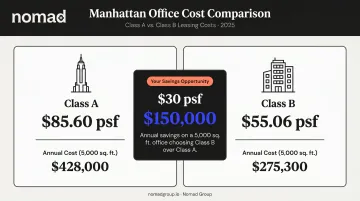
Cresa's Q1 2025 Manhattan data puts Class A asking rent at $85.60 psf versus Class B at $55.06 psf, a gap of roughly $30 psf. For a 5,000 sq. ft. office, that's $150,000 per year in rent savings before concessions.
Because Class B buildings are frequently repositioned into Class A, landlords in this tier often negotiate more aggressively, offering free rent periods, tenant improvement allowances, and flexible lease structures.
Nomad Group has helped clients like Authentic Insurance and Extend secure premium Class B space with strong buildout allowances in Flatiron and NoMad, sometimes at costs running 30% below comparable coworking alternatives.
Class C Office Buildings
Class C is the lowest classification tier. These are typically older buildings (20+ years with minimal capital improvements), located in less central areas, with dated infrastructure, limited on-site services, and rents below market average.
In a competitive market like NYC, true Class C inventory is shrinking fast. According to the NYC Comptroller, Class B and C buildings represent 60% of Manhattan office inventory — and as of Q1 2025, 44 completed, ongoing, or potential office-to-residential conversions totaling 15.2 million gross square feet were in the pipeline.
Older Class C stock is being converted to residential use or actively targeted by investors for repositioning — which means available inventory continues to tighten.
Who Uses Class C Space
- Early-stage startups on minimal runway where every dollar counts
- Service businesses operating primarily off-site (logistics, trades, field services)
- Companies where location and workplace aesthetics are a low priority
For most growth-stage companies, Class C rarely makes sense as a long-term fit. Shorter lease terms provide some flexibility, but displacement risk is high — buildings in this tier are frequently sold, repositioned, or taken offline for major renovation with little notice to tenants.
How to Choose the Right Office Class
Choosing between Class A, B, and C shapes more than your monthly rent. It affects recruiting, client perception, and how much runway you're committing to a single line item. Before you draft an LOI, you need to know which class you're targeting — and why.
Questions to Ask First
- What stage are you at? Early traction, scaling, or established enterprise each carry different space requirements and budget tolerances.
- How important is the office to recruiting? In a competitive talent market, the quality of your workspace affects candidate decisions.
- Do clients visit regularly? If your office is a client touchpoint, it needs to signal credibility and competence.
- What percentage of burn can go to real estate? Be honest about runway constraints before targeting Class A.
The Flight to Quality Trend
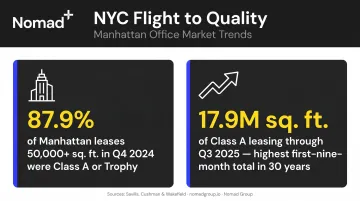
Post-pandemic, companies aren't just leasing more space — they're leasing better space. Savills reported that 87.9% of Manhattan leases of 50,000 sq. ft. or more in Q4 2024 were in Class A or Trophy buildings. Cushman recorded 17.9 million square feet of Class A leasing through Q3 2025 — the highest first-nine-month total in 30 years.
The driver is cultural: companies need an office worth commuting to. That pressure shows up in LOIs — tenants are specifying building class, amenity requirements, and asking rights earlier in negotiations than they were five years ago.
The NYC-Specific Calculus
In NYC's most competitive submarkets, the gap between Class A and Class B rents is significant — but the right neighborhood often matters more than the class tier. A well-located Class B building in Flatiron or NoMad may better serve a growth-stage tech company than a Class A tower in a less strategic location.
Nomad Group walks clients through this calculus before any LOI goes out. Their team has guided hundreds of high-growth companies through office searches across NYC's most active submarkets — helping companies like Extend, FloraFauna AI, and Authentic Insurance match the right building class to their growth stage and culture without overpaying.
Frequently Asked Questions
Is a commercial lease letter of intent legally binding?
Most LOIs are intentionally non-binding — they establish the framework for negotiation without locking either party into final terms. However, specific provisions like confidentiality clauses or exclusivity periods can be written as binding, so always review the document with a real estate attorney before signing.
What happens if a landlord or tenant walks away after signing an LOI?
Because LOIs are generally non-binding, either party can walk away without legal penalty — though doing so after significant negotiation can damage the relationship and your reputation in a tight market like Manhattan. If you need stronger commitment, negotiate a binding deposit or exclusivity clause into the LOI itself.
How long does it typically take to go from LOI to a signed lease?
In NYC, the timeline from executed LOI to signed lease typically runs 30 to 60 days, depending on lease complexity, landlord responsiveness, and how much negotiation carries over from the LOI stage. Resolving major business terms in the LOI upfront shortens that window significantly.
Which terms should a tenant prioritize in the LOI?
Focus on the terms hardest to renegotiate once attorneys get involved: base rent, free rent period, tenant improvement allowance, lease term length, and any expansion or termination options. Getting these locked in the LOI gives your lawyer a clear mandate and limits costly back-and-forth later.
Do I need a broker to submit an LOI in NYC?
You're not required to have one, but a tenant rep broker familiar with the specific submarket — Flatiron, NoMad, SoHo — can help you benchmark rent, identify negotiating leverage, and structure LOI terms that protect your interests before the formal lease process begins.
Can LOI terms change once lease negotiations begin?
Yes, and this is common. The LOI is a starting point, not a final agreement. Landlords sometimes push back on economic concessions during formal lease drafting. To minimize drift, keep the LOI as specific as possible and work with a broker who can hold the landlord accountable to what was agreed.