
This letter governs the entire brokerage relationship: who represents you, for how long, under what conditions, and what happens after it ends. For fast-moving startups and scaling companies searching for office space in NYC, the terms buried in this document directly affect your negotiating flexibility, your exposure to commission obligations, and your ability to change course if the relationship isn't working.
Understanding what you're agreeing to before you sign isn't optional — it's the first smart move in your office search.
Key Takeaways
- A broker engagement letter formalizes the relationship between a tenant and their commercial real estate broker before the search begins.
- It defines exclusivity, commission structure, engagement duration, geographic scope, and tail period rights.
- Signing without reviewing key clauses can limit flexibility and trigger unexpected financial obligations.
- Every letter is negotiable: push for fair terms on duration, tail length, and termination rights.
What Is a Commercial Real Estate Broker Engagement Letter?
A broker engagement letter — sometimes called a tenant representation agreement or broker representation agreement — is a written contract between a company seeking office space and a commercial real estate broker. It establishes the broker's authority to act on the tenant's behalf throughout the search and leasing process.
Brokers typically introduce it at the very start of the relationship: before space tours, before letters of intent, and often before any formal market analysis. Why so early? Because without a signed agreement, a broker's right to compensation is less certain.
The NYC Bar's Model Office Exclusive Brokerage Agreement notes that under New York law, a broker can technically earn a commission simply by producing a tenant "ready, willing and able" to lease — absent a written agreement defining otherwise. A signed engagement letter replaces that vague standard with clear, negotiated conditions.
What the engagement letter is NOT:
- Not a lease or any commitment to sign a particular space
- No financial obligation transfers to a landlord
- Not a guarantee the broker will find you the right fit
- Not something to skim and countersign without reading
It is the framework governing your working relationship with your broker — including exclusivity scope, commission triggers, and how long you're bound to the agreement.
For high-growth companies in NYC — startups moving fast, AI firms on short runways, Series A companies that may double in headcount within a year — this document deserves more attention than it typically gets. The terms you agree to here directly affect your negotiating flexibility, your exit options, and ultimately the lease you sign.
Key Clauses Every Tenant Should Understand
Scope of Services
This clause defines precisely what the broker is agreeing to do. A well-written scope should specify:
- Property search and market analysis
- Tour coordination and space evaluation
- Letter of intent (LOI) drafting and submission
- Lease negotiation support through execution
Vague scope language creates real problems. If the clause reads something like "broker will assist tenant in finding suitable space," there's no clear standard for what "assist" means. Before signing, make sure the scope is specific, comprehensive, and matches what you actually discussed during your introductory meetings.
Engagement Duration
This clause sets the time period during which the broker represents you. According to guidance from commercial tenant representation firms, typical tenant representation agreements run 3 to 12 months depending on search complexity and market conditions.
Both extremes carry risk:
- Too short (under 3 months): Insufficient time to search, negotiate, and execute a lease in a market like Manhattan
- Too long (over 12 months with no exit): Locks you into a relationship that isn't working, with no practical off-ramp
Pay close attention to what happens when the term expires without a signed lease. Does the engagement automatically renew? Does the tail period activate immediately? These mechanics matter.
Tail Period (Protection Period)
The tail — sometimes called the protection period — is the clause most tenants overlook and most regret later.
After your engagement ends, the broker retains commission rights for a defined window if you sign a lease with any property they introduced during the engagement. The NYC Bar model agreement leaves this period blank — meaning it's entirely negotiable.
The practical risk: a broad tail with a loosely defined list of "introduced" properties can expose your company to commission obligations months or even a year after you've moved on.
Push for:
- A specific, written list of properties covered (the Pending List)
- A defined expiration date on the tail, not an open-ended period
- A clear definition of what "introduced" actually means — an email with a listing doesn't necessarily constitute a formal introduction
Geographic and Property Scope
This clause limits or defines the neighborhoods and property types covered by the engagement. For NYC office searches, this is particularly important.
A search scope that reads "all commercial space in New York" is far too broad and creates commission dispute risk down the road. Conversely, limiting the scope to a single neighborhood when you're genuinely open to multiple areas can complicate your search.
Work with your broker upfront to define specific submarkets — NoMad, Flatiron, SoHo, Midtown South — and confirm that the scope covers only commercial office space, not retail or other property types.
Termination Rights
Scope and geography clauses define what you're searching for — termination rights define what happens if the relationship stops working. Look for clear language on how either party can exit early, what notice is required, and whether the rights are mutual or heavily favor the broker.
Many standard broker engagement letters give the broker extensive protections while offering the tenant little practical recourse. A reasonable arrangement includes:
- Mutual termination rights (not one-sided)
- A 15–30 day written notice window
- No penalty for termination if the broker has been non-responsive or failed to perform
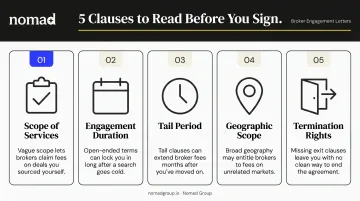
These five clauses — scope, duration, tail, geographic limits, and termination — are where most engagement letter disputes originate. Read each one carefully before signing, and push back on any language that feels open-ended or one-sided.
Exclusive vs. Non-Exclusive Broker Agreements
The Core Distinction
An exclusive agreement gives one broker sole authority to represent you for the defined scope and duration. A non-exclusive agreement allows you to work with multiple brokers simultaneously. In NYC commercial office leasing, most professional tenant rep brokers expect exclusivity.
Why Exclusivity Can Work in Your Favor
Exclusivity, done right, changes how a broker invests in your search. When a broker knows they're your sole representative, they have real incentive to:
- Leverage their landlord relationships to surface off-market options
- Invest time in thorough market analysis and financial modeling
- Push harder in LOI and lease negotiations
A non-exclusive arrangement often produces the opposite dynamic: brokers prioritize clients who are committed, not those who might go with a competitor.
The Risk of Exclusivity Without Vetting
Exclusivity only benefits you if you've chosen the right broker first. Signing an exclusive agreement with a broker who lacks market coverage, relevant landlord relationships, or sufficient bandwidth for your search can leave you locked into a disadvantaged position.
This is why the first conversation with a broker matters. Ask directly about their representation model, how many active clients they're managing, and whether they've worked with companies at your stage and size. A broker who answers those questions openly — without deflection — is demonstrating the transparency you'll need throughout the entire search process.
Dual Agency: Ask Directly
Dual agency occurs when the same broker represents both the landlord and the tenant in the same transaction. Under New York State law, dual agency requires informed written consent, and the NY Department of State warns that a dual agent cannot provide undivided loyalty to either party.
Before signing anything, ask your broker directly:
- Does your firm also represent landlords in this market?
- How are potential conflicts identified and disclosed?
- Will you be my sole point of contact if a conflict arises on a specific property?
How a broker answers these questions — and whether they answer them at all — tells you a great deal about the relationship you're entering.
How Broker Compensation Works
In NYC commercial office leasing, the landlord almost always pays the broker commission — not the tenant. The NYC Small Business Services commercial lease guide confirms that the landlord typically pays the commission as a percentage of annual rent or a set number of months of rent. As a sample reference, NYC SBS cites a commission structure of 5% of first-year base rent and 4% for years two through five on a five-year lease — though actual rates vary by deal.
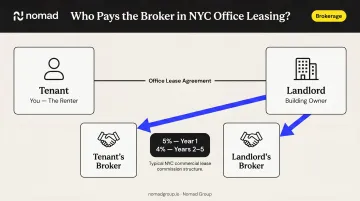
What this means for tenants: Signing an engagement letter does not directly cost you money in most NYC commercial transactions. A few terms are worth confirming before you sign:
- When both a tenant's broker and a landlord's broker are involved, they split the commission
- Engagement letters should specify what happens if the landlord fails to pay — whether any portion of that obligation could shift to the tenant
- Some advisory-only engagements use consulting-fee arrangements instead of commissions — ask your broker to spell out the exact compensation structure before you agree to anything
Red Flags to Watch Before You Sign
Some engagement letters are written to protect the broker, not you. Before you sign, check for these four patterns that consistently create problems for tenants:
- A tail period beyond 6 months tied to a vague "introduced properties" list leaves you on the hook for commissions long after the relationship has ended
- No exit mechanism for the tenant is a serious problem — if the broker underperforms, you need a clear path out, not just the broker's right to walk away
- Overly broad scope language (e.g., "any commercial space in New York") paired with no conflict-of-interest disclosure suggests the broker isn't operating exclusively in your corner
- Commission tied to "introduction" rather than a fully executed lease means you could owe fees on a deal that never closes — insist on payment conditioned on a signed lease
How to Negotiate Your Engagement Letter
The engagement letter is a starting point, not a final offer. Tenants have both the right and the leverage to request changes before signing.
Practical negotiation priorities:
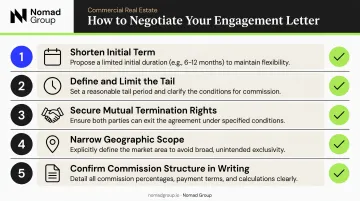
- Shorten the initial term — Request 6 months with a renewal option rather than committing to 12 months upfront
- Define and limit the tail — Ask for a written Pending List with a specific expiration date, not a blank protection period
- Secure mutual termination rights — Push for a 15–30 day notice window that works for both parties
- Narrow the geographic scope — Define specific NYC submarkets rather than accepting broad market-wide language
- Confirm the commission structure in writing — Make sure it's clear who pays, under what conditions, and what happens if the landlord doesn't
A quality broker will welcome these questions. At Nomad Group, that means walking clients through each clause before asking for a signature. If a broker responds to reasonable questions with pressure or evasion, that response is itself useful information.
According to Commercial Observer's H1 2025 data, Manhattan tech firms averaged 5.3-year lease terms and AI firms just 3.5 years — well below the 7.6-year average for financial services firms. For companies expecting to grow, pivot, or raise another round within 18–24 months, a shorter engagement term with clearly defined termination rights isn't just a negotiating win — it's the foundation for a lease that actually fits where the business is headed.
Frequently Asked Questions
Is a 5-year commercial lease good?
For most NYC office tenants, a 5-year lease is a reasonable middle ground — long enough to secure meaningful landlord concessions like free rent and tenant improvement allowances, without overcommitting to a decade. Whether it's the right term depends on your company's growth trajectory, headcount certainty, and financial stability.
What is the 1.25 rule for leasing?
The 1.25 reference describes the gap between rentable and usable square footage — what you pay for typically runs ~25% higher than your actual usable space. NYC loss factors generally range from 20% to 40%, so always ask your broker for the specific figure before evaluating any space.
What is the difference between an exclusive and non-exclusive broker engagement?
An exclusive agreement gives one broker sole authority to represent you for a set period; non-exclusive allows you to work with multiple brokers at once. Exclusive arrangements tend to produce more committed broker effort, but vet carefully before signing — you're locking in for the duration.
How long does a broker engagement letter typically last?
Most engagement letters in NYC commercial real estate run for 6 to 12 months, which is generally enough time to search, negotiate, and execute a lease. Tenants can negotiate shorter initial terms with renewal options if they prefer more flexibility.
Does signing a broker engagement letter cost the tenant money?
In most NYC commercial transactions, tenants don't pay broker commissions directly — the landlord pays, split between both brokers. Confirm this is explicitly written into your engagement letter, including your liability exposure if the landlord defaults on payment.
Can you negotiate the terms of a broker engagement letter?
Yes — the engagement letter is a negotiable document. Tenants should review and request changes to the tail period, duration, termination rights, and geographic scope before signing. If a broker resists reasonable pushback on standard terms, that's a signal worth paying attention to before committing.