
A commercial real estate buyer broker agreement is a legally binding contract between a business and a brokerage that formalizes the representation relationship, defines the broker's duties, and establishes how compensation is structured. Get the terms wrong, and you could find yourself locked into a relationship that doesn't serve your interests — or facing an unexpected commission bill.
Manhattan leasing activity hit 10.3 million square feet in Q1 2026, up 41% from the 2020–2024 first-quarter average, with new and expansion leases driving 80% of deals. First-time tenants are entering a competitive, landlord-favored market. Understanding your representation agreement before you sign is no longer optional.
This article covers what the agreement includes, how it works, how it differs from residential buyer agreements, and what to negotiate before you commit.
Key Takeaways
- A tenant representation agreement formally designates a broker to act on your behalf when searching for or acquiring commercial space.
- It defines scope of services, agreement term, exclusivity, and how commission is calculated (commission is typically paid by the landlord, not you).
- The NAR settlement's mandatory written agreement rules apply only to residential transactions; commercial agreements remain market-driven and negotiable.
- Key terms to negotiate: exclusivity, duration, protected property list, and termination rights.
- Signing without reading carefully can lock your company into a misaligned relationship and create commission liability you didn't anticipate.
What Is a Commercial Real Estate Buyer Broker Agreement?
A commercial buyer broker agreement — most commonly called a tenant representation agreement in a leasing context — is a formal contract that creates an agency relationship between your business and a commercial brokerage. It authorizes the broker to find, evaluate, and negotiate commercial property on your behalf, whether for lease or purchase.
Major firms like CBRE, JLL, Cushman & Wakefield, and the CCIM Institute all use "tenant representation" as the standard term. In practice, buyer broker agreement and tenant rep agreement refer to the same document — the name just shifts depending on whether you're buying or leasing.
How It Differs from a Listing Agreement
This distinction matters more than most tenants realize:
- A listing agreement is signed by the property owner (landlord or seller), meaning the broker represents their interests
- A tenant rep agreement is signed by the occupier, putting the broker squarely on your side
- Without a signed tenant rep agreement, a broker showing you space may technically be acting as the landlord's agent or subagent
Under agency law, an implied agency relationship can arise from actions and words alone, even without a written contract. That means a broker who's been informally helping you tour spaces may owe their fiduciary duty to the landlord, not you. The written agreement is what flips that relationship.
How a Commercial Buyer Broker Agreement Works
The agreement initiates a defined agency relationship, grants the broker authority to act on your behalf, and establishes when and how they earn compensation. Both parties benefit: you get a committed advocate; the broker gets protection for the substantial work they'll invest before a deal closes.
Step 1: Agreement Execution
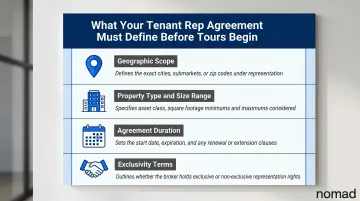
The process starts when both parties negotiate and sign the agreement. Before any formal tours begin, the agreement should define:
- Geographic scope — which neighborhoods or submarkets are covered
- Property type and size range — office only, or broader?
- Agreement duration — typically 3 to 12 months for commercial searches
- Exclusivity terms — whether you're committed to one broker or free to engage others
Unlike residential transactions post-NAR settlement, commercial agreements aren't mandated by regulation. You sign because it's good business practice — and because a signed agreement is what converts a broker from an information source into an actual advocate working on your behalf.
Step 2: Active Representation
Once signed, the broker goes to work. A full-service tenant rep engagement typically includes:
- Market surveys and availability analysis
- Property tours and comparative evaluations
- Financial modeling across shortlisted options
- Letter of Intent (LOI) drafting and submission
- Lease term negotiation on rent, concessions, tenant improvements, and escalations
Some tenant rep firms go well beyond lease execution. Nomad Group, for example, operates as a full-service tenant representative across NYC's Flatiron, NoMad, SoHo, and Bryant Park neighborhoods — handling buildout coordination, construction project management, and temporary swing space when lease timing gaps arise. With 300+ tenant buildouts completed at a 90-day turnaround, that scope of service is real, not theoretical.
Step 3: Commission Trigger and Closing
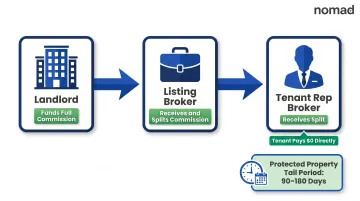
All that work in Step 2 ties directly to how the broker gets paid. Commission is earned when a lease or purchase agreement is executed for a property introduced by the broker during the agreement term. In most commercial leases, the landlord pays the full brokerage commission, which is then split between the listing broker and the tenant rep broker — the tenant generally pays nothing directly.
The protected property list (or tail period) matters here. If you tour a property during the engagement and circle back after the agreement expires, the broker is still owed commission. Understanding this clause before you sign prevents disputes later.
Key Terms and Clauses You Should Know Before Signing
This is where most first-time tenants get tripped up. The standard language in these agreements isn't complicated, but each clause has real financial consequences.
Exclusivity vs. Non-Exclusivity
- Exclusive agreements commit you to working with one broker for the defined search period. Brokers strongly prefer this because it justifies investing significant time and resources on your behalf
- Non-exclusive arrangements allow you to engage multiple brokers simultaneously. Useful if you're evaluating very different property types or markets, but rare in commercial practice
- Most skilled tenant reps in NYC will require exclusivity as a condition of full engagement
Agreement Duration and Scope
Term length typically runs 3 to 12 months for commercial searches. Vague scope language is a common source of disputes. If the agreement doesn't clearly specify which property types and geographies it covers, a broker can claim commission on deals you believe fell outside the engagement.
Define scope precisely: property type, size range, and specific neighborhoods or submarkets.
Protected Property Clause and Tail Period
Most agreements include a protection period (typically 90 to 180 days after the agreement ends, sometimes up to a full year) during which the broker is still owed commission if you transact on a property they introduced during the engagement.
The broker is required to deliver a written list of all properties introduced before the tail period activates. Review this list carefully. Properties on it remain subject to commission regardless of how the agreement ended.
Termination Rights
Well-drafted agreements include mutual termination provisions specifying:
- Required notice period (30 days written notice is common)
- Any compensation owed for work performed before termination
- Confirmation that the tail period activates upon termination
Negotiate this language before signing. Ambiguous termination language is one of the most consistent sources of post-deal disputes — nail it down upfront.
Compensation Definition
Commission in commercial leasing is calculated as a percentage of total lease value over the full term, not just annual rent. On a 5-year lease at Manhattan's current Class A asking rent of $83.25 per square foot, even a modest-sized deal represents a significant commission sum.
The agreement must specify:
- The commission rate or fee structure
- Who pays (landlord, seller, or tenant)
- What happens if the landlord's offered commission falls short of the agreed rate
"To be negotiated at closing" is the phrase that generates the most post-deal litigation. Avoid it.
Commercial vs. Residential Buyer Broker Agreements: Key Differences
The most significant regulatory distinction is this: the NAR settlement's August 2024 requirement (mandating written buyer agreements before showing residential properties) does not apply to commercial transactions. Commercial buyer broker agreements remain contractually voluntary, governed by state real estate license law and market custom — not MLS rules.
In New York, RPL Section 443's written disclosure requirement applies only to residential property (1–4 family dwellings). Commercial transactions are governed by NY DOS Rule 175.7, which requires brokers to disclose who they represent — but that disclosure doesn't have to be in writing, and verbal disclosure alone does not create a tenant agency relationship.
Structural Differences
| Factor | Commercial | Residential |
|---|---|---|
| Commission basis | % of total lease value over full term | % of sale price |
| Typical payer | Landlord | Seller (post-NAR: negotiable) |
| Agreement form | Deal-specific, negotiated | Standardized forms |
| Regulatory mandate | No federal/industry-wide requirement | Written agreement required pre-tour |
| Dual agency | Common; requires written informed consent | Restricted or prohibited in many states |
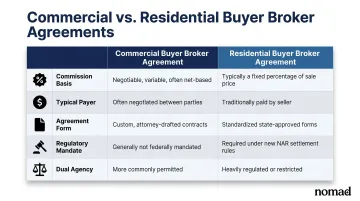
One structural difference in the table above carries outsized risk in practice: dual agency.
The Dual Agency Issue
Dual agency — where one broker represents both landlord and tenant — is more prevalent in commercial transactions and higher-stakes when deals involve complex lease structures and significant rent commitments. In New York, both parties must provide written informed consent.
Before signing any representation agreement, confirm in writing: does your broker represent you exclusively, or do they also represent landlords in this transaction? The answer determines how much negotiating leverage you actually have.
Common Misconceptions About Commercial Buyer Broker Agreements
"My broker is working for me even without a signed agreement."
Not necessarily. Without a formal tenant rep agreement, a broker showing you space may legally represent the landlord as a subagent — meaning their fiduciary duties run to the landlord, not you. The written agreement establishes undivided loyalty, confidentiality, and your full set of fiduciary protections.
"The broker commission comes out of my budget."
In the vast majority of commercial leases, the landlord funds the commission — it's built into the deal economics. The tenant typically pays nothing directly. However, in certain off-market or purchase transactions, the buyer may owe broker fees, which is exactly why having clear compensation terms in the agreement matters regardless of how obvious the payment structure seems.
"I can always exit the agreement if I find space on my own."
Read the exclusivity and protection period clauses carefully before assuming a clean exit. If a property you "found on your own" was toured or introduced during the active engagement, it likely appears on the broker's protected property list. That creates real exposure:
- Commission can be owed even after the agreement expires
- Properties you toured — even briefly — may qualify as protected
- "Self-sourced" deals aren't automatically exempt if prior contact occurred
Frequently Asked Questions
What does a buyer-broker agreement mean?
A buyer-broker agreement is a contract that formally establishes a brokerage as your legal representative in a real estate transaction. It defines the scope of services, the term of the relationship, and compensation structure — and it's the document that creates the broker's fiduciary duty to you.
What are the essential elements of a buyer-agency agreement?
Five elements should always be clearly defined: the parties involved, the scope and duration of representation, exclusivity terms, compensation structure, and termination rights. All five should be in writing before any property searches or tours begin.
Are there buyer's agents in commercial real estate?
Yes — in commercial real estate, the equivalent of a buyer's agent is called a tenant representative or tenant rep broker. They represent the occupier's interests in lease or purchase negotiations and are typically compensated by the landlord through a commission split with the listing broker.
What is the most common buyer representation agreement in commercial real estate?
The exclusive tenant representation agreement is the standard. It grants one broker the sole right to represent the client during the search period, ensuring they're compensated for the work a commercial deal demands: market surveys, financial analysis, LOI drafting, and extended lease negotiations.
Can a buyer get out of a buyer-broker agreement?
Yes, though the process depends on the specific agreement terms. Most include mutual termination provisions with a required notice period. Note that the tail/protection period typically activates upon termination, so properties introduced before the end date may still trigger commission obligations.
Who typically pays the broker commission in a commercial real estate deal?
In most commercial lease and sale transactions, the landlord or seller pays the full broker commission, split between the listing broker and the tenant rep broker. The tenant typically incurs no direct cost, but always confirm this in the written agreement rather than assuming it.
Conclusion
A commercial real estate buyer broker agreement determines whose side your broker is actually on, what they're obligated to do, and who owes what when the deal closes. It's a binding document with real consequences — treat it that way before you sign.
Understanding the key terms (exclusivity, scope, tail period, and termination rights) before signing protects your company from ambiguity and unexpected liability. Read what you're committing to, and push back on anything that doesn't reflect how you expect the relationship to work.
Companies navigating NYC's office market can work with a tenant rep firm like Nomad Group, which has completed 300+ tenant buildouts and leased over 2 million square feet across Manhattan. Their engagements are structured with full transparency, covering everything from initial search through final buildout.