First-time tenants consistently underestimate how long the process takes, how much the all-in cost exceeds base rent, and how much leverage they give up by skipping professional representation.
This guide covers every step — from defining your requirements to signing a lease — so you can move efficiently and avoid the mistakes that cost companies time and money.
Key Takeaways
- Define headcount, budget, and target move-in date before anything else — these three inputs drive every other decision
- Neighborhood choice affects rent, talent access, and brand perception more than most companies anticipate
- Tenant rep brokers cost you nothing — landlords pay them — and give you market data, off-market listings, and negotiating leverage
- Your lease type (direct, sublease, or flex) determines flexibility and total cost — match it to your growth stage
- Tour at least 5–8 spaces and request competing proposals before choosing
How to Find Office Space for Rent in NYC: Step by Step
Step 1: Define Your Requirements
Start with headcount — current and projected 12 to 24 months out. Space planning norms have compressed significantly from legacy benchmarks. CoreNet Global projects a shift toward 100 square feet per person or less for many companies, and CBRE's 2024 Office Occupancy Benchmark Report found corporations average just 69 workplaces per 100 employees — a figure projected to fall further as hybrid policies mature. If your team is hybrid, you likely need less space than you think.
Once you have a square footage target, build a realistic budget. Base rent is the starting point, not the full picture. Factor in:
- Security deposit (typically several months of rent for NYC commercial leases)
- Build-out costs if taking raw or white-box space
- Operating expenses — taxes, utilities, and building services passed through on top of base rent
- Furniture and IT infrastructure if the space isn't pre-built
- Moving costs and any interim space during transition
Getting these numbers right before you start touring prevents expensive course corrections mid-search.
Step 2: Choose Your NYC Neighborhood
The three primary submarkets for high-growth and tech companies each have a distinct character:
| Submarket | Typical Tenants | Avg. Asking Rent (Q1 2026) |
|---|---|---|
| Midtown South (Flatiron, NoMad, Union Square) | Tech, media, startups | $64.86 psf overall; $104.38 psf Class A |
| Downtown (SoHo, Tribeca, WTC area) | Finance, professional services, emerging tech | Vacancy at 22.3% — more availability |
| Brooklyn (Williamsburg, DUMBO) | Creative, early-stage, lifestyle brands | $49.28 psf overall |
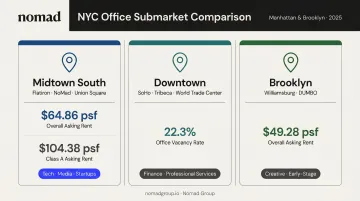
CBRE reported Midtown South Q1 2026 leasing at 1.90 million square feet — 36% above the five-year quarterly average, with TAMI companies (tech, advertising, media, information) accounting for nearly half of all activity over 10,000 square feet. Competition for quality space here is real and moving fast.
Beyond rent, consider transit access. Union Square and Flatiron sit above some of the most connected subway hubs in the city — a genuine advantage for recruiting across boroughs. Williamsburg draws teams that live locally and prefer a neighborhood with a residential feel.
That concentration of talent and infrastructure is why the Flatiron–Union Square–NoMad corridor has earned the nickname "Unicorn Lane" — it's where a disproportionate number of high-growth companies have planted their flags over the past decade.
Step 3: Decide on Office Space Type
Three categories cover most of what's available in NYC:
- Direct lease — Negotiated directly with the building owner for a set term, typically 3–10 years. Most control, most customization, best economics at scale. Requires strong financials and a clear growth runway.
- Sublease — An existing tenant sub-lets their remaining term, often with furniture and built-out infrastructure included. Faster move-in, potentially lower rent, but less flexibility to customize. Manhattan sublease supply has tightened significantly — down to 12.7 million square feet in Q1 2026 from 17.9 million a year earlier — so the window on quality subleases closes quickly.
- Flex/coworking — Month-to-month or short-term private suites through operators like WeWork or Nomad Group's own Flex by Nomad. Right for early-stage companies or those testing a new market before committing. Cost per desk runs higher than direct leasing at any meaningful headcount.
Match the structure to your stage. A Series A company with 20 people and an uncertain 18-month trajectory has different needs than a 60-person company post-Series B with a stable growth plan.
Step 4: Engage a Tenant Rep Broker
This is the step most first-time tenants skip — and later regret.
A tenant representation broker works exclusively for you, not the landlord. Their compensation comes from the landlord as part of the deal economics, meaning you get professional negotiation, market intelligence, and access to off-market inventory at no added cost.
What a good tenant rep actually does:
- Surfaces spaces before they hit public listings
- Runs financial analysis on competing options, not just headline rents
- Structures competing proposals across 2–3 landlords to create negotiating pressure
- Negotiates lease terms: free rent periods, tenant improvement allowances, subletting rights, and personal guarantee scope
- Coordinates build-out if needed after lease execution
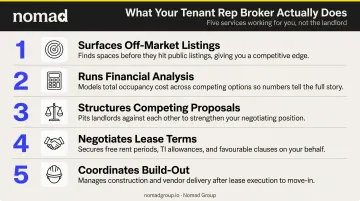
Nomad Group has leased over 2 million square feet across NYC's core neighborhoods and completed 300+ tenant buildouts. The Optimove deal is a useful example: the team secured a full-floor sublease from Lazard Asset Management (including a 3,000+ square foot private rooftop terrace), then engineered a temporary swing space solution when timing got complicated.
No listing platform surfaces those options. That comes from relationships built over years in a specific market.
Going directly to a landlord's listing agent puts you at a structural disadvantage: that agent legally represents the landlord.
Step 5: Tour, Compare, and Evaluate
Tour a minimum of 5–8 spaces. The shortlist looks different once you're standing in the room.
When evaluating each space, look beyond the floor plan:
- Natural light and layout — Does the flow support your actual work model?
- Building infrastructure — HVAC reliability, freight elevator access, internet connectivity
- Building management quality — Ask for references from current tenants if you can
- Growth headroom — Can the space absorb 30–40% headcount growth without requiring a move?
After tours, issue RFPs (requests for proposals) on your top 2–3 choices simultaneously. In NYC, landlords respond to competition. Multiple active offers routinely produce improved terms — more free rent, higher TI allowances, or reduced personal guarantee requirements — that a single-track negotiation would never surface.
Key Factors That Affect Your NYC Office Rental Search
Budget and Lease Structure
NYC rents are quoted annually per square foot. Current benchmarks as of Q1 2026:
- Manhattan overall average: $73.13 psf
- Midtown Class A: $86.57 psf
- Midtown South Class A: $104.38 psf
- Midtown South overall: $64.86 psf
- Brooklyn overall: $49.28 psf
These are base rent figures. Operating expenses, electricity, and annual tax escalations layer on top — the all-in occupancy cost is consistently higher than the headline number. Get a full operating expense history for any space you're seriously considering before you finalize your budget.
Market Conditions and Timing
Manhattan vacancy sat at 19.9% in Q1 2026 — its lowest level since Q3 2021 — with positive absorption of 1.7 million square feet. Tenants still have options overall, but quality spaces in Midtown South are moving faster than the broader averages suggest.
For companies with flexibility on timing, current conditions still favor tenants relative to a landlord's market. That window narrows as vacancy drops.
Lease Term Length
How you structure your term is just as important as where you land on rent. Shorter terms give you flexibility but typically cost more per square foot. Longer terms unlock meaningful concessions — free rent months, higher TI allowances, sometimes favorable escalation caps.
Match your lease length to your funding runway and realistic headcount projections. A three-year lease that expires when you're mid-Series C creates a forced negotiation.
Build-Out Timeline and Lead Time
Spaces delivered in raw or white-box condition require a build-out before you can move in — factor this into your search start date. Nomad Group's in-house construction team targets a 90-day buildout turnaround and completed a full build for Extend AI in just five weeks, though larger or more complex projects take longer.
Starting your search 9–12 months before your target occupancy is standard for spaces requiring significant work.
Common Mistakes to Avoid When Renting Office Space in NYC
Starting the Search Too Late
The search-to-occupancy timeline in NYC is longer than most companies expect. Add together market search time, proposal and negotiation cycles, lease execution, and build-out, and you're looking at six months minimum for straightforward deals — often nine to twelve for spaces requiring significant construction.
Companies that start three months out end up forced into unfavorable terms or expensive temporary space.
Start earlier than feels necessary. If your lease expires in twelve months, begin your search now.
Skipping Professional Representation
The landlord's listing agent represents the landlord. There's no version of that relationship where the tenant gets unbiased guidance. A dedicated tenant rep costs you nothing, brings competing options to the table, and negotiates on your behalf from a position of market knowledge. That leverage matters whether you're leasing 2,000 square feet or 20,000.
Underestimating Total Occupancy Cost
Representation helps — but it can't protect you if you're working from the wrong number. First-time tenants anchor to base rent and get surprised by everything else. The full cost checklist includes:
- Base rent (annual psf × square footage)
- Operating expense pass-throughs (taxes, insurance, maintenance)
- Electricity (often separate from base rent in NYC)
- Annual rent escalations built into the lease
- Security deposit
- Build-out capital or tenant improvement gap funding
- Furniture and AV/IT infrastructure
- Moving costs
- After-hours HVAC charges (billed separately in most buildings)
- Freight elevator fees for move-in and deliveries
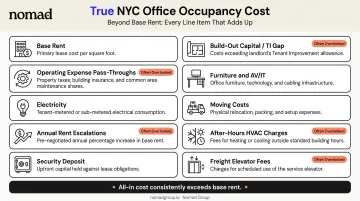
Run the full number before comparing spaces. A space with lower base rent and high operating pass-throughs can easily cost more than a higher-rent option with favorable operating structures.
Frequently Asked Questions
What should I look for when renting an office space?
Total occupancy cost — not base rent — is the real comparison metric. Beyond the number, evaluate escalation clauses, personal guarantee requirements, and subletting rights. Vet the landlord's responsiveness through current tenant references, and confirm the layout actually fits your work model.
How much is office rental per month in NYC?
Using Q1 2026 asking rents, a 3,000 sq ft space runs $16,215/month in Midtown South, $21,642/month for Midtown Class A, and $12,320/month in Brooklyn. These are base-rent figures only — operating expenses and other costs add to the total.
How long does it take to find and lease office space in NYC?
The full process — search launch through occupancy — typically takes 6–12 months for spaces requiring build-out. Plan to begin searching 9–12 months before your target move-in date, particularly if you're in the 5,000–15,000 square foot range and need a custom build.
What is the difference between a direct lease and a sublease in NYC?
A direct lease is signed with the building owner for a negotiated term, typically 3–10 years. A sublease is taken from an existing tenant for the remainder of their lease: often furnished, faster to occupy, and available at a discount, but with limited customization options and less long-term security.
Do I need a broker to find office space in NYC?
Use one. Tenant rep brokers are paid by the landlord, cost you nothing, and provide access to unlisted inventory, real market data, and professional lease negotiation. Going without one is one of the most common — and costly — mistakes first-time tenants make.
What NYC neighborhoods are best for startups and tech companies?
Midtown South (Flatiron, NoMad, Union Square) is the traditional hub for tech and high-growth companies, valued for talent density and transit access. SoHo suits companies with a creative or consumer brand identity; Williamsburg draws teams that want a more residential, community-rooted feel.