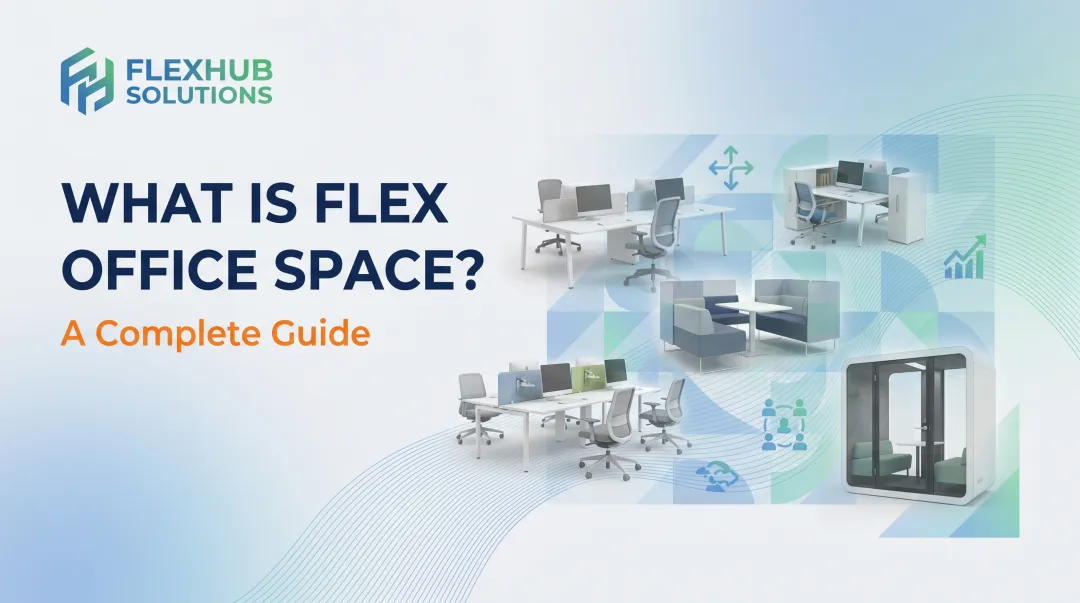
Flex office space has emerged as the practical answer — and not just for early-stage startups hot-desking at WeWork. A 2025 CBRE survey found 42% of companies use flex space to manage uncertain demand and 60% cite reduced capital expenditure as a primary driver. Those numbers reflect something real: headcount projections are harder than ever, and committing to five floors for five years no longer makes obvious sense.
This guide covers what flex office space actually means in NYC, the formats available, which neighborhoods make sense for which companies, what it costs, and how to find the right space without wasting months doing it.
Key Takeaways
- Flex office = private, dedicated space with shorter lease terms — not just hot desks in a coworking room
- Options include managed/serviced suites, short-term subleases, and hybrid models like Flex by Nomad
- Expect wide pricing swings by neighborhood: SoHo averages ~$104/SF, Grand Central ~$68/SF
- Total occupancy cost matters more than headline rent — hidden fees can add 30–40% to base costs
- Working with a tenant rep broker gives you off-market access and costs you nothing (fee paid by landlord)
What Is Flex Office Space?
Flex office space sits between a traditional direct lease and a hot desk in a coworking room. The formal industry definition — used by Cushman & Wakefield and CBRE — describes it as turnkey, technology-integrated, operationally managed workspace that reduces upfront capital commitment and adapts to changing headcount needs.
Two characteristics define it:
- Shorter terms with built-in exit options — no decade-long commitment, fewer buildout obligations, more predictable off-ramps
- Move-in-ready configuration — space is set up before you arrive, so teams aren't waiting months for construction to finish
- Private, controllable environment — unlike coworking, your team occupies dedicated space with real separation from other companies
Flex Office vs. Coworking
These terms get conflated constantly, but they're not the same product. Coworking is shared open workspace — hot desks, communal tables, and conference rooms booked by the hour. Flex office refers to private, dedicated suites or floors that a company controls, with branding potential and team separation, but without the 7-year lease commitment of a traditional direct deal.
The distinction matters because the experience, cost structure, and management dynamic are completely different once you cross about 10–15 people.
Why Demand Has Grown Post-Pandemic
That distinction took on real financial weight after 2020. CBRE's hybrid workplace research found that 80% of occupiers adopted and expected to sustain hybrid policies — and that hybrid planning can produce 10–50% space savings depending on attendance patterns.
Companies that don't know their actual in-office utilization can't confidently commit to 10,000 square feet for a decade. Flex lets them secure a real, private office on terms that can adjust as headcount data comes in — shorter commitments, cleaner exit options, and no buildout costs sunk before they've proven the space works.
Types of Flex Office Space Available in NYC
NYC has a wider range of flex formats than most markets. Here's how they break down:
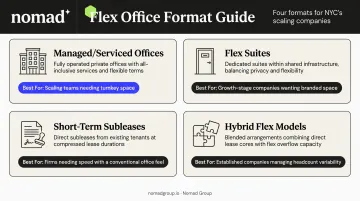
| Format | What It Is | Best For |
|---|---|---|
| Managed/Serviced Offices | Fully furnished, all-inclusive suites operated by a provider | Early-growth teams that want zero setup friction |
| Flex Suites (Coworking Operators) | Private suites within WeWork, Industrious, etc. | Teams of 5–30 who want amenities and short terms |
| Short-Term Subleases | Taking over another tenant's remaining lease, often furnished | Companies comfortable with fixed terms but want a discount |
| Hybrid Flex Models | Private, built-out space with flexible lease terms and in-house management | Growth-stage companies needing privacy + flexibility |
The Sublease Market as a Flex Option
Manhattan's sublease market is substantial — Savills reported 20.1M SF of available sublease space in Q4 2024, representing 20.9% of all available space. Sublet asking rents averaged $57.81/SF in Q1 2026, roughly a 27% discount to direct asking rents of $78.01/SF in the same period.
The catch: you're stepping into someone else's lease. That means:
- Fixed remaining terms with no built-in flexibility to extend
- Landlord consent required before you can sign
- Potential restrictions on modifications or branding
- Pricing advantage only holds if the remaining term matches your actual runway
The discount is real — but so is the rigidity. Subleases work best when your growth timeline is predictable.
Matching Format to Company Stage
- Early-stage (under 15 people): Coworking or shared managed suites — speed and flexibility over everything
- Growth-stage (15–75 people): Managed flex suites or hybrid flex models are the sweet spot. Privacy starts to matter, but a 7-year lease commitment doesn't make sense yet.
- Scaling/enterprise (75+ people): Short-term direct leases or custom flex programs with more control and brand visibility
Best NYC Neighborhoods for Flex Office Space
Neighborhood selection affects your cost per square foot, your commute story, your brand perception, and your ability to recruit. These four markets cover most of what high-growth NYC companies are actually looking for.
Here's a quick comparison before the details:
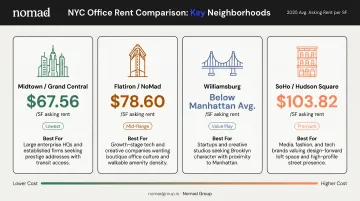
| Neighborhood | Avg. Asking Rent | Best For |
|---|---|---|
| Flatiron / NoMad | $78.60/SF | Tech, venture-backed, Series A–C |
| SoHo / Hudson Square | $103.82/SF | Creative, media, brand-forward |
| Midtown / Grand Central | $67.56/SF | Enterprise, financial services |
| Williamsburg | Below Manhattan avg. | Brooklyn talent, cost-conscious |
Flatiron and NoMad
Flatiron and NoMad have become the default landing spot for tech and venture-backed companies, sometimes called "Unicorn Lane" for the concentration of high-growth tenants. Flatiron/NoMad Class A and B leasing activity rose 27% year-over-year to more than 650,000 SF in Q3 2024, with IBM anchoring One Madison at 270,000 SF alongside tenants like Palo Alto Networks and Coinbase.
Overall asking rents average around $78.60/SF. Building stock ranges from boutique loft conversions to modern Class A, and subway access is excellent. Nomad Group's portfolio is heavily concentrated here; it's the corridor the firm knows best.
SoHo and Hudson Square
SoHo commands a premium for a reason. Creative, media, and brand-forward companies gravitate here for the aesthetic and the cultural signal it sends to talent and clients. Overall asking rents in NoHo/SoHo average $103.82/SF, with Hudson Square/Meatpacking at $87.40/SF. The tenant mix is increasingly tech-forward alongside the traditional media and design firms.
For companies where office location is part of the pitch to candidates, SoHo pays for itself differently than the rent line suggests.
Midtown / Grand Central
Grand Central is the pragmatic choice for companies with enterprise clients, financial services relationships, or teams commuting from Connecticut and New Jersey. Transit access is unmatched, building quality is high, and overall asking rents average around $67.56/SF — one of the more accessible price points in Manhattan.
Major flex operators including WeWork and Convene have strong footprints here, so the supply of managed suite options is broad.
Williamsburg
Williamsburg offers a distinct proposition: lower costs than Manhattan, strong appeal to Brooklyn-based talent, and a building stock that mixes converted industrial with newer Class A product. Nomad Group placed FloraFauna AI at 300 Kent Avenue (The Refinery at Domino): a 30–50 person team that secured roughly 5,000 SF with waterfront views and expansion optionality, then doubled its footprint within 30 days.
Brooklyn's Q4 2024 leasing totaled 0.14M SF with 21.4% availability. There's inventory here, and landlords are negotiating.
How Much Does Flex Office Space Cost in NYC?
NYC flex pricing is harder to benchmark than traditional leases because providers bundle services differently. A $2,000/person/month quote from one operator may include everything; a $900/person/month option elsewhere might exclude internet, meeting rooms, and cleaning.
Managed Suite Price Examples
Current publicly listed pricing from major operators:
- WeWork: Private office for 2 from $1,160/month; larger suites by inquiry
- Industrious: On-demand private offices from $75/day; managed suite pricing requires a quote
- Instant Offices examples: Range from ~$300/person/month (The HUB) to $2,250/person/month on Broadway; Brooklyn options from ~$745/person/month
These figures illustrate the range — not a reliable average. A 20-person team in Flatiron will face very different economics than a 5-person team in a shared Midtown building.
What's Typically Included vs. Excluded
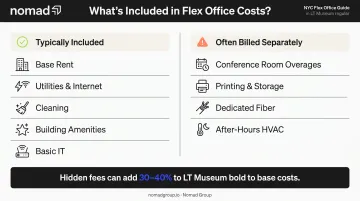
Typically included:
- Base rent
- Utilities and internet
- Cleaning services
- Building amenities (lobby, common areas)
- Basic IT infrastructure
Often billed separately:
- Conference room bookings beyond a monthly allowance
- Printing and storage
- Dedicated fiber upgrades
- After-hours HVAC
Hidden Costs to Watch
Meeting room fees, printing, and storage routinely add 30–40% on top of base costs — a gap most companies don't account for until invoices arrive.
Other costs frequently overlooked:
- Security deposits (typically 1–3 months)
- Month-to-month premiums vs. 12-month terms
- Broker fees in non-represented deals
- Build-out costs if the space isn't genuinely move-in ready
Before signing, model out total occupancy cost — headline rent rarely tells the full story.
What to Look for When Renting Flex Office Space in NYC
Lease and Contract Terms
Flex agreements vary more than people expect. Key terms to nail down before signing:
- Notice period for exit: Typically 30–90 days. Industrious publishes 60-day written notice requirements for 6- and 12-month terms. Month-to-month arrangements may have shorter windows but cost more.
- Initial term commitment: Industrious offers month-to-month, 6-month, and 12-month structures. WeWork's standard agreement historically required a 12-month initial commitment.
- Rent escalation: Some managed suites include annual increases; others are fixed. Confirm in writing.
- Expansion rights: If you expect to grow, ask specifically whether you have right of first refusal on adjacent space.
Many managed office agreements — including Regus — explicitly create no tenancy interest or leasehold estate. That affects your legal standing if a dispute arises.
Physical Space Checklist
NYC-specific factors to check before signing:
- Natural light: Especially relevant in older loft buildings — interior suites with no windows are common
- HVAC control per suite: Many buildings share HVAC across floors; confirm you can control temperature in your space
- After-hours and freight elevator access: NYC buildings have strict rules here. If your team works late or you need to move equipment, verify access windows before signing
- Building security: 24/7 key card access is standard in Class A buildings but not universal in older stock
Connectivity and Infrastructure
For tech companies and financial firms, verify:
- Fiber availability in the building (not just the neighborhood)
- Whether internet is shared across tenants or dedicated to your suite
- Backup power availability — relevant for any company running always-on infrastructure
Operator and Landlord Quality
Building management quality separates a smooth flex experience from a frustrating one — and in NYC's dense market, the gap is wide. Ask for tenant references. Find out who handles day-to-day maintenance requests and what the average response time looks like. The difference between an attentive ownership group and an absentee landlord becomes apparent quickly once you're in the space.
How to Find and Rent Flex Office Space in NYC
The Search Process
Start with two decisions: headcount range (accounting for growth over your target term) and target neighborhood. From there, the search spans at least three product types that don't always appear on the same platforms:
- Operator-managed suites (WeWork, Industrious, Convene, etc.)
- Direct landlord flex programs
- Short-term subleases, many of which are not publicly listed
Many of the best flex deals in NYC — especially quality furnished subleases and hybrid flex arrangements — don't appear on public listing platforms. This is where a broker relationship makes a real difference.
Working with a Tenant Rep Broker
A commercial real estate broker specializing in NYC tenant representation brings three things a platform search can't:
- Surfaces off-market deals through direct relationships with landlords and tenants before listings go public
- Normalizes total occupancy cost across managed suites, subleases, and direct flex deals so comparisons are actually apples-to-apples
- Costs the tenant nothing — in standard NYC tenant rep arrangements, broker fees are paid by the landlord
Nomad Group works with high-growth NYC companies across this full range — Flex by Nomad options, subleases, and direct landlord programs spanning Flatiron, NoMad, SoHo, and Williamsburg.
Typical Timeline
| Stage | Duration |
|---|---|
| Market tour and shortlist | 1–2 weeks |
| Proposal and negotiation | 2–4 weeks |
| Legal review and signing | 1–2 weeks |
| Move-in (flex/managed) | Days to 2 weeks after signing |
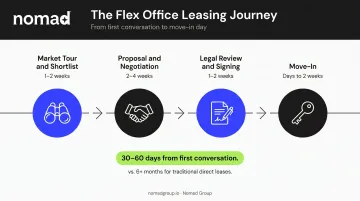
Flex spaces can be occupied in 30–60 days from first conversation. Traditional direct leases — which require buildout, permitting, and construction — routinely take 6+ months. For a company with a hard move-in deadline, that difference in timeline often drives the entire decision.
Frequently Asked Questions
What is the difference between flex office space and coworking space?
Coworking is shared open workspace — hot desks, communal tables, and hourly conference rooms. Flex office refers to private, dedicated suites or floors your company controls exclusively, with the short-term lease flexibility of coworking but the privacy and brand identity of a traditional office.
How much does flex office space cost per person in NYC?
Publicly listed pricing ranges from roughly $300 to $2,250+ per person per month depending on neighborhood, operator, and included services. Midtown and Brooklyn options tend toward the lower end; SoHo and premium Flatiron buildings toward the higher end. Always compare total occupancy cost, not just the headline rate.
What lease terms are typical for flex office space in NYC?
Flex leases commonly range from month-to-month to 24 months, with 30–90 day exit notice periods. This contrasts sharply with traditional direct leases, which typically run 5–10 years with 6–12 month early termination obligations.
Which NYC neighborhoods have the most flex office options?
Flatiron, NoMad, Midtown/Grand Central, and SoHo have the densest concentration of flex inventory. Williamsburg is growing as a legitimate Brooklyn alternative, particularly for companies targeting tech and creative talent.
Is flex office space a good option for a Series A or growth-stage startup?
Flex space is the right bridge for companies between 10–75 people that need a professional private office quickly without locking into a multi-year lease before headcount stabilizes. The ability to expand or exit on 30–90 days' notice is particularly valuable when hiring plans are still fluid.
Can I customize or brand flex office space in NYC?
Hybrid flex and managed suite arrangements allow partial branding — signage, furniture configuration, and paint — while fully serviced offices within larger shared buildings typically restrict structural modifications. Confirm customization rights before signing if client-facing brand presentation matters to your team.