Introduction
SoHo is unlike any other office market in Manhattan. Where Midtown offers glass towers and standardized floor plates, SoHo delivers cast-iron loft buildings, soaring ceilings, and a neighborhood energy that shapes how companies present themselves to clients and recruits.
That distinctiveness comes with real trade-offs. SoHo's office inventory totals just 6.6 million square feet — a fraction of Midtown South's 94 million — which means the market moves fast, quality spaces are limited, and starting a search without understanding the submarket is an expensive mistake.
Before signing anything, here's what the SoHo market actually requires you to understand: building types, current pricing, transit access, how the neighborhood compares to Flatiron and Tribeca, and how to navigate the leasing process end to end.
Key Takeaways
- SoHo asking rents average $89.52/sq ft (Q2 2025) — higher than Flatiron, Tribeca, and Midtown South
- Inventory is limited at 6.6M sq ft; most tenants occupy 2,000–15,000 sq ft in cast-iron loft buildings
- Multiple subway lines serve the neighborhood (A/C/E, B/D/F/M, N/Q/R/W, 1, J/Z, and 6), all within walking distance
- SoHo is the address of choice for brand-conscious companies: fashion, consumer tech, media, and creative agencies
- Local broker expertise is essential; quality spaces often trade before hitting public listings
Why Companies Choose SoHo: The Business Case for Leasing Here
SoHo is one of the few Manhattan neighborhoods where your office address does real marketing work — before a client walks through the door.
Who Leases Here
The tenant mix reflects SoHo's character: fashion brands, creative agencies, luxury goods companies, consumer-facing tech startups, and media businesses are well-represented. Office-based sectors — professional and technical services, information, and finance — account for 48% of the roughly 53,000 private-sector jobs in the SoHo/NoHo area, according to NYC Department of City Planning.
A recent example: The Farmer's Dog, the direct-to-consumer pet food company, signed a 58,000 sq ft, five-year lease at 568 Broadway in August 2025 — a clear signal that consumer-facing brands see SoHo as the right address for their teams.
The Talent and Client Angle
Two factors drive most SoHo leasing decisions beyond practical logistics alone:
- Creative and technical professionals actively seek out SoHo. Walkability, dining, and cultural density give it a recruiting edge that a Midtown tower can't match
- Hosting clients here carries built-in credibility for companies in consumer goods, luxury, design, or media — the neighborhood reinforces the brand before anyone says a word
Location Within Manhattan
Geography reinforces the business case. SoHo sits at the center of Manhattan's creative corridor — bordered by Tribeca to the south, Greenwich Village to the west, NoHo to the north, and the Lower East Side to the east. That position gives tenants easy access to partners and clients across lower and mid-Manhattan, without the commute overhead of Midtown.
What to Expect: SoHo Office Space Types and Building Stock
SoHo's office product is distinct from most of Manhattan. If you're used to evaluating Midtown Class A towers, the criteria shift considerably here.
The Cast-Iron Loft Building
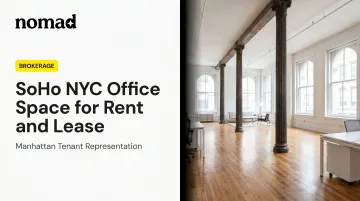
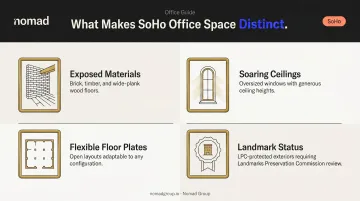
The Landmarks Preservation Commission designated the SoHo-Cast Iron Historic District in 1973, protecting approximately 500 buildings across 25 city blocks. A 2010 extension added roughly 135 more properties. These post-Civil War store-and-loft buildings were originally used by wholesale merchants and manufacturers: large floor plates, high ceilings, and heavy structural bones were practical requirements, not design choices.
For office tenants, this translates to:
- Exposed brick and timber, wide-plank wood floors, oversized windows
- High ceilings that create genuine volume (artists moved into these spaces in the 1960s specifically for the light and scale)
- Floor plates that can accommodate open-plan layouts, creative studios, or hybrid configurations
- Landmark status on many buildings, meaning exterior changes require LPC review
Space Types and Sizes
SoHo skews toward small and mid-size tenants. Most users occupy between 2,000 and 15,000 sq ft. Common space types include:
- Full-floor loft suites — Most desirable, often requiring direct landlord relationships to access
- Partial-floor suites — More common for tenants under 5,000 sq ft
- Ground-floor retail-to-office conversions — Available, but scrutinize ceiling height and natural light
- Boutique multi-tenant buildings — Character spaces with limited shared amenities
Large contiguous blocks (20,000+ sq ft) do exist — One SoHo Square at 233 Spring Street offers full-floor availabilities around 27,000 sq ft — but they're exceptions, not the norm.
Flex and Coworking Options
Flexible office options are more limited in SoHo than in Midtown or Flatiron. For companies not ready to commit to a direct lease, Flex by Nomad provides a full-service alternative built on in-house infrastructure — purpose-built for companies that need operational support alongside their space, not just a desk and a Wi-Fi password.
Building Infrastructure Considerations
Many SoHo buildings are mixed-use: retail at grade, office above. Before committing to a space, evaluate:
- HVAC capacity and existing ductwork (raw loft spaces often require full systems)
- Elevator condition and modernization status
- Electrical capacity for modern office loads
- Landlord's TI appetite versus self-funded buildout requirements
SoHo Office Lease Pricing and Market Conditions
SoHo commands a premium — and the data bears that out clearly.
Current Market Snapshot (Q2 2025)
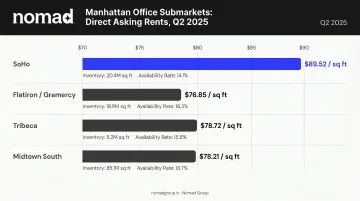
According to Avison Young's Q2 2025 Manhattan office report, SoHo's direct asking rent sits at $89.52/sq ft full service — above every comparable downtown submarket:
| Submarket | Inventory | Total Availability | Direct Asking Rent |
|---|---|---|---|
| SoHo | 6.6M sq ft | 15.2% | $89.52/sq ft FS |
| Flatiron/Gramercy | 40.5M sq ft | 16.0% | $76.85/sq ft FS |
| Tribeca | 7.7M sq ft | 17.5% | $78.72/sq ft FS |
| Midtown South | 94M sq ft | 17.8% | $78.21/sq ft FS |
What Drives Price Variation in SoHo
Not all SoHo loft space is priced equally. Key factors that push rents up or down:
- Floor height — Higher floors command notable premiums; ground floor is typically the lowest
- Ceiling height and natural light — Corner units and north-facing exposures trade at the top of the range
- Street address — Spring, Prince, Broome, and West Broadway are the most sought-after corridors
- Pre-built vs. raw — Pre-built suites carry higher base rents; raw loft space requires tenant investment
Lease Structure and TI Allowances
SoHo leases typically follow a base rent plus additional rent structure. On top of the base figure, tenants pay their proportionate share of:
- Operating expenses
- Real estate taxes
- Building insurance
Raw loft space is common in SoHo, which means buildout costs fall heavily on the tenant. For national context, CBRE reported that U.S. average tenant improvement allowances fell to $87.51/sq ft in 2024 from $97.55 in 2023 as landlords tighten concessions. SoHo-specific TI benchmarks vary by building and deal — in most cases, the allowance you secure comes down to how well you negotiate, and what comparable deals are currently trading at in the submarket.
SoHo's Location Advantages: Transit, Amenities, and Culture
Transit Access
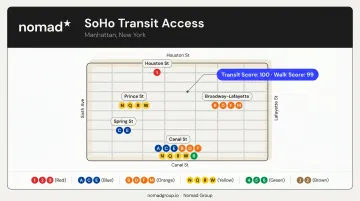
SoHo is exceptionally well-served by public transit. According to MTA line maps, nearby stations cover nearly every major line in the system:
- Spring St — C, E
- Canal St — A, C, E, J, Z, N, Q, R, W, 6
- Prince St — N, Q, R, W
- Broadway-Lafayette — B, D, F, M
- Houston St — 1
That coverage means employees commuting from Brooklyn, Queens, the Bronx, or anywhere across Manhattan can reach SoHo without a crosstown trek. SoHo holds a Transit Score of 100 and a Walk Score of 99, ranking as the 5th most walkable neighborhood in New York City.
Lifestyle Amenities as a Retention Tool
For companies competing for talent in creative, tech, and consumer industries, the neighborhood itself factors into how candidates weigh offers. The dining, retail, and cultural density surrounding SoHo offices functions as an unwritten benefit — one that shows up in recruiting conversations and retention alike.
Key draws for employees include:
- Dozens of acclaimed restaurants and cafes within a few blocks
- Art galleries, boutiques, and cultural institutions unique to the neighborhood
- Easy access to green space at nearby Hudson River Park and Washington Square Park
The geography works for business operations, too. SoHo sits close enough to NoHo, Tribeca, and Hudson Square that reaching partners and clients across lower Manhattan is straightforward — no Midtown congestion required.
SoHo vs. Neighboring NYC Office Markets
Understanding where SoHo fits relative to adjacent submarkets helps clarify whether it's the right call for your company — or whether a nearby neighborhood serves you better.
SoHo vs. Flatiron/NoMad
Flatiron and NoMad offer a fundamentally different product:
- Much larger inventory — 40.5M sq ft versus SoHo's 6.6M, meaning more options at every size
- Lower asking rents — $76.85/sq ft versus $89.52/sq ft in SoHo
- More traditional office product — Modern buildings, standard HVAC, plug-and-play suites
- Better for large blocks — Companies needing 20,000+ sq ft contiguous space have far more choices
Flatiron/NoMad is the better call for companies prioritizing cost efficiency or needing larger footprints. Nomad Group works extensively in this submarket and can surface off-market availability that doesn't appear in standard listings.
SoHo vs. Tribeca
Tribeca shares SoHo's loft character and historic building stock, with asking rents at $78.72/sq ft. But Tribeca skews more residential and carries less commercial office inventory. A few practical differences stand out:
- Fewer available listings — SoHo has more active commercial inventory at any given time
- Quieter street energy — Tribeca's pace is more subdued; SoHo's retail corridors create more foot traffic and brand visibility
- Similar rent range — The $10+/sq ft premium for SoHo reflects demand, not product quality differences
Companies seeking a creative address with genuine street-level visibility will generally find more options in SoHo.
When SoHo Is the Right Answer
SoHo makes most sense when:
- The neighborhood is part of your brand story — clients and recruits will form impressions based on your address
- Your team values cultural richness over a purely functional office environment
- You're a consumer-facing, fashion, media, or creative company where the space itself signals something to clients and talent
- You're at a stage where a ~$10–15/sq ft rent premium is justifiable against the brand and recruiting value of the address
How to Find and Lease Office Space in SoHo
Start With Realistic Parameters
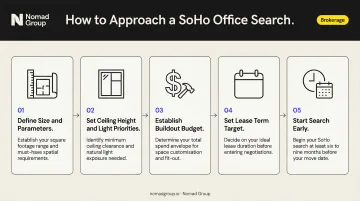
Before touring anything, establish your non-negotiables:
- Define your size in usable square feet, accounting for SoHo's often generous ceiling-to-floor ratios
- Decide how much ceiling height and natural light matter — both affect pricing significantly in loft product
- Know your buildout budget upfront: raw loft spaces and pre-built units carry very different TI expectations
- Set your lease term target early — direct leases typically require multi-year commitments, while sublets can offer shorter windows
- Start sooner than you think — SoHo moves quickly, and waiting six months to begin a search in earnest costs real options
Why Local Expertise Matters Here
Once your parameters are set, who you work with matters as much as what you're searching for. SoHo's office market is small and relationship-driven — quality spaces often trade through broker networks before appearing on public listing platforms. Working with a tenant-side advisor who actively covers SoHo, not just Manhattan broadly, gives you access to that inventory before it's widely marketed.
Nomad Group works with high-growth companies across SoHo and greater NYC, with 300+ tenant buildouts completed and over 2 million square feet leased. The full search-to-move-in process is covered in-house: market analysis, property tours, lease negotiation, buildout management, and the construction coordination that raw SoHo loft spaces routinely require. For companies weighing SoHo against other neighborhoods, that end-to-end capability matters when a space needs significant work before it's occupiable.
Frequently Asked Questions
What does SoHo mean in real estate?
SoHo stands for "South of Houston Street," a Manhattan neighborhood sitting just below Houston Street. The name is synonymous with cast-iron loft buildings, creative office space, and a premium business address for consumer-facing and creative companies.
What is the average cost to rent office space in SoHo, NYC?
SoHo direct asking rents averaged $89.52/sq ft full service as of Q2 2025, according to Avison Young. Pricing varies based on floor height, ceiling height, natural light, proximity to key streets (Spring, Prince, Broome), and whether the space is raw loft or pre-built.
What types of businesses typically lease office space in SoHo?
SoHo attracts fashion brands, creative agencies, media companies, consumer tech startups, and luxury goods firms, industries where the neighborhood's cultural identity directly reinforces company brand. Office-based sectors represent a significant share of private-sector employment across the SoHo/NoHo corridor.
Is SoHo a good location for a startup office in NYC?
SoHo works well for funded startups in consumer, creative, or brand-driven sectors where the address signals something meaningful. Companies prioritizing cost per square foot over brand positioning will find better value in nearby Flatiron or NoMad, where rents run roughly $12–13/sq ft lower.
What lease terms are typical for SoHo office space?
Direct leases in SoHo typically run 3–5 years minimum. The Farmer's Dog's 2025 deal at 568 Broadway, for example, was a five-year term. Shorter commitments are possible through sublets or flexible arrangements.
Are there flexible or short-term office space options in SoHo?
Flexible options exist in SoHo but are more limited than in Midtown or Flatiron. Nomad Group's Flex by Nomad service provides a full-service alternative to traditional coworking, built on in-house infrastructure, for companies that want professional space in or near SoHo without committing to a direct lease.