Introduction
When startups think "NYC office space," the conversation usually stops somewhere south of 59th Street. Flatiron, NoMad, Union Square — these are the neighborhoods that dominate the tech office playbook. Uptown Manhattan, meanwhile, remains one of the city's most livable and iconic areas, yet it rarely enters the equation for high-growth companies scouting their next headquarters.
This guide gives founders an honest, commercial-real-estate-first look at Uptown — not a pitch for it as the next startup hub, but a clear-eyed assessment before you write it off or sign a lease without knowing what you're walking into.
We'll cover what Uptown Manhattan actually is from a CRE perspective, how key neighborhoods compare for startups, where it fits relative to Midtown and Downtown, and what to know before committing to space above 59th Street.
Key Takeaways
- Uptown Manhattan covers neighborhoods above 59th Street including Upper West Side, Upper East Side, Harlem, Morningside Heights, and Washington Heights
- Office inventory is sparse and less startup-friendly than Downtown, with lower rents and proximity to Columbia and Hospital Row
- Harlem and the Upper West Side are the most commercially viable Uptown options for startups
- Health-tech, biotech, and edtech companies gain the most from Uptown's institutional anchors
- Most early-stage tech startups will find better infrastructure, flexibility, and ecosystem density in Midtown South or Flatiron
What Is Uptown Manhattan? Defining the Geography for Businesses
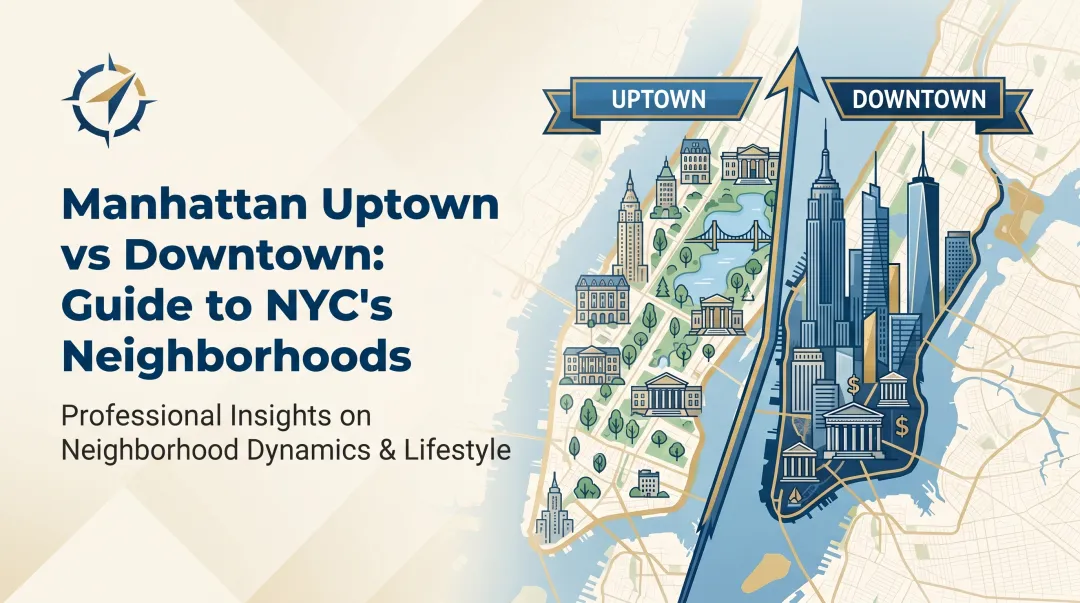
The term "Uptown" is used loosely in New York. For most real estate professionals, it refers to Manhattan above 59th Street (Columbus Circle). "Upper Manhattan" is more specific, describing neighborhoods above 96th or 110th Street — including Harlem, Washington Heights, and Inwood.
Primary neighborhoods include:
- Upper West Side (UWS)
- Upper East Side (UES)
- Harlem (Central, East, and West)
- Morningside Heights
- Washington Heights
- Inwood
These areas are predominantly residential. According to NYC Comptroller data, the area above 59th Street accounts for just 13% of total office asset value citywide, with almost all 5-star office space located south of that line.
The tenant base reflects that inventory gap. Medical institutions, universities, and nonprofits dominate — not corporate tech companies. Uptown has historically been an underserved commercial real estate market, with fewer Class A office towers, tighter residential zoning, and limited purpose-built startup infrastructure.
Uptown Manhattan Neighborhood Profiles: A Commercial Real Estate Breakdown
Not all Uptown neighborhoods offer the same commercial real estate value. Each has distinct inventory, rent dynamics, and tenant profiles.
Upper West Side
The UWS is overwhelmingly residential, with limited office inventory concentrated along Broadway and Columbus Avenue. Most available commercial space sits in converted brownstones or older mixed-use buildings.
That works well for boutique professional services, wellness studios, or creative agencies — but rarely for scaling tech startups that need large, open floor plans.
Industrious operates at 1900 Broadway, offering private offices from $2,003/month and day passes at $100 — one of the few flexible office options in the neighborhood.
Best suited for: Boutique professional services, wellness studios, and creative agencies needing modest, neighborhood-integrated space.
Upper East Side
The UES commercial landscape is anchored by Hospital Row along York Avenue — home to NewYork-Presbyterian/Weill Cornell, Memorial Sloan Kettering, and Hospital for Special Surgery. This creates a natural cluster for health-tech, biotech, and medical device startups.
Average asking rents in the East Side/UN submarket hit $70.67 per sq ft in Q4 2025 with 14.4% availability. Metro Manhattan reports zero sublease inventory for Class A space on the Upper East Side, meaning landlords retain pricing power and direct rents remain elevated.
Best suited for: Health-tech, biotech, medical research, and companies seeking proximity to top-tier medical institutions.
Harlem
Harlem represents the most commercially dynamic part of Uptown for startups. The 125th Street corridor has attracted increasing investment, including co-working operators and mixed-use developments. Regus maintains a location at 1-3 West 125th Street, and The Harlem Collective offers flexible workspace at 1850 and 1867 Amsterdam Avenue, with virtual offices starting at $75/month.
Recent commercial activity includes:
- Studio Museum in Harlem's new office space at 144 West 125th Street
- Mount Sinai healthcare development at 1578 Lexington Avenue in East Harlem
- Second Avenue Subway Phase 2 extension — a $7.7 billion project adding three new stations at 106th, 116th, and 125th Streets (scheduled for 2032)
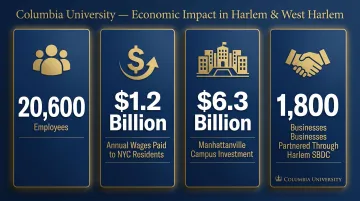
Columbia University's economic footprint runs deep: 20,600 employees, $1.2 billion in annual wages paid to NYC residents, and $6.3 billion invested in the Manhattanville campus expansion in West Harlem. That institutional presence compounds with ground-level entrepreneurial activity — the Harlem Small Business Development Center has partnered with 1,800 local businesses and created or saved 1,500 jobs.
Best suited for: Mission-driven, community-focused, or edtech startups that benefit from proximity to Columbia and diverse talent pipelines.
Washington Heights & Inwood
Washington Heights and Inwood are highly residential with minimal traditional office inventory. Office space typically lists at $35-$55 per sq ft, concentrated in Class B and C professional suites ranging from 1,000-3,500 sq ft. Large floorplate tech spaces are rare.
Transit access is strong via the A/C express lines and the 1 train, but the area is better suited for early-stage companies needing affordable, no-frills space, back-office functions, or nonprofits — not high-growth VC-backed startups prioritizing talent density and amenity access.
Best suited for: Early-stage companies, nonprofits, and back-office operations where low rent matters more than location prestige.
Uptown vs. Midtown vs. Downtown Manhattan: Which Is Right for Your Startup?
The core trade-off breaks down simply: Downtown offers ecosystem density, Midtown offers scale and prestige, and Uptown offers affordability with institutional adjacency. Where you land depends on your team, your funding stage, and who you need to be near.
Average Asking Office Rents (Q4 2025):
| Submarket | Avg. Rent (PSF) | Availability |
|---|---|---|
| Midtown | $82.80 | 13.8% |
| Midtown South | $81.49 | 16.7% |
| Downtown | $60.43 | 19.9% |
| Uptown | ~$40–55 | Higher vacancy in select corridors |
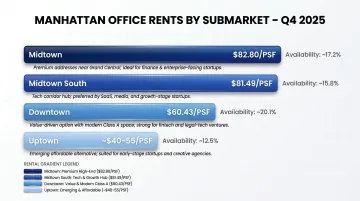
Source: Savills Manhattan Office Market Report Q4 2025
Tech tenant concentration tells a different story: tech tenants leased 6.54 million sq ft in Manhattan in 2025, with Midtown South capturing 66.7% of all tech demand. AI companies alone accounted for 0.79 million sq ft. For most SaaS or fintech startups, that gravitational pull is hard to ignore — but it comes at a premium.
That said, not every startup needs to be near a Flatiron accelerator. The right fit depends on your sector, your team's commute, and how much your budget can absorb.
Startup profiles best suited for Uptown:
- Health-tech and biotech companies leveraging Hospital Row proximity
- Edtech and mission-driven startups near Columbia or CUNY
- Nonprofits and community-focused organizations
- Companies whose workforce lives in northern Manhattan or the Bronx
Startup profiles better served Downtown or Midtown South:
- SaaS, fintech, and media startups needing investor proximity
- Companies prioritizing flexible lease terms and modern buildouts
- Teams recruiting talent from Brooklyn, Queens, or other boroughs
- Startups requiring dense ecosystem access (events, networking, vendors)
Commute considerations: Average NYC commutes range 40–60 minutes. For employees based in southern Brooklyn or eastern Queens, commuting to Uptown can exceed 60 minutes each way. For teams based in northern Manhattan or the Bronx, though, Uptown cuts commute time significantly — a real retention advantage worth factoring into your location decision.
Office Space in Uptown Manhattan: What's Actually Available
Typical space types in Uptown:
- Converted residential and mixed-use buildings
- Medical office stock in the UES
- Co-working facilities in Harlem
- Limited Class A availability
Traditional corporate-grade office towers are rare above 59th Street outside a few Midtown-adjacent blocks near Columbus Circle.
Co-working and flexible workspace operators:
| Operator | Address | Neighborhood | Pricing |
|---|---|---|---|
| WeWork | 430 Park Avenue | Upper East Side | From $450/mo |
| WeWork | 750 Lexington Avenue | Lenox Hill | From $450/mo |
| Industrious | 1900 Broadway | Upper West Side | From $2,003/mo |
| Regus | 1-3 West 125th Street | Harlem | Varies |
| Harlem Collective | 1850/1867 Amsterdam Ave | Harlem | Virtual: $75/mo |
Lease structures and negotiating leverage:
Many Uptown spaces sit in older buildings with landlords less accustomed to startup-style negotiations. Expect limited flexibility on tenant improvement (TI) allowances, free rent periods, and term lengths compared to competitive Downtown markets.
Many Uptown spaces sit in older buildings with landlords less accustomed to startup-style negotiations. Expect limited flexibility on tenant improvement (TI) allowances, free rent periods, and term lengths compared to competitive Downtown markets.
For context on what you'd be giving up: Manhattan-wide TI allowances averaged $132.57 per sq ft for new deals and $88.59 per sq ft for renewals in Q2 2024, with 13.6 months of free rent for new deals. Tech tenants achieved $131.70/SF in TI allowances in 2025. Matching those figures in Uptown buildings is rare.

Many Uptown spaces also require significant tenant improvement work to meet modern startup standards. Older infrastructure typically means longer timelines and higher buildout costs than you'd see in purpose-built office stock Downtown.
Key Considerations Before Leasing Office Space in Uptown Manhattan
Transit Access
Subway lines serving Uptown:
| Neighborhood | Subway Lines | Key Stations |
|---|---|---|
| Upper East Side | 4, 5, 6; Q | 59th, 68th, 77th, 86th, 96th |
| Upper West Side | 1, 2, 3; B, C | 59th-Columbus Circle, 72nd, 86th, 96th |
| Harlem | A, B, C, D; 2, 3; 4, 5, 6 | 125th (multiple lines), 135th, 145th |
| Washington Heights | A, C; 1 | 155th, 168th, 175th, 181st |
The Second Avenue Subway Phase 2 extension will add Q line service to East Harlem and Harlem with three new stations (106th, 116th, and 125th Streets) by approximately 2032.
Uptown is well-connected by subway, but may feel less central for employees commuting from Brooklyn or Queens compared to Midtown or Downtown hubs.
Zoning and Permitted Use
Much of Uptown is zoned residential or as Special Mixed Use Districts (MX), pairing M1 light manufacturing zones with residential districts. Offices are permitted as-of-right under M1 regulations, but restrictions apply:
- Commercial uses must generally occupy floors below the lowest residential story
- Lower Floor Area Ratios (FAR) than Midtown's C5/C6 districts
- 35 dB(A) noise attenuation required for residential units
- Restrictions on businesses requiring Risk Management Plans
Confirm commercial zoning and permitted use before signing any lease — especially in converted brownstones.
Working with a Commercial Real Estate Broker
Uptown inventory is thinner and less publicized than Downtown or Midtown. Many good spaces are found off-market. Nomad Group's team works with high-growth companies across NYC to source, negotiate, and build out office space — including off-market deals that never hit public listings. In a market like Uptown, where MX zoning adds complexity and available inventory is limited, that access matters.
The team helps companies assess whether Uptown fits their stage, headcount trajectory, and commute profile before committing to a lease — not after.
Frequently Asked Questions
Where does Uptown Manhattan begin?
"Uptown" informally refers to Manhattan above 59th Street (Columbus Circle) — the dividing line most New Yorkers and real estate professionals use. "Upper Manhattan" more specifically refers to neighborhoods above 96th or 110th Street, including Harlem, Washington Heights, and Inwood.
What is the difference between Uptown, Downtown, and Midtown?
From a CRE perspective: Midtown is the corporate core with the highest rents and prestige inventory. Downtown (Flatiron, NoMad, SoHo) is the startup hub with flexible leases and dense ecosystem infrastructure. Uptown is predominantly residential with niche commercial pockets serving medical, educational, and nonprofit tenants.
What is Upper Manhattan known for?
Upper Manhattan is known for its cultural institutions (Columbia University, Lincoln Center, the Apollo Theater), diverse communities, and growing commercial activity along corridors like 125th Street — alongside its identity as a residential area historically separated from the corporate office corridor.
Is Uptown Manhattan a good location for a startup office?
It depends on your sector, stage, and workforce. Health-tech, biotech, edtech, and mission-driven companies may find strong institutional alignment. Most early-stage tech startups will find more infrastructure, flexible lease options, and ecosystem density in Midtown South or Downtown neighborhoods like Flatiron and NoMad.
What's in Uptown New York from a business perspective?
Key commercial anchors include:
- Hospital Row on the Upper East Side — NewYork-Presbyterian, Memorial Sloan Kettering, Hospital for Special Surgery
- 125th Street commercial corridor in Harlem
- Columbia University in Morningside Heights
- A growing number of co-working options
Class A office stock remains limited. The area is predominantly residential, with commercial activity concentrated around institutional and corridor-based tenants.