Introduction
Choosing your first or next NYC office is one of the highest-stakes decisions scaling companies face. Uptown and Downtown Manhattan each carry distinct identities, cultures, and business environments that directly impact talent attraction, client perception, and day-to-day operations. The neighborhood you choose shapes how candidates perceive you on interview day and what clients think before they walk through the door.
The geography itself creates confusion. Manhattan's street grid divides the island into Uptown (above 59th Street), Downtown (below 14th Street), and the massive Midtown corridor in between.
Most brokers use these labels casually, but commercial real estate submarkets don't map neatly to cultural neighborhoods — and the differences have real consequences for rent, commute times, and the type of companies you'll be surrounded by.
This guide examines Manhattan's office market through a practical lens: neighborhood characteristics, rent dynamics, transit access, and which companies thrive in each zone.
Key Takeaways
- Downtown Manhattan (below 14th Street) attracts creative, media, and tech-forward companies drawn to SoHo lofts and converted industrial spaces
- Uptown Manhattan (above 59th Street) suits finance, law, and established enterprises prioritizing prestige and institutional proximity
- Midtown South (14th–59th Street), including Flatiron, NoMad, and Union Square, is where most high-growth startups and tech companies land
- Rent, transit, and industry clustering vary dramatically by submarket
- The right neighborhood depends on your company's stage, culture, client base, and budget
Uptown vs Downtown Manhattan: Quick Comparison
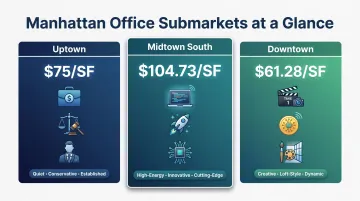
| Factor | Uptown (Above 59th St) | Midtown South (14th–59th St) | Downtown (Below 14th St) |
|---|---|---|---|
| Typical Tenants | Finance, law, healthcare, family offices | Tech, startups, media, creative agencies | Media, fashion, fintech, design studios |
| Average Rent (Class A) | ~$75/SF | $104.73/SF | $61.28/SF |
| Office Vibe | Quiet, polished, conservative | High-energy, collaborative, fast-paced | Creative, loft-style, entrepreneurial |
| Key Neighborhoods | Upper East Side, Upper West Side | Flatiron, NoMad, Union Square | SoHo, Tribeca, Financial District |
| Transit Hubs | Lexington Ave (4/5/6), Central Park West (A/C/B/D) | Union Square, Grand Central (south) | Fulton Center, World Trade Center PATH |
According to Cushman & Wakefield's Q3 2025 report, Midtown South Class A rents ($104.73/SF) now exceed both Midtown ($84.10/SF) and Downtown ($61.28/SF), reflecting intense demand from tech and creative firms. That premium reflects where leasing activity is concentrated: Flatiron, NoMad, and Union Square consistently lead the city in deal velocity, making Midtown South the default landing zone for high-growth companies entering the NYC market.
What is Uptown Manhattan?
Geographic Boundaries and Character
Uptown Manhattan begins at 59th Street and extends north through the Upper East Side, Upper West Side, Morningside Heights, and Harlem. In commercial real estate, "Uptown" office demand concentrates in select corridors — primarily the Upper East Side's Lexington Avenue spine — rather than spreading across residential blocks.
The architecture reflects that focus: tree-lined streets, pre-war limestone buildings, major museums (the Metropolitan Museum of Art, American Museum of Natural History), and top-tier hospitals (NewYork-Presbyterian, Memorial Sloan Kettering). The atmosphere is quieter and more polished — a sharper contrast to the open-plan, collaborative energy you'll find south of 34th Street.
Who Leases Uptown?
Typical Uptown tenants include:
- Wealth management and private banking firms
- Law practices serving high-net-worth clients
- Healthcare-adjacent businesses (medical offices, biotech)
- Family offices and legacy enterprises
These companies benefit from proximity to institutional wealth concentrated along the Upper East Side corridor and the prestige that comes with an Uptown address.
Transit and Commute Patterns
Major subway lines serve Uptown:
- East Side: 4/5/6 (Lexington Avenue), Q (Second Avenue)
- West Side: 1/2/3 (Broadway), A/C/B/D (Central Park West)
Grand Central Terminal connects Uptown to Metro-North Railroad, serving Westchester and Connecticut commuters — a 10-12 minute ride from 86th Street on the express 4/5 train.
The Brooklyn talent tradeoff: HR&A Advisors found that 30% of NYC's tech ecosystem workers live in Brooklyn. Uptown offices above 59th Street require 35-50+ minute commutes from most Brooklyn neighborhoods, which can affect recruitment for Brooklyn-resident candidates.
Office Market Characteristics
CBRE, Colliers, and Cushman & Wakefield don't track Uptown as a standalone submarket — pointing to its limited commercial footprint. SquareFoot reports Upper West Side Class A rents around $75/SF, with Class B at approximately $62/SF.
Key characteristics:
- Lower density of Class A buildings compared to Midtown
- Smaller boutique suites more common than large floor plates
- Conservative leasing environment
- Limited inventory for companies needing rapid expansion
Office Space Fit for Uptown
Those market constraints narrow the field considerably — Uptown works well for specific firm profiles and poorly for others.
Best for:
- Established firms prioritizing prestige over trendiness
- Businesses serving Upper East Side private clients
- Companies with suburban commuter bases (Westchester, Connecticut)
- Professional services wanting a subdued, polished environment
Poor fit for:
- Startups and high-growth tech companies
- Companies recruiting Brooklyn-based talent
- Firms needing large, modern floor plates
- Businesses seeking collaborative, open-plan environments
For venture-backed companies and scaling teams, the inventory gaps and commute math tend to push the search Downtown instead.
What is Downtown Manhattan?
Geographic Scope and Sub-Neighborhoods
Downtown Manhattan extends from the southern tip of the island to 14th Street, encompassing SoHo, Tribeca, the Financial District, Hudson Square, and the Lower East Side. The physical identity:
- SoHo/Tribeca: Cast-iron buildings, converted lofts, high ceilings, cobblestone streets
- Financial District: Modern glass towers, historic stock exchange, corporate high-rises
- Hudson Square: Media and tech corridor anchored by Google (1.3M SF at St. John's Terminal) and Disney (1.2M SF at 7 Hudson Square)
Colliers Q4 2025 data shows Downtown averaging $59.83/SF (roughly 30% below Midtown South).
Downtown's Office Landscape
SoHo and Tribeca are defined by loft-style spaces: exposed brick, 12-14 foot ceilings, open floor plans, wood beams. Design studios, creative agencies, and fashion brands gravitate here specifically because the space itself signals something about who they are.

The Financial District takes a different approach — traditional Class A high-rise inventory with modern amenities at value pricing. SquareFoot reports FiDi Class A rents around $66/SF, well below Midtown equivalents for comparable quality.
Leasing momentum backs this up. Downtown full-year 2025 volume hit 6.39M SF, up roughly 150% from 2024, with available supply down 25% from its post-pandemic peak.
Transit Access and the Brooklyn Advantage
Downtown's transit infrastructure is exceptional:
- Fulton Center hub: 2/3, 4/5, A/C, J/Z, R/W, 1 trains
- PATH service to New Jersey at World Trade Center
- Brooklyn connection: 10-15 minutes from Downtown Brooklyn via express trains
That Brooklyn connection has real hiring implications. While 74% of NYC's tech jobs are in Manhattan, HR&A research shows only 37% of tech workers actually live there — 30% are in Brooklyn. For companies competing for that talent, a Downtown office often means a shorter commute than Midtown.
Tenant Mix
Downtown attracts:
- Creative agencies and design studios
- Media and entertainment companies
- Fashion and luxury brands
- Fintech firms
- Tech startups drawn to cultural cachet
Notable 2025 leases include Horizon Media's 366,992 SF at 75 Varick Street and Moody's 461,567 SF at 200 Liberty Street.
Office Space Fit for Downtown
Best for:
- Companies where brand environment matters (design, media, fashion)
- Firms recruiting from Brooklyn and lower Manhattan
- Businesses wanting character-rich loft spaces over corporate towers
- Cost-conscious companies prioritizing value
One honest caveat: Downtown's inventory of large-floor-plate, purpose-built Class A stock is thinner than Midtown's. Companies scaling rapidly past 20,000-30,000 SF may find their options narrower than they'd like.
Uptown vs Downtown: Which is Right for Your Business?
Decision Framework
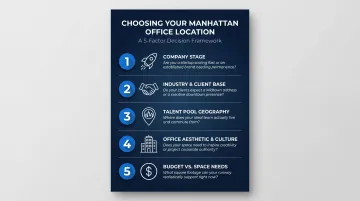
Five factors should drive your choice:
1. Company stage and growth trajectory Early-stage startups prioritize flexibility and cost; scaling companies need room to expand; established enterprises value stability.
2. Industry and client base Where do your clients expect to meet you? Financial services clients expect Midtown or Uptown addresses; media clients expect Downtown.
3. Talent pool and employee geography NYC tech workers live across Brooklyn (30%), Manhattan (37%), and Queens (21%). Office location directly impacts commute times and retention.
4. Office aesthetic and company culture Do you need loft-style character or polished corporate? Open collaboration or quiet professionalism?
5. Budget relative to space needs At $58-60/SF vs. $80-85/SF, Downtown delivers 30% more square footage per dollar than Midtown South.
When to Choose Uptown
Ideal for:
- Established finance, law, or healthcare firms
- Companies prioritizing institutional proximity
- Businesses with suburban commuter bases
- Firms seeking prestigious, conservative environments
Uptown is a harder sell for companies signaling innovation, recruiting Brooklyn-based talent, or needing the high-energy collaborative environments that draw younger workforces.
When to Choose Downtown
Ideal for:
- Creative, media, fashion, and design companies
- Tech-adjacent firms wanting distinctive loft spaces
- Companies hiring from Brooklyn
- Businesses where office aesthetic reinforces brand
Limitations:
- Thinner pipeline of large floor plates
- Some neighborhoods (SoHo) carry premium pricing despite "Downtown" label
The Midtown South "Third Option"
Many high-growth companies skip the Uptown/Downtown debate entirely. Flatiron, NoMad, and Union Square offer modern infrastructure, strong transit connectivity, and a high-energy ecosystem — without the trade-offs of either end of Manhattan.
Colliers Q4 2025 reports Midtown South delivered 16.20M SF of leasing in 2025 — the strongest year since 2019 — with six consecutive quarters of positive absorption.
Why Midtown South dominates:
- Direct subway access from Brooklyn (L train to Union Square: 5-7 minutes from Williamsburg)
- Tech ecosystem concentration between Union Square and Midtown
- Mix of loft character (NoMad) and Class A infrastructure (Flatiron)
- Balanced pricing relative to space quality
Notable 2025 leases include: NYU's 1.07M SF at 770 Broadway, Stripe's 139,789 SF expansion, and Monday.com's renewal — all in the Midtown South corridor.
Nomad Group works primarily in this corridor — handling tenant representation, buildouts, and space management for scaling companies across Flatiron, NoMad, Union Square, and adjacent neighborhoods.
Transit and Talent: The Data
Transit data reinforces what the pricing data already suggests: location south of 34th Street gives you access to NYC's largest and fastest-growing tech workforce. Here's how the commute math actually breaks down:
- Brooklyn to FiDi/Downtown: 10-15 minutes via express trains
- Brooklyn to Union Square (Midtown South): 5-7 minutes from Williamsburg (L train)
- Brooklyn to Midtown: 18-22 minutes to Grand Central
- Brooklyn to Uptown: 35-50+ minutes to Upper East/West Side
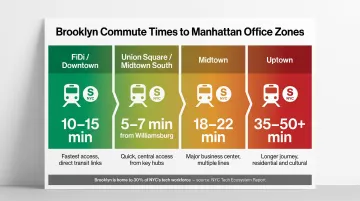
Tech:NYC reports NYC tech employment reached 203,819 jobs in 2025, up from 161,447 in 2019. With 30% of this workforce living in Brooklyn, an Uptown address puts you 30-45 minutes further from your largest available talent pool.
Conclusion
The Uptown vs Downtown decision isn't about which neighborhood is objectively better — it's about which environment aligns with your company's identity, hiring profile, and growth plans. Uptown offers prestige and proximity to institutional clients; Downtown provides creative energy and value pricing; Midtown South delivers infrastructure and ecosystem density.
Manhattan's office market keeps evolving, and many high-growth companies end up in the dynamic neighborhoods between those extremes — places like Flatiron, NoMad, and Union Square, where lease terms, transit access, and building quality vary block by block. Working with a broker who knows those corridors in detail — not just the ZIP code — is what determines whether you sign a lease that supports your growth or one you're trying to exit two years later. Nomad Group's focus on exactly these neighborhoods means clients get market intelligence that goes well beyond a standard search.
Frequently Asked Questions
What is the difference between Uptown and downtown in Manhattan?
Uptown refers to Manhattan north of 59th Street, including the Upper East Side and Upper West Side. Downtown refers to the area south of 14th Street, encompassing SoHo, Tribeca, and the Financial District. Midtown fills the large corridor between them.
What's the difference between Uptown, Midtown, and downtown?
Downtown is below 14th Street, Midtown spans 14th to 59th Street, and Uptown is north of 59th Street. For businesses, Midtown — especially Midtown South (Flatiron, NoMad, Union Square) — is the most commercially active zone with the strongest leasing velocity.
How do you know if you're going Uptown or downtown?
In NYC transit terms, "Uptown" means heading north toward higher street numbers, and "Downtown" means heading south toward lower street numbers. This applies to both subway directions and street navigation throughout the city.
Which part of Manhattan is the nicest?
"Nicest" depends entirely on what you value. Uptown offers elegant pre-war architecture and quiet residential streets; Downtown brings cultural energy and creative character; Midtown South blends modern infrastructure with a high-growth business ecosystem. Each appeals to a different type of tenant or resident.
Is Uptown Manhattan a good place to live?
Uptown suits families and professionals who value quieter streets, proximity to Central Park and major museums like the Met, and a residential feel. For office use, though, commercial inventory is limited and commutes from Brooklyn run longer than from Midtown South or Downtown.
Why is it called Uptown instead of downtown?
The terms derive from Manhattan's north-south geography. The island runs roughly north-south with street numbers increasing northward, so "Uptown" literally means the higher-numbered (northern) end of the island, while "Downtown" refers to the lower-numbered (southern) end.