Introduction: Navigating Uptown Manhattan
Many businesses searching for Manhattan office space stumble over the term "Uptown." Is it a single neighborhood? A collection of districts? Does it even have commercial office buildings?
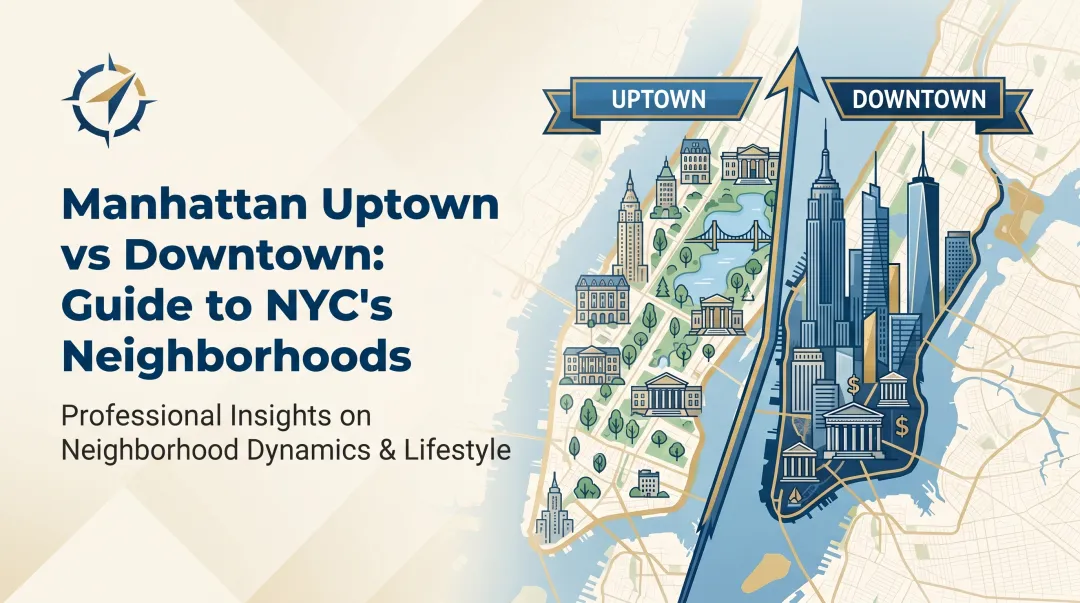
Unlike Midtown, which brings corporate towers and office corridors to mind immediately, Uptown Manhattan is a sprawling residential zone north of 59th Street. It runs from the museum-lined Upper East Side through Harlem to the Dominican cultural hub of Washington Heights.
For companies evaluating NYC office locations, this distinction matters: Uptown is not a traditional office market.
This guide provides a clear neighborhood-by-neighborhood breakdown of Uptown Manhattan, explains how it differs from Midtown and Downtown from a commercial real estate perspective, and clarifies where high-growth companies are actually setting up shop in Manhattan today.
Key Takeaways
- Uptown Manhattan spans 59th Street to the northern tip, covering the Upper East Side, Upper West Side, Harlem, Washington Heights, and Inwood
- Uptown is primarily residential — corporate office inventory is minimal compared to Midtown and Downtown
- Most NYC tech and high-growth companies cluster in Midtown South (Flatiron, NoMad, Union Square) for transit, talent, and ecosystem density
- Harlem's 125th Street corridor leads Uptown commercially, with asking rents below $50/SF vs. Midtown South's $79–84/SF average
What Is Uptown Manhattan? Defining the Boundaries
Uptown Manhattan generally refers to the area above 59th Street, which marks the southern edge of Central Park. Some definitions push that boundary to 96th or 110th Street — an ambiguity that matters when evaluating neighborhoods or searching for commercial space. In practice, most brokers and tenants treat "Uptown" as the neighborhoods north of Central Park.
Geographic Scope
Uptown sits on the northern portion of Manhattan island, bounded by:
- West: Hudson River
- East: East River and Harlem River
- South: 59th Street (most common definition)
- North: The island's northern tip at Inwood
The island narrows considerably as it moves north, tapering toward Inwood and Marble Hill.
Street Grid & Navigation
The numbered street grid continues through Uptown, but many avenues take on historical names alongside their numerical designations:
- Malcolm X Boulevard = Lenox Avenue = 6th Avenue (in Harlem)
- Adam Clayton Powell Jr. Boulevard = 7th Avenue
- Frederick Douglass Boulevard = 8th Avenue
These dual naming conventions can confuse first-time visitors and complicate address searches.
A Zone of Contrasts
Uptown encompasses vastly different sub-zones, each with distinct commercial and residential identities:
- Affluent residential corridors (Upper East Side, Upper West Side)
- Culturally significant neighborhoods (Harlem)
- Diverse immigrant communities (Washington Heights)
- Quiet residential enclaves (Inwood)
For anyone evaluating commercial space north of 59th Street, that means lease rates, building stock, and tenant demand can shift dramatically from one neighborhood to the next — sometimes within just a few blocks.
Uptown Manhattan Neighborhoods: A Map Overview
Upper West Side (59th to 110th Street, West of Central Park)
The Upper West Side ranks among Manhattan's most established residential neighborhoods, anchored by cultural landmarks like Lincoln Center (150 West 65th Street) and Riverside Park.
Character: Pre-war apartment buildings, tree-lined streets, and a bustling Broadway commercial corridor dominated by retail, dining, and neighborhood services. Columbia University's presence in the northern section (Morningside Heights) adds bookstores, cafes, and student services.
Commercial Activity: Predominantly retail and service businesses rather than traditional office tenants. The neighborhood serves as a residential commuter zone, not an employment hub.
Upper East Side (59th to 96th Street, East of Central Park)
One of the wealthiest zip codes in the country, the Upper East Side is defined by Museum Mile along Fifth Avenue (82nd to 110th Streets) — home to the Met, the Guggenheim, and more than a dozen major cultural institutions.
Character: Luxury residential towers, pre-war co-ops, and a high concentration of medical offices clustered near hospital corridors.
Commercial Activity: Strong demand for medical and professional office space near Lenox Hill Hospital (100 East 77th Street) and Memorial Sloan Kettering (1275 York Avenue). This medical office corridor is the Upper East Side's most active commercial sub-market, with rents priced to reflect direct access to two of NYC's top-tier hospital campuses.
Harlem (110th to 155th Streets)
Harlem is the historic center of African-American culture and birthplace of the Harlem Renaissance. The Apollo Theater (253 West 125th Street) has been a working performance venue since 1934 and remains the neighborhood's most recognized address.
Character: 125th Street serves as the commercial spine, attracting national retail tenants alongside long-established community institutions. The neighborhood spans East Harlem (east of Fifth Avenue) and West Harlem (west of Fifth Avenue).
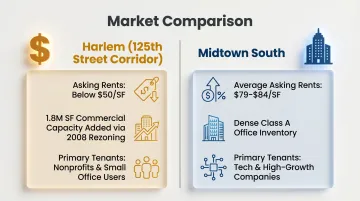
Commercial Activity: According to Metro Manhattan, asking rents here remain below $50/SF — well under Midtown South's $79–84/SF range. A 2008 rezoning along 125th Street added 1.8 million square feet of commercial capacity, and the area has since drawn nonprofits, community organizations, and small office users. Class A tower inventory is essentially nonexistent compared to Midtown.
Morningside Heights (110th to 125th Street)
Technically a sub-zone between the Upper West Side and Harlem, Morningside Heights is dominated by Columbia University's main campus.
Character: University-oriented commercial mix including bookstores, cafes, and student services. Institutional demand for lab and office space shapes the real estate landscape.
Commercial Activity: Columbia's presence drives specialized demand for lab and academic office space. Traditional corporate tenants have little reason to locate here.
Washington Heights & Inwood (155th Street to Northern Tip)
Washington Heights is the acknowledged center of Dominican culture in New York, densely populated and diverse. Columbia University Irving Medical Center (630 West 168th Street) occupies 20 acres and serves as the largest medical research enterprise in NYC and New York State, with 2,972 full-time faculty and 3,394 students.
Inwood is the quietest and most residential of Uptown's neighborhoods, anchored by Inwood Hill Park and the George Washington Bridge Bus Terminal (4211 Broadway).
Commercial Activity: Asking rents run below the Manhattan average, and the commercial base skews toward retail and community services. Columbia Medical Center dominates the institutional landscape. For companies prioritizing proximity to a major research hospital — or simply lower per-square-foot costs — Washington Heights warrants a look, though the inventory for traditional office users is limited.
Uptown vs. Downtown vs. Midtown Manhattan: What's the Difference?
Manhattan's three primary zones serve distinct functions in the city's commercial landscape:
Downtown (Below 14th Street)
NYC's historic core, home to the Financial District, SoHo, Tribeca, and the Lower East Side. Combines legacy financial institutions with newer tech and creative office clusters.
Midtown (14th to 59th Street)
The city's commercial and corporate heart, encompassing Flatiron, NoMad, Grand Central, Times Square, and Hudson Yards. Contains Manhattan's densest concentration of office inventory and Class A towers.
Uptown (Above 59th Street)
Predominantly residential, with commercial activity concentrated along specific corridors (125th Street, Upper East Side medical zones) rather than spread across entire districts.
Commercial Real Estate Implications
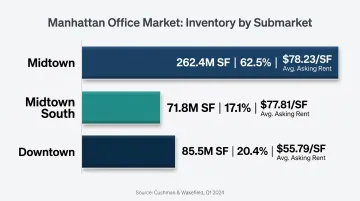
According to Cushman & Wakefield's Q1 2024 data, Manhattan's 419.7 million square feet of office inventory breaks down as follows:
- Midtown: 262.4M SF (62.5%) at $78.23/SF average asking rent
- Downtown: 85.5M SF (20.4%) at $55.79/SF
- Midtown South: 71.8M SF (17.1%) at $77.81/SF
Uptown office inventory isn't separately tracked in major market reports. That omission is deliberate: the zone simply doesn't register as a commercial corridor in the way Midtown or Downtown does.
Transit Connectivity Differences
Midtown's office districts are served by the highest density of subway lines and connections, with stations clustered around Penn Station, Grand Central, and Times Square.
Uptown neighborhoods are well-served by the 1/2/3, A/C, and 4/5/6 lines, but transit access here serves a different purpose. These areas function as residential commuter zones: employees commute from Uptown to office districts, not the other way around.
Commercial Real Estate in Uptown Manhattan: What to Expect
Unlike Midtown or Downtown, Uptown does not have a traditional "office district." The commercial real estate landscape consists of:
Ground-Floor Retail & Services
Most Uptown commercial space takes the form of street-level retail, restaurants, and neighborhood services catering to residential populations.
Medical Office Space (Upper East Side)
The corridor near Lenox Hill Hospital, Memorial Sloan Kettering, and other institutions generates strong demand for medical and professional office space. This specialized sub-market commands premium rates relative to the rest of Uptown, though most listings are smaller-scale professional suites rather than full-floor corporate spaces.
Harlem's Emerging Commercial Story
125th Street has attracted national retail tenants and new mixed-use developments, with growing interest from smaller office users and nonprofits. With asking rents below $50/SF, the pricing gap compared to Midtown South ($79–84/SF) creates opportunities for cost-conscious tenants willing to operate outside Manhattan's traditional office corridors.
Washington Heights: Institutional Dominance
Columbia University Irving Medical Center dominates the commercial landscape here, driving demand for specialized medical and research space. Beyond the medical corridor, the commercial base is thin:
- Retail and community services fill most remaining space
- Rents run lower than anywhere else in Manhattan
- High-growth tech and startup activity is minimal
Key Takeaway for Businesses
That pattern holds across every Uptown sub-market. Uptown Manhattan is not a primary market for companies seeking traditional office leases — high-growth startups and enterprises that need proximity to talent clusters, venture capital networks, and peer companies will find more options in neighborhoods like Flatiron, NoMad, and SoHo, where the density of commercial activity and available inventory better matches their needs.
Where High-Growth NYC Companies Are Setting Up
The majority of NYC's startup, tech, and high-growth company activity concentrates in a corridor stretching from SoHo through Flatiron, NoMad, and up toward Grand Central.
Colliers' Q1 2026 Tech Report shows that tech leasing in Manhattan reached 6.54 million square feet in 2025 — a 71.4% year-over-year increase. Midtown South captured approximately two-thirds of all tech demand, with 235 tech leases executed in 2025 (a record). Average tech taking rents hit $90.31/SF, with tenant improvement allowances averaging $131.70/SF and free rent averaging 13.3 months.
What Makes Midtown South Attractive
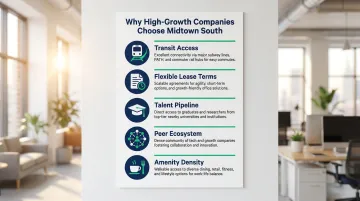
Flatiron, NoMad, and Union Square offer scaling companies:
- Transit access: Union Square serves as a subway hub connecting multiple lines
- Flexible lease terms: Newer building stock compared to traditional Midtown towers
- Talent pipeline: Proximity to universities and residential neighborhoods
- Peer ecosystem: Concentration of venture-backed companies creates collaborative opportunities
- Amenity density: Walkable access to restaurants, coffee shops, and services
These aren't abstract selling points. Authentic Insurance (Flatiron), Extend AI (NoMad), and Nirvana Health (Union Square) each cited neighborhood fit — transit, building character, and proximity to their talent base — as decisive factors in their location decisions.
Finding the Right Office Space in NYC
Choosing the right Manhattan neighborhood involves more than comparing rents — lease structure, buildout timeline, and proximity to your team all factor in.
Nomad Group works with high-growth companies on exactly these decisions, from initial site selection through buildout and ongoing space management. With 300+ tenant buildouts completed and 2 million square feet under management, the firm has direct experience across Flatiron, NoMad, Union Square, and SoHo.
Frequently Asked Questions
Where is considered Uptown Manhattan?
Uptown Manhattan is generally the area above 59th Street (the southern border of Central Park), encompassing the Upper West Side, Upper East Side, Harlem, Washington Heights, and Inwood. Some narrower definitions start at 96th or 110th Street, which can create ambiguity when searching for office space.
What is the difference between Uptown and Downtown Manhattan?
Downtown Manhattan refers to the area below 14th Street (Financial District, SoHo, Tribeca), while Uptown is north of 59th Street and primarily residential. Midtown (14th–59th Street) sits between them and serves as NYC's primary commercial and office hub, containing the majority of Manhattan's corporate office inventory.
What is the coolest neighborhood in Manhattan?
For commercial energy and street-level character, SoHo, Flatiron, and NoMad consistently rank among Manhattan's most vibrant neighborhoods. Uptown, Harlem stands out for cultural richness and a fast-evolving dining scene — though it operates differently as a commercial real estate market.
Is there commercial office space available in Uptown Manhattan?
Uptown has commercial space — medical offices on the Upper East Side, plus retail and flex space in Harlem — but it lacks the office inventory density of Midtown and Downtown. Most companies seeking traditional office leases focus on Midtown South and Downtown, where Class A towers and peer ecosystems are concentrated.
Which Manhattan neighborhood is best for a startup office?
Flatiron, NoMad, and Union Square consistently rank among the top choices for startups due to their combination of transit access, amenity-rich surroundings, flexible building stock, and proximity to NYC's broader tech and venture capital ecosystem. These neighborhoods captured approximately two-thirds of Manhattan's tech leasing demand in 2025.