The bias is understandable. Midtown West doesn't carry the "startup neighborhood" reputation of downtown corridors. But market data tells a different story: Hudson Yards availability sits at just 7.6% — the lowest in NYC — while Manhattan leasing hit 32 million SF in 2025, up 37% from the prior year. High-growth companies are choosing Midtown West not despite its corporate character, but because of it.
This guide answers three questions for founders and operators: what Midtown West offers commercial tenants today, how the market has changed post-pandemic, and what you need to know before signing a lease.
TLDR: Key Takeaways for Founders and Operators
- Penn Station serves 600,000+ daily passengers across NJ Transit, LIRR, and Amtrak — the deepest tri-state talent pipeline of any NYC submarket
- Class A rents average $81.89/SF across Manhattan — Midtown West spans Hudson Yards premiums down to Penn Plaza value corridors
- Corporate headquarters for BlackRock, Salesforce, KKR, and major media companies create enterprise sales proximity for B2B startups
- TI allowances dropped to $133/SF from $162/SF — landlord concessions are tightening and negotiation windows are narrowing
- Flex operators like WeWork and Industrious offer five on-ramp options in the submarket before you commit to a direct lease
What Is Midtown West, NYC?
Midtown West spans 34th to 59th Streets, west of Fifth Avenue to the Hudson River. Commercial brokers typically include several distinct sub-neighborhoods within this corridor:
| Sub-Neighborhood | Location | Office Character |
|---|---|---|
| Hudson Yards | 30th-34th St, 10th-12th Ave | New-build Class A towers |
| Manhattan West | 31st-33rd St, 9th-10th Ave | Brookfield's mixed-use campus |
| Penn Plaza / MSG Corridor | 31st-34th St, 7th-8th Ave | High-volume commuter access |
| Garment District | 34th-42nd St, 5th-9th Ave | Mid-rise value corridor |
| Theater District / Times Square | 42nd-53rd St, Broadway/7th Ave | Media and entertainment hub |
| Hell's Kitchen / Clinton | 34th-59th St, 8th Ave-Hudson River | Mixed residential/commercial |
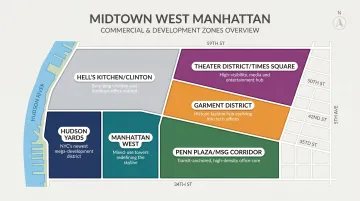
SL Green Realty, Manhattan's largest office landlord, categorizes properties into micro-markets including "Midtown West," "Times Square," "Penn Station," and "Westside" — a signal that even insiders recognize meaningful differences within the broader geography.
How Midtown West Compares to the Rest of Midtown
Midtown East (east of Fifth Avenue) centers on corporate finance and law firms along Park and Madison Avenues. Midtown South — encompassing Flatiron, NoMad, and Union Square — historically attracts startups due to smaller floor plates and tech-centric culture.
Midtown West sits in the middle: larger floor plates than downtown, stronger transit access than Midtown East, and a growing tech presence alongside established corporate tenants.
Why High-Growth Startups Are Choosing Midtown West
Enterprise Credibility and Address Value
A Midtown West address carries weight with investors, enterprise buyers, and executive recruits. When a Series B SaaS company lists 30 Hudson Yards or One Manhattan West on investor decks, it signals institutional legitimacy that downtown addresses don't always convey. This matters most for B2B startups selling into Fortune 500 accounts where procurement teams evaluate vendor stability.
Unmatched Commuter Talent Access
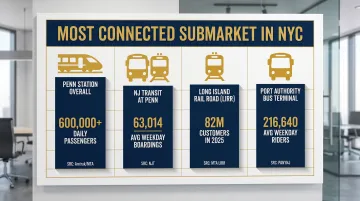
Penn Station processes 600,000+ daily passengers across 1,345 trains — operating at three times its original design capacity. The breakdown:
- NJ Transit: 63,014 average weekday boardings at Penn Station
- LIRR: 82 million customers in 2025, reaching 90% of 2019 levels
- Amtrak: 34.5 million trips in FY25, an all-time record
Port Authority Bus Terminal adds 216,640 average weekday riders. No other submarket offers comparable access to candidates from New Jersey, Long Island, Westchester, and all five boroughs. For startups competing for engineering and sales talent, that geographic reach is a real hiring edge.
Enterprise Sales Proximity
Midtown West concentrates more enterprise buying power per square mile than any NYC submarket:
Hudson Yards tenants: BlackRock, KKR, Meta, Warner Bros. Discovery, Wells Fargo, Deloitte, BCG
Manhattan West tenants: KPMG, Accenture, Ernst & Young, Amazon, D.E. Shaw
6th Avenue media corridor: NBC (30 Rock), News Corp (1211 Avenue of the Americas), Paramount Global (1515 Broadway), Salesforce (1095 Avenue, 310,500+ SF)
For a fintech pitching Wells Fargo or an enterprise SaaS startup targeting Deloitte, being in the same corridor turns a scheduled cross-town meeting into a 10-minute walk. That proximity compounds over time in sales cycles that run on repeated, in-person touchpoints.
The Hudson Yards Effect
Deloitte's $2.6 billion lease for 807,000 SF at 70 Hudson Yards — a nearly 22-year term and the priciest NYC office deal since the pandemic — signals institutional confidence in the corridor. Hudson Yards' 7.6% availability represents the city's tightest submarket, with 85% of Far West Side office stock built in the last decade.
That development pulled tech and professional services tenants who would have defaulted to Flatiron or downtown — and reset expectations for what an NYC office should look like. Trophy properties now account for 61.6% of Manhattan leasing activity, and most of that new-build inventory sits in Midtown West.
Growth-Stage Fit: Space Flexibility
Unlike tighter SoHo or Flatiron buildings with limited expansion options, Midtown West offers floor plates from 2,000 SF startup suites to 50,000+ SF full floors. Companies can enter via flex space, graduate to a partial floor direct lease, and eventually expand to full-floor or multi-floor configurations without relocating neighborhoods. That continuity matters: staying in the same neighborhood preserves commute patterns, client relationships, and the team culture built around a specific area of the city.
Commercial Office Rents and Market Dynamics in Midtown West
Current Asking Rents
Manhattan Class A asking rents average $81.89/SF, with Midtown overall at $75.58/SF. Within Midtown West, rents vary significantly by sub-location:
Premium corridors (Hudson Yards, 6th Avenue/Rockefeller Center, Columbus Circle): $85-$115+/SF for trophy Class A
Mid-tier corridors (Penn Plaza, Theater District): $65-$85/SF for Class A
Value corridors (Garment District, West 30s/40s): $55-$75/SF for Class B and boutique mid-rises
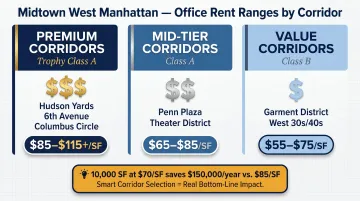
Startups evaluating Midtown West should map budget to sub-neighborhood — a 10,000 SF lease at $70/SF saves $150,000 annually versus $85/SF.
Post-Pandemic Market Shifts
Three trends define the current Midtown West market:
1. Sublease inventory shrinking: Manhattan sublease space fell below 15 million SF, down approximately 7 million SF year-over-year. Quality sublease opportunities with furniture and buildout — once abundant in corporate towers — are disappearing.
2. Landlord concessions tightening: Midtown trophy TI allowances dropped to $133/SF from $162/SF, with free rent declining to 12.5 months from 14.5 months. Startups waiting for softer terms will likely face higher effective rents and less buildout support than they'd expect.
3. Leasing volume surging: Manhattan hit 32 million SF in 2025, up 37% from 2024, with Class A leasing reaching a 30-year record. Vacancy hit 22.0% — the lowest since April 2023 — and landlords are negotiating less aggressively as a result.
Lease Structures Startups Encounter
Direct leases run 5-10 years in Class A buildings. Landlords expect credit history or personal guarantees from venture-backed startups with limited operating track records. Key parameters:
- TI allowances: $120-$150/SF (though actual buildout costs run $150-$300/SF for trophy space)
- Term length: typically 5-7 years minimum for meaningful concessions
- Credit requirements: personal guarantees common for pre-Series B companies
Subleases offer shorter terms (1-5 years), furnished space, and below-market rates. Corporate downsizing has created inventory in buildings managed by SL Green and Brookfield. The catch: you have less control over renewals, and most decisions require landlord consent from the original tenant.
Flexible/managed office (WeWork, Industrious, Convene, Regus, Spaces) eliminates TI spend entirely and offers month-to-month or 12-month commitments. Per-desk costs run higher than direct leases, but the flexibility is worth the premium for teams under 30 people or those testing the neighborhood before a longer commitment.
Financial Levers to Negotiate
Startups should focus on three variables:
- Tenant improvement allowances: Target $130-$150/SF in trophy buildings, $100-$120/SF in Class B. Remember that actual buildout costs often exceed allowances, requiring out-of-pocket capital.
- Free rent concessions: Negotiate 10-15 months free rent over a 5-7 year term to offset buildout timing and moving costs.
- Renewal options: Lock in renewal rights at predetermined rates (for example, 95% of fair market value) to avoid forced relocations when leases expire.
Beyond the core financials, push for:
- Expansion rights to adjacent space as headcount grows
- HVAC access for after-hours work (critical for engineering teams)
- Landlord flexibility on signage and buildout approvals
Office Space Options: Building Types Startups Should Know
Midtown West offers three distinct office categories — each suited to a different stage, headcount, and growth trajectory. Here's how they compare.
Class A Towers
The Penn Plaza corridor (1 Penn Plaza, Penn 2), Hudson Yards (10, 30, 50, and 55 Hudson Yards), and 6th Avenue high-rises like 1515 Broadway represent the neighborhood's top-tier inventory. These buildings deliver what enterprise tenants expect:
- Modern infrastructure: high-speed fiber, 24/7 HVAC, concierge lobbies, upgraded elevators
- Floor plates of 15,000-40,000 SF (divisible to 5,000+ SF)
- Rents ranging $75-$115+/SF depending on sub-location
- Lease terms of 5-10 years; landlords favor creditworthy tenants
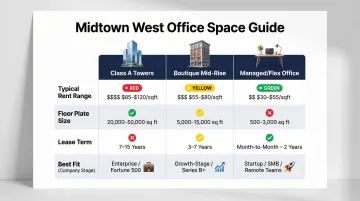
Best fit: Series B+ companies with stable headcount projections, enterprise sales teams that need client-facing space, or any company where address prestige matters for recruiting.
Worth noting: Higher per-SF costs come with the territory. Landlords are also less flexible on short-term leases, and buildout approvals move slower.
Boutique Mid-Rise and Pre-War Buildings
The West 30s and 40s Garment District and Hell's Kitchen mid-rises offer a different value proposition — smaller footprints, character-driven spaces, and landlords willing to deal.
- Floor plates: 3,000-10,000 SF
- Rents: $55-$75/SF for Class B inventory
- Lease terms: 3-5 years typical, with more room to negotiate
- Spaces often feature exposed brick, high ceilings, and large windows
This category suits 10-75 person teams that want a distinct office culture without paying Class A premiums. The trade-off: older infrastructure (always confirm fiber availability and HVAC capacity) and limited room to expand within the same building.
Managed/Flexible Office Options
For teams that need space now — or aren't ready to commit to a direct lease — Midtown West has solid flexible office coverage:
- WeWork: 1460 Broadway (Times Square), 500 7th Ave, 368 9th Ave
- Convene: 117 W 46th St, 810 7th Ave
- Industrious: 135 W 50th St
- Regus: 57 W 57th St (Columbus Circle)
- Spaces: 104 W 40th St (Bryant Park/Garment District)
These work best for teams under 30, early-stage companies testing the submarket before a direct lease commitment, or fast-pivoting teams that need month-to-month flexibility and move-in-ready space.
The cost premium is real: per-desk rates run 30-50% higher than direct lease equivalents. You also give up branding control, customization options, and private amenities.
What to Prioritize in Any Midtown West Space
Regardless of building type, these features separate functional spaces from ones that create friction as you scale:
- Column-free open floor plates — maximize collaboration and avoid locked-in layouts
- High ceilings (10+ feet) — enhance perceived space and reduce density feel
- Fiber infrastructure — confirm carrier diversity and bandwidth capacity before signing
- HVAC flexibility — negotiate after-hours access for engineering teams
- Amenity-rich ground floors — proximity to lunch, coffee, and fitness directly affects retention
Talent, Transit, and the Tech Ecosystem in Midtown West
Transit Connectivity in Numbers
Midtown West sits at the intersection of:
- Penn Station: 1,345 daily trains serving 600,000+ passengers — one train every 1.25 minutes during peak hours
- Port Authority Bus Terminal: 216,640 average weekday riders
- Times Square-42nd St subway hub: 14 subway lines converging steps from major office buildings
- Columbus Circle: A, B, C, D, 1 subway access at 59th Street
This multi-modal convergence extends the effective talent catchment area across the entire tri-state region — a structural advantage when 70%+ of your engineering team commutes from outside Manhattan.
Growing Tech and Startup Presence
While Silicon Alley historically centered on Flatiron/NoMad, Midtown West now hosts a dense mix of established tech players and enterprise anchors:
- Tech and fintech: Meta, SAP, Salesforce (310,500+ SF), Amazon, MarketAxess
- Media-tech: VaynerMedia, Intersection, Sidewalk Labs
- Enterprise SaaS: Tenants across Hudson Yards and Manhattan West including major financial services and professional services firms
Startups choosing Midtown West gain proximity to potential acquirers, enterprise customers, and talent that moves fluidly between corporate and startup environments.
Lifestyle Infrastructure for Talent Retention
Midtown West offers more than office space:
- Central Park: Northern boundary at 59th Street for lunchtime walks
- Hudson River Greenway: Continuous waterfront bike/pedestrian path
- High Line: Elevated park connecting Hudson Yards and Manhattan West
- Fitness density: Equinox, SoulCycle, Barry's Bootcamp, Peloton studio
- Dining variety: From $12 lunch spots in the Garment District to Michelin-starred options in Hudson Yards
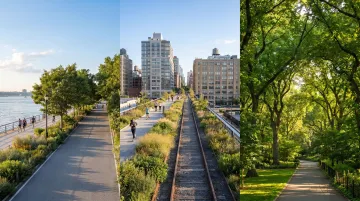
The same attributes that make Midtown West livable make it a neighborhood where employees want to show up, a real differentiator when competing against fully remote offers.
Navigating Your Midtown West Office Lease
Why Expert Representation Matters
Midtown West landlords include some of the largest institutional real estate owners: Brookfield (Manhattan West, approximately 7M SF), Related Companies (Hudson Yards), and SL Green (1515 Broadway, 810 7th Ave, and others). These landlords employ sophisticated leasing teams with decades of negotiating experience.
Startups negotiating without dedicated tenant representation face information asymmetry on:
- Current market comps and effective rents
- Standard vs. aggressive lease language
- TI allowance benchmarks and buildout cost realities
- Expansion rights and renewal option structuring
The cost of poor lease terms compounds over 5-10 years — a 5% rent premium on 10,000 SF costs $350,000+ over a seven-year term.
Typical Midtown West Leasing Timeline
Month 1-2: Initial search, market analysis, property tours (15-25 buildings)
Month 2-3: Shortlist finalization, financial evaluation, letter of intent negotiation
Month 3-4: Lease negotiation and execution
Month 4-6: Buildout design, permitting, construction
Month 6: Move-in and occupancy
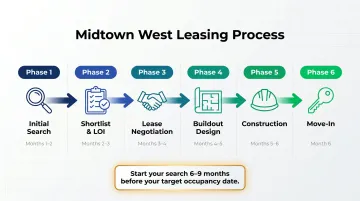
Total timeline: 3-6 months for direct leases. Startups should begin searching 6-9 months before target occupancy to avoid rushed decisions and suboptimal terms.
Sublease timelines compress to 2-4 months when space is pre-built. Flex office options offer immediate occupancy.
How Nomad Group Supports High-Growth Companies
Nomad Group helps scaling companies navigate NYC's most competitive office markets — from initial search through lease execution, buildout, and day-to-day operations. For startups evaluating Midtown West, that means going up against institutional landlords with an experienced team in their corner.
Key credentials and capabilities:
- 300+ tenant buildouts completed across NYC
- 2M+ square feet leased in Manhattan's high-growth neighborhoods
- ~90-day buildout turnaround via an in-house construction team
- Tenant-only focus — no landlord conflicts, full alignment with your growth trajectory
- Facilities support that continues after lease signing
For startups locking into 5-7 year commitments in a complex landlord market, experienced tenant representation isn't just helpful — it directly affects how much you pay and how quickly you can operate.
Frequently Asked Questions
Is Midtown West a good neighborhood?
Midtown West is one of NYC's strongest business districts, with direct transit access via Penn Station and Port Authority, top-tier amenities including Central Park and the Hudson River Greenway, and office stock ranging from boutique mid-rises to trophy towers. For companies focused on talent access and client proximity, few Manhattan neighborhoods compete.
What is Midtown West, NYC?
Midtown West is the western portion of Midtown Manhattan, generally spanning 34th to 59th Streets west of Fifth Avenue to the Hudson River, encompassing sub-neighborhoods including Hell's Kitchen, the Theater District, Hudson Yards, the Garment District, and Manhattan West.
Is Midtown Manhattan a wealthy area?
Midtown Manhattan ranks among the most economically active areas nationally, with median household income of $104,910 — approximately 32% above NYC's citywide median — and commercial real estate values that consistently place it among global top-tier markets.
What are typical commercial rent prices in Midtown West?
Class A asking rents in Manhattan average $81.89/SF, with Midtown West spanning $55-$75/SF in Class B Garment District buildings to $85-$115+/SF in trophy Hudson Yards and 6th Avenue towers — significant variation exists by sub-location and building quality.
How does Midtown West compare to Flatiron or NoMad for startups?
Flatiron and NoMad offer smaller floor plates and a startup-dense culture, while Midtown West provides stronger tri-state transit via Penn Station, larger floor plates for scaling teams (2,000–50,000+ SF), and direct access to Fortune 500 enterprise clients. Growth-stage and Series B+ companies that need room to scale often favor Midtown West for exactly those reasons.