Introduction
Queens doesn't get the same attention as Manhattan when companies start hunting for office space — but that's changing. Businesses priced out of Midtown are looking across the East River and finding something unexpected: strong transit infrastructure, a massive workforce, and rents that tell a very different story.
This guide covers what you need to know before signing a lease in Queens. That means a breakdown of the top neighborhoods, real pricing comparisons to Manhattan, the types of space available, and the lease factors that determine whether a deal actually works for your business.
Startups chasing their first permanent office, companies opening a second location, and enterprise teams rethinking real estate costs are all finding legitimate reasons to look here. The numbers and the infrastructure make a case worth hearing.
Key Takeaways
- Queens office rents in Long Island City average $49/SF — roughly 40% below Midtown Manhattan's $80.71/SF
- Long Island City is Queens' most established commercial hub, with 9.5M SF of office inventory across a range of building classes
- Three main space types: direct lease, coworking/flex, and sublease — each suited to different growth stages
- Transit access is strong — multiple subway lines, LIRR, AirTrain JFK, and major highway connections all within reach
- Working with a tenant rep broker costs tenants nothing and provides meaningful negotiating leverage
Why Queens Is Worth Considering for Your Next Office
The cost difference alone makes Queens worth a serious look. Long Island City office space averages $49.00/SF in asking rent, per Newmark's Q2 2023 NYC Office Market Overview. Midtown Manhattan sits at $80.71/SF and Midtown South at $79.30/SF, both per Colliers' Q3/Q4 2025 market reports. That's a 40–60% premium for a Manhattan address.
The Workforce Argument
Queens offers a talent pool that's hard to match anywhere else in the city. Key figures from U.S. Census data:
- 2.36 million residents with 63.1% civilian labor force participation
- 47.6% foreign-born population — one of the most diverse counties in the country
- 48,111 employer establishments reflecting a mature, active business ecosystem
- 20,849 minority-owned firms, signaling deep entrepreneurial roots
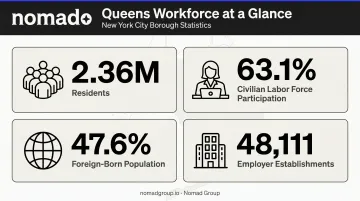
For companies hiring across industries, backgrounds, and language capabilities, that demographic breadth is a genuine recruiting advantage.
Transit Infrastructure That Actually Works
Queens is connected in ways that matter for employee commuting:
- Subway lines serving Long Island City: 7, E, M, N, and W
- LIRR access at Flushing-Main Street (Port Washington Branch) and Jamaica
- AirTrain JFK connecting through Jamaica Station
- LaGuardia Airport accessible via the free M60 SBS bus from Astoria
- Highways including the LIE and Queens-Midtown Tunnel for employees driving from Long Island or upstate
Parking costs significantly less than Manhattan too. Street meters in Queens business districts like Flushing and Jamaica run $2.50 for the first hour versus $5.50 in Manhattan Zone M1 — a meaningful operational difference for businesses with staff who drive.
Top Queens Neighborhoods for Office Space
Long Island City (LIC)
LIC is the borough's dominant commercial market — and it's not close. Newmark reports 9.5 million SF of existing office inventory with an average asking rent of $49.00/SF (Class A at $54.00/SF, Class B at $42.00/SF). The neighborhood sits minutes from Midtown via the 7, E, M, N, and W trains, making it viable even for companies with Manhattan-heavy client bases.
Recent leasing activity includes the NYC Department of Citywide Administrative Services taking 170,937 SF at 47-11 Austell Place, and The Fortune Society expanding to 91,462 SF at 29-76 Northern Boulevard in 2025. Tech companies, media firms, and professional services teams are all well-represented here.
Flushing
Flushing functions as a commercial center in its own right — particularly strong for businesses serving Asian-American communities or those that operate heavily in Northeast Queens. The dense retail and professional services ecosystem around Main Street supports a wide range of office users, and LIRR service on the Port Washington Branch provides direct rail access alongside numerous bus routes.
Hard office market data for Flushing isn't available from major brokerage sources, so local broker expertise carries more weight here than in a submarket with published data.
Jamaica
Jamaica is primarily a transit story — and it's a strong one. The station connects LIRR service, AirTrain JFK (with an $8.75 single-ride fare), subway access at Sutphin Blvd-Archer Av-JFK Airport, and a dense bus network. Companies in logistics, finance, government-adjacent sectors, and anything airport-related benefit from this connectivity.
The Jamaica Neighborhood Plan, adopted in October 2025, is projected to generate more than 2 million SF of new commercial and community facility space — signaling meaningful investment in the area's long-term development.
Astoria
Astoria offers more affordable rents than LIC and a strong creative community. Newmark data shows 4.8M SF of office inventory with 20.9% availability and standard rents around $42.85/SF. N and W train service runs the length of the neighborhood, and the M60 SBS provides a direct LaGuardia connection from Astoria Blvd — useful for teams that travel frequently.
Media companies, design studios, and small creative agencies have gravitated here for its combination of price point and neighborhood character.
Forest Hills / Rego Park
This is the quieter option — suburban in feel, well-connected by transit, and better suited to professional services firms, medical offices, or businesses that serve the local residential community. Verified office market data from major brokerages wasn't available for this submarket, but it works well for companies that don't need the density of LIC or Flushing.
Neighborhood snapshot:
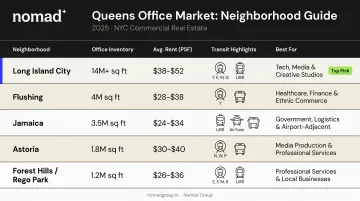
| Neighborhood | Inventory | Avg. Rent | Transit Highlights | Best For |
|---|---|---|---|---|
| Long Island City | 9.5M SF | $49.00/SF | 7, E, M, N, W trains | Tech, media, professional services |
| Flushing | N/A | N/A | LIRR, multiple bus routes | Northeast Queens-focused businesses |
| Jamaica | N/A | N/A | LIRR, AirTrain JFK, subway | Logistics, finance, airport-adjacent |
| Astoria | 4.8M SF | $42.85/SF | N, W trains; M60 SBS | Creative agencies, design studios |
| Forest Hills / Rego Park | N/A | N/A | E, F, M, R trains | Professional services, medical offices |
Types of Office Space Available in Queens
Traditional Direct Lease
A direct lease means negotiating a contract with the landlord for a defined space over a set term — typically 3 to 10 years for commercial office. This structure gives you full control over layout, buildout, and branding. It's the right choice for companies with stable headcounts and a long-term commitment to a Queens presence.
Direct leases come with real tradeoffs to weigh:
- Longer lead time before you can occupy the space
- More upfront capital required for build-out
- Less flexibility if business conditions shift
- TI allowances can offset build-out costs, but negotiating them takes time
Coworking and Flexible Office Space
LIC and Astoria have seen real coworking growth, with operators offering month-to-month terms, shared amenities, and minimal upfront commitment. This format works well for:
- Early-stage startups not ready to commit to a multi-year lease
- Companies testing a Queens presence before a larger commitment
- Teams that need overflow space alongside a primary office elsewhere
There's no verified pricing data from major brokerage sources for Queens coworking specifically, so current rates are best confirmed by contacting operators directly or working with a broker.
Sublease Space
Subleases come from tenants who have space they need to exit — and in a market with 24.5% availability in LIC, there are options. Sublease space typically comes at a discount to direct-lease asking rents, and terms are often shorter, which suits companies that want flexibility without paying coworking prices.
Before moving forward, there are a few things worth understanding: you're bound by the original lease's restrictions, the existing buildout may not fit your needs, and dealing through a sublandlord adds complexity to the relationship. Review the master lease carefully. Ultimately, the right structure — direct, sublease, or flexible — comes down to your growth stage, timeline, and how much certainty you can commit to right now.
What Does Office Space Cost in Queens, NY?
The most reliable data available comes from Newmark's Q2 2023 report on the Long Island City submarket:
| Submarket | Avg. Asking Rent | Class A | Class B | Availability |
|---|---|---|---|---|
| LIC Overall | $49.00/SF | $54.00/SF | $42.00/SF | 24.5% |
| Factory District, LIC | — | $58.89/SF (prime) | $39.52/SF | 32.4% |
| Hunter's Point / LIC Waterfront | — | $38.16/SF (prime) | $32.62/SF | 16.5% |
| Astoria | — | $36.66/SF (prime) | $42.85/SF | 20.9% |
| Midtown Manhattan | $80.71/SF | — | — | 13.1% |
| Midtown South | $79.30/SF | — | — | 13.7% |
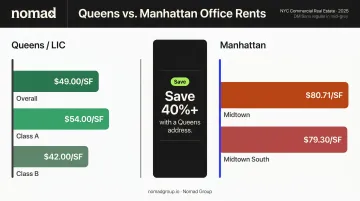
Borough-wide Queens figures aren't published by the major brokerage houses, so LIC is the best available benchmark. Neighborhoods like Flushing and Jamaica don't have publicly reported asking rent data from verified sources — a local tenant rep broker with on-the-ground Queens experience is your most reliable resource.
That said, asking rent is only part of the picture. What you actually pay per occupied seat depends on several cost layers that don't appear in any market report.
What "Asking Rent" Doesn't Include
The listed rent per square foot is rarely your total occupancy cost. Common additions:
- Operating expenses (taxes, insurance, common area maintenance) — often structured as a gross, modified gross, or NNN lease
- Utilities — sometimes included, often not
- Build-out costs — partially offset by TI allowances, but tenants frequently contribute
- Furniture, IT infrastructure, and move-in costs — one-time expenses that can add $10–$30/SF depending on fit-out level
Getting to true cost per occupied seat — not just asking rent — is one of the most valuable things a tenant rep broker provides.
Key Factors to Consider When Renting Office Space in Queens
Transit and Employee Commute
Transit breaks office moves. Before committing to any location in Queens, map where your current employees actually live. A great building in Jamaica helps nobody if 80% of your team lives in Brooklyn and faces a 75-minute reverse commute.
Before touring spaces, check:
- Which subway lines and LIRR branches serve each neighborhood
- Which bus routes fill the gaps
- How those routes actually overlap with where your workforce lives
Space Size and Scalability
Size for where you'll be in 18 months, not today. Key questions to ask:
- Does the building have adjacent space available if you need to expand?
- Can you negotiate a right of first refusal on neighboring suites?
- Is the layout configurable enough to handle headcount changes without a full renovation?
- What's the floor plate size, and does it accommodate your team's working style?
A common rule of thumb: add 20–30% buffer above your current headcount to avoid outgrowing your space before the lease is up.
Lease Terms and Landlord Flexibility
The headline rent number is rarely what drives satisfaction or regret over a multi-year lease. Pay close attention to:
- Annual rent escalations — typically 2–3% per year in NYC
- TI allowance — how much the landlord contributes to build-out
- Early termination clause — critical for companies in high-growth or uncertain environments
- Landlord experience with tenants at your stage — a landlord accustomed to large institutional tenants may not be the right partner for a 30-person startup
How to Find and Lease Office Space in Queens
The Typical Process
- Define requirements — size, budget, location priorities, must-have amenities, timing
- Market search — identify available spaces across target submarkets
- Shortlist and tour — visit properties, evaluate fit against requirements
- Negotiate the LOI — letter of intent sets the framework before full lease negotiation
- Due diligence — review building, landlord financials, lease structure
- Lease signing — legal review, final execution
- Build-out and move-in — construction, furniture, IT, occupancy
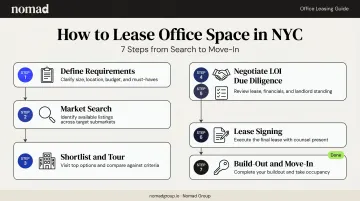
That process takes longer than most companies expect. For direct leases, Cushman & Wakefield recommends engaging advisors 12 to 24 months before lease expiration or expansion needs — enough runway to tour multiple options, negotiate from a position of choice, and avoid rushed decisions that lock you into the wrong space or terms.
Why a Tenant Rep Broker Matters in Queens
The Queens market is fragmented. Listings aren't always centralized, submarket data is harder to come by than in Manhattan, and landlord relationships vary significantly by neighborhood. A broker who works this market regularly has off-market access and comparable transaction data that you simply won't find on public platforms.
Using a tenant rep broker typically costs you nothing. Landlords build brokerage fees into their rent pricing, and those fees are paid to the broker by the landlord at closing.
Nomad Group works with scaling companies and enterprise teams across NYC — covering tenant representation, lease negotiation, construction management, and space build-out. With 300+ tenant buildouts completed and 2M+ square feet leased across the city, the team has the transaction history and submarket data that makes a real difference in lease negotiations. If you're evaluating Queens as a primary or secondary office location, they can provide current market comps and broker guidance specific to your requirements.
Frequently Asked Questions
How much does office space cost per square foot in Queens, NY?
Long Island City — the borough's most active commercial submarket — averages $49.00/SF in asking rent, with Class A space at $54.00/SF and Class B at $42.00/SF. Pricing varies by neighborhood and space type, so a broker can provide real-time comps that reflect current conditions.
Which neighborhood in Queens is best for office space?
Long Island City is the most established option, with the deepest inventory, strongest transit access, and the most lease data available. The right choice depends on where your team lives, your industry, and your budget — Astoria, Flushing, and Jamaica each serve different use cases.
What types of office space can I rent in Queens?
The three main categories are traditional direct leases (3–10 year terms with full customization), coworking and flexible office space (month-to-month, shared amenities), and sublease space (shorter terms, often below-market rents). Availability across these categories varies significantly by neighborhood.
Is office space in Queens cheaper than in Manhattan?
Yes. Long Island City asking rents average $49.00/SF versus $80.71/SF in Midtown and $79.30/SF in Midtown South — a difference of roughly 40%. For companies where occupancy cost is a meaningful line item, that gap adds up quickly across a multi-year lease.
Do I need a commercial real estate broker to rent office space in Queens?
You don't need one, but you should use one. A tenant rep broker brings market knowledge, negotiating leverage, and transaction experience, and their fee is paid by the landlord, not the tenant. In a fragmented market like Queens, that expertise is worth more than in well-documented Manhattan submarkets.
How long does it take to lease office space in Queens?
Coworking or flex arrangements can move in weeks. Direct leases typically take 3–6 months or longer from initial search through to occupancy, and Cushman & Wakefield recommends starting the process 12–24 months before your target move-in date.