Introduction
Signing a short-term office lease in Manhattan feels like the smart move when your headcount is climbing fast. You preserve flexibility, avoid overcommitting to space you might outgrow — or not need — and keep options open.
That flexibility can cut both ways. A neighboring suite opens up, a third party makes an offer on the space you've been eyeing for expansion, and suddenly you're locked out of the square footage your team needs. In a market where Manhattan Midtown South availability has dropped to 17.5% with year-to-date absorption already at positive 683,000 sq. ft. through April 2026, adjacent space doesn't stay available long.
The Right of First Refusal (ROFR) is the lease clause that protects you from that scenario — and one tenants consistently undervalue at the negotiating table. This guide covers what it means, how it works mechanically, and what tenants and landlords both need to know before signing.
Key Takeaways
- Short-term commercial leases typically run 1–3 years, offering flexibility that standard 5–10 year leases don't.
- They suit fast-growing companies that need space now but can't commit to long-term obligations.
- Key terms to negotiate include rent escalation clauses, renewal options, and early termination rights.
- Expect higher per-square-foot costs than long-term leases — the flexibility premium is real but often worth it.
- In NYC markets like NoMad, Flatiron, and SoHo, short-term deals are increasingly available as landlords adapt to tenant demand.
What Is the Right of First Refusal in a Commercial Lease?
A Right of First Refusal is a contractual clause embedded in a commercial lease that grants the tenant — called the "holder" — the first opportunity to act before the landlord can move forward with a third party. As Kessler Collins describes it, ROFR functions as an option contract that binds the landlord to offer the tenant the same terms and conditions contained in a qualifying third-party proposal.
Two Forms of ROFR in Commercial Leasing
ROFR appears in two distinct configurations, and the difference matters:
- **Right to lease additional space** — The tenant gets first opportunity to claim an adjacent suite, neighboring floor, or other specified area within the same building when it becomes available.
- Right to purchase the property — If the landlord decides to sell the building, the tenant has the first opportunity to match a qualified buyer's offer before the transaction closes.
Practical Law (Thomson Reuters) recognizes both forms as standard commercial lease provisions. That said, neither is a default right — each requires express drafting to be enforceable.
Why This Matters for High-Growth Companies
Companies scaling from 20 to 50 to 100 employees rarely know exactly when they'll need more space. ROFR solves this problem without requiring an upfront commitment: you don't pay for the adjacent suite now, but you retain the right to claim it when the moment arrives.
For Nomad Group's clients — typically venture-backed startups and Series A through Series C companies in Manhattan — this clause comes up in nearly every lease negotiation, particularly when signing into a multi-tenant building with room to expand.
ROFR must be explicitly negotiated and drafted into the lease — it is not automatic. Many tenants miss it entirely because they didn't know to ask for it.
How Does ROFR Work in a Commercial Lease?
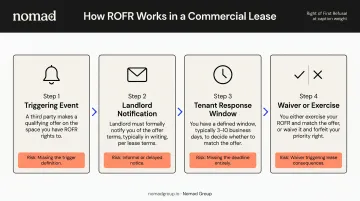
ROFR follows a clear sequence, but the details within each step are where disputes typically begin.
Step 1: The Triggering Event
ROFR doesn't run continuously. It activates when a specific condition occurs, typically one of these:
- The landlord receives a bona fide written offer from a third party for the ROFR space
- An adjacent tenant vacates, making the suite available
- The landlord expresses intent to offer the space to the market
The exact trigger must be defined in the clause. Lewis Rice describes the standard trigger as a bona fide written offer from a third party that the owner intends to accept. Vague trigger language — "when the space becomes available" without further definition — is a recurring source of litigation.
Step 2: Landlord Notification
Once triggered, the landlord must deliver written notice to the ROFR holder. A well-drafted clause specifies exactly what that notice must include. A real-world SEC lease exhibit (EX-10.22) requires the notice to contain the space description, rent amount, commencement date, lease term, allowances, and a redacted copy of the third-party proposal.
Step 3: The Tenant's Response Window
After receiving notice, the tenant has a defined period to respond. Real lease examples from SEC filings show negotiated windows of:
- 3 business days (Cricut's fourth amendment for one suite)
- 5 business days (iRhythm's lease amendment)
- 10 business days (separate SEC office lease exhibit)
There is no single "standard" window. The timeline is negotiated, and missing it typically forfeits the right for that trigger event.
Step 4: What Happens After a Waiver
If the tenant declines or fails to respond, the landlord can proceed with the third party. Whether the ROFR revives for future events depends entirely on how the clause was drafted: an "ongoing right" resets with each new trigger, while a "one-time right" expires after the first waiver.
There's also a material-terms gap to watch. If the landlord later offers the third party meaningfully better terms than those shown to the ROFR holder, some clauses require re-presenting those terms. The iRhythm amendment handles this directly: if a third party receives terms more than 10% more favorable than the original notice, the tenant gets a new three-business-day response window. Without similar language, that gap creates real exposure.
Key Requirements of a Strong ROFR Clause
A ROFR clause is only as useful as its drafting. These are the five elements that determine whether the clause holds up:
1. Clear Identification of Parties and Space
The clause must name the ROFR holder (typically the original tenant, not assignees), the granting party (landlord), and provide a precise description of the covered space. "Adjacent suite" is not sufficient. Suite 315, the entire fourth floor, or a specific wing — specificity prevents disputes about scope.
2. Defined Trigger Events
Kessler Collins identifies trigger language as a leading source of ROFR disputes. The clause should specify whether the right activates at the letter-of-intent stage or only after a fully negotiated offer exists. Each scenario has different implications: earlier triggers give the tenant more time but may interrupt preliminary landlord negotiations.
3. Pricing and Economic Terms
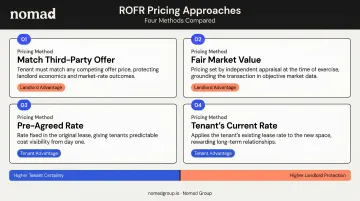
How the lease rate for ROFR space is determined needs to be spelled out. Common approaches:
- Match the third-party offer: tenant pays exactly what the third party proposed
- Fair market value: determined at time of exercise, often using an appraisal mechanism
- Pre-agreed rate: fixed in the original lease, regardless of market conditions
- Tenant's current rate: applied to the new space, which may be above or below market
Each structure has different risk profiles. Matching third-party terms protects the landlord's economics; a pre-agreed rate gives the tenant more certainty.
4. Notice and Response Requirements
The clause needs to address three specifics:
- Delivery method: email, certified mail, or both
- Response window: exact number of business days allowed
- Valid exercise: typically a written, irrevocable commitment to lease on the stated terms
5. Tenant-in-Good-Standing Condition
Both Kessler Collins and multiple SEC lease examples make ROFR exercise contingent on the tenant not being in default beyond applicable notice and cure periods. This protects landlords from being forced into an expansion lease with a tenant already behind on rent.
An experienced NYC tenant representative — Nomad Group's team has leased over 2 million square feet across NYC — can help ensure these conditions are structured in ways that don't inadvertently disqualify a tenant over minor technical issues.
ROFR vs. Right of First Offer: What Commercial Tenants Need to Know
These two rights are frequently confused, but they operate in opposite sequences.
| ROFR | ROFO | |
|---|---|---|
| Sequence | Landlord finds third party, then presents terms to tenant | Landlord negotiates with tenant first, before going to market |
| Tenant's role | Reactive — match or decline an existing offer | Proactive — receive the first offer and negotiate from there |
| Landlord's perspective | Can deter third-party interest; more operationally complex | Easier to manage; landlord controls the opening terms |
| Tenant's leverage | Defensive — prevents being shut out | Offensive — tenant influences the initial pricing |
ROFR is generally considered a preemptive right that favors the tenant. ROFO also protects the tenant but gives the landlord more control — they set the first offer terms and negotiate from a position of initiative.
Which right serves you better depends on your priorities. A ROFO often produces better pricing because you're negotiating before a competing bidder creates urgency. A ROFR gives stronger protection against being outbid — you see the actual market offer and decide whether to match it.
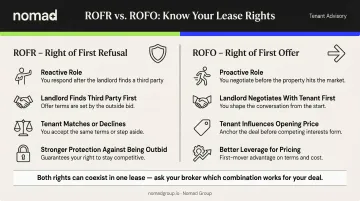
Both rights can appear in the same lease. A common structure: ROFO triggers first (landlord must negotiate with tenant before marketing), and ROFR serves as a fallback if that negotiation fails. In a tight NYC market, that combination can be the difference between staying in a space you've grown into and scrambling for alternatives on someone else's timeline.
Benefits and Risks of ROFR for Commercial Tenants and Landlords
Tenant Benefits
Space security without over-commitment. A tenant in a NoMad building might need 3,000 sq. ft. today and 6,000 sq. ft. in 18 months. ROFR lets that company lock in priority access to the adjacent suite without paying for it until growth demands it — a real advantage when inventory is shrinking.
Flora, one of Nomad Group's clients, doubled their office footprint within 30 days of moving in at 300 Kent Avenue. That kind of rapid expansion is far smoother when expansion rights are built into the original lease.
ROFR also provides competitive protection. It prevents an incompatible business — a direct competitor, a high-traffic operation, or a company whose culture simply doesn't fit — from moving into the space next door. In a boutique building where shared hallways and elevator banks matter, this is worth negotiating for.
Landlord Risks
Landlords carry most of the downside risk when ROFR clauses are poorly structured. Two issues come up consistently:
- Market deterrence. Third-party prospects often won't spend time and legal fees negotiating a lease an existing tenant can simply match. This slows lease-up — especially for smaller landlords with limited spaces — which is why many resist granting ROFR to newer tenants without an established payment history.
- Litigation exposure. Ambiguous language around trigger events, "material change" definitions, assignment limitations, and default conditions generates disputes. The New York case Long Beach Med. Ctr. v 249 E. Park Corp. shows how even mutually understood ROFR clauses can end up in litigation over trigger conditions and required documentation. Precision in drafting is the only real mitigation.

Frequently Asked Questions
What is the right of first refusal in a commercial lease?
ROFR is a lease clause giving an existing tenant the first opportunity to lease additional space or purchase the property before the landlord accepts a third-party offer. Tenants must negotiate it explicitly — standard commercial lease forms don't include it.
How common is the right of first refusal in commercial leases?
ROFR appears regularly in commercial leases but isn't universal. Tenants must request it during negotiations, and landlords frequently push back.
What are the requirements of a right of first refusal in a commercial lease?
A valid ROFR clause must include:
- Clear identification of the tenant and covered space
- A precisely defined trigger event
- Specified notice and response deadlines
- Pricing or rate terms
- A condition that the tenant is not in default at exercise
What is the difference between right of first refusal and right of first offer?
ROFO requires the landlord to negotiate with the tenant before going to market. ROFR allows the landlord to solicit third-party offers first, then present them to the tenant. In practice, ROFO gives tenants more leverage upfront, while ROFR functions as a safety net after the market has already been tested.
Can a landlord refuse to include a right of first refusal clause?
Yes. Landlords are not obligated to grant ROFR and often resist due to operational complexity and the deterrent effect on other prospects. Tenants negotiate ROFR most successfully when they have a strong payment history, a larger footprint, or experienced broker representation on their side.
What happens if a tenant doesn't exercise their ROFR in time?
Failure to respond within the specified window typically waives the right for that trigger event, and the landlord may proceed with the third party. Depending on how the clause was drafted, the ROFR may be permanently extinguished rather than reset for future opportunities.