Many tenants entering their first or second long-term lease assume abatement is standard, confuse it with a permanent rent reduction, or fail to capture it clearly in the lease language. That's a costly mistake. Depending on your lease size, a well-negotiated abatement period can represent $50,000 to several hundred thousand dollars in real cash savings during your buildout and ramp-up phase.
This guide covers what rent abatement actually is, why landlords offer it, how it's structured in a lease, and what to watch out for before you sign.
Key Takeaways
- Rent abatement is a temporary suspension of rent — most often offered at lease signing as a landlord concession, not a discount on your ongoing rate.
- It must be negotiated and written into the lease — it is never automatic.
- During most "free rent" periods, tenants still owe operating expenses, taxes, and utilities.
- If you default, landlords can recapture all abated rent — review this clause before signing.
- Savills Q4 2025 data puts average Manhattan Class A rent abatement at 14.6 months for new leases.
What Is Rent Abatement in a Commercial Lease?
Rent abatement is a contractual concession in which a landlord temporarily suspends or reduces a tenant's rent obligation. It appears in two distinct contexts:
- As a negotiated lease incentive — commonly called "free rent," this is a defined number of months at the start of a lease during which base rent is waived.
- As a remedial right — triggered by specific events, such as casualty damage, landlord-caused interference, or failure to deliver the space on the agreed date.
Abatement vs. Rent Reduction
These are not the same thing. Abatement is temporary — tied to a defined period or a triggering event. A rent reduction changes the ongoing rent rate, either permanently or across a structured term. Treating them as interchangeable leads to misaligned expectations during negotiations.
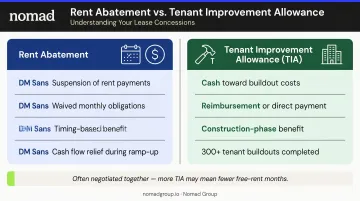
Abatement vs. Tenant Improvement Allowance (TIA)
Both are landlord concessions, but they work differently:
| Concession | What It Is | How It's Delivered |
|---|---|---|
| Rent Abatement | Suspension of rent payments | Waived monthly obligations |
| TIA | Cash toward buildout costs | Reimbursement or direct payment |
These are separate negotiating points, typically pursued together. In buildout-heavy deals, a larger TIA often trades off against fewer free-rent months — understanding how they interact gives tenants more leverage at the table.
Why Landlords Offer Rent Abatement
The short answer: vacancy is expensive. A landlord who offers three months of free rent on a five-year lease still captures years of income, while avoiding the cost and time of re-marketing an empty space.
Market Conditions Drive Concessions
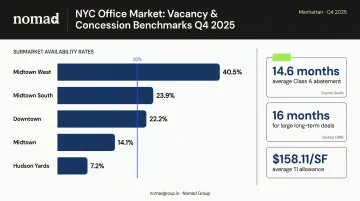
When vacancy is elevated, tenants hold real leverage. Manhattan's office market heading into 2026 reflects exactly that. According to Cushman & Wakefield's Q4 2025 report, overall Manhattan office vacancy stood at 21.1%. Avison Young's submarket availability figures tell a similar story:
- Midtown: 14.1% available / 14.1% vacant (Midtown South: 23.9% / 16.4%; Downtown: 22.2% / 16.7%)
In markets like these, landlords compete for creditworthy tenants. Free rent periods lengthen, TI allowances grow, and well-qualified tenants can push harder on concessions than they might expect.
The Buildout Rationale
Market conditions explain one driver. The other is purely practical. When a tenant is customizing a raw or partially-built space, they can't productively use it during construction. Landlords commonly grant a rent-free window that aligns with the buildout period — recognizing that asking for rent before a space is occupiable is unreasonable and a concession landlords rarely win.
How Rent Abatement Is Structured in a Commercial Lease
Every abatement provision should clearly define:
- The period — exact start and end dates
- The scope — full rent waived, or partial reduction
- Conditions — what must remain true for abatement to apply
- Consequences — what happens if conditions are breached, including recapture
Negotiated Concession Abatement (Free Rent Period)
This is the most common form. A defined number of months at lease commencement during which base rent is waived. However, "free rent" in a commercial lease is almost never completely free. Tenants typically remain responsible for:
- Operating expenses (CAM charges)
- Real estate tax pass-throughs
- Building insurance allocations
- Utilities
Base rent is waived — but additional rent obligations continue, and tenants who assume otherwise often face unexpected cash outflows during a period they planned to be cost-free.
Casualty and Damage Abatement
If a fire, flood, or other casualty renders the premises partially or fully unusable, most commercial leases include a provision abating rent in proportion to the loss of use. The critical details to nail down:
- How is "unusable" defined?
- What's the landlord's restoration timeline?
- What termination rights does the tenant have if restoration drags on?
Without tight definitions, tenants can end up paying full rent on space they have no ability to occupy.
Abatement for Delayed Possession
Casualty clauses address what happens after move-in. Delayed possession addresses what happens before it. If a landlord doesn't deliver the space on the agreed commencement date, a well-drafted lease should automatically abate rent for the delay. Without this clause, tenants may owe rent on space they can't yet access — a serious exposure for companies already paying rent on an expiring lease elsewhere.
Key Factors That Affect Rent Abatement Negotiations
Market Conditions and Lease Length
In high-vacancy submarkets, tenants can push for more. The benchmarks from the current NYC market reflect this:
- Savills Q4 2025 data shows Manhattan new Class A leases averaged 14.6 months of rent abatement and $158.11/SF in TI allowance.
- For large, long-term, high-end deals (25,000+ SF, 10+ years, asking rents at $100+/SF), CBRE data from 2023 showed averages reaching 16 months of free rent.
Lease length drives the math directly. A tenant signing a 10-year lease gives the landlord far more revenue to offset a concession against than a tenant on a 3-year term — longer commitments justify larger concessions, and landlords know it.
Tenant Creditworthiness
Landlords evaluate how much risk they're absorbing when they front-load concessions. A well-funded company with a strong balance sheet — or one backed by institutional investors — is in a notably stronger position than a tenant with unclear financials.
For tenants with less established credit, landlords may require a larger security deposit to offset the abatement risk. This can be a productive trade: offering more security upfront in exchange for more free rent months.
Recapture Clauses — What Tenants Must Watch For
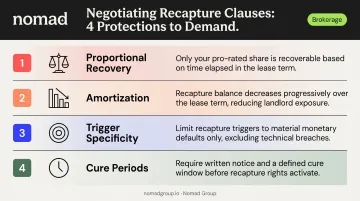
That same risk calculus shapes how landlords protect themselves in the lease itself. Most commercial leases include a recapture provision allowing the landlord to reclaim abated rent if the tenant defaults and terminates early — converting a negotiated concession into a repayment obligation that can extend to guarantors depending on lease language.
Key points to negotiate:
- Proportional recovery — if you're three years into a five-year lease, only a pro-rated share of abated rent should be recoverable, not the full amount
- Amortization — structure recapture as an amortizing balance that declines over the lease term
- Trigger specificity — limit recapture to material monetary defaults, not minor or technical ones
- Cure periods — require notice and a cure window before recapture kicks in
An experienced tenant broker will catch aggressive recapture language before it becomes a liability. Nomad Group's team routinely reviews and pushes back on these provisions as part of lease negotiations — across 2 million+ square feet of NYC deals, it's one of the most commonly overlooked exposure points tenants face.
Space Condition and Buildout Requirements
Raw shell spaces require significantly more tenant work — and justify longer abatement periods. Second-generation spaces with existing improvements may come with shorter or no free rent, since the landlord has already invested in the buildout. Understand what you're walking into before anchoring your abatement ask.
Common Misconceptions and Pitfalls
Misconception: Free rent is automatic. Abatement is never a given. It must be proposed, negotiated, and explicitly written into the lease — with exact dates, conditions, and scope spelled out. Tenants who assume it comes standard often discover otherwise after signing.
Misconception: Abatement suspends everything you owe. Base rent is typically the only obligation paused. These costs almost always continue through an abatement period:
- Operating expenses
- Real estate taxes
- Insurance pass-throughs
- Utilities
Plan your cash flow with these obligations in mind before negotiating abatement terms.
Pitfall: Vague casualty abatement language. Many standard lease templates include casualty provisions that are ambiguous about the damage threshold required to trigger abatement, the restoration timeline, and the tenant's termination rights. These clauses need legal review and often need to be strengthened before signing. Discovering weak protections after a damaging event is too late to fix anything.
Review casualty language carefully — it's one of the most overlooked sections in any commercial lease.
When Rent Abatement May Not Apply
There are situations where pushing for abatement isn't the right move, or won't succeed:
- Highly competitive submarkets with low vacancy — in tight markets, landlords have less incentive to offer concessions. Hudson Yards, for example, showed availability of just 7.2% per Avison Young's Q4 2025 data — a very different negotiating environment than Midtown West at 40.5%.
- Short-term or month-to-month leases — landlords won't front-load concessions on arrangements with limited revenue certainty.
- Spaces with substantial existing improvements — second-generation buildouts reduce the landlord's rationale for a rent-free construction period.
In these scenarios, shift focus to lower base rent, a larger TI allowance, or more favorable renewal and expansion options.
Some landlord-friendly leases — particularly in older Manhattan office buildings or triple-net leases — contain language that limits or outright eliminates casualty abatement rights, placing restoration responsibility on the tenant. Identify and negotiate around these clauses early.
Conclusion
Rent abatement can work in your favor — but only when it's properly negotiated, clearly documented, and fully understood. That means knowing what you still owe during the abatement period and what recapture exposure you're accepting before you sign.
For companies navigating lease negotiations in NYC, who represents you at the table matters. Nomad Group works exclusively on behalf of tenants across Manhattan's core neighborhoods, ensuring every concession — from free rent to TI allowances to casualty protections — is negotiated with full market context and lease-level precision.
Frequently Asked Questions
Is rent abatement the same as free rent in a commercial lease?
"Free rent" is the most common form of rent abatement — it's a period where base rent is waived as a lease-signing incentive. But abatement also encompasses remedial rights triggered by events like casualty damage or delayed possession. The terms are often used interchangeably, though they're technically distinct.
How much rent abatement can I realistically negotiate for a commercial lease in NYC?
It depends on lease length, space type, and market conditions. For context, Savills reported that Manhattan Class A leases in Q4 2025 averaged 14.6 months of rent abatement. Longer leases in higher-vacancy submarkets generally yield more. Short-term leases in tight markets will produce far less.
Do I still have to pay expenses during a rent abatement period?
In most commercial leases, yes. Base rent is abated, but operating expenses, real estate taxes, and utilities typically continue. Confirm exactly which obligations are suspended in the lease language — don't assume everything is paused.
Can a landlord take back abated rent if I break my lease early?
Most commercial leases include a recapture provision allowing the landlord to recover abated rent upon tenant default. Negotiating proportional or amortized recapture terms limits this exposure — and make sure cure periods are included before any recapture can trigger.
Does rent abatement apply if my office space is damaged and I can't use it?
Well-drafted leases include casualty abatement provisions that reduce rent proportionally when space is damaged and unusable. However, the scope, trigger thresholds, and termination rights vary significantly by lease — ensure these protections are explicitly defined before you sign.
Is abated rent considered taxable income or a deductible expense?
Tax treatment depends on the specific lease terms, accounting method, and whether Section 467 of the tax code applies. ASC 842 also changes how companies record free rent periods on financial statements. Consult a CPA or tax advisor to understand the treatment for your specific situation.