Key Takeaways
- Grand Central holds nearly 44 million square feet of office inventory — NYC's largest submarket by size
- Average asking rents run $67.26/SF overall and $71.22/SF for Class A space (Q3 2025, Cushman & Wakefield)
- Space types range from sub-500 SF furnished suites to full floors of 10,000+ SF in landmark towers
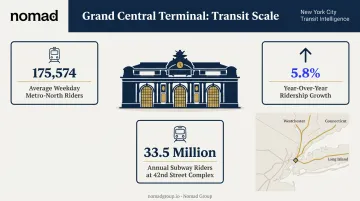
- 175,574 average weekday Metro-North riders use Grand Central Terminal, making this submarket NYC's most commuter-accessible office cluster
- Tenant-side brokers are paid by landlords — meaning expert lease negotiation costs you nothing out of pocket
Why Grand Central Is One of NYC's Top Office Markets
The office leasing market has shifted decisively toward transit-accessible neighborhoods since 2020. Companies bringing teams back to the office are prioritizing locations that are easy to get to — and Grand Central sits at the center of that demand.
According to CBRE's 2025 Americas Office Occupier Sentiment Survey, 53% of occupiers would reject a building without nearby public transportation. Grand Central doesn't just clear that bar — it defines it. Metro-North recorded 175,574 average weekday riders through the terminal in Fall 2024, up 5.8% year-over-year. The Grand Central–42nd Street subway complex adds another 33.5 million annual riders on top of that.
Prestige, Talent, and the Neighborhood Around It
A Midtown East address near Grand Central signals stability to clients, partners, and job candidates. The submarket is dense with financial services firms, law practices, and enterprise companies — including Guggenheim Partners, which recently expanded and renewed 360,000 SF at 330 Madison Avenue. That kind of institutional tenant activity shapes how the neighborhood is perceived.
Metro-North's reach into Westchester, Connecticut, and Long Island puts a broad commuter workforce within reasonable distance of a Grand Central office. For companies competing for experienced professionals who live outside Manhattan, that's a concrete recruiting advantage.
The neighborhood also supports retention once employees are in. Within a few blocks of the terminal:
- Grand Central Terminal houses dozens of restaurants and food vendors
- The 42nd–44th Street corridor offers retail, fitness studios, and cultural venues
- Daily foot traffic creates a walkable, active environment that makes coming in feel worthwhile
That kind of infrastructure matters when you're asking people to commute.
Industry Mix and Networking Density
Finance, law, media, and tech all maintain significant footprints in this submarket. Operating here means proximity to potential clients and partners — the informal deal-making that happens at lunch, in lobbies, and at neighborhood events is a genuine business advantage that's hard to replicate in a less concentrated market.
Types of Office Space Available Near Grand Central
The submarket accommodates nearly every lease structure and company size. Here's a practical breakdown:
Traditional Direct Leases
Best for mid-size to enterprise tenants with established headcounts and a clear need for branded, customized space. Typical terms run 5–10+ years. Many buildings offer pre-built suites (spaces already fitted with conference rooms, open workspace, and kitchens), which cuts both buildout costs and time to occupancy.
Short-Term and Flexible Leases
Month-to-month or 1–2 year terms through managed or serviced office providers. The tradeoff is real: flexibility costs more per square foot, but upfront capital requirements are lower and operational overhead is minimal. These work well for companies testing a new market, bridging a gap between leases, or expanding into a second location without a long-term commitment.
Coworking and Shared Environments
Hot desks, dedicated desks, and private offices within shared campuses give small teams immediate occupancy with no long-term commitment. The networking upside is genuine — but scaling teams often outgrow these environments faster than expected, and the economics shift quickly once headcount grows.
Furnished and Plug-and-Play Suites
Pre-built spaces with existing furniture, cabling, and sometimes IT infrastructure already in place. These are popular for companies that need to be operational in weeks rather than months — a genuine priority after closing a funding round or landing a major client.
Building Class: A vs. B
| Class A | Class B | |
|---|---|---|
| Avg. Rent | ~$71.22/SF | Below market average |
| Amenities | Superior lobbies, building systems, on-site services | Functional, less polished |
| Best For | Client-facing teams, senior talent recruitment | Internal ops teams, cost-sensitive tenants |
| Positioning | Premium brand signal | Strong value play |
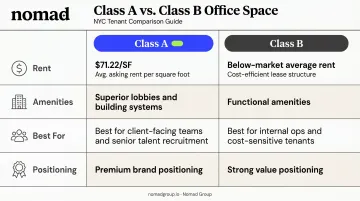
For companies competing for senior talent or hosting clients regularly, Class A often justifies the premium. For internal teams where location matters more than lobby aesthetics, Class B delivers solid value.
Key Factors to Evaluate Before Signing a Lease
Transportation Alignment
Before touring a single space, map where your team actually lives. Grand Central works well for employees commuting from Westchester, Connecticut, and Long Island via Metro-North, and for subway-dependent commuters across the five boroughs. If most of your team comes in from New Jersey, a different submarket may serve them better. Companies that skip this step often discover the problem only after signing — when attrition from a difficult commute starts showing up in retention data.
Lease Structure and Hidden Costs
Three lease types dominate NYC commercial real estate:
- Gross lease — tenant pays a fixed rent; landlord covers most operating expenses
- Net lease — tenant pays base rent plus some or all operating expenses separately
- Modified gross lease — a hybrid where specific costs are split between landlord and tenant
Watch for these commonly overlooked cost items:
- Electricity charges (often billed separately)
- Porter's wage escalations
- Real estate tax passthroughs
- Operating expense reconciliations
Read every "additional rent" clause before signing. These provisions can add hundreds to thousands of dollars to your monthly cost.
Buildout Timeline and Delivery Condition
The condition a space is delivered in affects both your budget and your move-in date:
| Delivery Condition | What It Means | Typical Timeline |
|---|---|---|
| Furnished/plug-and-play | Move-in ready | Weeks |
| Pre-built | Minor customization needed | 4–8 weeks |
| White-box | Basic finishes, needs fit-out | 2–4 months |
| Raw/shell | Full buildout required | 3–6+ months |
Nomad Group's construction management team typically delivers tenant buildouts in 90 days — faster than the industry standard — which matters when lease commencement and rent obligations start regardless of whether your space is ready.
Space Sizing
JLL's occupancy benchmarking data shows average office space per person has declined from 171 to 165 rentable SF, with organizations targeting closer to 132 rentable SF in hybrid environments. Factor in:
- Conference rooms and phone booths
- Private offices for leadership
- Kitchen and lounge areas
- Growth runway for the next 2–3 years
Under-sizing forces a disruptive mid-lease search. Over-sizing burns rent dollars from day one. Build in a realistic growth buffer — 15–20% above current headcount is a reasonable baseline for a 3-year term.
Scalability Clauses
For high-growth companies, these lease provisions are non-negotiable:
- Expansion rights — first right to adjacent space as you grow
- Renewal options — ability to extend at pre-agreed terms
- Early termination provisions — structured exit option when business conditions change
Negotiate these before signing. Landlords are far more flexible on these points during initial negotiations than after a lease is executed.
Office Space Costs in the Grand Central Market
Cushman & Wakefield's Q3 2025 Manhattan Office MarketBeat puts the Grand Central submarket at:
| Metric | Value |
|---|---|
| Total inventory | 43.9 million SF |
| Overall vacancy rate | 21.5% |
| Overall average asking rent | $67.26/SF |
| Class A average asking rent | $71.22/SF |
| Sublease vacant space | 1.48 million SF |
| YTD leasing activity | 2.5 million SF |
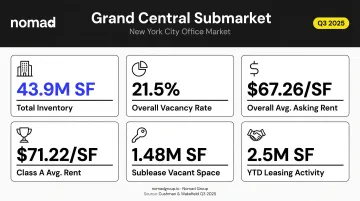
A 21.5% vacancy rate means tenants have real negotiating leverage right now. Sublease space from departing tenants is listed below market, pushing effective rents down further. Midtown-wide sublease asking rents averaged $60.74/SF as of June 2025 — a clear advantage for tenants who can move quickly.
Calculating True All-In Cost
Base rent is only part of the picture. A realistic monthly cost calculation includes:
- Base rent (your headline figure)
- Electricity — often $3–5/SF annually in older buildings
- Operating expense escalations — costs that increase as the building's expenses rise
- Tenant improvement allowance offset — TI money from the landlord reduces buildout cost, but has limits
- Furniture and IT buildout — not covered by TI unless negotiated
- Move-in costs — security deposit, first/last month, moving expenses
Model total occupancy cost on a monthly basis. For a 5,000 SF lease, the gap between headline rent and true all-in cost can easily run $20,000–$40,000 annually — enough to shift which options actually pencil out.
Notable Buildings and Streets in the Grand Central Submarket
The Core Corridors
- Park Avenue (42nd–50th Street): Trophy towers, financial services concentration, premium rents
- Lexington Avenue: High volume of mid-size tenants, direct terminal access at key buildings, strong value-to-prestige ratio
- Madison Avenue: Mix of institutional and boutique tenants; 330 Madison recently saw major activity with Guggenheim's renewal
- 42nd–44th Street corridor: Highest density of commuter-accessible buildings, variety of building classes
Buildings Worth Knowing
420 Lexington Avenue (The Graybar Building): Direct pedestrian access to Grand Central Terminal. Home to Graybar 19, an 18,000 SF tenant conference center with dedicated staff and A/V infrastructure. Managed by SL Green.
One Grand Central Place, 60 East 42nd Street: Fully renovated by Empire State Realty Trust. The first portfolio in the Americas to achieve WELL Certification. Upgraded systems throughout including windows, HVAC, elevators, and security.
10 Grand Central, 155 East 44th Street: Marx Realty property with 18,000+ SF of hospitality-designed amenity space across two levels, including The Meeting Galleries with indoor and outdoor configurations.
400 Madison Avenue — New institutional ownership completed a major capital improvement program here. It draws a strong financial services tenant base.
Not every company needs a Park Avenue address. For tenants watching the budget, there's a viable alternative a few blocks west.
Fifth Avenue Options for Cost-Conscious Tenants
Buildings along Fifth Avenue in the high-40s to low-50s blocks — including 551 Fifth and 501 Fifth — sit within easy walking distance of Grand Central while pricing below the core Park and Lexington corridors. For companies that want a Midtown presence without the top-of-market rent, these addresses offer a credible middle ground.
How to Find and Secure the Right Grand Central Office Space
Start With a Clear Brief
Tenants who enter the market without defined requirements waste time — sometimes months — on misaligned tours. Before reaching out to anyone, nail down:
- Current headcount and 24-month growth projection
- Target square footage range
- Preferred lease type and term
- Hard budget (base rent and all-in monthly)
- Required move-in date
- Must-have amenities (private offices, conference rooms, outdoor space, etc.)
Work With a Tenant-Side Broker
A tenant representation broker works exclusively for you — not the landlord. They have access to both publicly listed and off-market spaces, can benchmark any proposal against comparable recent deals, and negotiate lease terms on your behalf. Their fee is paid by the landlord, not you.
Nomad Group's tenant representation practice has leased 2M+ square feet across NYC and completed 300+ tenant buildouts. The team covers the Grand Central submarket alongside Flatiron, Union Square, NoMad, and SoHo — and because they also manage construction in-house, they can take a deal from signed lease to occupied space without the coordination gaps that slow most buildouts down.
The Leasing Timeline
- Define requirements — headcount, budget, timeline, and must-haves
- Tour and shortlist — typically 6–10 spaces narrowed to 2–3 finalists
- Issue an RFP or letter of intent to the landlord
- Negotiate lease terms: rent, TI allowance, escalations, flexibility clauses
- Complete due diligence — legal review and building inspection
- Sign the lease with delivery date confirmed
- Buildout and move-in — construction, furniture, IT, and operations
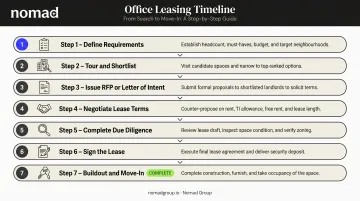
Having one partner manage both brokerage and buildout — as Nomad Group does — compresses steps 6 and 7 significantly. The typical friction point in any lease is the gap between "signed" and "operational." With in-house construction, that gap shrinks to roughly 90 days.
Frequently Asked Questions
How much does office space near Grand Central cost per square foot?
Asking rents in the Grand Central submarket average $67.26/SF overall and $71.22/SF for Class A space as of Q3 2025. Budget for additional costs including electricity, operating expense escalations, and any buildout expenses beyond what a tenant improvement allowance covers.
Is Grand Central a good location for startups?
Yes — particularly for teams with members commuting from outside Manhattan. Furnished and pre-built suites make smaller footprints financially viable, and the submarket's proximity to investors and enterprise clients gives startups a real advantage when pitching investors or landing enterprise clients nearby. Startups should prioritize lease flexibility and carefully model all-in costs before committing.
What's the difference between a traditional lease and a flexible office arrangement?
Traditional leases offer lower per-SF costs, full customization, and long-term stability — but require a multi-year commitment and upfront buildout investment. Flexible or serviced offices cost more per square foot but require minimal upfront capital and can be exited quickly. The right choice depends on your growth certainty and budget structure.
What size office spaces are available near Grand Central Station?
The submarket accommodates a wide range: sub-500 SF suites in boutique buildings for very small teams, mid-size floors of 2,000–5,000 SF for growing companies, and full floors of 10,000–15,000+ SF in major towers for larger organizations. Options span boutique buildings to Class A towers across the submarket.
How long does it typically take to move into a leased office near Grand Central?
Furnished or plug-and-play spaces can allow occupancy in a matter of weeks. White-box or raw spaces requiring full construction typically take 3–6+ months depending on scope and permitting. Nomad Group's in-house construction management targets a 90-day buildout turnaround, which is faster than typical market timelines.
Do I need a broker to find office space near Grand Central?
You can search independently, but a tenant-side broker adds real value: access to unlisted spaces, rent benchmarking against recent comparable deals, and professional lease negotiation. Since landlords pay broker fees, the service costs tenants nothing — making it a straightforward decision in any office search.