Introduction
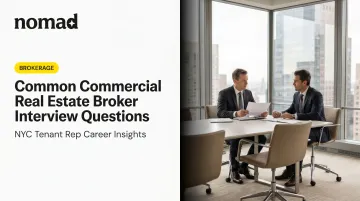
Getting a commercial real estate broker role in New York City is competitive. The city has over 77,000 active real estate salespersons statewide, and firms like Nomad Group — which operates across Flatiron, NoMad, SoHo, and Williamsburg — aren't hiring generalists. They're hiring people who can walk into a client meeting and immediately demonstrate market credibility.
Most candidates who struggle in CRE broker interviews don't fail on experience. They fail on preparation. Common gaps include vague deal examples, no knowledge of submarket trends, and questions that make it obvious they didn't research the firm beforehand.
This guide covers the most common questions you'll face, what interviewers are actually evaluating with each one, and how to close strong with questions of your own.
Key Takeaways
- CRE broker interviews test three things: market knowledge, client relationship skills, and your deal track record.
- Expect behavioral, market-specific, and deal experience questions — you need to prepare across all three.
- Asking sharp questions signals preparation and genuine interest just as much as answering well.
- NYC-focused firms expect specific submarket fluency, not general neighborhood awareness.
What to Expect in a Commercial Real Estate Broker Interview
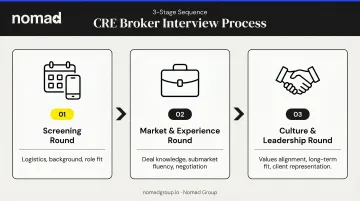
Most CRE broker interviews unfold across multiple conversations, not one. A typical sequence starts with an initial screening — often with an office manager or HR contact. From there, it moves to a deeper market and experience conversation with a principal or director, and sometimes ends with a culture-fit discussion at the senior leadership level.
Each round shifts in focus:
- Screening: Logistics, background, fit with role requirements
- Market/experience round: Deal knowledge, submarket fluency, negotiation approach
- Culture/leadership round: Values alignment, long-term fit, how you'd represent the firm to clients
Tenant Rep vs. Landlord Rep Interviews
The role type shapes what interviewers emphasize:
- Tenant rep interviews lean toward client advisory skills, search process management, and lease negotiation — how you identify options, narrow them down, and guide a client to the right decision
- Landlord rep interviews focus more on asset knowledge, leasing velocity, and your ability to market a building's strengths to prospective tenants
Some full-service firms handle both sides. At Nomad Group, for example, the tenant-first brokerage model runs alongside asset management services — so candidates may be expected to understand landlord dynamics even when their primary focus is tenant representation.
What doesn't change across any of these formats is this: interviewers are evaluating how you communicate, whether your questions reflect real market knowledge, and whether your deal experience holds up under follow-up. Preparation matters at every stage.
Behavioral and Background Questions
"Walk me through your background."
This is almost always the first question. Don't recite your resume. Instead, structure your answer to show progression — how your experience has moved you toward commercial real estate specifically, and why this brokerage role makes sense as the next step.
Strong answers connect the dots between past roles and CRE. Weak answers are chronological summaries that don't explain why this career, why commercial (not residential or investment sales), and why this firm.
"Why commercial real estate?"
Interviewers probe for conviction here. Rehearsed answers about "passion for the industry" don't land. What lands: a specific moment or experience that drew you in — the deal complexity, the relationship-driven nature of the business, or both.
If you came from sales, consulting, or finance, explain what CRE offers that those paths don't. Be specific.
"Tell me about a deal you worked on."
Few questions reveal more than this one. Prepare a specific example that covers:
- The client's need and situation
- How you identified and presented options
- Any obstacles — financing snags, competing offers, indecisive decision-making
- How the deal closed, or why it didn't
A failed deal, handled well, is just as compelling as a closed one. Interviewers respect candidates who can say what went wrong and what they'd do differently.
"Describe a difficult client situation and how you handled it."
Emotional intelligence is what's being assessed here. The scenario interviewers want to hear: you held a client's trust through uncertainty, communicated clearly when news was bad, and kept the process moving rather than going quiet.
What they don't want to hear: a situation that only sounds difficult because the deal terms were complicated, with no real human tension involved.
"What's your approach to prospecting?"
Interviewers use this question to distinguish brokers who build a business from those who chase one-off deals. A strong answer covers:
- Specific outreach methods (cold outreach, referrals, industry events)
- How you qualify a prospect before investing significant time
- How you maintain relationships over months or years without a live deal on the table
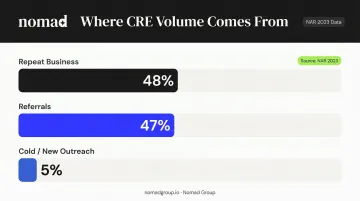
According to NAR's 2023 Profile of Real Estate Firms, firms generate a median of 48% of sales volume from repeat business and 47% from referrals. A broker who only pursues cold leads is leaving the majority of their potential volume on the table.
Market Knowledge and Deal Experience Questions
"How do you stay current on market conditions?"
Naming CoStar and a few market reports is a start. The best answers show you synthesize data into something useful for clients — not just forward a Cushman & Wakefield MarketBeat.
The real test is translation: what does Manhattan's Q4 2025 overall vacancy sitting at 21.1% actually mean for a tenant negotiating a lease renewal in Midtown South, where vacancy runs higher at 23.9% and average asking rents sit at $83.58 per square foot? That's the answer interviewers remember.
Resources worth knowing before your interview:
- CoStar (deal database, comps, availability tracking)
- Cushman & Wakefield and Colliers quarterly market reports for Manhattan
- NAR's RPR Commercial platform
- Commercial Observer, Bisnow, and The Real Deal for deal news
"What submarkets or property types do you know best?"
Speak to at least two or three neighborhoods with specific detail — not "Midtown is strong" but rather what's happening with rents, vacancy, and notable transactions in that submarket. Firms with concentrated NYC focus, like Nomad Group operating across NoMad, Flatiron, SoHo, and Williamsburg, will probe here seriously.
If you can't speak fluently to at least the general dynamics of a firm's core submarkets, that gap is hard to recover from mid-interview.
"Walk me through how you'd evaluate a commercial office space for a tenant client."
This tests deal process competency. A complete answer covers:
- The tenant's headcount, space requirements, and growth trajectory
- Budget parameters and target lease term
- TI allowance expectations and build-out needs
- How you'd structure and present competing options to guide the decision
The technical evaluation is table stakes. What separates strong candidates is showing you can build a clear recommendation — not just a spreadsheet of options.
"What lease structures are you familiar with?"
Know the differences between gross, modified gross, NNN, and full-service leases — and more importantly, know how to explain them to a client without defaulting to jargon. Per Holland & Knight's 2026 legal overview, here's the quick breakdown:
| Lease Type | How Expenses Work |
|---|---|
| Gross / Full-Service | Landlord bundles operating expenses, taxes, and insurance into a fixed rent |
| NNN (Triple Net) | Tenant pays base rent plus a proportional share of taxes, insurance, and maintenance |
| Modified Gross | Negotiated split — often uses a base-year concept to cap tenant exposure |
The practical question in office leasing: can you explain these trade-offs to a founder signing their first commercial lease?
"How do you approach lease negotiations on behalf of a tenant?"
Structure your answer around a clear framework:
- Understand the landlord's priorities (occupancy timing, creditworthiness, lease term)
- Identify the tenant's leverage points — competing options, move-in timing flexibility, term length
- Sequence concessions strategically so you're not trading your strongest chips early
- Keep the client informed and confident throughout what can become an adversarial process
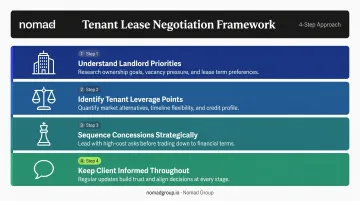
Firms like Nomad Group, where tenant advocacy is a core value, want to see you treat negotiation as a strategic process, not just a back-and-forth on price.
Client Development and Business Development Questions
"How do you build and maintain your client book?"
This reveals whether you think transactionally or relationally. Strong answers describe a deliberate system: staying connected to past clients, earning referrals without being transactional about it, and positioning yourself as an advisor worth calling before a lease decision becomes urgent.
If your outreach only happens when you have a live deal to pitch, interviewers will notice.
"How do you differentiate yourself to a client already working with another broker?"
Lead with insight, not price. Undercutting on commission signals desperation. Instead, demonstrate credibility through market knowledge, relevant experience with similar companies, or a specific angle the current broker isn't providing.
Ask about the client's situation before making a case for yourself. The real question to answer isn't "why should you hire me?" — it's "what does this client actually need that they're not getting?"
"How do you handle a deal that falls apart close to closing?"
Interviewers want to see that you protect the client relationship even when the transaction doesn't close. The response that lands well covers three things:
- Stay transparent — communicate what happened quickly, without spin
- Diagnose the shift — understand whether the issue was financial, operational, or something the landlord changed
- Pivot immediately — restart the search rather than going quiet
A client who trusts you after a deal falls through is worth more long-term than a clean close with someone you never hear from again.
Questions You Should Ask the Interviewer
Asking strong questions signals preparation and the kind of client-thinking interviewers want to see in a broker. Avoid anything you could Google — the best questions surface answers you can't find in a job posting.
Good starting points:
On structure and specialization:
- How does the team split responsibilities between tenant rep and landlord rep work — is it role-specific or does everyone handle both?
- How are listings or tenant mandates assigned among the team?
On growth and expectations:
- What does the typical trajectory look like for someone joining at this level?
- How does the firm define success for a broker in the first year?
On tools and support:
- What market intelligence resources does the firm provide — CoStar, internal reports, proprietary data?
- What business development support exists — CRM, marketing, co-brokerage relationships?
On culture and collaboration:
- How collaborative is the team on active deals?
- What do brokers here have access to that they wouldn't find at a larger, more transactional firm?
That last question tends to separate firms quickly. At a place like Nomad Group, the answer reflects a full-service model — brokerage, construction, facilities, asset management — where brokers operate as long-term partners rather than transaction processors. At a high-volume shop, you'll often hear a very different story.
How to Prepare Before the Interview
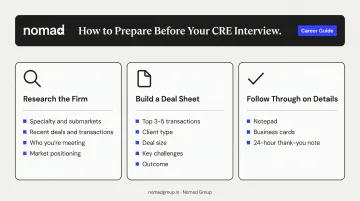
Three things separate candidates who do well from those who don't:
Research the firm properly. Know their specialty, their core submarkets, recent notable transactions, and who you'll be meeting. Walking into a Nomad Group interview without knowing they focus on tenant representation for high-growth companies — or that their work is concentrated in Flatiron, NoMad, and Williamsburg — signals you treated this like any other application.
Build a deal sheet. Before your interview, document your top 3–5 transactions: client type, deal size, lease term, key challenges, and outcome. This makes deal-specific answers precise rather than vague. If you're newer to the field, document transferable experiences in the same framework — a sales process, a negotiation, a complex client situation.
Follow through on the details. Arrive with a notepad. Ask for business cards. Send a brief thank-you note within 24 hours that references something specific from the conversation — a market point, a question they asked, something they mentioned about the firm's direction. These aren't formalities. They signal the same attention to detail clients expect from a broker managing a significant lease decision.
Frequently Asked Questions
Frequently Asked Questions
Do I need a real estate license before interviewing for a commercial broker role?
Most firms expect candidates to hold a New York State real estate license or be actively in the process of obtaining one. In New York, a salesperson license requires completing 77 hours of approved education, passing the state exam, and being sponsored by a licensed broker.
What is the difference between tenant rep and landlord rep in a CRE interview context?
Tenant rep brokers work on behalf of the company leasing space — finding options, negotiating terms, and advocating for the tenant's interests. Landlord rep brokers market and lease buildings on behalf of property owners. Some firms specialize in one; full-service brokerages like Nomad Group handle both sides.
How long does a commercial real estate broker interview process typically take?
Most processes run two to four conversations over a few weeks, starting with a screening call and progressing to market knowledge and culture-fit discussions with senior team members. Timelines vary by firm size and how active the search is.
How do I address a lack of commercial real estate experience in an interview?
Emphasize transferable skills: sales experience, client relationship management, negotiation, or strong knowledge of a specific NYC submarket. Demonstrate genuine research into how CRE brokerage actually works — lease structures, deal processes, market dynamics.
What technical knowledge should I have before a commercial real estate broker interview?
Understand the core lease types — gross, NNN, modified gross, full-service — and common terms like TI allowance, free rent, and base rent. Know how to read a basic floor plan and explain the difference between usable and rentable square footage.
Is it appropriate to negotiate compensation in a commercial real estate broker interview?
Yes — and it's expected. Brokerage compensation is typically commission-based, so understanding the split structure and whether there are desk fees is essential before accepting any offer. Asking about the compensation model is standard due diligence.