
Most companies underestimate the lead time required. JLL advises tenants to begin relocation discussions 18 to 24 months before lease expiration, particularly for larger requirements where a buildout is involved. In NYC, where lease negotiations and construction in markets like Flatiron, NoMad, and SoHo add months to the process, starting late is expensive.
This guide walks through a complete, phase-by-phase office relocation timeline — what to do, when to do it, and what can derail the process if you're not careful.
Key Takeaways
- Mid-to-large office moves typically require 12–18 months of planning; smaller moves into ready-to-use spaces can be done in 6 months
- The process spans six phases: strategic planning, space search and leasing, buildout and design, logistics, final preparations, and moving day
- Starting too late is the single most common reason office moves go over budget or disrupt business operations
- Furnished subleases and flex arrangements compress timelines significantly compared to direct leases with custom buildouts
- Plan for post-move tasks — IT verification, address updates, and employee orientation — before moving day, not after
What Is an Office Relocation Timeline and Why Does It Matter?
An office relocation timeline is a structured, phase-based schedule that maps every task, decision, and milestone from the moment a move is decided to the day operations resume in the new space.
Unlike a moving checklist — which is a flat task list — a timeline is sequence-driven and time-anchored. It accounts for dependencies, lead times, and task sequencing, because some steps can't begin until others are done.
What a well-built timeline prevents:
- Double-rent periods caused by misaligned lease start and end dates
- Rushed vendor decisions that cost more and deliver less
- IT downtime in the first week because infrastructure wasn't set up in advance
- Restoration penalties from the outgoing lease that were never planned for
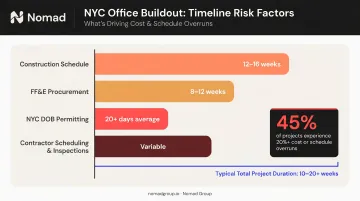
According to KPMG's 2023 Global Construction Survey, 45% of construction projects experienced schedule delays or cost impacts greater than 20%. Commercial buildouts face the same pressures — and when your space isn't ready on time, you're either paying rent on two locations or scrambling for temporary solutions.
The Office Relocation Timeline: Phase by Phase
The framework below covers six phases. Timeframes scale based on company size, market complexity, and whether a buildout is required.
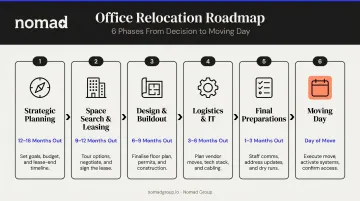
Phase 1: 12–18 Months Out — Strategic Planning
Before anything else, get clear on why you're moving. The reason shapes every downstream decision.
CBRE's 2024 Americas Office Occupier Sentiment Survey found that 59% of office occupiers were exploring relocation to upgrade space or location, while 41% of those planning to downsize cited increased hybrid work as their primary driver. The "why" determines your target size, location, lease type, and budget — so pin it down first.
At this stage, you should:
- Assign a dedicated internal relocation lead or cross-functional committee
- Establish a preliminary budget covering moving costs, buildout allowance expectations, furniture, and potential lease overlap
- Pull your existing lease and review it carefully for notice periods, termination clauses, and restoration requirements
Restoration obligations are a common surprise. Many companies arrive at move-out to discover they owe thousands in repairs or equipment removal that was buried in the lease they signed years earlier.
Phase 2: 9–12 Months Out — Space Search and Lease Negotiation
This is where the external work begins. Determine your target neighborhoods, square footage needs, and non-negotiable amenities, then engage a tenant representative broker who can run the search on your behalf.
In NYC, the leasing process moves through several stages: broker-issued RFP, landlord proposals, a non-binding letter of intent (LOI) covering rent, lease length, and security deposit, and finally lease execution. The LOI stage carries more weight than many tenants expect. NYC SBS notes that landlords may resist renegotiating terms once the lease draft is prepared, so what you agree to at the LOI largely sticks.
Factor in time for legal review and landlord counter-negotiations. In competitive submarkets like Midtown, Newmark's Q3 2024 data showed availability falling to 16.8% — the lowest level of 2024 — with Class A assets representing nearly 80% of leasing activity. If you're targeting high-quality space, expect competition. Nomad Group's tenant representation practice runs searches across Flatiron, NoMad, SoHo, Union Square, and Williamsburg — including off-market opportunities that never appear in public listings.
Phase 3: 6–9 Months Out — Design, Buildout, and Vendor Engagement
Once the lease is signed, engage an architect or space planner immediately. This phase is also when TI allowance scope gets finalized with the landlord and construction bids go out.
Cresa's project timing data puts typical office construction schedules at 12 to 16 weeks post-execution, with FF&E lead times adding another 8 to 12 weeks. In NYC, permitting adds its own layer: the NYC Department of Buildings reported average filing-to-approval times of 20.2 days in FY2024, up 11% from the prior year, and that's before contractor scheduling, procurement, and inspections.
Managing this independently introduces real risk. Nomad Group's in-house construction team has completed 300+ tenant buildouts with a standard 90-day turnaround. Extend AI went from white-box to fully built, HVAC included, in just five weeks at 135 West 29th Street. That timeline is nearly impossible to replicate when coordinating outside contractors independently.
TI allowance context: Savills reported that office TI allowances reached a cyclical peak in late 2024 but haven't kept pace with material and labor cost inflation. In New York, citywide TI packages run approximately $120/SF, making TI negotiation during the lease phase directly consequential to your buildout budget.
Phase 4: 3–6 Months Out — Logistics, IT, and Stakeholder Communication
Three months before move day is the right time to engage movers, data and telecom providers, and specialty vendors (AV, security, furniture procurement). Cresa recommends coordinating IT, internet, and security systems at least 3 months before move date — companies that treat IT as a moving-day task almost always face downtime in their first week.
Nomad Group coordinates vendor logistics as part of their move management process, covering furniture installation, Wi-Fi setup, and operations activation so clients can focus on running their business through the transition.
Also at this stage, begin external stakeholder notifications:
- Clients, vendors, and suppliers
- Banks and financial institutions
- Government registrations and licenses
- Website, Google Business Profile, and email signatures
Start your internal communication cadence with employees. SHRM reported in 2024 that 23% of workers had quit a job because of their commute. Address the commute impact directly and early — employees who feel informed and considered handle transitions very differently than those who feel blindsided.
Phase 5: 1–3 Months Out — Final Preparations and Packing
Conduct a detailed inventory of all office assets. Decide what moves, what gets donated or sold, and what gets discarded. Create a labeling and packing system organized by department with clear destination instructions.
Confirm and complete:
- All utility transfers (internet, phone, electricity, water)
- Full data backups for all systems
- Moving day schedule with assigned roles for internal team members
- Department-by-department or floor-by-floor move sequence
A detailed sequence here prevents most of the coordination problems that show up on moving day.
Phase 6: Moving Day
Assign one internal point of contact to supervise movers and manage access at both buildings. In NYC buildings, this means handling freight elevator reservations and ensuring certificates of insurance are on file — most buildings require them before movers can operate.
On moving day:
- Conduct room-by-room check against the inventory list
- Document anything that arrives damaged for insurance purposes
Before leaving the old space, do a final walkthrough and photograph every room for lease restoration documentation. Confirm you have everything, hand over keys per the lease terms, and verify that restoration obligations are met or formally scheduled.
Key Factors That Affect Your Office Relocation Timeline
Three variables drive more timeline variation than anything else:
Company size and complexity. A 10-person team moving into a pre-built space can execute in 3–4 months. A 200-person company requiring a ground-up buildout in raw space may need 18 months. Headcount, department count, and IT infrastructure all stretch the timeline.
Type of space. Direct leases with custom buildouts take the longest. Furnished subleases and flex arrangements can compress the timeline to weeks, though they involve trade-offs in flexibility, term commitment, and the ability to customize the space. Nomad Group's Flex by Nomad service takes this further, offering operational setup with month-to-month flexibility. Optimove used it for temporary swing space during a transition: furniture moved, Wi-Fi installed, and the space activated within days.
Lease dependencies. If your current lease expires before the new space is ready, you need a plan: a short-term extension, temporary storage, or interim space. Companies that don't plan for this gap face either double-rent or forced early departure.
Common Mistakes That Can Derail Your Office Relocation
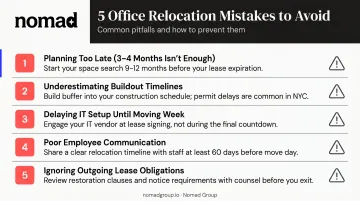
Most office moves that go wrong follow the same patterns:
Planning 3–4 months out isn't enough. For any space requiring construction or lease negotiation, that window is too tight. Rushed decisions lead to premium vendor rates, compromised space choices, and cost overruns that were entirely avoidable.
Buildout timelines almost always run longer than expected. Permitting delays, contractor scheduling gaps, and change orders add weeks — sometimes months — that companies don't budget for. Build contingency into both your timeline and your budget from day one.
IT setup can't wait until moving week. Phone systems, internet provisioning, and network cabling each require weeks of lead time. Organizations that kick off IT planning 2–3 months before move-in avoid the first-week downtime that catches everyone else off guard.
Silence about the move creates its own problems. A structured communication plan — from initial announcement through move-in day — reduces anxiety, addresses commute concerns early, and prevents the resentment that can turn a relocation into a retention issue.
Your outgoing lease has teeth. Restoration requirements, cleaning standards, and equipment removal clauses can cost you your security deposit — or more — if you don't address them at least 60–90 days before vacating.
Post-Move: What to Do After the Boxes Are Unpacked
The move isn't over when the last box arrives. A few focused actions in the first week prevent problems from festering.
Within 48–72 hours:
- Test all IT systems and confirm internet, phones, and networks are functional
- Walk each department to confirm workstations are operational
- Verify utilities are active and furniture arrived undamaged
- Document any damage or missing items for insurance
Within the first week:
- Update all address records: website, Google Business Profile, email signatures, invoices, bank accounts, vendor contracts, and government registrations
- Set up mail forwarding from the old address as a backup
Once the operational side is stable, turn attention to the people side.
For the team: Host a brief office orientation to walk employees through building amenities, protocols, and the neighborhood. A catered lunch or informal first-day gathering gives people a reason to explore the space together — and that shared experience goes a long way toward making the new office feel like theirs.
Frequently Asked Questions
How long does it take to relocate an office?
Timelines range from 3–4 months for small teams moving into pre-built or furnished spaces, to 12–18 months for mid-to-large companies requiring lease negotiation and custom buildouts. The earlier you start, the more negotiating leverage you retain on both cost and space quality.
How far in advance should I start planning an office move?
If a buildout is involved, start at least 12 months before your target move date. For smaller moves into ready-to-use spaces, 6 months is a reasonable minimum. In NYC's competitive leasing market — particularly for Class A space — plan for 12–18 months to preserve your options.
What are the biggest mistakes companies make when relocating their office?
The most common errors are starting planning too late, underestimating construction timelines, failing to communicate proactively with employees, and not reviewing lease exit obligations before the move begins. All four tend to surface together — and all four are preventable.
How much does an office relocation cost?
Costs depend on company size, buildout scope, furniture, mover fees, and IT infrastructure. In New York, TI allowances average around $120/SF and can offset buildout costs, but furniture and operating expenses require separate budget line items.
Do I need a real estate broker to find office space in NYC?
A tenant representative broker is strongly advisable. They access off-market listings, negotiate lease terms on your behalf, and cost you nothing directly — the landlord pays the commission under standard Manhattan market practice.
How do I keep employees informed and engaged during an office move?
Announce early with clear context on why the move benefits the team. From there, share regular updates, invite input on the new space design, and distribute a communication plan covering move dates, commute impacts, and day-one logistics well before moving day.