Introduction: What Is a Triple Net Lease and Why Does It Matter?
Signing a commercial lease is one of the largest financial commitments a growing company will make. Yet many tenants — particularly fast-scaling startups — focus almost entirely on the base rent figure, only to discover months later that their actual monthly costs are far higher than expected.
That gap often comes down to one thing: the triple net lease structure.
A triple net lease (NNN) is a commercial lease agreement where the tenant pays base rent plus three additional categories of property expenses — property taxes, building insurance, and maintenance/operating costs. It's one of the most common structures in commercial real estate, and it's worth understanding before you sign.
This article breaks down exactly how NNN leases work, who they benefit, how they compare to other lease structures, and — most importantly — what protections to negotiate before you sign.
TL;DR: Key Takeaways
- A NNN lease means paying base rent plus property taxes, building insurance, and maintenance/operating expenses
- Base rent is typically lower than a gross lease — but total occupancy cost is often higher
- NYC operating expenses — driven by high property tax assessments and insurance premiums — routinely exceed national averages by a significant margin
- Cost escalations on taxes and insurance can be significant year over year
- Expense caps, audit rights, and CAM exclusions are all negotiable — push for them in every lease
What Is a Triple Net Lease? Breaking Down the Three "Nets"
According to NAIOP's commercial real estate definitions, a triple net lease requires the tenant to pay taxes, maintenance, property insurance, and operating costs associated with occupancy — on top of base rent. CoStar's lease management framework describes it similarly: base rent plus CAM charges, property taxes, and building insurance, with utilities paid separately by the tenant.
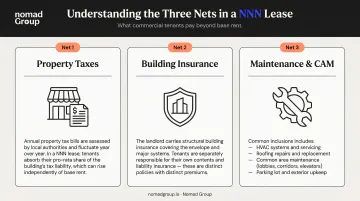
The Three Nets, Defined
- Net 1 — Property Taxes: Your proportional share of the building's real estate tax obligation. This fluctuates annually based on local assessments and can increase sharply in high-demand markets.
- Net 2 — Building Insurance: Your contribution to the landlord's structural insurance premiums. This is separate from your own contents and liability coverage, which you'll still need to carry independently.
- Net 3 — Maintenance and Operating Expenses: Costs for maintaining common areas, HVAC systems, roofing, landscaping, and other building infrastructure — often labeled as CAM (Common Area Maintenance) charges.
NNN vs. Absolute NNN
A standard NNN lease and an absolute NNN lease aren't the same thing. A standard NNN passes through taxes, insurance, and operating costs. An absolute NNN lease goes further — the tenant assumes responsibility for virtually every property expense, including structural repairs and roof replacement.
The landlord retains almost no financial obligation. These structures are most common in single-tenant freestanding properties.
The Base Rent Illusion
NNN leases advertise lower base rents than gross leases, and that's real — but it can be misleading. Once you add the three nets, your total monthly cost for the same space will often match or exceed what a gross lease would have cost. The key difference is predictability: under a gross lease, your all-in cost is fixed. Under NNN, it fluctuates.
How Triple Net Leases Work in Practice
Operating Expense Reconciliation
NNN charges aren't billed precisely — landlords estimate your monthly share at the start of each year and collect accordingly. At year-end, they reconcile those estimates against actual expenses. If actual costs exceeded estimates, you receive a "true-up" bill for the difference. If costs came in lower, you get a credit.
This annual reconciliation process creates real budget uncertainty. A true-up bill arriving in January can disrupt cash flow planning for the entire quarter.
Pro-Rata Calculation
Your NNN share is calculated proportionally based on your leased square footage relative to the total leasable building area. The math is straightforward:
A tenant occupying 5,000 SF in a 50,000 SF building holds a 10% pro-rata share — meaning they pay 10% of all shared operating expenses.
If the building's annual operating costs are $300,000, that tenant owes $30,000/year in NNN charges, or roughly $2,500/month on top of base rent.
The Base Year and Expense Stops
Many office leases include a base year provision: the landlord establishes a baseline expense level for a specific year, and the tenant only pays increases above that threshold. This structure — described in detail by Practical Law's base year escalation guidance — is a meaningful tenant protection when negotiated correctly.
The base year definition matters enormously. If the base year falls during a low-occupancy period, future pass-throughs will look inflated — even if actual cost growth is modest. It's a critical negotiating point that's easy to overlook.
What These Numbers Look Like in NYC
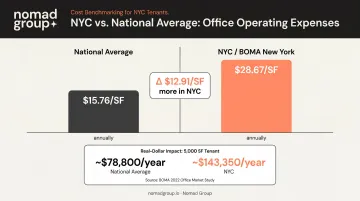
The BOMA 2022 Office Market Study reported that the BOMA/New York territory averaged $28.67/SF annually in office operating expenditures — compared to just $15.76/SF nationally across 85 BOMA markets. That gap reflects the structural cost premium of operating commercial buildings in the New York metro area.
For NYC tenants, that gap isn't academic. A 5,000 SF tenant in a Manhattan office building could be absorbing roughly $143,350/year in NNN charges at the BOMA New York average — nearly double what the same footprint would cost nationally. Understanding the mechanics of reconciliation, pro-rata shares, and base year definitions isn't just useful background; it's what separates a well-negotiated lease from an expensive surprise.
Benefits and Risks: The Tenant's Full Picture
Why Tenants Agree to NNN Leases
Lower base rent is the primary draw. In exchange for absorbing operating expense risk, tenants negotiate a meaningfully lower headline rate. For early-stage companies managing runway carefully, the reduced upfront monthly commitment can look attractive on a cash flow model.
There's also a control argument: because you're paying for building operations directly, you may have more influence over the quality and timing of services — rather than relying entirely on landlord discretion.
Where the Risk Lives
The real exposure is cost unpredictability. Property taxes, insurance premiums, and maintenance costs all escalate. Nationally, Trepp's 2024 office expense analysis found that average office property insurance costs rose 12.3% from 2021 to 2022, with some markets exceeding 30% increases in a single year. Office expenses overall rose 7.8% in the year ending Q2 2023 — well above the pre-2019 trend rate of 3.6% annually.
Those national trends show up locally too. In NYC, the FY2025 commercial property tax levy rose 2.3%, with the total property tax levy up 4.4% according to the NYC Comptroller's office. Neither number is catastrophic in isolation — but compounded over a 7- or 10-year lease term, they add up fast.
For a growing company, the bigger problem is unpredictability. A true-up bill for $40,000 isn't a crisis for an established enterprise, but it can seriously disrupt a Series B company that built its real estate budget around the base rent figure alone.
The Audit Rights Gap
Many tenants don't know they have the right — or need to negotiate the right — to audit their landlord's expense statements. Without audit rights, you have no way to verify that charges are accurate, properly allocated, or even legitimate.
Landlords occasionally include management fees, capital improvements, or expenses unrelated to your building in CAM reconciliations. If your lease doesn't give you the right to review the underlying records, you're paying whatever number arrives — no questions asked.
This is where lease negotiation expertise pays off directly. Nomad Group has worked through hundreds of NYC commercial leases across Flatiron, NoMad, SoHo, and surrounding neighborhoods — reviewing expense reconciliations, securing audit rights, and negotiating expense caps before clients sign. Those protections don't appear in a standard lease. You have to ask for them.
NNN vs. Other Commercial Lease Structures
| Lease Type | What the Tenant Pays | Base Rent Level | Best For |
|---|---|---|---|
| Gross Lease | Single all-in rent; landlord covers all operating expenses | Highest | Smaller tenants, shorter terms, budget certainty |
| Modified Gross Lease | Base rent plus some expenses (such as utilities and janitorial) | Mid-range | Mid-size tenants in multi-tenant office buildings |
| Triple Net (NNN) | Base rent plus taxes, insurance, and maintenance/CAM | Lowest | Larger tenants on longer terms who can manage cost variability |
The right structure depends on your company's profile. Gross leases favor tenants who prioritize budget predictability and don't want to track variable operating costs. NNN leases suit financially stable companies with longer-term commitments who can absorb some cost variability in exchange for a lower base rent.
Modified gross leases are common in multi-tenant office environments and sit between the two extremes.
For high-growth startups still refining their headcount and space needs, the predictability of a gross or modified gross structure often outweighs the base rent savings of NNN.
What to Negotiate Before Signing a NNN Lease
Don't sign a NNN lease without addressing these four provisions:
1. Operating Expense Cap (CAM Cap) Negotiate a contractual limit on how much controllable operating expenses can increase annually. According to Lowndes Law's analysis of commercial lease structures, caps typically range from 3% to 10% per year, with some landlords agreeing to 5% caps in negotiation. Non-controllable expenses — taxes, insurance, utilities — are usually excluded from caps, but limiting controllable costs still provides meaningful predictability.
2. CAM Exclusions Not everything belongs in a CAM reconciliation, but some landlords try anyway. Push for explicit written exclusions covering:
- Capital improvements and major structural repairs
- Management fees above a defined percentage
- Depreciation and amortization
- Expenses related to other tenants' build-outs or fit-outs
- Costs covered by insurance proceeds
3. Audit Rights Negotiate the right to audit the landlord's operating expense records — typically once per lease year, within a defined window after receiving the reconciliation statement. Without this, the landlord's numbers are essentially unverifiable.
4. Base Year Definition Ensure the base year is clearly defined and set at a representative expense level. If possible, negotiate a base year that reflects a fully occupied building with normal operating costs — not an artificially low period that will make future escalations appear larger.
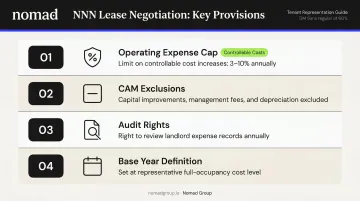
These four provisions matter most when you're committing to a 5- to 10-year term in a market where expense definitions and landlord practices vary building by building.
In NYC especially, lease language is rarely standardized. Having a tenant rep like Nomad Group negotiate these terms alongside a commercial real estate attorney — before you sign, not after — can prevent significant financial exposure from compounding over the life of the lease.
Frequently Asked Questions
What are the three "nets" in a triple net lease?
The three nets refer to property taxes, building insurance, and maintenance/operating expenses (often called CAM charges). Under a NNN lease, tenants pay all three on top of base rent, in addition to their own utilities and contents insurance.
Is a triple net lease good for tenants?
It depends on the company's financial position and lease term. NNN leases offer lower base rents and some operational control, but expose tenants to unpredictable annual cost escalations — making them better suited to financially stable companies with long-term space commitments than to early-stage startups managing tight budgets.
What types of properties commonly use triple net leases?
NNN leases are most common in freestanding retail properties, commercial office buildings, and industrial/warehouse spaces. They're especially prevalent when a single creditworthy tenant occupies an entire building, though multi-tenant office buildings also use NNN and modified gross structures widely.
How is a triple net lease different from a gross lease?
In a gross lease, the tenant pays one flat rent and the landlord covers all operating expenses from that amount. In a NNN lease, the tenant pays a lower base rent but assumes direct responsibility for taxes, insurance, and maintenance — making total occupancy costs variable and harder to budget.
Can you negotiate the terms of a triple net lease?
Yes. Expense caps on controllable costs, audit rights, exclusions from CAM charges, and the base year definition are all negotiable.
What is the difference between a single, double, and triple net lease?
A single net (N) lease passes only property taxes to the tenant. A double net (NN) adds building insurance. A triple net (NNN) adds maintenance and operating expenses — making it the most comprehensive transfer of cost responsibility from landlord to tenant.