Introduction
The Garment District has spent decades reinventing itself. Once the heartbeat of American fashion manufacturing — accounting for the city's largest industry throughout the 1920s and 30s — this stretch of midtown Manhattan between 34th and 42nd Streets, from 6th to 9th Avenues, now draws a much wider crowd.
Today, office uses account for 65.1% of built floor area in the district, while garment manufacturing sits at just 1.8%. That shift has created a real opportunity: pre-war loft buildings with character, Penn Station one block away, and rents well below comparable Midtown addresses.
Most companies searching here already know the location works. The harder questions are whether the space types, pricing, and lease structures actually fit their needs. This guide covers all of it: what draws companies to the district, what spaces are available, what you'll pay, and how to approach the search.
Key Takeaways
- Garment District starting office rents benchmark around the mid-$40s/SF — well below Times Square ($72/SF), Grand Central ($83/SF), and Hudson Yards ($126/SF)
- Space types range from pre-war loft conversions to conventional Class B offices, coworking, and flex arrangements
- Direct leases typically run 3–10 years; shorter terms are available through sublease or flex arrangements
- Penn Station (Amtrak, NJ Transit, LIRR) is one to two blocks away, making it one of Manhattan's most transit-accessible office neighborhoods for companies with regional teams
- A tenant rep broker is paid by the landlord — meaning you get professional deal negotiation, market comparables, and lease review at no cost to you
Why the Garment District Is Attracting Modern Businesses
The Rent Gap Is Substantial
The clearest reason companies are landing here: pricing. According to Q1 2025 data from the Garment District Alliance, starting office rents in the district benchmark in the mid-$40s per square foot — a significant discount compared to neighboring Midtown nodes:
| Location | Starting Office Rent Benchmark |
|---|---|
| Garment District | Mid-$40s/SF |
| Times Square | $72/SF |
| 34th St / Penn Station | $74/SF |
| Grand Central | $83/SF |
| Bryant Park | $96/SF |
| Hudson Yards | $126/SF |
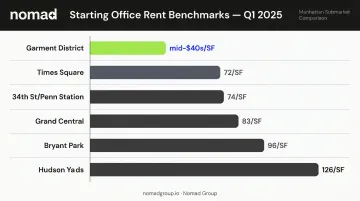
A 5,000 SF office in the Garment District vs. Bryant Park can represent a six-figure annual difference in rent alone.
The Building Stock Is the Product
The 2018 City Council text amendment removed manufacturing preservation requirements from the Special Garment Center District, clearing the path for a broader mix of uses. What that left behind is an inventory of early-1920s high-rise loft buildings — typically 12 to 30 stories — now being repositioned as office space.
For companies that want something other than a generic glass tower, that's genuinely attractive. The concentration of showrooms, design studios, and creative agencies gives the neighborhood a distinct aesthetic that resonates with media companies, tech startups, and anyone who needs an office environment that signals something beyond a generic address.
Penn Station Changes the Commute Equation
Companies with distributed workforces — employees coming from New Jersey, Long Island, or Connecticut — have a real transit advantage here. Penn Station, serving Amtrak, NJ Transit, and the LIRR, sits one to two blocks from most of the district. For a company recruiting regionally, that proximity is a concrete hiring argument.
The surrounding environment is improving as well:
- The Garment District Alliance's Broadway plazas now span 20,000 SF of landscaped pedestrian space from 36th to 41st Streets
- New food and beverage options have continued to expand throughout the area
Types of Office Space Available in the Garment District
The district has more variety than most tenants expect. Here's a quick breakdown:
Loft and Converted Showroom Space
The defining building type in the district. Pre-war construction, multi-tenant floors, and industrial character that's difficult to replicate in newer buildings make these spaces popular with creative, media, fashion, and tech tenants.
They range widely in size and condition — some delivered raw (you build out your own space), others in plug-and-play condition with existing layouts.
Traditional Class B Office Space
Not everything here is a loft. The district also has conventional multi-tenant office buildings with standard layouts — appropriate for professional services, finance, or legal firms that need a polished Midtown address without paying Midtown premiums.
Coworking and Flex Options
Several coworking operators run memberships and short-term private offices in the district — useful for very early-stage companies or those testing the neighborhood before committing to a direct lease.
For companies that want something more sophisticated, Nomad Group's Flex by Nomad model offers managed office arrangements where fit-out, furniture, and services are handled under a simpler license agreement — designed for fast occupancy without a lengthy buildout process.
Sublease Inventory
Fashion and media tenants rightsizing their footprints regularly put furnished, move-in-ready space on the sublease market here. These deals can be negotiated on shorter terms, often come with existing furniture and infrastructure, and can move fast. Sublease terms in the district typically run 1–3 years, making them a practical fit for companies that need space quickly without locking into a long direct lease.
Key advantages of sublease space:
- Move-in ready with existing furniture and infrastructure
- Shorter terms (typically 1–3 years) than direct leases
- Often priced below market to move quickly
- Negotiable conditions with motivated sublessors
Garment District Office Space Pricing: What to Expect
Base Rent
Starting rents benchmark in the mid-$40s per square foot based on Q1 2025 GDA data. Actual pricing varies meaningfully depending on:
- Floor level and natural light
- Building age and condition
- Raw vs. built-out delivery condition
- Lease term length
Shorter-term deals (under three years) typically carry a rent premium on direct leases or are only available through sublease or flex arrangements.
What's Not in the Headline Number
The asking rent is rarely the all-in cost. Budget for:
- Tenant electricity — often billed separately or added as a rent inclusion
- Building operating expenses — real estate taxes, insurance, and maintenance pass-throughs
- Security deposit or personal guarantee — New York has no statutory cap on commercial security deposits, so requirements vary by landlord and tenant credit profile
- Buildout costs — many Garment District spaces, particularly loft buildings, are delivered in raw or semi-raw condition
Tenant Improvement Allowances
Landlords often offer tenant improvement (TI) allowances as a negotiating concession — a per-square-foot sum applied toward construction costs. CBRE reported average TI allowances of $94.69/SF across 12 major U.S. markets in H1 2024, including Manhattan, though specific Garment District Class B figures aren't broken out separately in authoritative market data.
These are all legitimate negotiating levers — treat them as such:
- TI allowance — per-SF landlord contribution toward your buildout
- Free rent periods — rent abatement during construction or early occupancy
- Buildout contribution — direct landlord investment in space delivery
The Garment District's Location Advantages
Transit Access
Few Manhattan neighborhoods match this corridor for transit density. The MTA's 2023 ridership data shows just how heavily used the surrounding stations are:
- Times Sq-42 St / Port Authority — 54.2M annual riders (A/C/E/B/D/F/M/N/Q/R/W/S/1/2/3/7)
- 34 St-Herald Sq — 23.7M annual riders (B/D/F/M/N/Q/R/W)
- 34 St-Penn Station (A/C/E) — 17.0M annual riders
- 34 St-Penn Station (1/2/3) — 15.2M annual riders
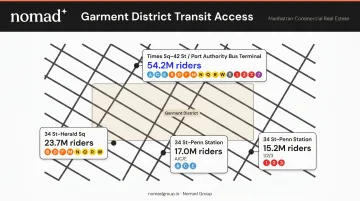
Port Authority Bus Terminal occupies 40th–42nd Streets between 8th and 9th Avenues — essentially on the district's doorstep.
Central Manhattan Position
The Garment District sits between Chelsea and Hudson Yards to the south and core Midtown to the north. Practically, that means walkable access to clients, hotels, and major employers across a wide swath of Manhattan without the premium you'd pay for an address directly in Grand Central or Times Square.
Neighborhood Amenities
That central positioning also puts you close to some of Manhattan's most useful daily infrastructure. Bryant Park — with over 12 million annual visitors and free daily programming spanning fitness, film, and live events — sits just blocks east. Restaurant and coffee density along 7th and 8th Avenues is high, with a strong mix of quick-service and sit-down options throughout the corridor. For companies navigating return-to-office, a location employees can actually get to — and want to be near — makes a real difference in daily attendance.
Tips for Renting Office Space in the Garment District
Define Your Needs Before You Start Touring
The variety of building types in the Garment District is an asset — but it can also create paralysis. Before engaging with listings, get clear on:
- Headcount now and 18 months from now
- Layout preference: open plan, private offices, or a mix
- Non-negotiable amenities: freight elevator access, dedicated HVAC, natural light
- Acceptable lease term and budget for buildout
Touring a raw loft with a 3-month buildout timeline and a 5-year minimum term is a waste of time if you need to move in 45 days.
Understand the Negotiating Landscape
The Garment District is competitive but more tenant-friendly than core Midtown submarkets. Tenants with strong credit and clear business cases can negotiate real concessions — free rent periods, TI allowances, flexible exit clauses, and sublease rights. Some of the most negotiable situations are sublease deals, where the sublandlord often prioritizes speed over price.
Nomad Group's work with Optimove at 1407 Broadway illustrates what's possible: uncovering a sublease opportunity that included high-end finishes, full-floor privacy, and a rare 3,000+ SF private rooftop terrace. That deal required knowing the right contacts and moving fast — exactly the kind of off-market access a tenant rep provides.
Work With a Tenant Representative
Tenant rep brokers are paid by the landlord, not the tenant, so there's no cost argument for going it alone. What you gain: pricing benchmarks that listing sites don't show, off-market inventory, and a negotiator whose interest is aligned with yours.
That's the model Nomad Group is built on — guided, end-to-end NYC office leasing for scaling companies. With over 2 million square feet leased and 300+ buildouts completed, the team brings pricing benchmarks, building histories, and landlord tendencies that a listing search won't surface. For companies that need help with the buildout after signing, Nomad's in-house construction team averages a 90-day turnaround.

Frequently Asked Questions
What is the average cost of office space in the Garment District, NYC?
Starting office rents benchmark in the mid-$40s per square foot based on Q1 2025 Garment District Alliance data. Actual costs vary by building condition, floor, and lease term — and the all-in cost including electricity and building expenses runs higher than the headline rent.
Is the Garment District a good location for non-fashion businesses?
Yes. Office uses now account for over 65% of the district's built floor area. Tech companies, media firms, creative agencies, and professional services businesses are all active tenants here, drawn by competitive rents, central location, and Penn Station access.
What types of office spaces are available in the Garment District?
The main options are pre-war loft conversions, conventional Class B office space, coworking memberships, managed flex arrangements (such as Flex by Nomad), and furnished sublease opportunities.
How does the Garment District compare to Chelsea or Midtown for office space?
Garment District starting rents in the mid-$40s/SF compare favorably to Chelsea, where all-class average asking rents reached $83.95/SF in Q3 2025 per Cushman & Wakefield. Penn Station sits two blocks away — a transit advantage Chelsea can't match — and the neighborhood delivers more character than generic Midtown towers at a lower cost.
What lease terms should I expect when renting in the Garment District?
Direct leases typically run 3–10 years. Shorter terms — under 3 years — are available through sublease inventory or flex arrangements but usually carry a premium. Security deposits or personal guarantees are standard requirements, with no statutory cap on deposit amounts in New York commercial leases.
Do I need a broker to find office space in the Garment District?
You don't need one, but the commission is paid by the landlord — so there's no cost to the tenant for using a tenant rep. The practical benefit: access to off-market inventory, current pricing benchmarks, and a negotiator working on your behalf — not the landlord's.