Introduction
You've found the right office space in Flatiron. The layout works, the location is ideal, and the landlord seems motivated. Then comes the question that can define the next several years of your business: how long do you commit?
Get this wrong and the consequences are real. Sign too short and you may face higher costs, fewer concessions, and a space that doesn't reflect where your company is headed. Sign too long and you're locked into square footage that stops fitting 18 months in.
Commercial lease lengths range from month-to-month arrangements to 10+ year commitments, and the right choice depends on lease structure, property type, your growth stage, and what the market will bear.
According to CBRE, the average U.S. office lease term ran close to 8 years in Q3 2023, but that average masks significant variation across tenant sizes and submarkets.
This guide covers what's typical by lease type and property category, the factors that determine the right term for your business, and how to use lease length as a negotiating tool.
Key Takeaways
- Most NYC office leases run 5–10 years, with 5 years as the practical floor for direct-lease economics
- NNN leases (retail and industrial) typically run 10–25 years, though most NYC office tenants won't encounter these structures
- Longer leases unlock better concessions — more free rent, higher TI allowances, and lower base rates
- Short-term leases protect flexibility but often cost more per square foot with fewer landlord incentives
- Key decision factors: growth stage, lease type, TI needs, and current submarket vacancy
What Is a Typical Commercial Lease Length?
Commercial leases in the U.S. typically run anywhere from 1 to 10+ years. A standard residential lease is 12 months — commercial leases are built around multi-year commitments, reflecting longer planning cycles and landlord cost recovery needs.
The "typical" range varies significantly by market:
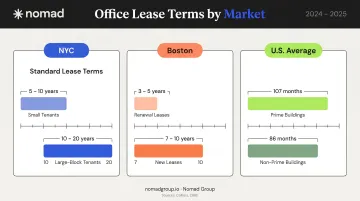
- NYC: Colliers' New York Global Occupier Guide lists a standard office lease term of 5 to 20 years — a wide band that reflects the range from small-tenant sub-10,000 sq ft deals to large-block corporate commitments
- Boston: Colliers benchmarks 3–5 years for renewals and 7–10 years for new leases — a narrower range than NYC
- U.S. average: CBRE data shows prime office buildings averaged 107 months (roughly 9 years) from 2021–2024, versus 86 months for non-prime buildings
Base Term vs. Effective Lease Length
The stated lease term is only part of the picture. A 5-year lease with two 5-year renewal options gives a tenant access to 15 years of occupancy — if exercised. Renewal options, expansion rights, and early termination clauses all reshape what a stated term actually delivers.
Post-Pandemic Shifts
Understanding that gap between stated and effective term length matters especially now, because the post-2020 market shifted — but not uniformly toward shorter terms. CBRE's analysis of H1 2024 activity shows lease signings running slightly above 2018–2019 averages — but average lease size was 27% smaller, and renewals grew from 31% to 42% of transactions. Companies are staying put more and taking less space, not necessarily signing shorter terms.
Quick Reference: Term Categories
| Term Length | Category | Best Suited For |
|---|---|---|
| Under 3 years | Short-term | Early-stage startups, market testing, bridge arrangements |
| 3–7 years | Mid-term | Growing companies with 3+ year projections |
| 7–10+ years | Long-term | Stable businesses, significant buildout needs, prime space |
Commercial Lease Lengths by Lease Type and Property
Lease structure is one of the strongest predictors of typical term length. The type of lease determines who bears operating costs — and that fundamentally shapes how long both parties expect the relationship to last.
Gross and Modified Gross Leases (Office Spaces)
Gross and modified gross leases dominate multi-tenant office buildings. Under a gross lease, the tenant pays a single flat rent and the landlord covers operating expenses like taxes, insurance, and maintenance.
Modified gross leases split the difference — tenants pay base rent plus their proportionate share of expense increases above a base year.
Because landlords retain operational control and absorb re-leasing costs, these structures produce medium-length terms. In NYC:
- Under 10,000 sq ft: 5-year terms are standard
- 10,000+ sq ft with buildout: 7–10 year leases are typical, giving landlords enough runway to recoup tenant improvement investment
The free rent mechanic also reflects this: Colliers' NYC guide notes roughly one month of free rent per year of lease term as a standard benchmark — shorter leases mean proportionally fewer months off the clock.
Triple Net (NNN) Leases (Retail and Industrial)
Where gross leases shift operating risk to landlords, NNN leases flip the structure entirely. Tenants take on property taxes, building insurance, and maintenance costs on top of base rent — in exchange for more landlord-friendly, lower-management income.
That risk transfer justifies much longer commitments. SVN reports NNN leases typically feature 10–25 year terms. Retail chains and industrial operators favor these structures because they can customize and operate the space on near-ownership terms, while landlords lock in credit-tenant income certainty over a long horizon.
Ground Leases and Absolute NNN
For context on the full spectrum: ground leases — where a tenant owns the building but leases the land — typically run 50–99 years. Absolute NNN leases used by large national retailers transfer virtually all property expenses to the tenant. Neither structure applies to most office tenants, but they illustrate just how wide the range of commercial lease commitment can run.
Key Factors That Determine the Right Lease Length
Company Growth Stage and Headcount Projections
This is where most NYC startups get the calculation wrong. An early-stage company with unpredictable hiring velocity faces genuine risk in a 7-year lease — if headcount doubles, the space doesn't fit, but the obligation doesn't go away.
A Series B+ company with clearer 3-year projections can commit longer with confidence, capturing rent savings and better concessions without the same exposure. Nomad Group's team works with high-growth NYC companies at exactly this inflection point — helping them assess the term that aligns with trajectory rather than defaulting to whatever the landlord prefers.
Tenant Improvement Allowances and Buildout Costs
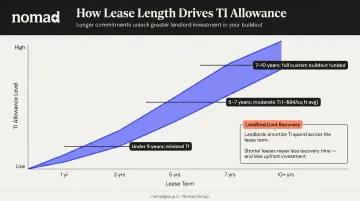
TI allowances are directly tied to lease length. A landlord offering $80–$100/sq ft in buildout funding needs enough lease term to recoup that investment.
CBRE data shows the average U.S. TI allowance was $94.69/sq ft in H1 2024. At that level, expect landlords to require a minimum 5–7 year commitment — so a high-quality, fully customized buildout comes with a term negotiation attached.
Market Conditions and Vacancy
Current conditions in NYC still favor tenants, though conditions shifted noticeably through early 2026. Cushman & Wakefield reported Manhattan office vacancy at 19.9% in Q1 2026, with Midtown South (covering Flatiron, NoMad, and SoHo) at 22.8%. That's meaningful negotiating leverage.
In high-vacancy markets, landlords will accept shorter terms with concessions to fill space. In tight markets, they push for longer commitments. The submarket you're targeting matters — and real-time deal data from an active broker matters more than any published benchmark.
Rent Escalations
Longer leases include annual escalation clauses — typically tied to CPI or fixed percentages. Before committing, model both scenarios:
- Lock in today's rate: Predictable escalators may beat re-leasing at market rates in 3 years if rents rise
- Stay flexible: If rents soften, a shorter term leaves you free to re-lease at lower rates
Neither answer is universal — run the numbers against your specific submarket before signing.
Short-Term vs. Long-Term Leases: What's Right for Your Business
The core trade-off is straightforward: flexibility costs money, and commitment buys concessions.
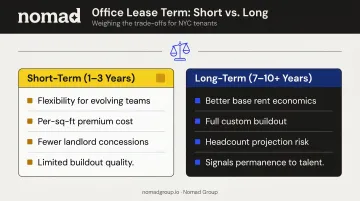
Short-term leases (1–3 years):
- Protect against space misalignment as the business evolves
- Typically command a per-square-foot premium vs. longer terms
- Offer fewer landlord concessions — less free rent, smaller TI allowances
- May limit buildout quality (landlords won't fund major TI spend for a 2-year tenant)
Long-term leases (7–10+ years):
- Unlock better economics across base rent, free rent, and TI
- Allow for fully custom buildouts that reflect the company's culture and needs
- Expose tenants to more risk if headcount projections miss
- Signal permanence to employees and clients, which carries real weight in competitive hiring markets
Who Should Favor Shorter Terms
- Pre-Series A companies with uncertain hiring velocity
- Businesses in transition (post-acquisition, restructuring, entering a new market)
- Companies not yet sure how hybrid work affects their space needs
For these situations, subleases — Manhattan sublease supply was still 12.7 million sq ft in Q1 2026, per Cushman & Wakefield — or a flexible arrangement like Flex by Nomad often make more sense than a direct short-term lease at a per-square-foot premium.
Who Should Favor Longer Terms
- Companies with stable 3+ year headcount projections
- Businesses requiring significant infrastructure buildout (data infrastructure, custom layouts, dedicated reception)
- Series B+ companies that want space reflecting their stage — and the negotiating position to get a deal that reflects it
That last point is worth illustrating: when Nomad Group placed Extend in their Haymarket Building space — white-box to fully built in 5 weeks — Extend went on to raise a $17 million Series A. The right space, secured at the right moment in a company's trajectory, compounds. That's what a well-structured longer-term lease is designed to do.
How to Negotiate Lease Length to Your Advantage
Lease length is one of the most negotiable elements of a commercial lease. Most tenants don't treat it that way.
Key Clauses That Modify the Practical Impact of Term Length
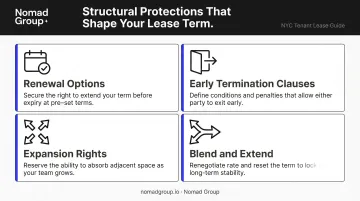
Rather than fighting over the number of years, experienced tenants negotiate structural protections that change what the term actually means:
- Renewal options — the right to extend at predetermined or market rates; the NYC Bar Association notes 5 years as a standard renewal period in NYC office leases
- Early termination clauses — exit rights after a defined period (typically the midpoint) with a penalty covering the landlord's unamortized costs — useful if your growth trajectory outpaces the space
- Expansion rights — right of first offer or right of first refusal on adjacent space, which modifies your growth options without requiring a longer initial commitment
- Blend and extend — for tenants already mid-lease at above-market rates, this blends the rate down in exchange for a longer term — landlords get security, tenants get near-term rent relief
The Value of Tenant-Side Market Intelligence
A landlord's proposed term reflects their interests, not yours. Understanding what comparable tenants in the same submarket signed last quarter is the only reliable way to know whether the term on the table is market, above, or below.
For NYC office tenants, Nomad Group's brokers draw on active deal data across NoMad, Flatiron, SoHo, and other high-growth neighborhoods to benchmark what's being offered against what's actually being accepted — and where the spread between the two creates room to negotiate.
Frequently Asked Questions
What are the main types of commercial real estate leases?
The three primary structures are gross leases, triple net (NNN) leases, and modified gross leases. Gross leases have the landlord covering operating costs; NNN leases pass taxes, insurance, and maintenance to the tenant; modified gross leases split expenses through negotiation. Lease type directly influences term length — NNN structures typically run far longer than standard office gross leases.
What is the typical length of a commercial office lease?
Most office leases in NYC run 5–10 years, with 5 years serving as the practical floor for standard direct-lease economics. Smaller tenants under 10,000 sq ft typically land in the 5–7 year range; larger tenants requiring significant buildout often sign 7–10 year leases to justify the landlord's TI investment.
Can you negotiate a shorter commercial lease term?
Yes — lease length is negotiable. Tenants can achieve shorter base terms by accepting fewer concessions (lower TI allowance, less free rent, higher base rent), or by pairing a shorter initial term with renewal options that give both parties flexibility. The trade-off is real: shorter terms typically cost more per square foot.
How does lease length affect rent price?
Longer leases typically produce lower base rent rates and greater landlord concessions — more free rent months and higher TI allowances — because landlords can amortize their costs over a longer period. Shorter leases command a premium because landlords bear more re-leasing risk and must recoup buildout costs faster.
What happens at the end of a commercial lease?
The main options are to exercise a renewal option, renegotiate a new lease at current market rates, or relocate. Without action, most leases shift to holdover status at a significantly higher monthly rate — reason enough to start renewal planning 12–18 months before expiration.
What is the shortest commercial lease you can get?
Traditional direct leases rarely go below 1 year, though month-to-month arrangements and short-term subleases exist. Flexible workspace options like Flex by Nomad can offer terms as short as 1–3 months, at a higher per-square-foot cost that reflects the added services and flexibility built into the fee.