Introduction
Picture this: a company tours a 5,000 square foot office in Flatiron, the numbers look right, they sign the lease, and then move day arrives. The space feels noticeably smaller than expected. Desks are tighter. The floor plan doesn't quite work. What happened?
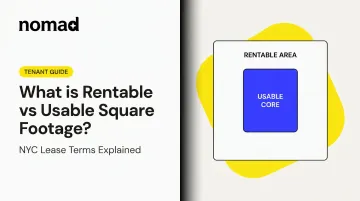
Nothing went wrong with the space itself. The disconnect comes from a fundamental distinction in commercial leasing: rentable square footage versus usable square footage. Both figures appear in every commercial lease. They mean very different things, and confusing them is one of the most common — and costly — mistakes NYC tenants make.
In a market where Manhattan asking rents averaged $76.00 per square foot in Q4 2025, even a 20% gap between what you pay for and what you actually occupy translates to thousands of dollars annually. This guide breaks down what each number means, how landlords calculate the difference, and what to check before you sign.
Key Takeaways
- Usable SF (USF) is the physical space your team actually works in; rentable SF (RSF) is what you're billed for — always larger
- The gap between the two is the load factor (also called the loss factor or add-on factor), representing your share of shared building areas
- NYC load factors typically run 20–40% — meaning you may pay for 1,300 SF while occupying only 1,000
- Always calculate cost per usable square foot when comparing spaces — rent per RSF alone is misleading
- Both figures together give you real leverage when negotiating rent, free rent, and tenant improvement allowances
Rentable vs. Usable Square Footage: Quick Comparison
| Usable Square Footage (USF) | Rentable Square Footage (RSF) | |
|---|---|---|
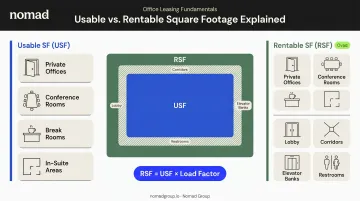
| Definition | Space entirely within your leased suite | USF plus your share of building common areas |
| What's included | Private offices, workstations, conference rooms, break rooms, private bathrooms | All of USF + lobbies, corridors, elevator banks, shared restrooms, mechanical rooms |
| What drives the number | Physical dimensions of your suite | USF × load factor |
| In the lease | Not stated; must be requested | Listed explicitly — basis for all rent calculations |
| Primary use | Space planning, headcount, design | Budgeting, rent calculations, cost comparison |
Both figures are valid — each answers a different question. USF tells you how much space your team actually occupies; RSF tells you what you're paying for. Mixing them up is one of the most common reasons tenants miscalculate their true cost per employee.
A Note on Measurement Standards
These standards matter because they determine how RSF is calculated in the first place. Nationally, BOMA (Building Owners and Managers Association) sets the most widely referenced framework — the current version being ANSI/BOMA Z65.1-2024. In New York City, REBNY (Real Estate Board of New York) publishes its own Floor Measurement guidelines that apply to how landlords advertise and disclose office space. Under REBNY rules, landlords must disclose the loss factor on request — a right tenants should always exercise before signing.
What Is Usable Square Footage?
Usable square footage is the physical area entirely within your leased suite. It's measured from the interior surface of exterior walls to the centerline of walls shared with adjacent tenants or common areas.
What USF includes:
- Private offices and open workstation areas
- Interior conference and meeting rooms
- Break rooms and pantries within the suite
- In-suite storage and filing areas
- Private bathrooms located inside the suite
What USF excludes:
- Building lobbies and elevator banks
- Common-floor hallways and corridors
- Shared restrooms on multi-tenant floors
- Stairwells and fire exits
- Mechanical and utility rooms
Why USF Matters for Space Planning
Usable SF drives every internal decision: seating capacity, headcount planning, desk ratios, and floor plan design. When your architect is laying out workstations or you're sizing a space for 30 employees under a hybrid schedule, USF is the number to anchor on — not the rentable figure quoted in the listing.
Tech companies and startups are particularly sensitive to this metric. When real estate budgets are tied to headcount growth and density targets, wasted square footage — space you're paying for but can't sit in — compresses what your budget delivers.
What Is Rentable Square Footage?
Rentable square footage is the number printed in your lease. It takes your usable SF and adds a proportionate share of the building's shared common areas, based on how much of the total floor or building you occupy.
Common areas factored into RSF:
- Main building lobbies
- Elevator cores and vestibules
- Common corridors on multi-tenant floors
- Shared restrooms
- Building mechanical and utility rooms
- Amenity spaces (depending on the building's measurement method)
How RSF Drives Your Rent Bill
If the asking rent is $80 per square foot, that rate applies to the rentable SF — not the usable SF. This means two spaces with identical usable footage can have materially different monthly rents depending on how much common-area space each building allocates to tenants.
Landlords use RSF to distribute the cost of maintaining shared building infrastructure across all tenants proportionately, rather than absorbing those costs themselves. It's a logical system — and one that directly affects how much usable space your rent dollar actually buys.
The math is straightforward: RSF × rate per square foot = annual rent obligation
In NYC, Cushman & Wakefield's Q4 2025 data shows Midtown South Class A asking rents averaging $105.64 per square foot. At that rate, every 100 square feet of "phantom" space in your load factor costs over $10,000 per year.
Understanding the Load Factor: The Number That Connects Both
The load factor (also called the add-on factor or loss factor) is the multiplier that converts usable SF into rentable SF. There are two common ways it's expressed:
- As a ratio: Load Factor = RSF ÷ USF
- As a percentage: Loss Factor % = (RSF − USF) ÷ RSF × 100
A Worked Example
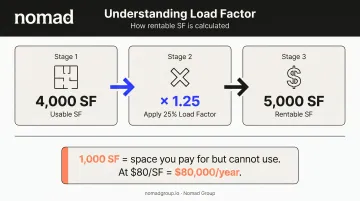
Say a suite measures 4,000 USF and the building carries a 25% load factor:
- RSF = 4,000 × 1.25 = 5,000 SF
- You pay for 5,000 SF but occupy 4,000 SF
- 1,000 square feet you cannot directly use
At $80/SF, that's $80,000 per year for space your team never touches.
NYC Load Factors Run High
According to multiple NYC office leasing sources, NYC loss factors typically range from 27% to 40%, with some sources citing the broader range of 20–40%. One widely cited benchmark puts the average NYC office building loss factor at around 27% — and CommercialCafe notes that NYC figures generally run 5 to 10 percentage points above national averages.
What drives that number? Building design, floor plate configuration, lobby size, and elevator banks all play a role — not simply building class. Always request the landlord's stated figures directly to confirm what applies to a specific space.
Why the Load Factor Changes Your Math
A space listed at a lower rent per RSF can actually cost more per usable square foot than a higher-priced space with a leaner load factor. Before comparing any two listings, calculate the effective cost per USF — that's the number that reflects what your team actually gets.
How This Difference Impacts Your NYC Office Search and Budget
The numbers make the stakes clear. Consider two hypothetical NYC offices, both quoting 5,000 RSF at roughly similar rents:
| Space A (Efficient Building) | Space B (Less Efficient Building) | |
|---|---|---|
| Rentable SF | 5,000 | 5,000 |
| Load Factor | 15% | 28% |
| Usable SF | ~4,348 | ~3,906 |
| Rent per RSF | $80/SF | $76/SF |
| Annual Rent | $400,000 | $380,000 |
| Effective cost per USF | $92/SF | $97/SF |
Space B looks cheaper on paper. It isn't. You're paying more per square foot of space your team actually occupies — and getting 440 fewer square feet to work with.
That gap exists because most tenants evaluate spaces on RSF alone — which is exactly how inefficient buildings stay competitive on asking rent.
Common Mistakes Tenants Make
- Comparing spaces purely on RSF without calculating usable SF
- Accepting the landlord's RSF figure without requesting usable SF separately
- Budgeting based on rent per RSF rather than effective cost per usable SF
- Assuming similar-looking spaces in similar neighborhoods carry similar load factors
Using Load Factor as Negotiation Leverage
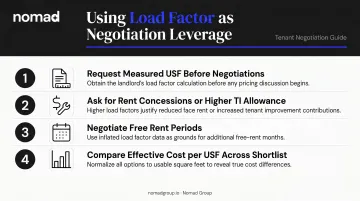
Tenants who understand load factors can push back in concrete ways. Options include:
- Requesting the measured usable SF before entering lease negotiations
- Asking for rent concessions or a higher tenant improvement allowance that accounts for a high load factor
- Negotiating free rent periods that offset the economic impact of inefficient space
- Comparing effective cost per USF across your full shortlist before making a final decision
Nomad Group runs this analysis as a standard part of tenant representation — so clients in Flatiron, NoMad, SoHo, and beyond know the true cost of a space before they sign anything.
Conclusion
RSF and USF measure different things — one sets your rent, the other determines how your team actually works. You need both to make a sound leasing decision.
Before signing any lease, ask for the usable square footage measurement, calculate the load factor, and benchmark cost per usable SF across every space on your shortlist. That analysis is exactly what Nomad Group's tenant representation team handles — so you walk into every negotiation knowing what you're actually paying for.
Frequently Asked Questions
What is the load factor in commercial real estate?
The load factor (also called the add-on factor or loss factor) is the ratio between rentable and usable square footage. It represents your proportionate share of shared common areas, expressed as a percentage added to usable SF to produce the rentable figure used for billing.
What is included in usable square footage?
Usable SF covers all space within your private suite — offices, open workstations, conference rooms, break rooms, and private bathrooms. It excludes shared building elements like lobbies, common hallways, elevator banks, and shared restrooms on multi-tenant floors.
Is rentable or usable square footage listed in commercial lease agreements?
Commercial leases almost universally state rentable square footage, which is the figure used to calculate rent. Tenants should request usable SF separately — landlords in NYC are expected to disclose it under REBNY guidelines — to understand how much space they can actually occupy.
What is a typical load factor for NYC office space?
NYC office loss factors typically fall in the 27–40% range — roughly 5–10 percentage points above national averages. Load factors vary by building design and measurement methodology, so request building-specific figures rather than relying on market averages.
Can I negotiate the load factor or rentable square footage calculation with a landlord?
Landlords typically use building-wide measurement methodologies that apply uniformly across the building. However, tenants can negotiate the economic impact — through rent concessions, larger tenant improvement allowances, free rent periods, or other lease terms that offset the cost of a high load factor.
How much do commercial agents charge for tenant representation?
In NYC, tenant-rep broker fees are paid by the landlord — according to NYC Small Business Services, a common structure is 5% of the first year's rent and 4% for subsequent years, though terms vary by deal. For most tenants, representation costs nothing out of pocket.