The challenge is that Chelsea's office market is genuinely complex. Rent benchmarks vary dramatically depending on the source. Building quality ranges from fully renovated to raw industrial. Lease structures differ widely across the neighborhood's many private landlords.
This guide covers what you need to know: the neighborhood's appeal, space types, current pricing, key submarkets, what to watch for in a lease, and how to run a smart search.
Key Takeaways
- Chelsea asking rents range from roughly $59–$85/SF — figures vary by submarket and data source, so confirm the quarter when comparing
- The market is dominated by pre-war loft buildings with open floor plates and high ceilings, making it a genuine draw for creative and tech tenants
- Chelsea scores a perfect 100 Transit Score, placing it among the most accessible office locations in the city
- Budget beyond base rent: operating expenses, electricity, and buildout allowances meaningfully affect total occupancy cost
- Plan 3–6 months for a direct lease; subleases and prebuilt spaces can move faster
Why Chelsea? What Makes It a Top NYC Office Destination
The Neighborhood's Pull on Forward-Thinking Companies
Chelsea sits at a useful intersection. The High Line draws nearly 5 million visitors annually, and the commercial footprint around it has more than tripled since the 2005 rezoning.
Chelsea Market anchors the southern edge. More than 200 galleries operate within the neighborhood. For companies competing for creative and technical talent, the surrounding environment matters — and Chelsea's density of cultural anchors is hard to replicate anywhere else in the city.
The types of companies drawn here reflect that: media firms, advertising agencies, fashion-tech companies, SaaS platforms, and design-forward startups. The neighborhood's physical identity — converted industrial buildings, gallery-lined streets, the High Line overhead — gives these companies an environment that signals something to both clients and recruits before they walk in the door.
Transit Access That's Actually Measurable
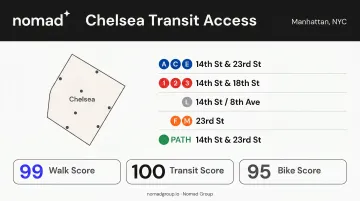
Chelsea's transit credentials aren't soft talking points. The neighborhood holds a 99 Walk Score, 100 Transit Score, and 95 Bike Score — putting it among the most accessible locations in the city.
Subway access is extensive:
- A/C/E lines at 14th and 23rd Streets
- 1/2/3 lines at 14th and 18th Streets
- L train at 14th Street/8th Avenue
- F/M lines via PATH connections at 14th and 23rd Streets
- PATH stations at West 14th and West 23rd Streets (Sixth Avenue), connecting to New Jersey
The 14th Street Busway serves approximately 28,000 daily M14 riders, adding surface transit density that few Manhattan corridors match.
A Geographic Bridge in NYC's Business Ecosystem
Chelsea functions as a connector between two of Manhattan's most active commercial corridors — the Flatiron/NoMad tech cluster to the east and Hudson Yards to the west. Companies that want proximity to both, without the premium of either, find Chelsea's positioning genuinely useful.
The lifestyle amenities reinforce retention as much as location. What's around the office matters to employees making decisions about where to spend their time. Chelsea delivers on that front:
- Diverse dining along Ninth Avenue within walking distance
- Rooftop bars and boutique fitness studios throughout the neighborhood
- Direct High Line access for midday breaks or after-work wind-downs
That combination makes Chelsea feel like a considered choice for a team's base — not a default.
Types of Office Space Available in Chelsea
The Pre-War Loft as Chelsea's Defining Asset
NYC Planning confirms that lofts and former manufacturing buildings make up roughly one-third of West Chelsea's building stock, with commercial uses accounting for approximately 76% of total floor area. These are open-floor-plate spaces with high ceilings, large windows, exposed brick, and reinforced concrete or timber framing.
The difference from Midtown Class A towers is functional as much as visual. Loft buildings support flexible layouts that companies can configure around their actual work patterns, not inherited corporate floor plans.
Space Categories Worth Understanding
Prebuilt / move-in ready suites
- Already configured with conference rooms, kitchens, and workstations
- Fastest path to occupancy — ideal when timelines are tight
- Trade-off: limited ability to customize for your culture or brand
Raw / white-box space
- Blank slate for full design customization
- Better suited for companies with a strong design vision and time to build
- Factor buildout timelines into your move date planning
Sublease space
- Often comes furnished and wired — someone else paid for the buildout
- Typically priced below direct-lease asking rent (Newmark's 1Q26 data shows Chelsea sublet asking at $73.64/SF vs. $86.16/SF direct)
- Evaluate carefully: remaining lease term, landlord consent requirements, and the sublandlord's financial stability all affect risk
Flex and coworking options
- Growing segment of Chelsea's inventory for smaller teams or companies not ready for a traditional lease commitment
- JLL estimates flexible office supply in New York sits at roughly 4.2% of total inventory
- Nomad Group's Flex by Nomad offering provides a full-service alternative to traditional coworking for companies that want dedicated space without the typical overhead
Building Class in Chelsea
Most of Chelsea's inventory is Class B/C, and that's precisely where the value lies. These buildings typically offer more flexible landlords, better value per square foot, and the raw, high-ceiling aesthetic that newer Class A towers simply don't have. Before signing, scrutinize the infrastructure — power capacity, fiber availability, and HVAC condition vary significantly from building to building.
Chelsea Office Space Costs: What to Budget For
Current Asking Rent Benchmarks
Rent figures in Chelsea vary significantly depending on which research firm's submarket definition you use — and which quarter you're looking at. Two credible sources currently show notably different numbers:
| Source | Quarter | Chelsea Asking Rent | Availability |
|---|---|---|---|
| Newmark | 1Q 2026 | $84.71/SF (total avg); $86.16/SF (direct); $73.64/SF (sublet) | 19.2% |
| Avison Young | Q2 2025 | $58.97/SF (direct) | 26.6% |
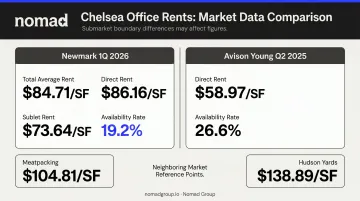
For context, Newmark's 1Q26 data shows Meatpacking District at $104.81/SF and Far West Side (Hudson Yards area) at $138.89/SF — making Chelsea look comparatively accessible while sitting between two premium markets.
The gap between Newmark and Avison Young likely reflects differences in submarket boundaries and methodology. When evaluating specific spaces, use building-level proposals, not market averages, to benchmark your deal.
Beyond Base Rent: Total Occupancy Cost
Base rent is a starting point. Your actual occupancy cost includes:
- Electricity and HVAC — often billed separately in Chelsea's older buildings; understand whether HVAC is separately metered or included before comparing spaces
- Building operating expenses — management, insurance, maintenance, and real estate taxes pass-through to tenants in many leases
- Tenant Improvement Allowance (TIA) — landlords frequently contribute toward buildout costs; Savills data shows TI allowances increased 112% from 2016 through 2025 YTD, though no Chelsea-specific range is publicly documented
- Effective rent vs. asking rent — Avison Young's Q2 2025 data shows Manhattan Class A net effective rent running ~$30/SF below base rent at the high end, once concessions like free rent and TIA are factored in
Don't compare spaces by asking rent alone. Model out total cost over the full lease term, including buildout, concessions, and operating expense structures.
Sizing for Hybrid Work
If your team works on a hybrid schedule, CBRE's 2026 workplace research offers useful benchmarks: 172 sq ft/person in 2024 trending toward 158 sq ft/person in 2026, with a 1.5 people-per-seat ratio potentially supporting 10–50% space savings versus traditional full-occupancy planning. Most companies leasing today are taking less space than they historically would have — Chelsea's flexible floor plates accommodate this well.
Typical Lease Terms
- Tech companies in Manhattan average 5.3-year lease terms; AI firms average 3.5 years (per Commercial Observer)
- Renewal and expansion deals in gateway markets run roughly 94 months; new leases around 122 months (CompStak, Q2 2024)
- Longer commitments typically unlock better pricing and more landlord concessions — worth modeling if your growth trajectory is reasonably predictable
Key Submarkets Within Chelsea
The Sixth Avenue Commercial Corridor (14th–23rd Streets)
The densest concentration of commercial loft inventory runs along Sixth Avenue between 14th and 23rd Streets. PATH stations at both ends of this corridor make it highly accessible for employees commuting from New Jersey. This stretch attracts the broadest mix of tenants — from small creative agencies to mid-size tech companies.
West Chelsea and the High Line Submarket
West Chelsea — roughly 10th to 12th Avenues between 14th and 29th Streets — has seen the most dramatic transformation since the 2005 rezoning. Office and retail space in the area has more than tripled.
Buildings near the High Line tend to be newer or more extensively renovated, with asking rents reflecting that premium. Tenants in this submarket skew toward media, architecture, and design-forward tech companies that treat their office as part of their brand.

The Southern and Northern Edges
Chelsea's southern border with the Meatpacking District gives companies near 14th Street access to both neighborhoods' dining and amenity density. The northern transition into Flatiron/NoMad around 23rd Street is equally valuable — companies near this edge can recruit from both talent pools and credibly position themselves within NYC's tech corridor.
That overlap is one reason Nomad Group focuses heavily on this corridor. With over 2 million square feet leased across the Flatiron/Chelsea/NoMad stretch, the team understands which buildings and blocks best fit different company stages and cultures.
What to Look for When Evaluating a Chelsea Office Lease
Lease Terms That Drive Hidden Costs
Pre-war buildings in Chelsea come with lease structures that deserve careful review before signing:
- Annual rent escalations — typically CPI-linked or fixed percentage increases; model the compounding effect over a 5-year term
- HVAC provisions — understand exactly when HVAC is available and what after-hours usage costs; older buildings often charge separately for extended service
- Renewal options — confirm options are personal to the tenant (not transferable) and understand any fair-market rent reset mechanics
- Sublease and assignment rights — critical if your headcount changes significantly; negotiate these upfront
Building Infrastructure Checks
Older Chelsea buildings can have real limitations. Before signing:
- Confirm fiber availability at the specific building address — don't assume; check directly with providers
- Verify the building's electrical capacity can support your power requirements, particularly for tech-heavy teams
- Assess elevator capacity and reliability — relevant both for daily use and moving in
- Ask about loading dock access if you're moving significant equipment
The building's infrastructure condition often reflects who's managing it — which makes landlord evaluation as important as the lease itself.
How to Evaluate Chelsea Landlords Before You Sign
Chelsea has a high proportion of smaller, private landlords relative to institutional owners, and management quality varies considerably. Before committing, assess:
- Responsiveness — how quickly does the landlord or property manager address issues?
- Maintenance standards — walk the common areas and mechanical spaces; deferred maintenance shows up fast
- Capital investment — has the owner updated systems, or is the building running on aging infrastructure?
The best signal: talk to current tenants. Their experience with day-to-day management will tell you more than any broker pitch.
How to Find and Secure Your Chelsea Office Space
The Search Process
A typical direct lease in Chelsea moves through these phases:
- Define your requirements — headcount, layout needs, budget, must-have infrastructure, timeline
- Tour target spaces — shortlist buildings that match your criteria across the relevant submarkets
- Issue RFPs to shortlisted landlords — get proposals in writing so you can compare economics directly
- Negotiate your LOI — letter of intent locks in the key business terms before legal drafting begins
- Execute the lease — legal review, landlord comments, final signature
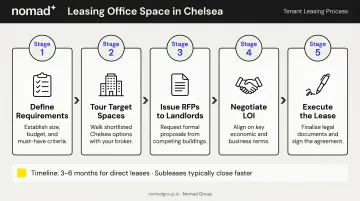
Subleases and prebuilt spaces typically move faster than raw space requiring full buildout. Build your timeline around your actual move-in date requirements, not just when you start looking.
The Case for Tenant Representation
Chelsea's market has characteristics that make tenant rep genuinely valuable: many private landlords with individual negotiating styles, significant variation in building quality within the same rent range, and off-market availability that doesn't show up on listing platforms.
An experienced NYC tenant rep brings those relationships, knows which buildings have infrastructure limitations, and understands what concessions are realistic in the current environment. Landlords typically cover the broker fee, meaning there's no direct cost to the tenant.
Working with Nomad Group
Nomad Group's model covers the full lifecycle of an office move — not just finding a space. For companies leasing in Chelsea or the adjacent Flatiron/NoMad corridor, that means one partner handling:
- Brokerage — search through lease execution
- Construction management — in-house buildout from permit to punch list
- Facilities operations — day-to-day management through Flex by Nomad
Having one team coordinate all three eliminates the handoff overhead that typically falls on internal ops during a move.
In Chelsea, where buildout quality and speed directly affect your move-in date, the construction piece carries real weight. Nomad's team has completed 300+ tenant buildouts — including a white-box-to-fully-built transformation in five weeks for a NoMad client — so timelines aren't estimates, they're track record.

Frequently Asked Questions
How much does office space cost per square foot in Chelsea, NYC?
Current data shows Chelsea direct asking rent at $86.16/SF (Newmark, 1Q26) or $58.97/SF (Avison Young, Q2 2025); the gap reflects different submarket definitions and timing. Budget for total occupancy cost, including operating expenses and buildout, not just base rent.
What types of companies lease office space in Chelsea?
Chelsea primarily attracts creative agencies, tech firms, media companies, fashion-tech startups, and SaaS businesses. Companies choose Chelsea when the office environment itself is part of the brand — the neighborhood's aesthetic and talent pool are a draw, not just an amenity.
What is the difference between a loft office and a traditional office in Chelsea?
Chelsea lofts are in pre-war buildings with open floor plates, high ceilings, large windows, and exposed architectural details — designed for flexibility. Traditional offices feature dropped ceilings, enclosed perimeter offices, and conventional layouts more common in Midtown Class A towers.
How long does it take to lease office space in Chelsea?
A direct lease typically takes 3–6 months from initial search to move-in. Sublease or prebuilt spaces can move faster given less buildout time, but direct lease timelines depend heavily on how much customization is required.
Is sublease space in Chelsea a good option for startups?
Subleases often offer shorter terms, furnished space, and below-market pricing. Newmark's 1Q26 data puts Chelsea sublet asking rent at $73.64/SF versus $86.16/SF for direct space. Evaluate the remaining lease term carefully and confirm landlord consent requirements before proceeding.
Do I need a tenant representative broker to lease office space in Chelsea?
Not required, but the practical advantages are real: brokers bring market knowledge, landlord relationships, and negotiating experience that most tenants simply don't have on their own. Because landlords typically pay the broker fee in commercial transactions, it costs the tenant nothing.