Introduction
Manhattan isn't the only borough where serious companies put down roots in New York City. Brooklyn has spent the last decade building a commercial real estate market that now rivals Manhattan in quality — while still undercutting it significantly on price.
For startups, scaling tech firms, and creative agencies rethinking their office footprint, that combination drives real demand. Brooklyn's 2025 leasing activity hit 1.42 million square feet — the highest yearly post-pandemic total on record — and available supply has tightened to its lowest level since mid-2023. The market is moving fast.
If you're considering a move to Brooklyn, this guide covers what you need to know: which neighborhoods fit which company types, what office space costs across each submarket, how lease structures differ, and what to watch before you sign. Whether you're eyeing DUMBO for your Series B company or exploring Industry City for a larger footprint, the breakdown below will help you find your fit.
Key Takeaways
- Brooklyn's 2025 office leasing hit record post-pandemic highs, with vacancy declining for three consecutive quarters
- Asking rents average roughly $45–$58/SF depending on submarket — well below Manhattan's $73–$77/SF range
- DUMBO, Williamsburg, and Downtown Brooklyn lead demand; Greenpoint and Gowanus offer more affordable emerging options
- Lease structures span direct leases, subleases, and flex arrangements — matched to your company's growth stage
- A tenant-side broker unlocks off-market listings and negotiating leverage landlords won't offer directly
Why Brooklyn Is One of NYC's Most In-Demand Office Markets
Brooklyn's commercial office market has crossed a threshold. Companies aren't landing here because Manhattan priced them out — they're choosing Brooklyn on purpose.
According to Colliers' Q4 2025 Brooklyn Office Market Report, full-year 2025 leasing velocity reached 1.42 million square feet — the highest post-pandemic annual total on record. Q4 alone came in at 360,000 SF, up 25% from the prior quarter.
Cushman & Wakefield reported that Brooklyn's overall vacancy rate fell for the third consecutive quarter to 21.8%, with net absorption turning positive at nearly 480,000 SF for the year.
The infrastructure story matters too. Brooklyn is served by more than a dozen subway lines and sits minutes from Manhattan via bridge and tunnel. That connectivity, combined with a large and diverse local talent pool, makes it practical — not just appealing in theory.
What's Driving the Demand
The companies leading Brooklyn's commercial resurgence tend to cluster around a few sectors:
- Tech and software — startups and growth-stage companies attracted by lower rents and talent access
- Creative agencies and media — drawn to loft-style spaces and neighborhood character
- Wellness, fintech, and design firms — whose brand identity aligns with Brooklyn's collaborative culture
DUMBO's tenant roster illustrates this well. Companies like Etsy, Rent the Runway, Boston Consulting Group, and Bjarke Ingels Group have established operations there, alongside dozens of VC-backed startups. That concentration signals a self-reinforcing ecosystem — where established anchors draw the next wave of tenants seeking proximity to peers and partners.

Class A Space Is Now Available
One thing that held Brooklyn back for enterprise tenants was the lack of quality inventory. That's changed. The Refinery at Domino — a converted 19th-century sugar refinery on the Williamsburg waterfront completed in 2023 — now offers Class A space from 1,500 to 30,000 RSF. Downtown Brooklyn has added 2.7 million square feet of office since its 2004 rezoning. Companies no longer have to trade quality for cost savings.
Brooklyn's Top Neighborhoods for Office Space
Brooklyn's commercial activity isn't evenly distributed. Each submarket has its own character, pricing profile, and tenant type. Here's how to think about them.
Williamsburg
Williamsburg draws creative agencies, media companies, and tech startups in roughly equal measure — a product of its mix of converted industrial lofts and newer boutique buildings.
The L and G trains connect Williamsburg to Manhattan and the rest of Brooklyn — Bedford Avenue and Lorimer Street are the main L stops. The Refinery at Domino at 300 Kent Avenue represents the neighborhood's Class A ceiling: waterfront views, high ceilings, and flexible floor plans from small suites up to full-floor options.
Nomad Group placed FloraFauna AI, a generative AI company, in a 5,000 SF space at The Refinery. The team of 30–50 people doubled their footprint within 30 days of moving in — a useful reminder that choosing a building with expansion capacity matters as much as the initial lease.
DUMBO
DUMBO (Down Under the Manhattan Bridge Overpass) is Brooklyn's most established tech hub. The neighborhood's loft-style warehouse conversions — exposed brick, heavy timber, high ceilings — have become synonymous with the Brooklyn office aesthetic.
The tenant roster reflects it: Etsy, Rent the Runway, BCG, Sidewalk Labs, and dozens of early-to-mid-stage startups operate there.
Transit access includes the A/C to High Street, F to York Street, and 2/3 to Clark Street. DUMBO commands Brooklyn's highest rents (it falls within Cushman's "Coastal Brooklyn" submarket), but for companies whose brand equity is tied to the address, it's worth the premium.
Downtown Brooklyn
Downtown Brooklyn is the borough's most traditional corporate office environment. Class A towers, deep transit connectivity — 2/3/4/5, A/C/F/R, N/G lines all within walking distance — and proximity to courts, financial institutions, and government agencies make it the right fit for legal, financial, and enterprise tenants.
It doesn't have DUMBO's aesthetic, but it has everything else:
- 2.7 million SF of office built since rezoning
- Flexible coworking options, including the 50,000 SF Orchard Workspace at 15 MetroTech
- Strong amenity density across food, retail, and services
If your company needs prestige, accessibility, and corporate infrastructure, this is your submarket.
Industry City and Sunset Park
The 35-acre Industry City campus in Sunset Park operates on a different scale than Brooklyn's other submarkets. Pre-built offices run from 2,000 to 25,000 SF, with raw spaces up to 500,000 SF and flexible lease terms starting at one year.
The tenant profile skews toward design firms, manufacturing, food businesses, and tech companies needing large footprints at lower per-foot costs. Campus amenities include a food hall, Innovation Alley, outdoor courtyards, and a gym. Transit access is via D/N/R at 36th Street — a bit further from Manhattan, but the trade-off on rent and space size often makes sense for the right company.
Greenpoint and Gowanus
Both neighborhoods attract early-stage startups and boutique creative firms that have been priced out of DUMBO and Williamsburg. Space tends to be smaller — converted warehouses, modest floor plates, raw loft environments.
Before committing to either neighborhood, weigh the trade-offs:
- Transit: G train only in Greenpoint; R/F/G in Gowanus — limited compared to other submarkets
- Team fit: Works best when your team is concentrated in nearby residential areas
- Rent: Among Brooklyn's most affordable per square foot
- Talent pull: The neighborhood culture is itself a recruiting asset for the right candidates
Types of Office Space Available in Brooklyn
Three Lease Structures
| Structure | Best For | Term | Key Trade-off |
|---|---|---|---|
| Direct Lease | Established companies, full customization | 3–10 years | Maximum control, maximum commitment |
| Sublease | Companies needing furnished space quickly | 1–3 years | Faster move-in, less flexibility to modify |
| Flex / Coworking | Small teams, market testing | Month-to-month | All-inclusive pricing, premium per SF |
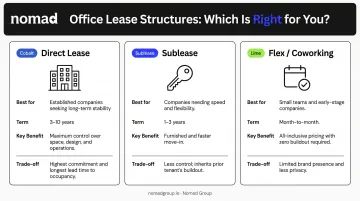
Brooklyn currently has roughly 489,000 SF of vacant sublease space on the market — concentrated heavily in the Coastal Brooklyn submarket, where sublease availabilities comprised more than half of new Q4 2025 listings. That's a buyer's market for companies that want a furnished, shorter-term option.
Physical Space Types
The lease structure you choose often determines which physical formats are actually available to you. Brooklyn's range is wider than most markets:
- Raw loft space — ideal for companies that want to design from scratch; expect build-out costs on top of rent
- Plug-and-play furnished suites — faster to occupy, often found in sublease or flex inventory
- Open-floor creative offices — shared amenities and collaborative layouts common in DUMBO and Williamsburg; typically no build-out required
- Large-format campus space — Industry City's model, suited to companies with atypical square footage needs
For companies that want a fully managed, move-in-ready office without a long-term direct lease commitment, Nomad Group's Flex by Nomad service provides that middle path — full-service scope on in-house infrastructure, priced on actual usage rather than per-desk coworking markups.
How Much Does Brooklyn Office Space Cost?
The Brooklyn-Manhattan Gap
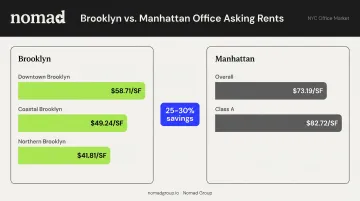
The price advantage is real and material. According to Cushman & Wakefield's Q4 2025 Brooklyn MarketBeat, Brooklyn's overall average asking rent was $53.02/SF, with Class A averaging $58.37/SF.
Compare that to Manhattan: Cushman's Q4 2025 Manhattan report showed an overall asking rent of $73.19/SF and Class A at $82.72/SF. That's a 25–30% discount for comparable quality — a real number for companies managing burn rate.
Pricing by Submarket
Cushman's submarket data gives the clearest picture available:
| Submarket | Average Asking Rent (Q4 2025) | Includes |
|---|---|---|
| Downtown Brooklyn | $58.71/SF | Class A towers, MetroTech |
| Coastal Brooklyn | $49.24/SF | DUMBO, Williamsburg waterfront |
| Northern Brooklyn | $41.81/SF | Greenpoint, parts of Williamsburg |
These figures don't break down to the address level — Greenpoint vs. Gowanus, or DUMBO vs. Red Hook, won't appear in public market reports. For building-specific comps, a tenant rep broker with active Brooklyn deal flow is the fastest path to accurate numbers.
Total Occupancy Cost: What to Budget Beyond Base Rent
The NYC SBS Commercial Leasing Guide makes this explicit: base rent is the floor, not the ceiling. Budget for:
- Operating expenses (building maintenance, insurance, common area upkeep)
- Real estate taxes (often passed through to tenants proportionally)
- Electricity (metered separately in most Brooklyn buildings)
- Build-out costs if taking raw or white-box space
Depending on lease structure and building class, these add-ons can represent 20–40% on top of base rent. Model the full number before comparing options — two spaces at the same asking rate can look very different once operating expenses and electricity are factored in.
What to Look for When Renting Office Space in Brooklyn
Due Diligence Checklist
Before signing anything, verify:
- Zoning compliance — many Brooklyn offices sit in M1 manufacturing zones, which do permit office use, but confirm this for your specific building and business type
- Building infrastructure — HVAC capacity, fiber internet (critical for tech tenants), freight elevator access if you're moving equipment
- Lease terms — subletting rights, renewal options, tenant improvement allowances, and escalation clauses all require careful review
- Landlord track record — particularly important in converted buildings where capital improvements may still be pending
Transit: Map Your Team First
This is the step most companies skip. Brooklyn's transit coverage varies significantly by neighborhood. Downtown Brooklyn has 8+ subway lines within walking distance. Greenpoint has the G train. That's it. Before committing to a submarket, look at where your team lives. A beautiful space in a neighborhood your employees can't easily reach will cost you in retention and attendance.
Transit access shapes who can realistically show up — and how often. The same logic applies to your headcount timeline.
Plan for Your 3-Year Headcount, Not Today's
Signing a lease sized exactly to your current team is one of the most common and costly mistakes in office leasing. If you're at 25 people today and expect to be at 50 in 18 months, your lease needs to account for that — whether through expansion rights, a larger initial footprint, or a building with additional availability.
Ask about right-of-first-offer clauses on adjacent suites. A broker who knows the building's vacancy pipeline can often negotiate those terms upfront, before you ever need them.
How Nomad Group Helps You Find Brooklyn Office Space
Nomad Group's tenant brokers bring hands-on Brooklyn market expertise — including direct transaction experience in Williamsburg — to every search engagement. The engagement covers every phase:
- Requirements scoping and space shortlisting
- Tour coordination and comparative analysis
- Lease negotiation and deal execution
- Post-lease buildout and space delivery
What separates Nomad Group from listing platforms and single-transaction brokers is the infrastructure behind the search. The firm has completed 300+ tenant buildouts, manages 2 million+ square feet, and maintains a 90-day buildout turnaround standard. That means clients don't just find a space — they get a fully operational office, delivered on time and on budget.

The Flex by Nomad service model adds another option for companies not ready for a multi-year direct lease: full-service, move-in-ready space built on in-house infrastructure, without the overhead of generic coworking.
Whether you're targeting a long-term DUMBO loft, a furnished Williamsburg sublease, or a flex arrangement while you assess the market, Nomad Group works across the full range of Brooklyn options — with the deal experience and buildout capacity to close and deliver.
Frequently Asked Questions
How much does office space cost per square foot in Brooklyn?
Brooklyn's overall average asking rent was approximately $53/SF as of Q4 2025, with Class A space averaging around $58/SF. Pricing varies significantly by neighborhood — Downtown Brooklyn commands the borough's highest rents while Northern Brooklyn submarkets run closer to $40–$42/SF. Contact a broker for current availability and negotiated rates.
Is Brooklyn office space cheaper than Manhattan?
Yes — Brooklyn runs roughly 25–30% below Manhattan for comparable quality. Manhattan averaged $73–$77/SF in Q4 2025 versus Brooklyn's $53/SF. The trade-offs are transit density and corporate prestige, which is why the borough skews toward startups over large enterprises.
What are the best neighborhoods in Brooklyn for office space?
DUMBO, Williamsburg, and Downtown Brooklyn are the most established submarkets. Industry City suits companies needing large footprints at lower cost. Greenpoint and Gowanus are worth exploring for early-stage companies prioritizing rent over transit convenience.
What types of office leases are available in Brooklyn?
The three main options are direct leases (longer-term, fully customizable), subleases (shorter terms, often furnished, faster to occupy), and flex or coworking memberships (month-to-month, all-inclusive). Direct leases work best for established companies; subleases and flex suit teams that need speed, shorter commitments, or want to test Brooklyn before fully committing.
What is the typical lease term for office space in Brooklyn?
Direct leases typically run 3–10 years; subleases fall in the 1–3 year range depending on the remaining term on the prime lease. Flex arrangements offer month-to-month options at a pricing premium over direct leases.
How do I find office space for rent in Brooklyn?
Listing platforms show available inventory, but only what landlords choose to make public. A tenant-side broker adds off-market access, negotiates on your behalf, and handles everything from initial search through lease signing — almost always resulting in better economics and fewer surprises.