Brooklyn has emerged as a compelling alternative. Lower rents than Manhattan—roughly $30 per square foot less than Midtown—combined with genuine fiber infrastructure in select neighborhoods creates an opportunity for tech teams to secure better space and better connectivity. But not all "fiber-ready" claims are equal, and choosing the wrong building means expensive retrofits or operational bottlenecks that cost far more than the rent savings.
This guide breaks down why fiber connectivity matters for tech operations, which Brooklyn neighborhoods offer verified infrastructure, and what to evaluate before signing a lease. Written for founders, operations leads, and office managers evaluating Brooklyn for the first time or planning a move within the borough.
Key Takeaways
- Brooklyn offers $53/sqft average rents versus $83/sqft in Midtown—a 36% discount that enables larger, higher-quality space
- Fiber delivers 528 Mbps upload speeds versus cable's 16.6 Mbps, a 32x gap that matters for cloud workflows and video collaboration
- DUMBO, Williamsburg, Industry City, and Downtown Brooklyn lead in fiber infrastructure, but verification is essential
- WiredScore Gold/Platinum certification signals multiple ISPs and redundant entry points, making it a reliable connectivity shorthand
Why Brooklyn Has Become a Serious Option for Tech Companies
NYC's tech sector has grown 26.2% since the pandemic—nearly 10 times the 2.7% rate for all private sector jobs. Brooklyn is capturing meaningful share of that expansion, driven by a combination of cost efficiency and infrastructure investment.
The rent differential matters:
- Brooklyn overall: $53.02/sqft (Q4 2025)
- Midtown Manhattan: $82.92/sqft (Q4 2025)
- Lower Manhattan: $55.04/sqft (Q1 2025)
Brooklyn Class A space averages $58.37/sqft, nearly matching Lower Manhattan's $59.17/sqft, but with newer inventory and growing tech clusters. For a 10,000-square-foot office, that gap translates to roughly $300,000 in annual savings versus Midtown—or the ability to lease 15,000 square feet in Brooklyn for the same budget as 10,000 in Manhattan.
Tech companies are noticing:
- Rilla Voice leased 57,350 sq ft in Williamsburg (25 Kent Avenue)
- Etsy maintains headquarters at 117 Adams Street, DUMBO
- AI-powered firms including Fundraise Up are clustering at Industry City
- Brooklyn's Information industry grew 5.4% year-over-year—the borough's fastest business growth sector
The geography clusters around five neighborhoods:
- DUMBO – Established tech/media hub with premium pricing
- Williamsburg – Growing tech corridor with converted industrial lofts
- Downtown Brooklyn – Transit-rich, newer commercial towers
- Industry City (Sunset Park) – Enterprise-grade connectivity infrastructure
- Brooklyn Navy Yard – Emerging hardware/robotics focus
The neighborhood you choose shapes not just your rent, but your access to fiber infrastructure—a factor that increasingly drives where tech teams actually want to be.
Why Fiber Internet Is Non-Negotiable for Tech Office Space
The Technical Gap Between Fiber and Cable
Fiber optic internet transmits data as light pulses through glass or plastic threads, while cable broadband uses electrical signals over coaxial copper. That physical difference creates performance gaps that compound under real-world tech workloads.
FCC measurement data (2024) shows the upload speed chasm:
| Connection Type | Mean Upload Speed | Mean Download Speed | Median Latency |
|---|---|---|---|
| Fiber | 528 Mbps | 586 Mbps | 7-14 ms |
| Cable | 16.6 Mbps | 483 Mbps | 12-24 ms |
| DSL | 9.5 Mbps | 31 Mbps | 23-34 ms |
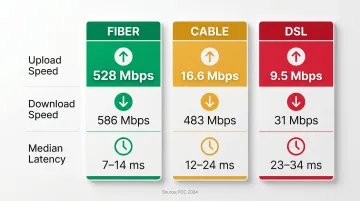
The critical distinction: fiber delivers symmetrical bandwidth. Upload and download speeds match. Cable caps upload at roughly 3% of download capacity.
Why Upload Speed Matters for Tech Teams
Most office workers primarily download—loading web pages, streaming video, pulling files. Tech teams operate differently:
- Continuous deployment pipelines push code to cloud infrastructure multiple times daily
- Cloud development environments sync local changes to remote instances in real-time
- Large file transfers send video, design files, and datasets to collaborators and clients
- Video conferencing requires simultaneous high-quality upload from all participants
- Backup and replication push data to cloud storage continuously
A 20-person engineering team running video calls, syncing code, and pushing builds simultaneously can saturate a 50 Mbps upload connection. On cable, that means degraded video quality, failed pushes, and VPN timeouts. On fiber, it's invisible.
The Cost of Inadequate Connectivity
ITIC's 2024 survey found that 90% of mid-size and large enterprises estimate downtime costs exceed $300,000 per hour. For 41% of firms, hourly costs range between $1 million and $5 million.
Those figures capture full outages. Degraded connectivity creates subtler but persistent drains: developers waiting for builds, designers unable to access cloud libraries, sales teams dropping from client video calls. Fiber eliminates slow connectivity as a daily friction point before it ever compounds into something worse.
"Fiber Available" vs. Fiber Infrastructure
Buildings market fiber connectivity in three ways:
- Fiber to the building – ISP can pull a line, but tenant pays installation (often $10,000-$50,000+ and 60-90 day lead time)
- Fiber to the floor – Infrastructure in place, tenant selects ISP and service tier (5-10 day activation)
- Multiple fiber ISPs – Competitive options, redundant entry points, faster activation
Only the third option provides true flexibility and resilience. Single-ISP buildings create vendor lock-in and single points of failure.
That distinction between marketed and verified connectivity is exactly what WiredScore was built to address.
WiredScore Certification as a Connectivity Shorthand
WiredScore independently assesses buildings across seven infrastructure categories — covering everything from internet service provision and mobile performance to technology resilience and future capacity.
Certification levels:
- Certified – Basic connectivity standards met
- Silver – Above-average infrastructure
- Gold – Multiple ISPs, diverse entry points, documented telecom rooms
- Platinum – Best-in-class connectivity, backup power, strong mobile coverage, future capacity
WiredScore-certified buildings achieve a 4.1% rental premium and 3.8% lower vacancy on average. For tenants, certification signals that connectivity was evaluated by a third party, not just claimed in marketing materials.
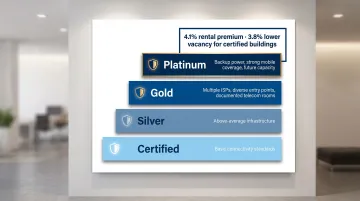
Over 4,000 buildings globally hold WiredScore certification. NYC, where the certification was founded in 2013, remains the largest market. Check the WiredScore building map to filter Brooklyn properties by certification level.
Best Brooklyn Neighborhoods for Tech Office Space with Fiber
Williamsburg and Greenpoint
Williamsburg anchors Brooklyn's tech office market with converted industrial lofts and newer commercial buildings that have attracted creative and technology companies seeking proximity to where employees live.
Rent range:
- Overall: $41.81/sqft
- Class A: $48.62/sqft The most affordable of Brooklyn's three office submarkets.
Notable leases: Rilla Voice (57,350 SF at 25 Kent Avenue), FloraFauna AI (300 Kent Avenue). Nomad Group has placed tech tenants in Williamsburg's Class A buildings, drawing on the neighborhood's industrial-modern aesthetic and room to grow.
Transit:
- L train (Bedford Avenue) to Manhattan's 14th Street corridor
- G train connecting to other Brooklyn neighborhoods
- Best fit for teams concentrated along the L line; less convenient for city-wide distributed commutes
Greenpoint offers adjacent inventory with slightly lower rents and improving connectivity infrastructure as fiber ISPs expand coverage northward.
DUMBO and Downtown Brooklyn
DUMBO commands Brooklyn's highest office rents—approaching Manhattan pricing—but delivers the borough's most mature tech ecosystem. Landlords have invested in infrastructure to attract and retain media, tech, and fintech tenants.
Rent range: DUMBO sits within the Coastal Brooklyn submarket:
- Overall: $49.24/sqft
- Class A: $55.00/sqft Individual DUMBO listings average closer to $71/sqft.
Notable tenants: Etsy (117 Adams Street HQ), Bjarke Ingels Group (45 Main Street, 50,000 SF), Overtime (20 Jay Street, 41,891 SF).
Fiber availability: DUMBO falls within coverage areas for multiple NYC fiber ISPs. Buildings in the core DUMBO triangle typically offer competitive ISP options.
Premium rents come with an upside: the established tenant base and landlord infrastructure investment reduce connectivity risk compared to less-developed Brooklyn submarkets.
Downtown Brooklyn provides a middle ground:
Rent range:
- Overall: $58.71/sqft
- Class A: $62.50/sqft
Transit advantage: Atlantic Terminal/Barclays Center hub connects approximately 10 subway lines (2, 3, 4, 5, B, D, N, Q, R) plus LIRR. Best transit access in Brooklyn for teams commuting from across the city or Long Island.
Inventory: Newer commercial towers, some WiredScore-certified, with more negotiable lease terms than DUMBO's premium buildings.
Industry City and the Brooklyn Navy Yard Area
Industry City (Sunset Park) offers campus-style infrastructure purpose-built for bandwidth-intensive tenants.
Connectivity infrastructure: DataVerge serves as the exclusive connectivity partner, providing:
- Dark fiber cabling throughout the 16-building campus
- Access to 40+ carriers, ISPs, and major cloud providers
- On-site colocation facility at 882 3rd Avenue
- Campus Connect program offering dark fiber links between Meet-Me Room and tenant suites
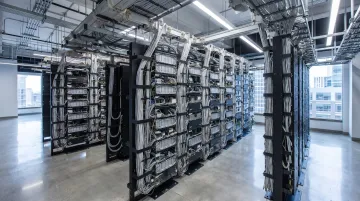
This infrastructure rivals Manhattan's best-connected buildings and positions Industry City for AI, data analytics, and infrastructure companies with heavy bandwidth requirements.
Tenants: AI-powered firms including Fundraise Up are clustering at what Crain's described as "Brooklyn's Silicon Valley."
Worth knowing: Industry City sits deep in Sunset Park — not the easiest commute. The campus runs shuttle service to nearby subway stations to reduce that friction.
Brooklyn Navy Yard targets hardware, robotics, and deep tech companies needing combined office/lab/manufacturing space.
Connectivity: Brooklyn Fiber offers symmetrical gigabit internet throughout all Navy Yard buildings:
- 100 Mbps: $50/month
- 500 Mbps: $100/month
- 1 Gbps: $250/month No contracts or installation fees.
Tenants: Qunnect (quantum networking startup) and other companies requiring specialized infrastructure.
The Navy Yard's mission centers on quality job creation and deep tech manufacturing — the fiber buildout reflects that commitment, not an afterthought.
What to Look for When Evaluating a Brooklyn Tech Office Space
Internet Infrastructure Verification Checklist
Ask landlords or building managers these questions before touring:
ISP and service options:
- How many ISPs serve the building?
- Are those dedicated fiber (DIA) or shared broadband connections?
- Is fiber already pulled to the floor, or does the tenant pay installation?
- What bandwidth tiers are available (100 Mbps, 1 Gbps, 10 Gbps+)?
- Are redundant connections available (diverse entry points, failover ISPs)?
Building infrastructure:
- Where are the telecom rooms located, and are they secure/climate-controlled?
- Is there riser capacity for additional cabling if we need to upgrade?
- Does the building have backup power for telecom equipment?
- What is the typical installation timeline for new service activation?
Mobile and wireless:
- Is cellular coverage strong throughout the space, including elevators and interior areas?
- Is a Distributed Antenna System (DAS) installed?
Buildings that can answer these questions with specifics—naming ISPs, showing telecom room documentation, citing past tenant installation timelines—signal genuine infrastructure. Vague answers or "we'll figure it out during buildout" indicate risk.
WiredScore certification (Gold or Platinum) shortcuts this diligence. Certified buildings have already documented these details as part of their assessment.
Lease Terms That Affect Connectivity
Tenant Improvement (TI) allowances cover buildout costs, including network infrastructure. National averages dropped to $87.51/sqft in 2024 from a peak of $97.55/sqft in 2023, but NYC concessions remain 30% higher than pre-pandemic levels.
Negotiate TI allowances to cover:
- Structured cabling (Cat6/Cat6a runs from telecom room to workstations)
- Server closet buildout (electrical, cooling, cable management)
- Network hardware installation (switches, routers, access points)
- ISP installation fees (if fiber must be pulled to the floor)
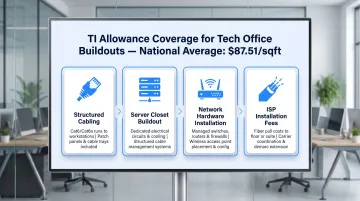
In competitive Brooklyn submarkets, landlords may offer pre-wired spaces or infrastructure credits to attract tech tenants. Make TI allocations explicit in the letter of intent—don't assume "standard buildout" includes enterprise networking gear.
Lease flexibility: Direct leases typically run 3-5+ years. If your connectivity needs may change (moving from 1 Gbps to 10 Gbps, adding a secondary ISP for redundancy), ensure the lease allows infrastructure modifications without landlord consent for every change.
Physical Infrastructure That Supports Tech Operations
Fiber internet sits within a broader set of physical requirements:
Electrical capacity:
- Can the space support server closets, high-density workstations, and multiple monitors per desk?
- Is dedicated electrical available for networking equipment (separate from general office circuits)?
HVAC:
- Will server rooms or high-density equipment areas require supplemental cooling?
- Can the building's HVAC system handle 24/7 operation if you run always-on infrastructure?
Cable management:
- Is there raised flooring, overhead cable trays, or ceiling pathways for clean cable runs?
- Can you run conduit without major structural modifications?
Scalability:
- If you grow from 20 to 80 people, can the building's electrical, HVAC, and network infrastructure scale?
- Can you expand within the building (additional floors, adjacent suites)?
- Will the ISP support bandwidth upgrades without reinstallation?
Where Nomad Group Adds Value
Working through every checklist above takes weeks — and it's easy to miss a building with no riser capacity or sign a lease before confirming fiber is already pulled to the floor. A specialized NYC tech tenant broker closes those gaps before they become lease obligations.
Nomad Group works across Brooklyn and Manhattan office inventory with in-house construction capabilities: 300+ tenant buildouts completed, with a typical 90-day turnaround. The team coordinates ISP installation, structured cabling, and network hardware as part of integrated buildout timelines. Connectivity is live on move-in day, not weeks later while your team waits on a vendor queue.
Because landlords pay broker fees (not tenants), this coordination costs nothing. The real cost is signing without it — a lease in a building that can't support your bandwidth needs, or a TI allowance that doesn't cover the fiber pull you assumed was already done.
Flex Workspace vs. Direct Lease: Which Is Right for Your Tech Team?
Flex Workspace Model
Pre-built, fully managed office space where internet (usually fiber), furniture, utilities, and amenities are bundled into a single monthly payment. Typical commitments range from month-to-month to 12 months.
Best for:
- Early-stage teams (under 20 people) needing to move immediately
- Companies testing Brooklyn before committing long-term
- Teams without runway to invest in custom buildout
- Businesses prioritizing flexibility over physical control
Connectivity trade-off: Operators select the ISP and service tier. You inherit whatever connectivity the building provides—no ability to bring in a preferred ISP or configure dedicated bandwidth.
Pricing: Brooklyn coworking memberships average $320/month per person. For a 15-person team, that's roughly $4,800/month or $57,600 annually.
Direct Lease Model
Negotiated lease directly with a landlord, typically 3-5+ year terms. Tenant builds out the space, including all internet infrastructure and IT systems.
Best for:
- Teams with defined headcount projections (25+ people)
- Companies ready to invest in a purpose-built space that reflects brand and culture
- Tech teams needing specific ISP partnerships, dedicated bandwidth, or custom network configurations
- Businesses with 12-18+ months of runway to cover buildout time and upfront capital costs
Connectivity advantage: Full control. You select ISPs, configure redundancy, deploy your own network hardware, and scale bandwidth as needed.
Cost structure: Brooklyn Class A space at $58/sqft for a 10,000 SF office = $580,000 annually, plus buildout costs (national average $87.51/sqft TI allowance may cover most infrastructure).
The Emerging Middle Ground
Neither model fits every team perfectly. For companies caught between needing speed and wanting control, some Brooklyn landlords now offer "flex by design" spaces—pre-built suites with real fiber infrastructure, shorter-term commitments (12-24 months), and semi-customizable layouts. Growing teams get move-in speed without giving up ISP choice.
Decision framework:
| Stage | Headcount | Best Fit |
|---|---|---|
| Seed/Pre-Series A | 5-15 | Flex workspace (test neighborhood, minimize commitment) |
| Series A | 15-40 | Flex-by-design or short-term direct lease (balance speed and control) |
| Series B+ | 40+ | Direct lease (full customization, ISP control, long-term cost efficiency) |
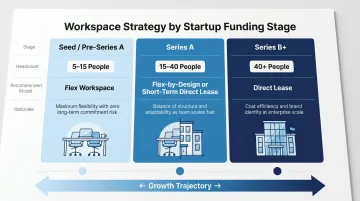
Nomad Group's Flex by Nomad service is built on in-house infrastructure rather than third-party operators, which keeps costs tighter and gives clients more control over their setup. For tech teams deciding between these models, the right answer usually comes down to headcount trajectory and how much ISP flexibility your stack actually requires.
Frequently Asked Questions
How much is it to rent office space in NYC?
Brooklyn office space averages $53/sqft overall and $58/sqft for Class A buildings, compared to Midtown Manhattan's $83/sqft and Lower Manhattan's $55/sqft. For a 10,000 SF office, that translates to roughly $250,000-$300,000 in annual savings versus Midtown.
What does "flexible workspace" mean?
Flexible workspace refers to managed office space with all-inclusive pricing (rent, internet, furniture, utilities, amenities) and shorter lease terms (month-to-month to 12 months). Unlike traditional direct leases requiring multi-year commitments and custom buildouts, flex space is move-in ready with minimal upfront capital.
What Brooklyn neighborhoods are best for tech office space?
DUMBO and Williamsburg lead as established tech corridors with strong infrastructure and talent access. Industry City offers enterprise-grade connectivity for data-intensive companies. Downtown Brooklyn provides excellent transit access and newer inventory at mid-market pricing.
What should I look for when choosing an office with fiber internet?
Four things to confirm before signing:
- Fiber is pulled to your floor, not just available in the building
- Multiple ISPs serve the space (redundancy matters)
- WiredScore certification is Gold or Platinum
- TI allowance covers structured cabling and ISP installation fees
Is Brooklyn office space cheaper than Manhattan for tech companies?
Yes. Brooklyn averages $53/sqft versus Midtown's $83/sqft—a 36% discount. Williamsburg and Sunset Park offer the deepest discounts. DUMBO has compressed closer to Manhattan pricing due to tech demand, while Downtown Brooklyn hits the sweet spot of newer inventory at mid-market rates.
Do I need a broker to find tech office space in Brooklyn?
Brokers cost tenants nothing — landlords pay the commission. A specialized NYC tech tenant broker vets actual fiber infrastructure (not just marketing claims), negotiates TI allowances for tech buildout needs, and manages the full process from search to lease execution.
Nomad Group has completed 300+ tenant buildouts across NYC and knows which Brooklyn buildings have verified fiber infrastructure — not just marketing language. Reach out to start your Brooklyn office search.