Introduction
NYC is now the world's second-largest tech and startup ecosystem — a city where fintech unicorns, AI labs, enterprise software firms, and generative AI companies have all chosen to put down roots. According to NYCEDC, the city's tech workforce exceeds 360,000 people, with the NYC metro capturing $28.5 billion in VC investment in 2024 — more than Boston, LA, and Philadelphia combined.
Choosing the right neighborhood matters far beyond rent per square foot. The wrong zip code can hurt recruiting, strain client relationships, and erode a brand that took years to build. The right one signals credibility, shortens commutes for the talent pool you're targeting, and puts you inside the networks that drive deals.
This guide covers six neighborhoods where NYC's highest-density clusters of funded startups and scaling tech companies have consistently chosen to locate — with honest trade-offs for each.
Key Takeaways
- Midtown South (Flatiron, NoMad, Union Square) anchors NYC's tech corridor and suits most Series A–C companies
- SoHo draws consumer tech, media, and design-forward companies where brand identity is part of the product
- Williamsburg and DUMBO offer Brooklyn's lower rents and younger talent pipelines at a 25–40% cost discount
- Transit access, peer ecosystem, and company stage are the three factors that matter most beyond headline rent
- Buildout costs ($95–$260+/SF in Manhattan) can erode Brooklyn's rent advantage for tech-heavy offices
NYC's Tech Scene: From Silicon Alley to a Citywide Ecosystem
The term "Silicon Alley" dates to the 1990s dot-com boom, describing the Flatiron-anchored tech corridor that stretched from 14th Street to 30th Street along the Fifth Avenue and Broadway spine. Early anchors like DoubleClick, Razorfish, and About.com defined its character.
That geography has expanded well beyond its original boundaries. Today, significant tech clusters exist in SoHo, Hudson Square, Williamsburg, and DUMBO — "Silicon Alley" now describes a mindset more than a map coordinate.
The scale of what's here today, though, is worth understanding before you start your search:
- 2,000+ AI startups in NYC, including 35 unicorns with combined funding of $17 billion
- 87,000+ AI-ready degree graduates produced by NYC metro universities between 2018 and 2023 — the highest count in the US
- Q1 2026 Midtown South leasing activity hit 1.90 million SF, 36% above the five-year quarterly average, with availability tightening to 17.7%
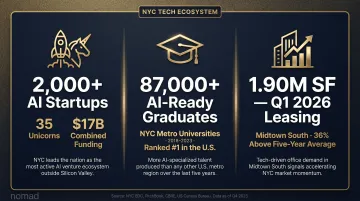
The following neighborhood profiles are selected for their concentration of tech tenants, office inventory quality, transit infrastructure, and access to talent. Each profile covers what's actually available, who's already there, and what growth stage each neighborhood suits best.
Best NYC Neighborhoods for Tech Companies and Startups
These six neighborhoods represent where NYC's highest-density clusters of funded startups and technology companies have consistently chosen to locate — and where the real estate market actively supports their growth.
Flatiron District
The historic birthplace of Silicon Alley runs roughly from 14th to 30th Streets along the Fifth Avenue and Broadway corridor. Today it's the densest startup corridor in NYC, home to Ramp (132,000 SF), Datadog, Adyen (90,000 SF), and a cluster of AI firms including Actively AI and AI One — both of which signed leases at buildings on West 21st and West 23rd Streets in late 2025.
The real draw is the cluster effect: VCs, accelerators, enterprise clients, and peer companies are often within walking distance. Loft-style converted buildings with high ceilings sit alongside modern Class A floors. Madison Square Park functions as a genuine amenity that recruiters actually mention in offer letters.
Nomad Group placed Authentic Insurance in a full-floor 5,500 SF space at 30 West 21st Street — a high-character Flatiron building with wood mullion glass doors and architectural finishes — delivered at 30% below comparable coworking costs. That's the Flatiron opportunity in concrete terms.
| Category | Details |
|---|---|
| Best For | Series A through growth-stage SaaS, fintech, and adtech companies seeking ecosystem density |
| Typical Office Vibe | Mix of creative lofts and polished Class A floors; highly adaptable for open-plan or hybrid buildouts |
| Transit & Connectivity | Exceptional — N/R/W, F/M, 4/5/6, L, PATH; walkable to Penn Station and Grand Central |
NoMad (North of Madison Square Park)
NoMad runs from 25th to 30th Streets between Park and Sixth Avenues — close enough to Flatiron to share its ecosystem density, distinct enough to command a premium. Average asking rents sit at $85–$110/SF, reflecting the submarket's concentration of architecturally distinctive inventory with full-floor availability suited to branded headquarters.
The neighborhood's density of boutique hotels and high-design restaurants is a functional asset for companies whose culture depends on in-person collaboration and client entertainment.
Nomad Group placed Extend at 135 West 29th Street (The Haymarket Building by Kaufman Organizations) — taking a white-box space to fully built, HVAC included, in just five weeks. Kaufman's buildings consistently appear on Nomad Group's shortlist for growth-stage tech clients, precisely because ownership invests in tenant experience rather than treating the lobby as an afterthought. That direct relationship with NoMad building owners is also how off-market availability surfaces before it hits general listing platforms.
| Category | Details |
|---|---|
| Best For | Funded startups and scaling companies (Series B+) seeking headquarters-quality addresses with design-forward spaces |
| Typical Office Vibe | High-character lofts and full-floor boutique buildings; suited to custom buildouts with distinct architectural detail |
| Transit & Connectivity | Strong — N/R/W at 28th Street, 6 train, PATH; close to Penn Station and Grand Central |
SoHo
SoHo's cast-iron architecture and pre-war loft buildings have pulled creative industries for decades — and the neighborhood's tech tenant profile has shifted meaningfully toward consumer tech, media tech, and AI. OpenAI leased 90,000 SF at the Puck Building here for its first NYC office. Warby Parker built its brand identity partly around a SoHo address.
Office stock is predominantly Class B, with asking rents around $80/SF and a tight vacancy rate of approximately 5%. Floor plates tend to run smaller than Flatiron or Midtown South — which makes SoHo well-suited to focused teams of 20–75 people rather than large enterprise operations.
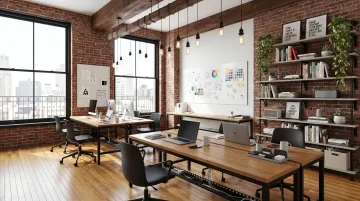
The pre-war details — dramatic ceiling heights, oversized windows, hardwood floors — double as a recruiting signal, particularly for design, product, and creative talent who factor workspace into their decision.
| Category | Details |
|---|---|
| Best For | Consumer tech, media tech, fashion-tech, and design-driven startups prioritizing brand identity and creative talent |
| Typical Office Vibe | Pre-war loft character with high ceilings, large windows, and historic detail; intimate and design-forward |
| Transit & Connectivity | Good — A/C/E at Spring Street, 1 train, N/R/W at Prince Street; walkable to Hudson Square and Tribeca |
Union Square
Union Square functions as the transit crossroads of NYC's tech ecosystem — and the office market reflects it. The Union Square Partnership's 2025 Commercial Market Report puts availability at 10.9%, compared to Manhattan's overall 17.2%, with three major buildings at full occupancy. Worker visits peaked at 444,000 in October 2024, representing 123% of January 2020 levels — the strongest return-to-office recovery of any Midtown BID.
That recovery rate matters for hybrid-work mandates. When employees are actually showing up, transit access is the determining factor. The 14th Street–Union Square station serves nine subway lines and logged nearly 23 million annual riders in 2024, ranking it as the city's fourth busiest station.
Office stock ranges from renovated loft buildings to larger floor plates, giving companies more size flexibility than SoHo. The neighborhood's mix of wellness, edtech, and marketplace companies reflects its foot-traffic-heavy, cross-borough accessibility.
| Category | Details |
|---|---|
| Best For | Marketplace, wellness tech, edtech, and consumer-facing companies that prioritize commute accessibility above all |
| Typical Office Vibe | Mix of renovated loft and mid-century commercial buildings; solid infrastructure with good natural light in newer stock |
| Transit & Connectivity | NYC's most connected intersection — 4/5/6, L, N/Q/R/W converge; easy access from Brooklyn, Queens, and NJ |
Williamsburg, Brooklyn
Williamsburg has crossed the threshold from artist enclave to legitimate startup hub. Asking rents run $50–$65/SF — a real discount against Midtown South's $84.37/SF average — with larger, rawer, and more customizable spaces than equivalent Manhattan product.
The trade-off is an approximately 20% vacancy rate, meaning the inventory pool is thinner and the buildings vary more in quality. Companies choosing Williamsburg are typically making a deliberate bet on Brooklyn's younger talent demographic and live-work culture rather than trading down from a Manhattan preference.
Nomad Group placed FloraFauna AI (Flora) at 300 Kent Avenue (The Refinery at Domino) — a Class A Two Trees building on the Williamsburg waterfront. Flora's team of 30–50 people specifically wanted proximity to where they lived, a building with expansion potential, and a vibe that matched their product focus. Thirty days after move-in, they reached out to double their footprint.
| Category | Details |
|---|---|
| Best For | Early-stage and seed-funded startups, creative and media tech companies, and companies targeting millennial/Gen Z talent |
| Typical Office Vibe | Converted factories, warehouse lofts, and new mixed-use developments; raw, flexible, and highly customizable |
| Transit & Connectivity | Good — L train to 14th Street (8–12 min), J/M/Z lines; waterfront access and strong local amenities |
DUMBO, Brooklyn
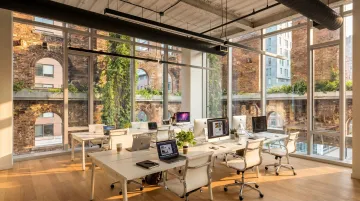
DUMBO is one of the few neighborhoods where the office address is genuinely distinctive. Exposed timber, stone walls, and Manhattan Bridge views aren't marketing language — they're what you actually get in buildings like those managed by Two Trees along Jay Street. Etsy built its global headquarters here. Hugging Face chose 20 Jay Street for its NYC office.
The neighborhood sits at the center of the Brooklyn Tech Triangle, with a tight-knit community of product and engineering teams. Rents are meaningfully below comparable Manhattan product (approximately $55–$68/SF based on available market data), though transit dependency on the A/C and F trains can extend commutes for employees coming from outer boroughs or New Jersey — a real consideration for hybrid attendance mandates.
Brooklyn overall represents just 7.5% of all NYC office square footage versus Manhattan's 83.5%, which means DUMBO's inventory pool is limited. Companies that find the right space here tend to stay.
| Category | Details |
|---|---|
| Best For | Open-source tech, AI research, creative-tech startups, and companies that want a branded HQ with distinct architectural character |
| Typical Office Vibe | Historic warehouse conversions with dramatic structural elements; strong identity, well-suited to design-forward buildouts |
| Transit & Connectivity | Moderate — A/C/F trains, NYC Ferry; manageable for local Brooklyn talent, less convenient for NJ and outer borough commuters |
How to Choose the Right NYC Neighborhood for Your Tech Company
Neighborhood selection is a brand and talent decision as much as a real estate one. Here's how to structure the evaluation:
Match Neighborhood to Company Stage
Early-stage companies (seed to Series A) should prioritize cost-per-seat and flexibility over prestige. Williamsburg sublets, smaller SoHo floors, and subleases in the Flatiron/NoMad corridor all offer strong options without committing to a long direct lease.
Series B+ companies benefit from the ecosystem density and headquarters-quality inventory of Flatiron, NoMad, and Union Square — where proximity to peer companies, investors, and enterprise clients drives real outcomes: faster investor intros, warmer candidate referrals, and shorter sales cycles with enterprise clients.
Map Your Talent Before You Sign
Before committing to a neighborhood, map where your current team lives and where you expect to hire. Union Square's transit connectivity makes it accessible from anywhere in the city. Williamsburg and DUMBO appeal strongly to Brooklyn-based talent but create longer commutes for employees coming from Queens, the Bronx, or New Jersey.
Understand the Full Cost of Occupancy
Advertised rent per square foot is the least important number in the analysis. Manhattan office buildout costs range from $95–$140/SF for basic fit-outs to $190–$260+/SF for tech-heavy infrastructure — costs that apply regardless of whether you're in Flatiron or Williamsburg. A 10,000 SF tech-heavy buildout adds $2 million in upfront costs before you pay a single month's rent.
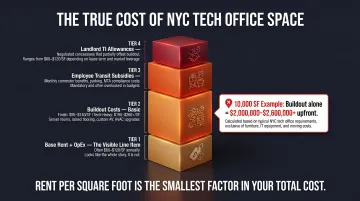
Budget by total occupancy cost:
- Base rent + operating expenses — the full lease obligation
- Buildout amortized over lease term — typically 1–3x annual base rent for a full custom build
- Employee transit subsidies — required in NYC for companies above a certain headcount
- Landlord TI allowances — negotiated deal by deal; a skilled broker surfaces these early
Consider the Peer Ecosystem Signal
VCs, enterprise clients, and strong candidates routinely use a company's address as a proxy for ambition and seriousness. An address in Flatiron or NoMad signals you're operating in the same arena as the companies you're trying to partner with, recruit from, and sell to.
When evaluating a neighborhood's ecosystem density, look for:
- Investor office concentration — are your target VCs walking distance away?
- Adjacent-stage companies — neighbors at Series B/C signal a healthy talent market
- Enterprise client presence — proximity to potential customers shortens the sales cycle
- Candidate pipeline depth — neighborhoods with high startup density attract engineers and operators already comfortable in that environment
A lower-rent address in an emerging submarket can work at the early stage. Once you're raising a Series B or building an enterprise sales motion, the ecosystem around your office becomes part of the pitch.
Conclusion
NYC offers one of the world's richest concentrations of tech talent, VC capital, and enterprise clients — but that density also means the right neighborhood depends entirely on your company's stage, culture, and growth trajectory. Here's what this guide covered:
- Flatiron and NoMad deliver ecosystem density and proximity to investors and enterprise clients
- SoHo and Union Square serve distinct brand identity and transit priorities
- Williamsburg and DUMBO offer Brooklyn's cost advantage and a younger talent pipeline
The right choice isn't about prestige — it's about fit.
Nomad Group has completed over 300 tenant buildouts and leased more than 2 million square feet across NYC's most active tech neighborhoods — from Flatiron and NoMad to SoHo, Union Square, and Williamsburg. If you're navigating site selection, lease negotiation, or space delivery, the Nomad Group team works these markets daily and can help you move from search to signed lease to built-out space.
Frequently Asked Questions
Where are most tech companies located in NYC?
The highest concentration remains in Midtown South's Silicon Alley corridor — particularly the Flatiron District, NoMad, and Union Square. Significant secondary clusters have developed in SoHo, Hudson Square, and the Brooklyn neighborhoods of DUMBO and Williamsburg.
Where do tech people live in New York?
NYC's tech workforce clusters near Midtown South: Brooklyn's Williamsburg, Park Slope, and DUMBO, plus Manhattan's East Village and Lower East Side. Transit access between home and office ranks among the top factors companies weigh when choosing a location.
Where does Gen Z live in NYC?
Gen Z employees skew toward Brooklyn — Williamsburg, Bushwick, and Crown Heights — and lower Manhattan. Tech companies targeting younger talent often prioritize L train access or Brooklyn-based offices to reduce cross-borough commute friction.
What are the most prestigious buildings in NYC for tech offices?
Prestige for tech companies is defined less by trophy tower addresses and more by design quality, co-tenant caliber, and neighborhood energy. High-profile examples include the Puck Building in SoHo (OpenAI's NYC office), the Haymarket Building at 135 West 29th Street in NoMad, and high-character buildings along the Flatiron corridor like 30 West 21st Street.
What should a startup consider when choosing an NYC neighborhood?
The top factors: team commute patterns, company stage and budget, office culture fit, proximity to investors and clients, and the peer ecosystem. For companies planning to hire aggressively in their first 18 months, these considerations consistently outweigh raw rent comparisons.
Is office space in Brooklyn cheaper than Manhattan for tech companies?
Yes. Williamsburg asking rents of $50–$65/SF represent a genuine 25–40% discount versus Midtown South's $84.37/SF average. The gap has narrowed as Brooklyn has grown in desirability, so buildout costs, transit subsidies, and thinner inventory should all factor into your total occupancy cost comparison.