
A Request for Proposal (RFP) solves that problem. It gives you a consistent set of criteria to evaluate every firm against, forces brokers to address what actually matters to your project, and signals to respondents that you're running a serious process worth their time.
That said, the quality of broker proposals you receive depends almost entirely on what you put into the RFP itself — how specific you are, how much time you give respondents, and how clearly you define what you're looking for. A vague RFP produces vague proposals.
This guide covers when a formal RFP process makes sense, how to run it step by step, what to include in the document, and the mistakes that derail most processes before they even get to evaluation.
Key Takeaways
- A broker RFP is a structured document that lets companies solicit, compare, and select brokerage firms on consistent criteria
- Formal RFPs are most valuable for large projects, multi-stakeholder decisions, or organizations with governance requirements
- Every RFP needs six components: project overview, space requirements, scope of services, broker qualifications, scoring weights, and submission guidelines
- Give respondents at least four weeks — rushed timelines produce thin proposals and experienced firms may decline to respond
- No formal process? This framework still helps you clarify requirements before you start talking to brokers
When Should You Use a Formal RFP to Hire a Commercial Real Estate Broker?
Most companies hire brokers informally — through a referral from an investor, a peer recommendation, or direct outreach after reading about a transaction. Writing and managing a proper RFP takes real time, and for many straightforward office searches, that overhead isn't justified. Treat it as the exception, not the default.
When a Formal RFP Makes Sense
Run a formal RFP when one or more of these conditions apply:
- Governance requirements exist — nonprofits, universities, public agencies, and companies with federal funding are typically required by their governing rules to document competitive procurement. Federal procurement standards under 2 CFR Part 200 require publicized solicitations with defined evaluation factors for competitive proposals.
- Multiple internal stakeholders need to align — an RFP creates a shared decision-making framework and prevents a last-minute veto from someone who wasn't involved in earlier conversations
- The project is large or complex — multi-market searches, large square footage requirements, or transactions involving significant capital expenditure justify the added rigor
- You need a documented audit trail — board-level oversight or investor reporting may require evidence of competitive vendor selection
When to Skip It
Fast-growing companies with tight timelines often don't need a formal RFP. If you're a Series A startup searching for 5,000–10,000 square feet in a single market, a structured interview process with two or three referred firms will get you to a quality decision faster. The RFP framework is still worth borrowing: use it to define your requirements and build a scoring rubric, even if you skip the formal submission process entirely.
How to Write an RFP for a Commercial Real Estate Broker
Step 1: Assemble Your RFP Committee and Define Roles
Before writing a single word, establish who owns what:
- RFP author — drafts the document and manages revisions
- Communications lead — single point of contact for respondent questions (critical for maintaining a level playing field)
- Evaluation committee — reviews and scores proposals; typically includes HR, finance, and operations leads alongside the real estate decision-maker
- Final authority — the person with the last word on vendor selection
Undefined decision-making structures are the most common reason RFP processes stall. A last-minute stakeholder who wasn't consulted can force you to restart the process from scratch.
Step 2: Set a Timeline and Share It with the RFP
A typical broker RFP timeline:
| Milestone | Timing |
|---|---|
| RFP released to invitees | Day 0 |
| Respondent questions due | Day 7–10 |
| Q&A answers distributed to all | Day 12–14 |
| Proposals due | Day 28–35 |
| Shortlist announced | Day 42 |
| Interviews conducted | Day 49–56 |
| Final award | Day 63 |
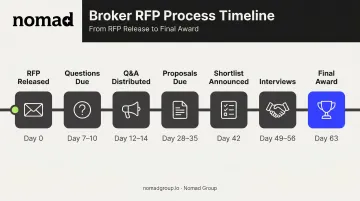
Four weeks is a reasonable minimum for a broker RFP. Compress the timeline and you'll get rushed, incomplete proposals — or none at all from the firms worth hiring.
Step 3: Draft the RFP Document
The specificity of your RFP directly determines the quality of proposals you receive. A well-structured document covers:
- Project overview and company background
- Scope of services required
- Broker qualifications and team requirements
- Evaluation criteria with scoring weights
- Submission format and deadline
Include explicit format requirements — page limits, digital submission format, required sections. Brokers should know exactly where to focus their effort.
Step 4: Research, Invite, and Distribute to Qualified Firms
Don't blast your RFP broadly. Build a targeted list drawing on:
- Peer and investor referrals
- Known market reputation in your target submarkets
- Any diversity or HUB designation requirements
Distribute the RFP simultaneously to all invitees. All questions must go through your designated communications lead, and answers must be distributed to every respondent at the same time — not just the firm that asked.
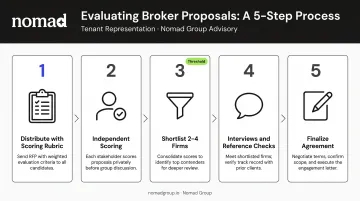
Step 5: Evaluate Proposals, Conduct Interviews, and Select a Firm
Once proposals arrive:
- Distribute to all evaluation committee members with a scoring rubric attached
- Score independently before group discussion to avoid anchoring bias
- Shortlist two to four firms for interviews
- Use the interview stage to probe specific items from their proposals and conduct reference checks
- Finalize the services agreement before notifying firms that were not selected
What to Include in Your Commercial Real Estate Broker RFP
Project Overview and Company Background
Give brokers enough context to write a relevant proposal. Include:
- Company size, industry, and growth stage
- Current real estate situation (first lease, relocation, renewal, expansion)
- Estimated square footage range
- Target neighborhoods or submarkets
- Anticipated lease term and start date
A 40-person fintech company searching for 6,000–8,000 square feet in Flatiron or NoMad with a Q4 move-in target gives a broker very different context than a vague "looking for NYC office space." Specificity drives better proposals.
Scope of Services
Specify exactly what you need. Options include:
- Tenant representation only (search through lease execution)
- Space planning and programming support
- Lease negotiation and financial modeling
- Buildout coordination and project management
- Ongoing facilities management
Also clarify whether you want a single-transaction engagement or a longer-term strategic partner. Some firms, like Nomad Group, cover the full spectrum: transactional tenant representation through buildout, move-in, and ongoing facilities operations. Knowing which model you need helps brokers propose the right team structure.
Broker Qualifications and Team Information
Request the following from every respondent:
- Bios and credentials for the specific individuals who will work your account (not company-wide stats)
- Proof of New York State licensure
- At least 5–6 comparable transactions completed in your target submarkets within the past four years
- Client references from similar-sized companies
- Disclosure of any potential conflicts of interest or dual-agency arrangements
Use published RFPs as a calibration tool when drafting your own minimums. The State Bar of California's 2022 broker RFP required lead brokers to document 10 years of experience and at least six Class A office transactions of 10,000+ RSF within the prior four years.
Proposal Evaluation Criteria and Scoring Weights
Include explicit weights so brokers know where to focus. A sample breakdown:
| Criterion | Weight |
|---|---|
| Market expertise and submarket transaction history | 30% |
| Team qualifications and seniority | 25% |
| Understanding of project scope | 20% |
| Client references | 15% |
| Fees and compensation structure | 10% |
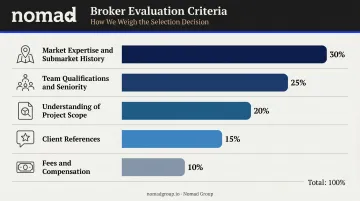
The State Bar of California assigned 55% to functional and technical ability and 30% to total cost. That weighting reflects a clear principle: capability matters more than price in a high-stakes transaction.
Submission Guidelines and Format Requirements
Specify:
- Page limit (typically 15–20 pages)
- File format (PDF preferred)
- Submission deadline with time zone
- Where to submit (email address or portal)
- A firm policy on late submissions — most RFPs should not accept them
- Instructions for the Q&A process
Key Criteria for Evaluating Broker Proposals
Scoring a broker RFP is mostly a qualitative exercise. Companies that optimize purely for cost often end up with a broker who lacks the neighborhood depth their project requires.
Demonstrated submarket expertise matters more than firm size. A broker who has closed 15 transactions in NoMad and Flatiron over the past three years knows which landlords will negotiate, which buildings have flexible lease structures, and where market conditions are actually moving. Ask for transaction lists — addresses, sizes, and dates — not just narrative claims.
For context: Manhattan Midtown South average asking rents were $64.86/sf in Q1 2026, with year-to-date leasing activity up 18% from the prior year. Brokers without recent, active transaction history in your target submarkets are working from stale data.
Evaluate whether the firm is genuinely tenant-focused. Ask directly whether the firm represents both landlords and tenants on transactions in your target submarkets, and require written disclosure of any dual-agency arrangements. A broker representing your landlord on the same deal has competing interests, regardless of how the firm describes its approach.
Look for seniority and bandwidth. Ask who specifically will work your account. Many firms win RFPs with senior principals and then hand execution off to junior associates. Get names, not titles, and confirm their current deal load during the interview.
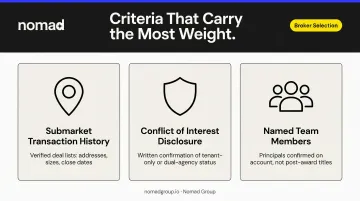
When evaluating responses, these three criteria should carry the most weight:
- Submarket transaction history — verified deal lists with addresses, sizes, and close dates
- Conflict of interest disclosures — written confirmation of tenant-only representation or dual-agency arrangements
- Named team members — principals or directors confirmed on the account, not titles assigned post-award
Nomad Group structures engagements so that principals and directors stay hands-on from search through lease execution. Their work with Extend AI — delivering a NoMad office from white-box to move-in-ready in five weeks — reflects what that senior involvement delivers in practice.
Common Mistakes When Writing an RFP for a Commercial Real Estate Broker
Being Too Vague About Scope
If your RFP doesn't specify square footage range, target neighborhoods, lease timeline, and expected services, every broker will interpret the scope differently. The result: proposals you can't compare, and follow-up rounds that add weeks to your timeline.
Skipping the Scoring Framework
Without predefined weights, evaluation committees default to subjective impressions from the final interview. The most persuasive presenter wins, not necessarily the most qualified broker. Define your criteria and weights before proposals arrive, not after.
Giving Respondents Too Little Time or Information
Experienced brokerage firms evaluate whether an RFP is worth responding to before they invest in writing a proposal. A compressed timeline (under two weeks) or a document missing basic project details signals a process not worth their effort.
Expect generic responses, or silence from the firms you most want to hear from.
Allowing Uncontrolled Communications
If multiple people field questions from different brokers, you create an uneven playing field. Worse, informal conversations can produce commitments that fall outside the formal process. Keep all respondent contact routed through one person, and send Q&A answers to all respondents simultaneously.
Frequently Asked Questions
What is an RFP in commercial real estate?
An RFP (Request for Proposal) in commercial real estate is a formal document used to solicit proposals from service providers — either from brokerage firms you're considering hiring or from landlords when searching for space. It's a structured way to collect and compare submissions from multiple firms before making a selection.
Do I need a formal RFP to hire a commercial real estate broker?
Most companies don't use a formal RFP — they hire through referrals or informal interviews. A formal process adds real value when governance requirements exist, multiple stakeholders need to align, or the project is large enough to justify competitive bidding. For many growing companies, a structured vetting framework without a full formal submission process hits the right balance.
What are the core steps in a broker RFP process?
The core steps are:
- Assemble your committee and define roles
- Set and publish a timeline, then draft the RFP document
- Research, invite, and distribute to all qualified firms simultaneously
- Evaluate proposals using a scoring rubric
- Conduct shortlist interviews and make a final award
What is the difference between an RFP and an LOI in commercial real estate?
An RFP is used early in the process to solicit proposals — either from brokers you're considering hiring or from landlords whose buildings you're interested in. An LOI (Letter of Intent) comes later and outlines the proposed business terms of a specific lease deal.
What are the most common RFP mistakes to avoid?
The top mistakes are: vague project scope that makes proposals impossible to compare, missing scoring rubric leading to subjective final decisions, insufficient response time (under four weeks), and unclear decision-making authority within your organization. Most are preventable by resolving these decisions before the RFP goes out — not after proposals arrive.