

Introduction
The commercial real estate industry is undergoing a fundamental shift from instinct-based to data-driven decision-making. Asset managers who leverage property analytics, market forecasts, and risk modeling consistently outperform those relying on gut feel alone. Recent research from McKinsey found that asset selection now accounts for approximately 70% of performance differentials relative to benchmarks—up from less than 50% during 2020-2022.
That gap makes manager selection a high-stakes decision. Choosing a firm with proven data infrastructure directly impacts acquisition pricing accuracy, deal velocity, and long-term portfolio returns. With 88% of investors already piloting AI for competitive advantage, the distance between data-mature managers and legacy operators is only growing.
What follows is a breakdown of the firms leading this shift — what they do differently, how to evaluate their capabilities, and which criteria actually predict performance when the data gets hard.
Key Takeaways
- Data-driven asset managers use property analytics and market forecasting to spot high-yield opportunities before they're widely visible
- Top firms pair proprietary data infrastructure with experienced deal teams — both matter equally
- Key evaluation criteria include technology capability, asset class specialization, geographic coverage, and transparency in reporting
- Blackstone, CBRE Investment Management, Nuveen, LaSalle, and Nomad Group span the spectrum from global institutions to NYC-focused boutiques
- Aligning your investment goals with a manager's data strengths and market focus matters more than AUM size
What Is a Data-Driven Real Estate Acquisition Strategy?
A data-driven acquisition strategy uses structured inputs to identify, underwrite, and prioritize property acquisitions—rather than relying on broker relationships or gut feel. Those inputs typically include AVM valuations, rental yield analysis, cap rate benchmarks, neighborhood-level demand signals, and macro market forecasts.
Core Components Required
Such a strategy requires three foundational elements from an asset manager:
- Unified data architecture that connects internal portfolio performance with external market intelligence — so deal teams aren't working from five different spreadsheets with five different numbers
- Scenario modeling before capital commitment, stress-testing variables like interest rate changes, tenant demand shifts, and supply pipeline additions
- Post-acquisition performance monitoring that flags deviations from projections early enough to act, not just report

The Data Fragmentation Challenge
According to EY research published in January 2026, real estate investors frequently stall their data strategy not due to lack of ambition but due to fragmented data environments. The study surveyed more than 50 real estate CTOs and CIOs and found:
- Only 60% have a formal data initiative currently underway
- Data remains "inherently disparate and fragmented" across asset-level, investment-level, and third-party sources
- Lack of consistency across property managers, research sources, and internal teams creates disconnected use and inconsistent taxonomy
This makes choosing a manager with mature data infrastructure critically important. Firms that treat data as a reporting tool — something you look at after a decision — will consistently lose deals to firms that use it to make the decision.
Best Real Estate Asset Managers for Data-Driven Acquisition Strategy
Each firm below was selected based on documented use of analytics platforms, proprietary data systems, transparent reporting capabilities, and a demonstrated track record of using market intelligence to drive acquisition decisions—not solely AUM size.
Blackstone Real Estate
Blackstone Real Estate is the world's largest real estate private equity manager, with a global portfolio valued at $618 billion as of December 31, 2025. The firm manages $319.3 billion in investor capital across logistics, rental housing, hospitality, office, and digital infrastructure in the Americas, Europe, and Asia-Pacific. Blackstone has consistently used macro trend analysis and sector rotation to guide its acquisition thesis.
Blackstone's acquisition strategy is underpinned by Data Direct, a proprietary cloud-based analytics platform built on AWS. Originally developed for the real estate business, Data Direct was later expanded across Blackstone's private equity portfolios. The platform aggregates rent trends, occupancy data, and supply pipeline intelligence across geographies, enabling the firm to identify high-conviction themes before institutional consensus forms.
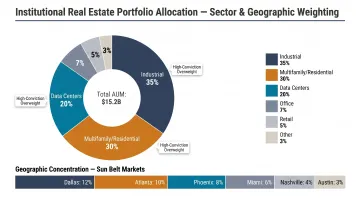
Blackstone's BREIT product is approximately 90% concentrated in highest conviction sectors—rental housing, industrial, and data centers—with roughly 65% in fast-growing Sunbelt markets. The firm established a 35% ownership interest in QTS data centers (representing 20.4% of BREIT's portfolio value) through a $10 billion acquisition, positioning itself early in the digital infrastructure boom. BREIT's 2025 Year-End Shareholder Letter notes that new construction starts in key sectors are "down more than two-thirds to decade lows," giving Blackstone's existing portfolio a significant supply advantage.
| Investment Focus | Data & Technology Capability | Target Client / Investor Type |
|---|---|---|
| Logistics, multifamily, data centers, hospitality, office | Proprietary Data Direct platform; real-time occupancy and rent tracking across portfolio | Institutional LPs, sovereign wealth funds, family offices, retail investors via BREIT |
CBRE Investment Management
CBRE Investment Management is the investment management arm of CBRE Group, managing $155.5 billion in real assets as of December 31, 2025, across equity, debt, and infrastructure strategies globally. The firm benefits from a direct data feed from CBRE's global brokerage and advisory operations, creating a structural data advantage in acquisition underwriting.
CBRE IM's integration with CBRE's broader platform provides access to real-time leasing velocity data, tenant demand signals, and property-level transaction comps that external managers cannot easily replicate. The firm sources and evaluates $300 billion in investment opportunities annually, using this deal flow to inform pricing models and sector conviction.
In August 2024, CBRE Strategic Partners U.S. Value 9 acquired McKinney National Business Park—three newly constructed, fully leased Class A industrial buildings totaling 481,000 SF in the Dallas-Fort Worth metro. The property "became 100% leased within 12 months of delivering." The fund cited the "supply-constrained market with strong fundamentals" and 31% population growth over two decades—data points drawn directly from CBRE's brokerage intelligence.
| Investment Focus | Data & Technology Capability | Target Client / Investor Type |
|---|---|---|
| Office, industrial, residential, infrastructure, real estate debt | Integrated with CBRE global brokerage data; proprietary analytics on tenant demand and market velocity | Pension funds, insurers, sovereign wealth funds, endowments |
Nuveen Real Estate
Nuveen Real Estate, part of TIAA, manages $142 billion in assets as of June 30, 2025, spanning public and private investments, debt and equity, across 30+ cities globally with 360+ investment professionals. The firm has built a dedicated research platform that informs portfolio construction decisions across core, value-add, and debt strategies.
Nuveen's differentiation lies in its proprietary research function, which publishes forward-looking market outlooks that directly feed into acquisition committee decisions. The firm uses demographic trend modeling, supply-demand analytics, and climate risk scoring as acquisition filters.
For example, Nuveen's Q1 2026 Global Overview reported that global transaction volumes reached $945 billion over the trailing year, up 17% year-over-year—and that total returns were positive across 20 out of 21 countries in the MSCI index. This research-driven conviction led Nuveen to make its first investment in Germany in April 2026, acquiring Munich-LEN, a fully let business park in Ismaning, as part of its Global Cities Real Estate strategy.
| Investment Focus | Data & Technology Capability | Target Client / Investor Type |
|---|---|---|
| Core and value-add office, retail, industrial, residential | Dedicated research platform; demographic modeling; climate risk integration in underwriting | Pension funds, insurance companies, endowments, high-net-worth investors |
LaSalle Investment Management
LaSalle Investment Management is a global real estate investment manager leveraging JLL's expansive research and advisory infrastructure across more than 80 countries. The firm manages $86.4 billion in assets as of December 31, 2025, and integrates JLL's market data directly into its acquisition decision-making process.
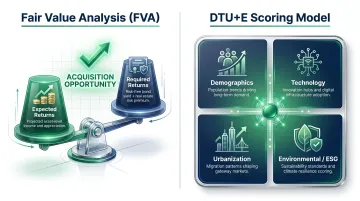
LaSalle uses quantitative scoring models to rank acquisition targets by risk-adjusted return potential. The firm's proprietary Fair Value Analysis (FVA) framework compares expected returns against required returns (built up from bond yields plus a risk premium), creating a "unifying framework" to screen, debate, and test investment ideas. This is complemented by the DTU+E investment philosophy, which scores every potential acquisition against secular drivers: Demographics, Technology, Urbanization, and Environmental/ESG factors.
LaSalle's ISA Outlook 2026 demonstrates this data-driven conviction in action. The firm's 2026 top conviction picks include Industrial Outdoor Storage (IOS) in the U.S., European Outlet Centers, and Japan Living/Hospitality sectors—each backed by FVA modeling and DTU+E scoring. The firm also uses proprietary data sources including JLL bidding trend data on transaction competition and bid-ask spreads, providing a real-time read on demand before it shows up in public data.
| Investment Focus | Data & Technology Capability | Target Client / Investor Type |
|---|---|---|
| Diversified global real estate including office, industrial, residential, and alternatives | Quantitative deal-scoring models (FVA framework); JLL market research integration; occupier demand tracking | Global institutional investors, pension funds, sovereign wealth funds |
Nomad Group
Nomad Group is a full-service commercial real estate firm specializing in NYC office space for high-growth companies—covering brokerage, asset management, construction management, and facilities management. With over 2 million square feet leased and 300+ tenant buildouts completed, the firm has built deep market intelligence across NYC's most active commercial corridors, including NoMad, Flatiron, SoHo, and Williamsburg.
For investors and asset owners focused on NYC commercial real estate, Nomad Group's edge comes from ground-up market intelligence—sourced from active deal flow across high-growth tenant sectors—paired with end-to-end execution from site selection through buildout and ongoing facilities management.
Key differentiators for asset managers and property owners:
- Off-market deal visibility driven by live deal flow across tech, fintech, and AI tenant sectors
- 90-day buildout turnaround enabling rapid deployment after acquisition
- Relationship-first model that surfaces opportunities pure data platforms miss
- End-to-end execution from lease negotiation through construction and facilities operations
In practice: Nomad Group secured a Class A space at 300 Kent Avenue for FloraFauna AI, doubling the client's footprint within 30 days. For Optimove, the firm facilitated a zero-downtime relocation using temporary swing space—demonstrating the ability to move fast without disrupting operations.
| Investment Focus | Data & Technology Capability | Target Client / Investor Type |
|---|---|---|
| NYC commercial office; high-growth company tenants across tech, fintech, AI, and wellness sectors | Tech-enabled leasing platform; active deal-flow intelligence across NYC submarkets; real-time tenant demand visibility | Landlords, property investors, asset managers, and high-growth companies leasing or acquiring NYC office space |
How We Chose These Asset Managers
The firms on this list were evaluated based on four criteria:
- Documented use of proprietary or integrated data systems in acquisition underwriting
- Transparency and quality of investor reporting
- Demonstrated track record of using market analytics to drive sector or geographic conviction ahead of the broader market
- Relevance across different investor scales—from large institutional mandates to NYC-focused commercial real estate
Common Mistakes Investors Make
Many investors choose asset managers based purely on AUM size or brand recognition. While scale can create data advantages—McKinsey notes that "larger platforms have a structural advantage because they possess richer data sets"—size is only part of the picture.
Data maturity, team expertise, and alignment with your specific asset class and geography are more predictive of outcomes. EY research confirms this: even well-resourced real estate firms frequently fail to leverage data effectively due to fragmented data environments and siloed teams.
Data as Competitive Advantage
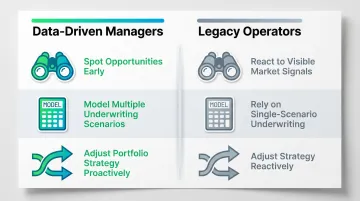
The best asset managers treat data as an active deal-finding tool, not just a reporting layer. Where fragmented teams react, these firms move first. They use data to:
- Spot opportunities before the broader market does
- Underwrite more accurately by modeling multiple scenarios
- Adjust portfolio strategy proactively rather than reactively
That distinction — acting on data versus archiving it — is exactly what this list is built to surface.
Conclusion
Choosing an asset manager with a mature data-driven acquisition strategy is a core risk management decision. The gap between managers who use data proactively and those who rely on legacy methods is widening.
McKinsey projects that agentic AI will create between $430 billion and $550 billion in annual value across global real estate, construction, and development sectors — a shift that rewards firms already invested in data infrastructure.
Assess prospective partners not only on historical returns but on the quality and integration of their data infrastructure, the specificity of their market intelligence, and their ability to adjust strategy as conditions shift. Scalability and transparency matter as much as past performance.
For companies operating in NYC commercial real estate, Nomad Group provides full-service support across tenant representation, asset management, and facilities operations — backed by deep market expertise in neighborhoods like Flatiron, NoMad, SoHo, and Williamsburg. Reach out to explore how their team can support your real estate goals.
Frequently Asked Questions
What is a data-driven acquisition strategy in real estate?
A data-driven acquisition strategy uses property analytics, market forecasts, rental yield models, and risk metrics to identify and underwrite acquisitions—replacing broker relationships and intuition with structured, evidence-based decision-making. This allows managers to spot opportunities earlier and adjust course before market shifts become obvious.
What does a real estate asset manager do?
A real estate asset manager oversees the financial performance of a property or portfolio—covering acquisition strategy, capital planning, risk management, and value enhancement. This is distinct from property management, which handles day-to-day operations such as leasing, maintenance, and tenant relations.
How do I choose a real estate asset manager?
Choose based on alignment with your asset class and geography, fee transparency, track record relative to benchmarks, and depth of market expertise. Evaluate technology capability and research infrastructure with the same rigor as past performance.
What metrics do data-driven real estate asset managers typically track?
Key metrics include cap rate, IRR, cash-on-cash return, rental yield, vacancy rate trends, AVM value changes, and supply pipeline data. Managers layer these alongside market-specific signals—tenant demand, leasing velocity—to form a complete acquisition picture.
What is the 3-3-3 rule in real estate?
The 3-3-3 rule is a financial readiness heuristic used primarily in residential real estate purchasing. It advises buyers to have three months of living expenses saved, three months of mortgage payments in reserve, and to compare at least three properties before purchasing. Professional asset managers may reference similar reserve thresholds, but embed them within more comprehensive underwriting models.
What is the 4-3-2-1 rule in real estate?
The 4-3-2-1 rule is a property appraisal heuristic for estimating how land value is distributed across a lot. It allocates 40% of the value to the quarter fronting the street, 30% to the second quarter, 20% to the third quarter, and 10% to the rear quarter, per the IAAO Glossary for Property Appraisal and Assessment.