If you're scratching your head, you're not alone. Many NYC companies use these terms interchangeably, but they describe fundamentally different projects. The distinction matters because choosing the wrong path—or not understanding what you've signed up for—can derail your budget, extend your timeline by months, and leave you with a workspace that doesn't support your team's actual needs.
The stakes are real. Office fit-out costs in NYC averaged approximately $212 per square foot in 2026, with all-in costs reaching roughly $330/SF when you factor in furniture, technology, and soft costs. Meanwhile, lease terms in competitive neighborhoods like Midtown South and NoMad often hinge on tenant improvement allowances that can offset a significant portion of your buildout—but only if you negotiate them correctly.
This guide breaks down the core differences between office fit outs and refurbishments, explains when each approach makes sense, and provides a practical decision framework for NYC companies navigating lease renewals, relocations, and workspace transformations.
Key Takeaways
- Office fit out transforms an empty or raw space into a functional, branded workspace—typical when signing a new lease
- Office refurbishment renovates an existing, already-occupied space—common at lease renewal or when refreshing a dated office
- Fit outs involve broader scope, longer timelines (6–9 months), and higher upfront costs than refurbishments
- Refurbishments are faster and more targeted—ideal when the core infrastructure still works
- Your decision hinges on space condition, lease timing, and your business growth stage
- In NYC, landlord requirements, TI allowances, and building codes make professional guidance essential for both
Office Fit Out vs Refurbishment: Quick Comparison
| Dimension | Office Fit Out | Office Refurbishment |
|---|---|---|
| Scope of Work | Full interior buildout from raw shell or Cat A space—walls, ceilings, HVAC, lighting, flooring, furniture, and IT infrastructure | Updates to finishes, furniture, layout, and systems within an existing space—new flooring, paint, reconfigured zones, upgraded AV/IT, refreshed branding |
| Starting Condition | Raw shell, base building, or Cat A space with minimal interior infrastructure | Existing, functional office with established layout and systems |
| Typical Timeline | 6-9 months in NYC (including design, permitting, procurement, construction); experienced teams can compress to ~90 days | 2-6 months depending on scope; often phased to minimize disruption |
| Relative Cost | Higher upfront investment; NYC averages ~$212/SF hard costs, ~$330/SF all-in with furniture and technology | Lower cost due to existing infrastructure; typically 40-60% of full fit-out cost depending on scope |
| Best Suited For | New lease signing, relocating to larger space, scaling significantly, need for fully custom environment | Lease renewal in place, dated aesthetics, reconfiguring for hybrid work, post-merger rebranding |
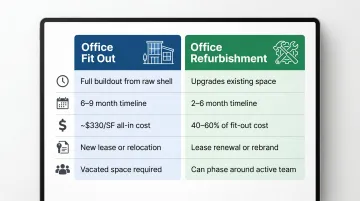
The biggest practical difference: fit outs require a vacated space, while refurbishments can run in phases—letting your team stay operational while construction moves through the office zone by zone.
What Is an Office Fit Out?
An office fit out is the process of transforming a raw, unfinished, or stripped-back commercial space into a fully functional, move-in-ready office. It starts from what the industry calls a "base building" or shell — with little to no interior infrastructure beyond structural elements and core building systems.
The Three Stages of Fit Out Work
The fit out process breaks down into three main categories:
Shell & Core is the foundational structural and mechanical work delivered by the developer or building owner. This includes the structural frame, exterior cladding, elevators, core plumbing and electrical risers, fire protection systems, and basic HVAC plant. In the US market, this is equivalent to a "cold dark shell" condition.
Cat A (or "Vanilla Shell" in US terms) is the basic habitable finish landlords typically deliver before tenant customization. It covers suspended ceilings, raised access flooring (in some buildings), basic HVAC distribution to the floor, lighting grids, fire alarm systems, and basic power distribution. The space is functional but generic — no partitions, no branding, no furniture.
Cat B (or Full Tenant Improvement) is where NYC tenants spend most of their budget. This is the tenant-specific buildout that makes the space actually yours, including:
- Custom floor plans and partitioning
- Branded finishes (paint, flooring, wall coverings)
- Furniture and workstations
- Kitchen and breakout areas
- Meeting rooms and private offices
- IT/AV infrastructure and cabling
- Acoustic treatments
NYC Fit Out Context: Tenant Improvement Allowances
In the NYC market, most tenants signing a new lease move into a space that already has Cat A infrastructure delivered by the landlord. Your job is the Cat B buildout — making it truly functional for your team.
This is where tenant improvement (TI) allowances become critical. TI allowances are negotiated as part of your lease and expressed as a dollar amount per square foot. According to CBRE's 2024 market analysis, the average TI allowance across 12 US markets was $87.51/SF in 2024, down from a peak of $97.55/SF in 2023. However, Class A and top-tier buildings averaged $98/SF in H1 2024.
Despite the recent decline, current concessions remain 30% higher than pre-pandemic levels, and TI allowances have increased 37% in top-tier buildings since 2019. The catch? TI allowances are generally not keeping pace with fit-out cost increases, meaning tenant out-of-pocket costs are rising.
Key factors that influence TI allowance amounts:
- Lease term length (longer terms typically secure higher allowances)
- Tenant credit quality and financial strength
- Scope of work required
- Market competition and vacancy rates
- Your negotiation expertise and broker relationships
Managing the Fit Out Process
A full-scale fit out requires coordination across designers, contractors, mechanical/electrical subcontractors, furniture vendors, IT installers, and building management. Timeline matters enormously — especially for growing companies that need to move in on schedule.
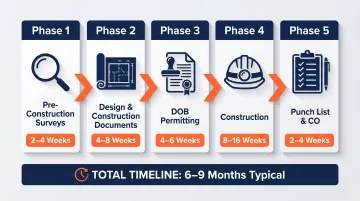
NYC fit-out timelines typically run 6-9 months from initial surveys to occupancy for a standard 3,000-10,000 SF Manhattan office. Key phases include:
- Pre-construction surveys: 2-4 weeks
- Design and construction documents: 4-8 weeks
- DOB permitting (standard Alt-2): 4-6 weeks
- Construction: 8-16 weeks
- Punch list and Certificate of Occupancy: 2-4 weeks
With experienced management and early procurement, compressed timelines closer to 90 days are achievable. Nomad Group has completed 300+ tenant buildouts in NYC and manages the entire process — from lease signing and permitting through construction and move-in — with a consistent 90-day turnaround.
What Is an Office Refurbishment?
An office refurbishment is the renovation or upgrade of an existing, already-functional office space. Unlike a fit out, a refurbishment doesn't start from scratch—the bones of the office are already there. The goal is to modernize, reconfigure, rebrand, or refresh.
Typical Refurbishment Scope
A refurbishment can range from cosmetic updates to substantial reconfiguration. Common elements include:
- New flooring, paint, and wall finishes
- Updated or replacement furniture and workstations
- Refreshed color schemes and branded graphics
- Reconfigured layouts (adding collaborative zones, focus rooms, or open areas)
- Upgraded audiovisual and IT systems
- Improved acoustics and sound masking
- Enhanced lighting (task lighting, natural light optimization)
- Kitchen and breakout area modernization
A major refurbishment can approach the scope and cost of a Cat B fit out. The critical difference: you're working within an existing interior framework, not building from bare walls.
Why Companies Pursue Refurbishments
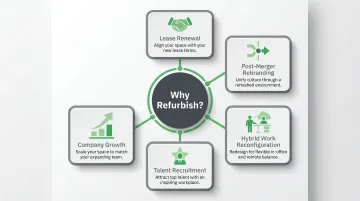
Companies typically invest in refurbishments at key trigger points:
- Lease renewal: Landlords often offer refurbishment allowances to retain tenants, making an upgrade more economical than relocating.
- Post-merger rebranding: Acquisitions create pressure to unify brand identity and office culture across formerly separate teams.
- Hybrid work reconfiguration: Companies are redesigning offices to emphasize collaboration over individual desks — employees come in for teamwork, not solo tasks.
- Talent recruitment: A dated office signals stagnation to candidates. Conversely, a well-designed space signals investment in people.
- Company growth: Scaling from 20 to 100 people often makes a scrappy startup aesthetic feel misaligned with where the business now stands.
Office environment has measurable recruiting and retention consequences. Gensler's 2025 Global Workplace Survey of 16,000+ workers found that employees in "great workplaces" are nearly 3x more likely to stay with their company. Meanwhile, 90% of employees who like their workspace say they're proud to work there, versus only 47% of those who feel disconnected from their environment.
The same research found that two-thirds of employees are "hacking" their workspace to compensate for deficiencies in noise control, ergonomics, or visual privacy — and one in four have resorted to DIY fixes just to make their environment functional.
Cost and Timeline Advantages
Refurbishments generally cost less and take less time than a full fit out because the structural and mechanical infrastructure is already in place. You're not installing new HVAC systems, pulling electrical from the core, or waiting for DOB permits for structural changes.
That said, larger refurbishments — particularly those involving layout reconfigurations, mechanical upgrades, or significant demolition — can still be substantial projects. Professional project management and phased execution are often essential to keep the business running throughout.
Office Fit Out vs Refurbishment: Which Is Right for You?
The core question is simple: Are you moving into a new (or newly vacated) space, or are you staying in place and improving what you have?
The Decision Framework
Choose a fit out when:
- You're taking on a new lease, especially a raw or Cat A space
- Your company is scaling significantly into a larger footprint
- You need a fully custom environment built to exact specifications
- You're relocating from a coworking space or sublease to your first dedicated office
- The existing space configuration fundamentally doesn't work for your needs
Choose a refurbishment when:
- You're renewing your lease in your current location
- Your space functions but looks or feels dated
- You're reconfiguring for hybrid work without changing total footprint
- You need to rebrand after a merger or corporate evolution
- Your budget or timeline doesn't support a full relocation and fit out
The Gray Zone
A heavy refurbishment can blur into a Cat B-style fit out in terms of cost and complexity. If you're essentially gutting your existing office and rebuilding from scratch (tearing down all partitions, replacing mechanical systems, reconfiguring the entire layout), the practical distinction becomes less meaningful. The planning, permitting, and professional involvement required is comparable to a full fit out.
NYC-Specific Considerations
Lease structure is the controlling factor in NYC. If you're mid-lease, a refurbishment may be your only practical option unless you're willing to negotiate an early exit or sublease. If you're at lease-end, it's worth evaluating both scenarios: refurbish-in-place versus relocate and fit out.
This decision hinges on:
Market conditions: In a tenant-favorable market with high vacancy, you may secure generous TI allowances and free rent that make relocation attractive. Midtown South availability fell to 13.7% in Q4 2025—the lowest since January 2021—suggesting tightening supply in popular neighborhoods.
Your space needs: Are you growing, contracting, or staying flat? If you need 30% more space, relocation and fit out likely makes more sense than trying to expand in place.
TI availability: Relocation can unlock $80-100/SF in TI allowances versus $20-30/SF for a lease renewal—a gap that often tips the financial math toward moving.
A real estate partner with both brokerage and construction management capabilities (like Nomad Group) can model both scenarios before you commit, comparing total occupancy costs, timelines, and strategic alignment.
Illustrative Scenario: Tech Startup at Lease Renewal
Consider a 30-person software company in a 6,000 SF Flatiron office. They signed a 5-year lease in 2021 during the pandemic at $65/SF with a modest $40/SF TI. Now their lease is up for renewal in 2026, and they're evaluating two paths:
Option A: Refurbish in place
- Landlord offers 5-year renewal at $78/SF with $25/SF refurbishment allowance
- Total refurbishment budget: $150,000 (Cat B-level refresh)
- Timeline: 3 months, phased to avoid disruption
- Pros: Familiar location, minimal business disruption, lower upfront cost
- Cons: Constrained by existing layout, no expansion capacity, neighborhood may not attract talent as well as newer options
Option B: Relocate and fit out
- New 7,500 SF space in a Union Square building at $82/SF with $95/SF TI allowance
- Total fit out budget: $247,500 (covered by TI), additional $80,000 out-of-pocket for premium finishes
- Timeline: 6 months (3 months overlap paying double rent)
- Pros: 25% more space for growth, modern building amenities, recruiting advantage, custom-built to exact specs
- Cons: Higher total cost, business disruption during move, double rent period
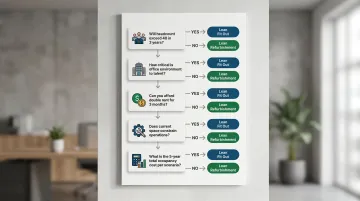
Key questions to work through:
- Do we expect headcount to grow beyond 40 people in the next 3 years?
- How important is office environment to our talent retention and recruiting?
- Can we afford 3 months of double rent and the associated moving costs?
- Does our current space fundamentally constrain our operations or culture?
- What's the total 5-year occupancy cost for each scenario (including all rent, buildout, and operating expenses)?
The right path depends on growth trajectory, financial position, and cultural priorities. Running both scenarios with actual cost models—not rough estimates—is the only way to make a defensible decision.
Conclusion
An office fit out builds your workspace from the ground up, transforming a raw or minimally finished space into a fully functional, branded environment. A refurbishment works differently—it evolves what you already have by modernizing, reconfiguring, or refreshing an existing space.
Both are meaningful investments. The right choice depends on where you are in your lease cycle, how much your space needs to change, and what your company is growing into.
A fit out offers complete customization and a fresh start but requires more time, budget, and planning. A refurbishment delivers targeted improvements faster and with less disruption—but works within existing constraints.
For NYC companies navigating this decision, the smartest first step is working with a team that understands both the real estate and the construction side. That means getting into the conversation before you sign—not after.
Nomad Group brings brokerage and in-house construction management under one roof, so decisions about lease terms, TI allowances, and buildout scope are made together, not in isolation. The result is a workspace built around your growth, your culture, and your real estate budget.
Frequently Asked Questions
What is the difference between fit-out and refurbishment?
A fit out transforms an empty or raw space into a functional office by installing all interior elements from scratch. A refurbishment upgrades or renovates an existing, already-built space. The key difference is starting condition and scope.
What does "office fit out" mean?
An office fit out is the process of installing all interior elements—walls, ceilings, flooring, utilities, furniture, and technology—into a commercial shell to make it a usable workspace. Projects typically progress through three stages: Shell & Core, Cat A (basic infrastructure), and Cat B (tenant-specific finishes).
What does office refurbishment mean?
Office refurbishment is the renovation or modernization of an existing office space. It may include new furniture, updated finishes, reconfigured layouts, and upgraded technology without rebuilding the space from scratch.
How much does it cost to fit out an office?
In NYC, hard construction costs averaged approximately $212/SF in 2026, with all-in costs (including furniture, IT, AV, and soft costs) reaching roughly $330/SF. Tenant improvement allowances from landlords can offset a meaningful portion of this. Costs vary by market and project complexity.
When should you choose a fit out over a refurbishment?
Choose a fit out when you're moving into a new space, signing a fresh lease, or need a fully custom buildout from scratch. Choose a refurbishment when you're staying in your existing space and need to upgrade or reconfigure without a full rebuild.
Does a fit out or refurbishment affect your lease agreement?
Yes, both can have lease implications. Fit outs often involve negotiating tenant improvement allowances and build-out clauses as part of your lease. Refurbishments may require landlord approval depending on the scope of structural or systems changes.