Introduction
Most commercial property owners excel at acquiring properties—but the real challenge lies in what happens next. Attracting creditworthy tenants and negotiating lease terms that protect your interests takes expertise most owners don't have in-house.
In New York City, tenants typically arrive backed by experienced brokers and ready to negotiate hard. An unrepresented landlord is at a structural disadvantage from the first conversation.
This guide covers the full scope of landlord representation: what it is, what a landlord rep actually does, how it differs from tenant representation, and what to look for when hiring one. Whether you're dealing with persistent vacancy, approaching lease renewals, or lack the bandwidth to manage leasing yourself, this guide gives you a clear framework for making the right call.
Key Takeaways
- Landlord representation means a broker works exclusively for property owners — marketing space, negotiating leases, and managing tenant relationships
- Landlord reps handle marketing strategy, tenant sourcing and screening, lease structuring, and renewal negotiations
- Retaining an existing tenant costs roughly one-third of replacing one, making renewal strategy essential
- NYC landlords benefit most from professional representation given the market's complexity, high concession levels, and demanding tenant expectations
What Is Landlord Representation?
Landlord representation is a specialized commercial real estate service where a licensed broker is retained exclusively by a property owner to manage the leasing process: marketing vacant space, qualifying tenants, and closing signed leases. The landlord rep's sole obligation is to the property owner, not prospective tenants.
Every decision — pricing, tenant selection, lease terms — is made with the landlord's financial and operational goals in mind.
Exclusive Agency and Fiduciary Duty
When you engage a landlord rep, they work for you alone. Unlike dual agency arrangements (where the same broker represents both sides), a dedicated landlord rep advocates exclusively for your interests. This matters during negotiations: your rep won't compromise your leverage to close a deal faster or to satisfy a tenant they're also representing.
Landlord Representation vs. Property Management
Landlord representation is primarily about leasing strategy and transaction execution — finding and securing tenants. Property management involves the day-to-day operational oversight of an occupied building: collecting rent, coordinating maintenance, managing vendor relationships. Some full-service firms offer both under one roof. Nomad Group's asset management services, for instance, pair strategic leasing with operational support — giving landlords a single point of accountability across their portfolio.
Scope Across Property Types
Landlord representation is used across office buildings, retail spaces, industrial properties, and mixed-use developments. In the NYC office market specifically, it is especially critical given the density of competition and the sophistication of tenants. Midtown South, for instance, recorded 13.7% availability in Q4 2025 — the lowest since January 2021 — with leasing velocity up 39.5% year-over-year. In a market this competitive, professional representation can mean the difference between securing a quality tenant at favorable terms or watching your space sit vacant.
Compensation Model
Landlord reps are typically compensated through a commission paid upon lease signing. Two structures are common:
- Percentage commission: 4–8% of total lease value, typically higher in early lease years and stepping down over time
- Flat fee: $1.00–$2.00 per square foot per year of lease term
Both models tie the rep's payout directly to lease execution — meaning their incentives align with yours from day one.
Core Responsibilities of a Landlord Representative
Property Marketing and Positioning
A landlord rep develops and executes a targeted marketing strategy to fill vacancies. This includes:
- Crafting compelling property listings with professional photography and detailed specs
- Leveraging CRE listing platforms and databases
- Tapping broker networks and co-brokerage opportunities
- Running digital advertising campaigns to reach qualified prospects
The goal is maximum visibility among the most qualified prospective tenants. A skilled landlord rep also advises on how to price and present the property relative to comparable spaces in the submarket — recommending staging, space improvements, or amenity upgrades that can increase asking rent or shorten time-to-lease.
Nomad Group, for instance, has leased over 2 million square feet across NYC's most competitive office submarkets—NoMad, Flatiron, SoHo, and Williamsburg—bringing landlords access to a pipeline of high-growth tech and startup tenants actively searching for space.
Tenant Sourcing and Screening
Landlord reps prospect for tenant candidates directly rather than waiting on inbound inquiries. This includes:
- Outreach through broker relationships and co-brokerage networks
- Direct marketing to target industries and companies
- Identifying off-market opportunities through existing tenant networks
The screening process covers financial background checks, business stability assessments, credit history reviews, and whether a prospective tenant's business fits the property's intended use and existing tenant mix. A financially unstable tenant can easily cost more than a short vacancy.
Red flags to watch for during screening:
- Poor credit history or financial instability
- Unusually short or vague business history
- Reluctance to provide references or financial documentation
- Unrealistic demands that signal a high-maintenance or high-risk tenancy
Lease Negotiation and Structuring
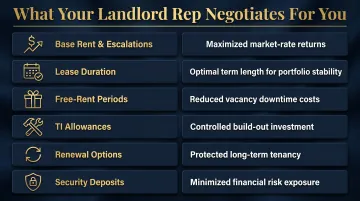
A landlord rep negotiates key lease terms to maximize favorable outcomes for the owner:
- Base rent and escalations - Securing market-rate or above-market rent with annual increases
- Lease duration - Longer terms provide stability; Manhattan lease terms now average 118 months, 3.9% above pre-pandemic levels
- Free-rent periods - NYC office tenants averaged 17 months of free rent in 2023, significantly above the national average
- Tenant improvement (TI) allowances - Manhattan TI allowances averaged $145/SF in 2023, with Midtown and Midtown South both at $148/SF—roughly 30% above pre-pandemic levels
- Renewal options - Structuring options that protect the landlord's ability to adjust rent at renewal
- Security deposits and guarantees - Ensuring adequate financial protections
A skilled landlord rep also monitors critical dates in existing leases—renewal windows, rent step-ups, and expiration dates—to ensure the owner is always in a proactive, not reactive, negotiating position.
Renewal Negotiations and Tenant Retention
Getting a lease signed is only part of the job. Once a tenant is in place, landlord reps manage renewal negotiations — structuring incentives like TI dollars or temporary rent reductions to retain high performers while still pushing for improved terms on the owner's behalf.
Replacing a commercial tenant costs approximately 3X more than retaining an existing one. For a 10,000 SF office space at $40/SF rent, re-tenanting costs can exceed $500,000:
- 3-month vacancy loss: $100,000
- Higher commission for new tenant: $56,000 difference
- TI allowance differential: $350,000 ($50/SF new vs. $15/SF renewal)
- Marketing costs: ~$10,000
Given that renewals now account for 42% of U.S. office lease transactions (up from 31% pre-pandemic), a landlord rep who prioritizes tenant retention delivers measurably greater value than one focused solely on new-tenant acquisition.
Landlord Rep vs. Tenant Rep: Understanding the Difference
Both roles involve commercial leasing expertise, but they represent opposing parties.
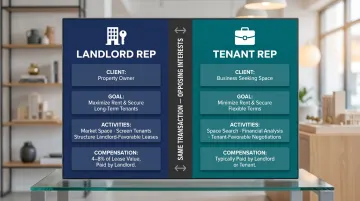
Fundamental Distinction
- Tenant Rep: Advocates for the business leasing the space (lower rent, flexible terms, exit options)
- Landlord Rep: Advocates for the property owner (higher rent, longer commitments, creditworthy tenants)
| Factor | Landlord Rep | Tenant Rep |
|---|---|---|
| Client | Property owner | Business seeking space |
| Primary Goal | Maximize rent, secure long-term tenants, protect owner interests | Minimize rent, negotiate flexible terms, secure tenant protections |
| Key Activities | Marketing vacant space, screening tenants, structuring landlord-favorable leases | Market-wide space search, financial analysis, negotiating tenant-favorable terms |
| Compensation | Paid by landlord (typically 4-8% of lease value) | Paid by landlord or tenant, depending on market |
Dual Agency: A Conflict of Interest
Dual agency arises when the same broker or firm represents both sides of a transaction. New York State requires informed written consent from all parties before a broker can act as a dual agent — and once appointed, that broker cannot use one client's disclosures to benefit the other.
Most property owners prefer dedicated representation for this reason. A landlord-only rep pursues occupancy, favorable lease terms, and creditworthy tenants without splitting attention or loyalty.
Is Agency Leasing the Same as Landlord Representation?
Terminology confusion is common in commercial real estate, and the landlord rep space is no exception. Yes — major brokerages like CBRE use "Landlord Leasing" and "landlord representation" interchangeably. "Agency leasing" is not a distinct service category; it refers to the same landlord-side representation, particularly for large office or retail portfolios.
Benefits of Hiring a Landlord Representative
Maximize Rental Income and Lease Value
A landlord rep's market knowledge allows them to price space accurately—neither leaving money on the table with below-market rents nor deterring qualified tenants with inflated asking rates. Prime buildings now capture 12% of total leasing volume despite representing only 8% of inventory, with new leases in prime buildings averaging 107-month terms versus 86 months in non-prime buildings.
This divergence underscores why positioning matters: landlord reps who help owners invest in building quality and amenities capture disproportionate demand and longer lease commitments.
Reduce Vacancy Periods
A landlord rep's active pipeline of tenant relationships, co-broker network, and targeted marketing shorten the time a space sits empty. A 1% increase in vacancy can reduce a commercial property's value by 2-3%, with cascading effects on NOI, cap rates, and financing terms. Extended vacancy erodes asset value directly — through lost rent and through the downward pressure it places on cap rate valuations.
Access to a Qualified Tenant Pipeline
In markets like NYC, the best tenants—funded startups, established tech firms, enterprise companies—are often brought by tenant rep brokers. A landlord rep with strong broker relationships ensures your property gets in front of this demand, not just generic inquirers. Nomad Group, for example, has successfully placed companies like Optimove, FloraFauna AI, and Middesk into spaces across NoMad, Williamsburg, and Union Square—connecting landlords with high-growth tenants actively seeking quality space.
Mitigate Legal and Financial Risk
Landlord reps structure leases to protect the owner, ensuring appropriate guarantees, security deposits, and representations are in place before signing. Most commercial leases place the inspection burden on tenants, requiring them to accept the space "as-is" — which means a poorly drafted lease can expose landlords to post-occupancy disputes. A skilled rep anticipates these pressure points during negotiations, pushing for clauses that limit liability while keeping the deal moving forward.
Signs You Need Landlord Representation
High or Persistent Vacancy Rates
If your space has been vacant for more than 3-6 months, or if you're struggling to attract tenants of sufficient credit quality, professional representation can reset your strategy. Midtown South's availability dropped to 13.7% in Q4 2025—the lowest since January 2021—signaling that landlords in NoMad, Flatiron, and SoHo face a narrowing window to capture quality tenants at favorable terms.
Lease Renewals Coming Up Without a Clear Strategy
If you have leases expiring in the next 6-12 months and haven't started renewal discussions, you're already behind. A landlord rep monitors critical dates and ensures you enter renewal negotiations from a position of strength, not desperation.
Time and Expertise Gap
Many commercial property owners are investors, not operators—they lack the bandwidth to run marketing campaigns, vet tenants, or track renewal windows across a portfolio. A landlord rep functions as an outsourced expert, freeing the owner to focus on capital allocation and investment strategy.
The NYC-Specific Challenge
NYC office tenants are sophisticated and almost always represented by experienced tenant rep brokers. An unrepresented landlord sitting across the table from a represented tenant starts the negotiation at a structural disadvantage. In a market this competitive, professional landlord representation isn't optional — it's the baseline.
NYC concession levels reinforce the point. Without a clear benchmark, landlords routinely leave value on the table:
- Manhattan TI allowances averaged $145/SF in 2023 — versus a national average of $87.51/SF in 2024
- Overall concession packages remain roughly 30% above pre-pandemic levels
- Mispriced TI deals are one of the most common ways landlords quietly lose margin on otherwise solid leases
What to Look for in a Landlord Representative
Deep Local Market Expertise
Your landlord rep should know your specific submarket—current vacancy rates, comparable asking rents, which tenant sectors are actively looking, and what lease concessions are typical right now. Generic brokerage firms with no submarket specialization may misprice your listing or miss the right tenant pool entirely.
For example, Midtown's asking rent averaged $83.35/SF in March 2025, while Midtown South averaged $79.30/SF. A landlord rep who doesn't know these nuances may misprice your space.
Proven Track Record and Active Tenant Network
Look for a firm with documented transaction history:
- Square footage leased
- Number of deals closed
- Types of tenants placed
Established relationships with both tenant rep brokers and directly with the types of occupiers you want are critical. Nomad Group has leased over 2 million square feet across NYC's most competitive office submarkets—NoMad, Flatiron, SoHo, and Williamsburg—bringing landlords access to a pipeline of high-growth tech and startup tenants.
Full-Service Capability Beyond Just Leasing
A strong track record matters, but transaction volume alone doesn't protect your asset after the lease is signed. The best landlord representatives extend beyond leasing into buildout management, ongoing facilities needs, and asset management, reducing the number of vendors you coordinate and keeping the tenant experience consistent enough to drive renewals.
Nomad Group's integrated approach covers construction management (300+ tenant buildouts, 90-day turnaround), facilities management, and asset management, giving landlords a single partner across the entire real estate lifecycle.
Industry Credentials and Professional Designations
Look for brokers with recognized industry credentials:
- SIOR (Society of Industrial and Office Realtors): requires 5+ years of active brokerage and meets rigorous production and ethics standards
- CCIM (Certified Commercial Investment Member): covers investment analysis and portfolio management through a comprehensive credentialing curriculum
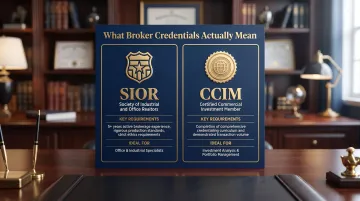
When interviewing brokers, ask which designations they hold and request transaction examples that demonstrate that expertise in your specific submarket.
Frequently Asked Questions
What is landlord representation?
Landlord representation is a specialized commercial real estate service where a licensed broker or agent represents a property owner's interests throughout the leasing process—from marketing vacant space to negotiating and closing tenant leases. The landlord rep works exclusively for the owner, not the tenant.
Is agency leasing the same as tenant representation?
No. Agency leasing (or landlord representation) refers to representing the property owner. Tenant representation refers to representing the business seeking space. They are opposite sides of the same transaction, with distinct goals and fiduciary obligations.
What are red flags for landlords?
Watch for these warning signs when evaluating prospective tenants:
- Poor credit history or signs of financial instability
- Vague or unusually short business history
- Reluctance to provide references or financial documentation
- Unrealistic demands that signal a high-risk tenancy
What are the common mistakes in office leasing?
Common landlord-side errors include:
- Pricing space above market without clear differentiation
- Skipping thorough tenant financial vetting
- Missing critical lease renewal window dates
- Signing leases without personal guarantees or security deposits
What is the lease abstraction process?
Lease abstraction extracts and summarizes key lease terms—rent, escalations, renewal options, critical dates, and tenant obligations—into a standardized document. Landlord reps and asset managers use it to track and manage multiple leases across a portfolio efficiently.