Introduction
Williamsburg, Brooklyn attracts movers with its waterfront parks, acclaimed restaurants, and dense creative energy. But is it actually safe to live there? That question deserves a direct answer — not a neighborhood pitch.
This guide draws on current crime data and sub-neighborhood breakdowns to give you a clear picture of what to expect. We'll compare Williamsburg's safety profile to other Brooklyn neighborhoods, explore how North, South, and East Williamsburg differ, and share what to expect as a new resident — from housing costs to transit access.
TLDR:
- Williamsburg ranks #6 safest in Brooklyn with violent crime rates below NYC averages
- Property crime (especially package and phone theft) is more common than violent crime
- North Williamsburg is the most polished and family-friendly sub-neighborhood; East Williamsburg skews industrial
- Median rent is $4,770/month, rivaling Manhattan's East Village
- L train (Bedford Ave stop) connects to Midtown in ~14 minutes
Is Williamsburg, Brooklyn Safe? The Short Answer
Yes, Williamsburg is generally considered one of Brooklyn's safer neighborhoods. It ranks #6 on PropertyClub's 2024 list of safest Brooklyn neighborhoods, with crime rates 32% below the national average across the top 10. CrimeGrade assigns it an overall B grade, placing it in the 60th–75th percentile nationally for property crime and murder rates.
The neighborhood is patrolled by two NYPD precincts:
- 90th Precinct (covering core Williamsburg)
- 94th Precinct (covering northern Williamsburg/Greenpoint)
Williamsburg's safety profile has improved dramatically since the 1990s. Total index crimes in the 90th Precinct dropped 68.7% from 5,392 in 1990 to 1,686 in 2025. The 94th Precinct saw a similar 67.0% decline over the same period.
That improvement tracks the neighborhood's broader transformation: rising development, an influx of young professionals and creatives, and increased commercial activity along Bedford Avenue and the waterfront all contributed to a more stable environment.
That said, no urban neighborhood is crime-free. Property crime — primarily theft and vehicle break-ins — makes up the bulk of reported incidents, so situational awareness in busy commercial corridors remains worthwhile.
Crime Data: How Williamsburg Compares to the Rest of Brooklyn
Violent vs. Property Crime
The most important distinction for prospective residents is understanding what types of crime occur in Williamsburg. In 2025, the 90th Precinct recorded 1,686 total major felonies. Of those:
- Property crimes (burglary, grand larceny, grand larceny auto): 1,162 incidents (69%)
- Violent crimes (murder, rape, robbery, felony assault): 524 incidents (31%)
Grand larceny alone — primarily package theft, phone theft, and shoplifting — accounted for 788 incidents, nearly half of all reported crimes. By contrast, there were only 3 murders in the 90th Precinct and 0 in the 94th for all of 2025.
Day-to-day safety concerns here center on protecting your belongings. Lock your apartment, avoid leaving valuables visible in parked cars, and keep your phone secure in crowded areas.
Comparison to Other Brooklyn Neighborhoods
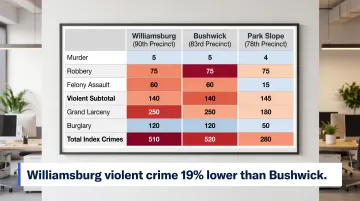
Knowing where Williamsburg stands relative to comparable neighborhoods puts those numbers in context. The table below compares the 90th Precinct to Bushwick (83rd Precinct) and Park Slope (78th Precinct) using full-year 2025 NYPD CompStat data:
| Crime Category | Williamsburg (90th) | Bushwick (83rd) | Park Slope (78th) |
|---|---|---|---|
| Murder | 3 | 7 | 2 |
| Robbery | 203 | 217 | 78 |
| Felony Assault | 295 | 391 | 159 |
| Violent Subtotal | 524 | 650 | 252 |
| Grand Larceny | 788 | 705 | 407 |
| Burglary | 252 | 149 | 119 |
| Total Index Crimes | 1,686 | 1,675 | 848 |
Key takeaways:
- Williamsburg's violent crime total (524) is 19.4% lower than Bushwick's (650)
- Total index crimes in Williamsburg (1,686) are comparable to Bushwick (1,675)
- Park Slope is significantly safer across all categories, with half the total crime
Recent Trends
Brooklyn-wide, major felonies fell approximately 27% year-over-year in early 2025, with Brooklyn DA Eric Gonzalez describing 2024 as "the safest year for gun violence in Brooklyn's history." However, year-to-date 2026 data shows the 90th Precinct running 8.4% higher than 2025, driven by increases in burglary and grand larceny auto. The 94th Precinct is running 15.7% lower, with burglary down over 50%.
Short-term upticks in property crime are worth watching — but they don't reverse a decade of sustained improvement across Brooklyn.
Safety by Sub-Neighborhood: North, South, and East Williamsburg
Williamsburg isn't monolithic. Safety, vibe, and lifestyle vary significantly depending on which part of the neighborhood you're considering.
North Williamsburg (Northside)
Boundaries: Grand Street north to Greenpoint, East River to roughly Bushwick Avenue
Primary transit: L train (Bedford Avenue station)
North Williamsburg is the most gentrified sub-area and widely considered the safest. Luxury waterfront condos line Kent Avenue, while Bedford Avenue and Lorimer Street anchor the commercial scene with bars, boutique hotels, and restaurants. The Bedford Avenue L station connects to Manhattan in roughly 14 minutes.
Safety profile: High foot traffic and 24/7 activity provide natural surveillance, making streets feel safe even late at night. However, property crime — especially bike theft and phone snatching near nightlife hubs — is more common here than in quieter parts of Williamsburg. CrimeGrade's geographic analysis shows moderate property crime risk in this area.
Best for: Young professionals, newcomers to NYC, and anyone who values walkability and convenience.
South Williamsburg
Boundaries: South of Division Avenue
Primary transit: J/M/Z trains (Marcy Avenue, Hewes Street)
South Williamsburg has a distinct character, anchored by a large Hasidic Jewish community of approximately 57,000 Satmar residents. It's quieter and more residential than the Northside, with fewer bars but a strong communal fabric — including the Shomrim, a volunteer patrol that actively contributes to local safety.
Safety profile: CrimeGrade identifies South Williamsburg as the safest sub-area in the neighborhood, with a property crime victimization rate of 1 in 79. Crime rates are slightly higher than North Williamsburg in raw numbers, but the difference is modest and concentrated outside the core residential blocks.
Best for: Those seeking a quieter, community-rooted environment with lower rents than the waterfront.
East Williamsburg
Boundaries: The transitional zone between Williamsburg and Bushwick, east of Bushwick Avenue
Primary transit: G train (Metropolitan Avenue)
East Williamsburg still has working warehouses alongside converted artist studios and a growing creative scene. It's less polished than the Northside — fewer commercial corridors, quieter blocks, and a grittier street-level feel.
Safety profile: Fine for residents who take standard urban precautions, but CrimeGrade flags the southeast corner as having the highest property crime risk in Williamsburg (1 in 34). Fewer pedestrians and sparse commercial activity leave some blocks isolated after dark.
Best for: Budget-conscious creatives and renters prioritizing affordability and a grittier, more authentic vibe.
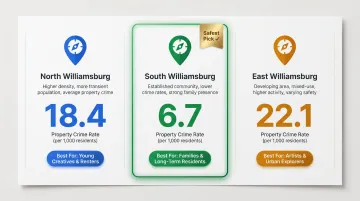
At a Glance: Sub-Neighborhood Comparison
| Sub-Neighborhood | Safety Profile | Property Crime Rate | Best For |
|---|---|---|---|
| North Williamsburg | Moderate — active streets, higher nightlife theft | Moderate (CrimeGrade) | Young professionals, newcomers |
| South Williamsburg | Safest overall | 1 in 79 victimization | Community-seekers, budget renters |
| East Williamsburg | Variable — isolated pockets | 1 in 34 (southeast) | Creatives, affordability-focused renters |
Pedestrian Corridors to Know
Well-lit, active streets include:
- Bedford Avenue (shops, restaurants, consistent foot traffic)
- Lorimer and Graham Avenues (commercial hubs)
- Williamsburg Waterfront greenway (Domino Park, Marsha P. Johnson State Park)
Quieter industrial pockets, particularly in East Williamsburg, may feel more isolated after dark.
What Makes Williamsburg a Great Place to Live
Culture and Lifestyle
Williamsburg earned the nickname "Little Berlin" in the late 1980s and 1990s during its Immersionist arts movement, projecting its creative energy internationally. Today, the neighborhood remains a hub for artists, foodies, and young professionals.
Key cultural draws include:
- Smorgasburg: 70+ food vendors at Marsha P. Johnson State Park every Saturday (April–October)
- Brooklyn Bowl (61 Wythe Avenue): Live music venue with 16 bowling lanes and full-service dining
- Independent galleries, performance venues, and creative spaces
Parks and Green Space
Williamsburg offers multiple well-maintained outdoor spaces that contribute to safety and community:
- McCarren Park (35 acres, shared with Greenpoint): Pool, running track, baseball, soccer, bocce, tennis
- Domino Park (5 acres): Waterfront park built on the former Domino Sugar Refinery site
- Bushwick Inlet Park (25+ acres upon completion)
- East River State Park and Marsha P. Johnson State Park: Waterfront greenways
Schools and Families
Williamsburg works well for families. There are multiple public elementary schools and three Brooklyn Public Library branches, including the 26,000-square-foot Williamsburgh Library (a designated NYC landmark). Approximately 50% of Community Board 1 residents hold a college degree or higher, compared to 43% for Brooklyn overall.
Families should be aware that rents are high and nightlife activity can make some blocks noisier on weekends.
Business and Commercial Growth
Williamsburg's converted industrial buildings now house a mix of coworking spaces, boutique offices, and creative agencies. The neighborhood attracts startups drawn to its transit access, talent pool, and lower rents compared to Manhattan — making it a practical alternative to traditional Midtown or Downtown office corridors. Nomad Group actively works with companies securing office space in Williamsburg as part of its broader NYC practice.
Housing and What to Expect as a New Resident
Housing Types and Costs
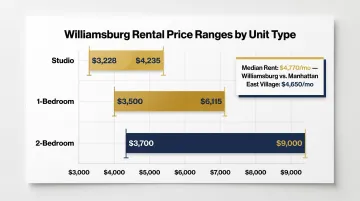
Williamsburg offers a wide range of housing — from walkup apartments and brownstones to luxury high-rises and waterfront condos. According to StreetEasy, the median base rent is $4,770/month, exceeding Manhattan's East Village ($4,650).
Current rental ranges:
- Studio: $3,228–$4,235
- 1-bedroom: $3,500–$6,115
- 2-bedroom: $3,700–$9,000
Cost of Living Context
Those rents put Williamsburg squarely in Manhattan territory. Two nearby neighborhoods offer lower costs worth considering:
- Bushwick: $3,495 median rent (adjacent, more affordable)
- Bedford-Stuyvesant: $3,300 median rent (further alternative)
Practical Moving Considerations
Once you've settled on a budget and location, the logistics of actually moving in require some planning. NYC buildings add several steps most cities don't:
- Certificate of Insurance (COI): Most buildings require movers to submit proof of insurance 1–2 weeks before move-in
- Elevator reservations: Book 1–2 weeks in advance (3–4 weeks for luxury co-ops during peak season)
- Parking: Approximately 77.9% of Williamsburg households do not own a car — and street parking is nearly impossible to find.
Practical Safety Tips for Moving to Williamsburg
Moving to any new neighborhood requires a short adjustment period. The tips below cover the basics — both for staying safe and for settling in quickly.
Urban Awareness Basics
A few habits go a long way:
- Stay aware of surroundings late at night, especially in quieter industrial areas
- Keep valuables out of sight in parked vehicles
- Use well-lit main thoroughfares after dark
- Secure packages (consider building lockers or delivery to a staffed location)
Community and Familiarity
The faster you get familiar with the area, the more comfortable you'll feel:
- Walk different blocks at different times of day before signing a lease
- Introduce yourself to neighbors and building staff
- Join local community boards or neighborhood groups (for example, r/williamsburg on Reddit)
- Attend local events at McCarren Park or Smorgasburg to build connections
Frequently Asked Questions
Is Williamsburg, Brooklyn a safe neighborhood?
Yes, Williamsburg is considered one of Brooklyn's safer neighborhoods, ranking #6 on PropertyClub's 2024 list. Violent crime rates are below the NYC average, and gentrification over the past two decades has significantly improved safety conditions throughout most of the area.
Is Williamsburg, Brooklyn a nice place to live?
Williamsburg consistently ranks among Brooklyn's best neighborhoods for quality of life. The food and arts scene, transit access via the L and J/M/Z trains, and parks like McCarren and Domino make it a strong draw for residents at most stages of life.
What is the safest part of Williamsburg, Brooklyn?
North Williamsburg, particularly the waterfront corridor and the blocks around Bedford Avenue, is generally considered the safest and most polished sub-area. Heavy foot traffic and dense commercial activity provide natural surveillance throughout the area.
Is East Williamsburg safe?
East Williamsburg is generally safe for residents but has a more industrial, transitional character compared to North Williamsburg. Standard urban awareness is recommended, especially at night, and safety continues to improve as the area develops.
Is Williamsburg good for families?
Yes, Williamsburg works well for families, with multiple public elementary schools, McCarren and Domino Parks, and three library branches. Rents are high, and weekend nightlife can make some blocks noisy — worth factoring in before committing to a block.
What subway lines serve Williamsburg, Brooklyn?
The L train (Bedford Avenue stop for North Williamsburg) provides the fastest connection to Manhattan (~14 minutes to Midtown). The J/M/Z trains serve South Williamsburg (Marcy Avenue and Hewes Street stops), and the G train connects to Greenpoint and broader Brooklyn.