The "right" amount of space isn't a fixed number. It shifts based on team size, work style, how often people actually show up, and where you expect to be 24 months from now.
This guide breaks down industry benchmarks per person, the key factors that push your number up or down, how to allocate square footage across different space types, and a step-by-step formula for calculating your total requirement.
Key Takeaways
- Office space generally ranges from 80–500 sq ft per person depending on layout density
- Most mixed-use offices (open desks + some private rooms) land in the 150–250 sq ft per person range
- Common areas add roughly 20–30% on top of your per-person calculation
- Build in a 10–20% growth buffer, especially if you're hiring aggressively
- NYC offices run smaller than national averages, so define what "efficient" means for your team before you start touring
How Much Office Space Do You Need Per Person?
There's no single correct answer. The industry standard is a range, and the right number depends on how your team actually works — not just how many people you have.
Companies that misread this end up in one of three situations:
- Signed too little space and forced into a costly early relocation
- Signed too much and paying for empty square footage for years
- Forgot common areas entirely and have nowhere to hold a meeting
Here's how the major density tiers break down.
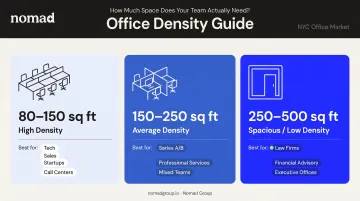
Density Tier 1 — High Density (80–150 sq ft per person)
What's typically included: Open bench seating or rows of small desks, few or no private offices, large shared collaboration zones.
Best for: Tech companies, sales teams, call centers, and startups prioritizing headcount-per-floor efficiency. This tier makes sense when most employees don't need a dedicated desk for the full day.
JLL's 2025 occupancy benchmark targets 132 rentable sq ft per person for large corporate occupiers, and IFMA reported the average dropping to 145 sq ft per employee — both fall squarely in this range.
Density Tier 2 — Average Density (150–250 sq ft per person)
A traditional mix of open workstations, a handful of private or semi-private offices, and a moderate allocation for conference rooms and break areas.
This is the most common setup among scaling companies. Series A/B companies, professional services firms, and mixed-function teams land here — they need both collaborative space and focused work areas. Client buildouts Nomad Group has completed for companies like Optimove (10,500 sq ft for 75–100 employees) reflect density decisions in this range. JLL's reported average of 165 rentable sq ft per person and CoreNet Global's pre-pandemic baseline of 175 sq ft per person both sit comfortably here.
Density Tier 3 — Spacious/Low Density (250–500 sq ft per person)
What's typically included: Majority private offices, generous individual square footage, significant common areas, lower utilization per square foot overall.
Best for: Law firms, financial advisory practices, executive-level offices, or any business where confidentiality and private client interaction are central to daily operations.
| Tier | Sq Ft Per Person | Best For |
|---|---|---|
| High Density | 80–150 sq ft | Tech, sales, startups, call centers |
| Average Density | 150–250 sq ft | Series A/B, professional services, mixed teams |
| Spacious/Low Density | 250–500 sq ft | Law firms, financial advisory, executive offices |
Key Factors That Affect How Much Space You Need
Headcount is just the starting point. Several operational and cultural factors push your actual requirement significantly higher or lower.
Work Style and Layout Type
Open-plan offices use less square footage per desk but require more supplemental space — phone booths, quiet zones, and additional meeting rooms to compensate for the lack of enclosed areas. Private office layouts consume more per-person square footage but reduce the need for those supplemental spaces.
The balance is shifting. IFMA reported that assigned seating dropped from 83% to 55% of workplaces, while hybrid and desk-sharing models rose from 12% to 36%. That has a direct impact on how much total space you actually need.
Hybrid Schedules and Desk-Sharing Ratios
If employees are only in the office three days per week on average, you don't need a 1:1 desk-to-employee ratio. A team of 30 with 60% average in-office attendance may only need 18 desks.
IFMA data shows the average desk-to-person ratio has moved from 1.2:1 to 1.5:1 across the industry. That shift is playing out in real time: NYC companies are increasingly using badge-swipe and reservation data to right-size their footprint rather than defaulting to headcount alone.
Frequency of Client Visits
A company that hosts ten clients a week has very different space needs than one that operates entirely internally. Client-facing businesses need to budget for:
- A proper reception and waiting area
- Formal conference rooms (not just a huddle space)
- Presentation-ready rooms that reflect the brand
Skimping here to save on rent tends to show — first impressions with clients are hard to recover from.
Growth Trajectory and Lease Length
A company expecting to double headcount over a three-year lease should plan space for its future size. Commercial Observer reported in 2025 that Manhattan tech firms averaged 5.3-year lease terms, while AI firms averaged 3.5 years.
The standard guidance: plan to reach full occupancy no earlier than two-thirds through your lease. For a five-year NYC lease, your space should comfortably support your projected headcount at year three or four — not just at signing.
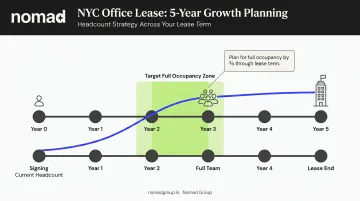
Translating that guidance into lease terms takes some upfront structuring. Nomad Group negotiates expansion optionality into initial agreements for this reason — including right of first refusal on adjacent floors and sublease provisions for downside protection.
How Office Space Breaks Down: Workstations, Common Areas, and More
Total square footage isn't just desks. A practical breakdown ensures nothing critical gets left out of your calculation.
Individual Workstations and Private Offices
| Space Type | Square Footage Range |
|---|---|
| Open workstation / bench seat | 35–110 sq ft per person |
| Small private office | 90–150 sq ft |
| Medium private / shared office | 150–250 sq ft |
| Large / executive private office | 200–400 sq ft |
IFMA data shows standardized workstations averaging 35–49 sq ft account for 64% of workspaces in modern offices, with individual offices trending toward the 100–149 sq ft range. Your mix of these space types — and how many of each you need — is what ultimately sets your overall density tier.
Conference Rooms and Meeting Spaces
A practical sizing formula: 50 sq ft base + 25 sq ft per seated person.
| Room Type | Seats | Estimated Size |
|---|---|---|
| Small / huddle | 4–6 | 150–200 sq ft |
| Medium | 8–10 | 250–300 sq ft |
| Large / boardroom | 16–20 | 450–550 sq ft |
General rule of thumb: one conference room per 10 employees in open or dense offices; one per 20 in more traditional layouts. For most companies, a mix of small and medium rooms outperforms a single large boardroom.
Break Rooms, Reception, and Support Spaces
These areas are consistently underbudgeted and create real operational friction when cut too tight:
- Reception / waiting: 100–200 sq ft per person waiting
- Break room: 75 sq ft base + 25 sq ft per seated person
- Mail / file room: 125–200 sq ft
- Hallways and circulation: 20–30% of total usable area
The Common Area Multiplier
Once you've accounted for all the space categories above, layer in a common area allocation on top. The ratio depends on your layout type:
- Dense / open offices: budget closer to 30% — open environments need more supplemental space for private calls, focus work, and team meetings
- Traditional offices: 20% is typically sufficient, since enclosed offices absorb some of that need
How to Calculate Your Total Office Space Needs
The formula itself is straightforward. The key is making sure the inputs are accurate before you multiply.
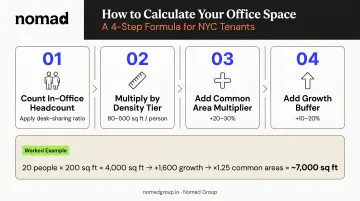
Step 1: Count your current full-time in-office headcount. Apply your desk-sharing ratio if hybrid.
Step 2: Multiply by the sq ft that matches your density tier (80–500 sq ft per person).
Step 3: Add 20–30% for common areas.
Step 4: Add a 10–20% growth buffer based on projected hiring over the lease term.
Worked Example
A 20-person NYC tech company at average density (200 sq ft/person), planning to hire 8 people over a 4-year lease:
| Component | Calculation | Result |
|---|---|---|
| Current headcount | 20 people × 200 sq ft | 4,000 sq ft |
| Growth buffer (8 new hires) | 8 × 200 sq ft | 1,600 sq ft |
| Common area multiplier (25%) | 5,600 × 1.25 | 7,000 sq ft |
| Total target | ~7,000 sq ft |
NYC buildings have specific floor plate sizes, column placements, and usable-to-rentable ratios that affect how efficiently you can occupy a space. Loss factors here typically range from 27% to 40% under the REBNY measurement standard — meaning a 7,000 sq ft usable target may require searching for 9,500–10,000 rentable sq ft depending on the building.
That gap between usable and rentable square footage is where many companies get tripped up. Nomad Group's tenant reps, who have completed 300+ buildouts across NYC, translate your raw square footage target into a realistic search range tied to specific buildings and submarkets.
What Companies Get Wrong When Sizing Their Office
Most sizing mistakes fall into the same predictable categories:
- No growth buffer. Companies that size for today's headcount often hit relocation or subletting conversations before the lease is even halfway done — renegotiating mid-term costs far more than sizing up at signing.
- Ignoring common areas. Square footage calculated purely from desk count leaves no room for conference tables, a functional kitchen, or a reception area. Common areas aren't optional overhead — they're part of the floor plan.
- Density decisions driven by rent alone. High-density layouts only work if your team's workflow supports them. Packing a heads-down engineering team into bench seating without quiet zones creates productivity and retention problems that quickly eclipse any rent savings.
- Applying national benchmarks to NYC floor plates. What "250 sq ft per person" looks like in a Flatiron loft versus a suburban office park is a different experience entirely — and the usable area you get for your rentable dollar varies considerably between building types and neighborhoods.
If your space needs are still evolving or you're not yet ready to commit to a direct lease, Flex by Nomad offers a full-service flexible office solution without the inflated costs typical of coworking spaces — a practical option when headcount is still in flux.
Frequently Asked Questions
How much office space do I need per person?
The industry range is 80–250 sq ft per person depending on density, with 150–175 sq ft being the most common benchmark for a mixed-use office. NYC offices frequently trend toward the lower end of that range due to real estate costs and building constraints.
Is a 10x10 office too small?
A 10x10 room (100 sq ft) works well as a single-person private office or focus room, but is tight for two people. It sits at the lower end of the small private office range (90–150 sq ft) and is best suited as a solo workspace or quiet room.
What is the standard office space per person in NYC?
NYC offices typically run more efficient than the national average. Many high-growth companies in Manhattan and Brooklyn operate in the 125–175 sq ft per person range, driven by higher per-square-foot costs and the prevalence of efficient floor plates in converted loft buildings.
How many conference rooms does my office need?
A general rule: one conference room per 10 employees in open or dense offices, one per 20 in traditional layouts. For most companies, a mix of small (4–6 seat) and medium (8–10 seat) rooms is more practical than a single large boardroom.
How do I account for future growth when calculating office space?
Add 10–20% to your calculated square footage as a growth buffer. On a 5-year NYC lease, plan for your space to reach full occupancy around year 3–4 — not at signing. That way, you're not hunting for new space the moment your team hits a growth sprint.
Should I choose open plan or private offices for my team?
Open plan suits collaborative teams and reduces per-person square footage; private offices work better for roles requiring focus or confidentiality. Most scaling companies land on a hybrid layout — open workstations plus a mix of small private rooms and phone booths.