Introduction
NYC tech startups face a defining tension: they need office space that signals credibility to investors and engineering talent, yet traditional long-term leases can strangle the cash flow and agility that early-stage growth demands. With 21.5% of new businesses failing within the first year and approximately 30% by year two, the office decision carries real stakes.
This guide provides a direct comparison of mobile/flexible office solutions—coworking, short-term leases, serviced spaces—versus traditional office leases. We'll explore what drives the right decision at each funding stage, from pre-seed through Series B, using specific cost benchmarks, neighborhood breakdowns, and portfolio examples from NYC's tech corridor.
That NYC context matters here. Flexible office space now represents 4.2% of NYC's total inventory, the second-highest concentration in the U.S. Meanwhile, tech companies leased 1.2 million square feet in Manhattan in Q1 2025 alone. The market is tightening, and the window to secure the right space at the right terms is narrowing.
Key Takeaways
- Mobile/flexible offices deliver low upfront cost, month-to-month flexibility, and built-in infrastructure — best for pre-seed through early Series A teams still validating product-market fit
- Traditional offices offer full customization, privacy, brand control, and better long-term economics: the right fit for Series B+ companies with stable headcount and investor-facing requirements
- Coworking saves over 50% versus traditional leases for 10-person teams ($62,900/year difference); Manhattan Class A space runs $80–$150/sqft annually
- Your decision hinges on funding stage, 24-month headcount projections, client/investor meeting frequency, and culture-building priorities
- Most NYC tech companies start in flexible space, then graduate to a traditional lease once revenue and headcount stabilize
Mobile vs Traditional Offices: Quick Comparison
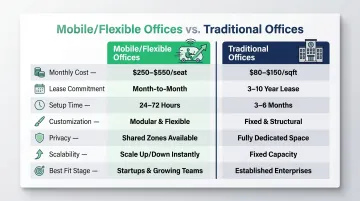
| Factor | Mobile/Flexible Offices | Traditional Offices |
|---|---|---|
| Monthly Cost | $250–$550/seat (dedicated desk) | $80–$150/sqft annually (Class A Manhattan) |
| Lease Commitment | Month-to-month or 6–12 months | 3–10 years (tech average: 3.5 years) |
| Setup Time | Immediate to 2 weeks | 4–8 months (Nomad Group: 90 days) |
| Customization | Minimal—branded signage only | Full control over layout, finishes, identity |
| Privacy | Shared common areas, limited soundproofing | Dedicated private space, secure access |
| Scalability | Add/remove seats monthly | Requires lease amendments or subleasing |
| Best Fit Stage | Pre-seed through early Series A (<20 people) | Series B+ (25–50+ employees) |
Key Tradeoffs at a Glance:
- Flexible offices win on speed, cost predictability, and month-to-month adaptability
- Traditional offices win on control, culture-building infrastructure, and long-term unit economics
Terminology Clarification:
- Mobile/flexible offices = coworking memberships, managed/serviced offices, short-term flex leases
- Traditional offices = direct commercial leases in Class A/B buildings with multi-year terms
What Are Mobile and Flexible Offices?
Mobile and flexible offices are workspaces accessed without a long-term commercial lease—including coworking memberships, managed/serviced offices, and flex-lease arrangements running month-to-month or on 6–12 month terms.
Core Operational Benefits for Tech Startups
- No build-out capital required — move in immediately with furniture, IT, and utilities already installed
- Included infrastructure — high-speed internet, conference rooms, event spaces, front desk support, and cleaning services
- Scalable seating — add or remove desks monthly as hiring plans shift, avoiding the risk of paying for empty space or scrambling for expansion room
- Preserved runway — 60% of remote-capable employees prefer hybrid work, and flexible offices let startups test their remote-vs-office ratio before committing capital
Three Main Subtypes for NYC Tech Startups
- Hot-desk/open coworking — Shared workspace with rotating seating; best for solo founders and very small teams (1–3 people) who need occasional desk access
- Dedicated desks or private suites — Consistent assigned seating within a shared building; ideal for small teams (5–15 people) wanting stability without full-floor commitments
- Fully managed flex offices (e.g., Flex by Nomad) — Private suites with branded space, in-house infrastructure, and on-the-ground market access; bridges the gap between coworking and traditional leases for teams of 10–25
Culture and Talent Considerations
The same Gallup data shows that 60% of exclusively remote employees would be "extremely likely" to seek new jobs if flexibility were removed—a direct argument for keeping workspace options open early. Where you land still matters for credibility, though. A well-chosen address (Flatiron, NoMad, SoHo) signals legitimacy to recruits and investors alike.
The Broadway corridor between 10th and 33rd Streets houses 7,500+ businesses and 135,000 jobs, giving engineering candidates a tangible reason to view your company as stable—even if you're operating out of a private suite rather than a full floor.
Primary Use Cases
- Pre-seed and seed-stage startups conserving runway while validating product-market fit
- Companies expanding into NYC from another city who need immediate presence without long lease negotiations
- **Teams experimenting with hybrid work models** before committing to full-floor leases
- Bridge space during traditional office buildouts (Nomad Group has provided temporary swing space for clients like Optimove to avoid downtime)
What Are Traditional Offices?
Traditional offices are direct commercial leases in dedicated private spaces, typically 3-to-10-year terms in Class A or B buildings, where the tenant controls the full fit-out, branding, and operations.
Key Benefits for Scaling Tech Startups
- Complete design and branding control — Critical for culture-building at 30+ person teams; custom layouts reinforce company identity and recruiting narrative
- Stronger privacy — Essential for proprietary R&D, regulated data (fintech, health tech), and sensitive investor/client diligence meetings
- Headquarters identity — A branded, permanent space signals stability to enterprise clients and top-tier engineering talent
- Long-term cost efficiency — At scale, per-seat costs drop below flexible options; tech firms are signing 7-10 year leases and pre-leasing 60% more space than current headcount
True Cost Structure Beyond Base Rent
Startups must budget for more than the advertised per-square-foot rate:
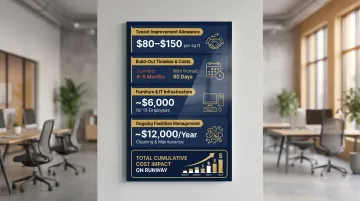
- Tenant improvement allowance (TIA) — Class A NYC offices typically offer $80–$150/sqft for new leases; negotiate hard on this
- Build-out costs and timelines — Industry standard: 4–8 months from planning to move-in; Nomad Group typically completes buildouts in 90 days
- Furniture and IT infrastructure — Budget approximately $6,000 for 10 employees (one-time cost)
- Ongoing facilities management — Cleaning (~$12,000/year for 2,000 sqft), maintenance, and operations
Where Traditional Offices Make Clear Sense
- Series B+ startups with 25–50+ employees and stable 24-month headcount projections
- Companies hosting enterprise clients or investor diligence regularly (weekly or more)
- Regulated sectors (fintech, health tech) requiring dedicated secure environments for compliance
- Culture-driven teams where in-person collaboration is core to the product-building process
The Flexibility Risk
That fit-only-when-conditions-are-right profile points to the core trade-off: commercial leases lock in cost and space for years. A startup that signs for 5,000 sqft at Series A but doubles to 50 employees in 18 months faces either wasted space or expensive subletting.
The downside cuts both ways. A company that downsizes after a down round is stuck paying for empty desks. Manhattan sublease inventory peaked at 23 million SF in early 2023 as over-committed companies shed space they could no longer fill.
Mobile vs Traditional Offices: Which Is Right for Your NYC Tech Startup?
The office decision hinges on four key variables:
Four Decision Variables
- Current funding stage and runway remaining — Pre-Series A with under 18 months of certainty? Flexible space preserves capital
- Team size today vs. 24-month headcount projection — Can you confidently forecast 25+ employees in two years? Traditional leases become economical at that scale
- Investor/client/recruiting meeting frequency — Hosting enterprise clients or VC partners weekly? A branded HQ reinforces credibility
- Culture-building priorities — Is in-person collaboration core to your product process, or does your team thrive remotely?
Clear Situational Recommendations
Choose flexible/mobile if:
- Pre-Series A with under 20 people
- Fewer than 18 months of runway certainty
- Still testing remote vs. in-office ratio
- Expanding into NYC from another city and need immediate presence
Choose traditional if:
- Series B or beyond with multi-year runway secured
- Stable team of 25+ with predictable hiring plan
- Need to project permanence to enterprise clients or investors
- Culture-building requires branded, permanent space for team cohesion
The Hybrid Path (Most Common for NYC Tech Startups)
Many NYC tech companies use flexible space as a "bridge" — typically 6–18 months — while identifying and negotiating their first real headquarters. The benefit is twofold: you avoid locking up capital prematurely, and your team gets to experience different neighborhoods before committing to a long-term lease.
That bridge model works in practice, not just in theory. Nomad Group helped Optimove move from coworking to a fully branded flagship office at 1407 Broadway, using temporary swing space at 11 East 44th Street to ensure zero downtime during construction.
NYC-Specific Cost Calculus
Coworking Per-Seat Costs:
- Hot desk: ~$149/month (national median; NYC likely higher)
- Dedicated desk (NYC metro median): $424/month
- Private office (Brooklyn): From $250/month
Direct Lease Rates (Annual Per Sqft):
- Manhattan Class A: $81.89/sqft
- Midtown South/Flatiron: ~$86–$96/sqft
- Brooklyn: $53.02/sqft (26–44% discount vs. Midtown South)
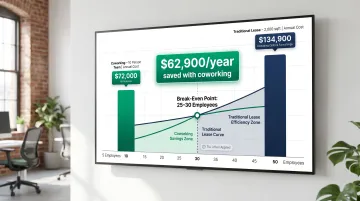
Break-Even Point: For a 10-person team, coworking saves approximately $62,900/year (over 50%) compared to a 2,000 sqft traditional lease. As team size grows beyond 25–30 employees, traditional leases become more cost-effective, especially when Tenant Improvement Allowance (TIA) offsets buildout costs.
What Competitors Miss: Neighborhood Signaling Value
Cost is only part of the equation. Where you plant your flag in NYC sends a signal — to engineers evaluating offers, to VCs walking into your pitch, and to enterprise clients sizing you up.
Tech companies are actively choosing Midtown South (NoMad, Flatiron, SoHo) — dubbed "Unicorn Lane" — where Pinterest (83,000 SF), Chime (84,000 SF), and Ramp (80,000+ SF) anchor a thriving tech cluster. Neighborhood selection matters as much as office type for attracting engineering talent and VC attention.
Real-World Scenarios: How NYC Tech Startups Navigate the Office Decision
Scenario 1: Extend AI — From WeWork to Custom HQ in Five Weeks
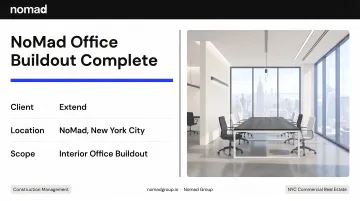
Extend, an AI-powered document intelligence startup, started in a Flatiron WeWork but outgrew the coworking setup as the team scaled to 20–30 employees. Frustrations with a previous broker and the limitations of shared space prompted the search for a dedicated office.
What triggered the switch:
- Team growth beyond coworking capacity
- Need for branded space to attract top engineering talent
- Desire for customization and privacy for proprietary R&D
Outcome: Nomad Group identified a white-box space at The Haymarket Building (135 West 29th Street) in NoMad. The buildout (HVAC installation, sleek finishes, and a wet pantry) wrapped in just five weeks. Within months of moving in, Extend secured $17 million in Series A funding, with the new office signaling momentum to investors at a critical fundraising moment.
Scenario 2: Authentic Insurance — From Costly Coworking to 30% Cost Savings
Authentic Insurance transitioned from a coworking setup to a full-floor office at 30 West 21st Street in Flatiron. The dedicated space offered scalability for up to 40 desks and came in 30% below comparable coworking costs.
What triggered the switch:
- Coworking costs became unsustainable as team size approached 20–25
- Need for branded space to reinforce clarity and confidence to enterprise clients
- Desire for expansion room without renegotiating memberships
Outcome: The new office became a cultural hub, and Authentic began integrating a sister company into the building shortly after moving in — a consolidation move that wouldn't have been possible in coworking.
Scenario 3: The Risk of Leasing Too Early
While specific client examples remain confidential, the NYC market provides cautionary tales. Manhattan sublease availability peaked at 23 million SF in early 2023 as companies shed space committed during growth phases that didn't materialize. Startups that signed 5-year leases pre-Series A and later faced down rounds or hiring freezes found themselves locked into expensive, underutilized space.
Key Lesson: Time your traditional office transition to align with funding milestones (post-Series A/B close), not growth projections. Build flexibility into lease agreements with options for expansion, sublease rights, and renewal terms tied to business performance.
How Nomad Group Helps
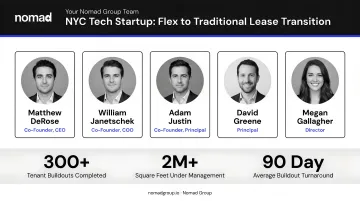
The scenarios above reflect a pattern Nomad Group sees repeatedly across NYC's tech sector. Helping companies navigate this timing question — whether to stay flexible, when to commit to a traditional lease, and how to execute the buildout without blowing the budget — is core to what the team does. From site selection and lease negotiation to 90-day buildouts and ongoing facilities management, the process is built to preserve runway and keep space strategy tied to funding cycles, not guesswork.
Conclusion
Mobile/flexible offices serve startups in the early, uncertain stages where capital efficiency and adaptability matter most. Traditional offices become the right investment once the team, culture, and business model have reached predictable scale.
The office choice touches every part of the business: burn rate, talent pipeline, investor perception, and team cohesion. In NYC's competitive tech market, availability has dropped to 15.4% and bidding wars are emerging for sub-20,000 SF spaces in Flatiron and NoMad. Getting both the decision and the timing right can meaningfully accelerate a company's trajectory.
The hybrid path offers a pragmatic middle ground: start in flexible space to preserve runway, test your team's in-office needs, and explore different neighborhoods. Then, when headcount stabilizes and funding provides multi-year visibility, transition to a traditional lease that becomes a foundation for culture and growth.
Nomad Group works with NYC startups at every stage of this journey — from flexible arrangements through Flex by Nomad to full tenant representation when it's time to commit to a permanent space.
Frequently Asked Questions
What is a flexible or mobile office, and how is it different from a traditional office lease?
Flexible/mobile offices are short-term or month-to-month workspace arrangements—coworking, serviced offices, managed flex spaces—that require no long-term lease commitment. Traditional offices involve multi-year direct commercial leases (3–10 years) with full tenant control over the space.
How much does office space cost for a tech startup in NYC?
Costs vary widely by type and neighborhood. Coworking dedicated desks run approximately $424/month in NYC metro. Traditional leases average $81.89/sqft annually for Manhattan Class A space, with Flatiron/NoMad at ~$86–$96/sqft and Brooklyn at $53/sqft.
When should a tech startup transition from flexible to traditional office space?
Transition when you have a stable team of 25+, post-Series A/B funding with multi-year runway, regular need to host clients or investors in person, and culture-building priorities that require a branded, permanent space. The typical trigger is 12–18 months after closing a major funding round.
Does the type of office space affect a startup's ability to hire tech talent?
Office location signals stability and culture fit—a recognized NYC tech corridor address (Flatiron, NoMad, SoHo) matters to candidates. Since 60% of remote-capable employees prefer hybrid work, a well-designed space that supports collaboration becomes a real hiring advantage.
Can NYC tech startups use a hybrid office approach?
Many startups use flex or coworking as a bridge while planning their first traditional lease—avoiding premature capital commitment while establishing headcount needs before locking into long-term space. Nomad Group has provided swing space for clients navigating exactly this transition.
What should tech startups look for in a traditional office lease in NYC?
Prioritize these four factors:
- Lease terms: Length and renewal options aligned with your funding cycles
- Tenant improvement allowance: $80–$150/sqft is standard for Class A space
- Buildout timeline: Industry standard is 4–8 months; Nomad Group delivers in 90 days
- Broker scope: End-to-end support covering site selection, construction, and facilities management—not just deal execution