The good news: disputes arise even in well-structured leases, and knowing how to respond systematically makes all the difference. This guide covers the most common dispute types, a clear resolution process, how to choose the right resolution method, and how to prevent conflicts before they start.
Key Takeaways
- Most commercial lease disputes involve rent, CAM charges, maintenance obligations, permitted use, or early termination
- Resolution should escalate gradually: direct communication → negotiation → mediation → arbitration → litigation
- Document everything from day one — payments, communications, maintenance records, photographs
- Missed notice deadlines can forfeit renewal rights or your ability to contest charges — timing matters
- A well-negotiated lease with explicit rent escalation, CAM caps, and repair obligations prevents most disputes before they start
Common Types of Commercial Lease Disputes
Most disputes fall into predictable categories. Recognizing the type early shapes your entire response strategy.
Rent and Financial Disputes
These are among the most financially consequential conflicts a tenant can face. Common triggers include:
- Unpaid or disputed rent and the cure periods that follow a monetary default notice
- Rent escalation calculations where the formula is ambiguous or applied inconsistently
- CAM charge reconciliations — operating expense pass-throughs that tenants have the right to audit under standard commercial lease clauses
- Operating expense disputes over what landlords legitimately include in annual reconciliations
Audit rights for operating expenses are a recognized standard in commercial leasing. If your lease includes them, use them — discrepancies in CAM reconciliations are frequent enough that audit rights have become a standard negotiation point.
Maintenance, Repairs, and Property Condition
Commercial leases typically split maintenance responsibilities between landlord and tenant, and disputes arise when one party claims the other has failed to uphold their end. The most frequent friction points:
- HVAC systems (responsibility for repair vs. replacement is often ambiguous)
- Structural repairs versus cosmetic upkeep
- Response times for urgent maintenance requests
Lease language is the deciding factor here. Vague terms like "tenant responsible for interior maintenance" can lead to wildly different interpretations about who pays for what.
Use of Premises, Subleasing, and Early Termination
Maintenance disputes are about physical obligations. This category is about strategic flexibility — and for growing companies, it's often the higher-stakes fight. A startup that signs a five-year lease at Series A may need twice the space — or half — by Series C. Common conflicts include:
- Tenant use that allegedly violates lease restrictions (adding a second business line, hosting client events, etc.)
- Unauthorized sublease or assignment attempts, or landlords who unreasonably withhold consent
- Early termination exposure — in New York, landlords can seek future rent under acceleration clauses after a tenant vacates, meaning walking away carries real financial liability
New York courts have addressed this directly (172 Van Duzer Realty Corp. v Globe Alumni Student Assistance), reinforcing that early exits require careful legal review, not just a conversation with your landlord. Beyond termination risk, Manhattan sublease supply fell to 13.5 million square feet in Q4 2025 from a recent high of 20.5 million square feet, according to Cushman & Wakefield — a sign that sublease flexibility is a real and active market concern, not a theoretical one.
How to Resolve a Commercial Lease Dispute: Step-by-Step
The most damaging mistake in a lease dispute is reacting emotionally or taking unilateral action — withholding rent, changing locks, or ignoring notices — without following a structured process first.
Step 1: Review Your Lease Agreement Thoroughly
Before doing anything else, re-read the full lease. Pay close attention to:
- Each party's specific obligations
- Notice requirements and cure periods
- Dispute resolution clauses
- Timelines for raising objections or exercising renewal options
Many disputes are resolved at this stage. What feels like a landlord violation may already be addressed in the lease language — or vice versa.
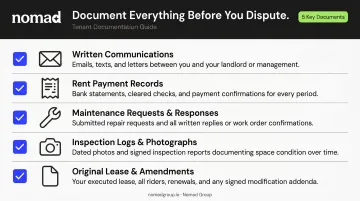
Step 2: Document Everything
Before reaching out, gather all relevant evidence:
- Written communications (emails, letters, texts)
- Rent payment records and receipts
- Maintenance requests and landlord responses
- Inspection logs and photographs of disputed physical conditions
- The original lease and any amendments
Strong documentation not only supports your position — it often motivates the other party to settle quickly once they see the evidence is organized and complete.
Step 3: Attempt Direct, Professional Communication
Reach out in writing with a calm, solution-focused tone. Your communication should:
- Summarize the issue clearly
- Reference specific lease clauses
- Propose a resolution timeline
This step creates a paper trail and demonstrates good faith — both of which matter if the dispute escalates to mediation, arbitration, or litigation. Courts and arbitrators weigh how each party behaved before proceedings began — documented good faith efforts can shift outcomes.
Step 4: Engage Legal Counsel Before Escalating
Most parties wait too long to involve an attorney — often until after a missed deadline or an ill-advised response has already weakened their position. Once direct communication fails, or if the stakes are significant, get counsel involved before taking the next step. An experienced commercial real estate attorney can:
- Assess your legal standing under the lease
- Identify missed notice deadlines (including Yellowstone injunction relief in New York, which must be sought before a cure period expires)
- Draft demand letters
- Advise on the strongest path forward
For business entities — LLCs, corporations, partnerships — many jurisdictions require legal representation in formal landlord-tenant proceedings.
Waiting until you're already in proceedings often means waived rights and foreclosed remedies. Engaging counsel early keeps your options open.
Choosing the Right Resolution Method
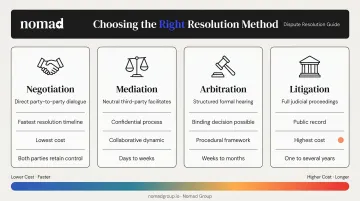
Once informal attempts are exhausted, four formal paths exist. The right choice depends on your lease's ADR clauses, the nature of the dispute, your relationship with the landlord, and how quickly you need resolution.
Negotiation (Attorney-Led)
The first formal escalation step. Attorney-to-attorney negotiation is faster and cheaper than any formal process, allows both parties to maintain control over the outcome, and can resolve disputes in days or weeks. It's binding once a settlement agreement is signed.
Mediation
A neutral third party facilitates discussion but doesn't impose a decision. Mediation is:
- Confidential — nothing said in mediation can be used in later proceedings
- Collaborative — ideal when preserving the landlord relationship matters
- Fast — typically resolved in days or weeks, not months
- Lower cost — AAA commercial mediations charge each party a $350 non-refundable administrative fee, with mediator time billed at approximately $75/hour (minimum four hours), split between parties
Many commercial leases now include mandatory mediation clauses before litigation can be pursued — check yours before assuming you can skip this step.
Arbitration
More structured than mediation. A neutral arbitrator — often a retired judge or experienced attorney — reviews evidence and issues a decision that may be binding or non-binding depending on your lease clause and the rules governing the proceeding.
AAA's filing fees start at $775 for claims up to $10,000 and $975 for claims between $10,000 and $75,000. Total costs — including arbitrator compensation and attorney fees — will be substantially higher. If your lease includes a binding arbitration clause, read it carefully before proceeding: you may have limited ability to appeal the outcome.
Litigation
The last resort — necessary when the other party refuses ADR, when fraud or criminal conduct is involved, or when only a court order will suffice (eviction proceedings, injunctive relief). In New York City, commercial landlord-tenant cases are handled by Civil Court judges, with summary proceedings returnable in Part 52.
The downsides are significant:
- Public record — filings and outcomes are accessible to anyone
- High cost — attorney fees alone can run tens of thousands of dollars
- Slow resolution — NYC commercial cases can take one to several years
- Permanent damage — an adversarial proceeding rarely leaves a landlord relationship intact
If you're a NYC tenant facing a dispute that has escalated to this point, having an experienced broker or advisor who knows the local market and landlord relationships can sometimes open back-channel conversations that keep you out of court entirely.
Common Mistakes Tenants Make During a Lease Dispute
Tenant errors during a lease dispute are rarely intentional — but they're often expensive. These four mistakes consistently damage tenant positions before the dispute even reaches negotiation or court:
Withholding rent without legal guidance — In New York, RPAPL § 711 allows landlords to initiate summary proceedings after a rent default and required demand. Stopping payment without proper legal standing can itself constitute a breach — and give your landlord grounds to pursue eviction.
Missing contractual notice deadlines — Failing to respond within the lease's specified cure period can forfeit renewal rights or eliminate your ability to contest charges. In New York, a Yellowstone injunction must be sought before the cure period expires. Miss that window and it's gone — no exceptions.
Handling everything verbally — Verbal agreements and conversations leave no evidentiary record. Every significant communication should be in writing.
Waiting too long to seek legal advice — Delay lets deadlines pass and gives the other party time to build their case. Early legal counsel is almost always cheaper than catching up later.
How to Prevent Commercial Lease Disputes Before They Start
The most cost-effective resolution strategy is prevention. Vague or one-sided lease language is the single biggest driver of disputes — and every problematic clause is easier to fix before the lease is signed than after.
Before signing, negotiate clear, specific language around:
- Maintenance responsibilities — who handles HVAC, what counts as structural vs. cosmetic, response time requirements
- Rent escalation formulas — how calculations are defined and verified
- CAM charges — caps on controllable expenses and explicit audit rights
- Permitted use — broad enough to accommodate realistic business evolution
- Sublease and assignment rights — including consent standards and landlord recapture provisions
- Renewal options — notice windows, pricing mechanisms, and deadlines calendared at signing
- Dispute resolution clauses — mandatory ADR as a built-in safeguard before litigation

An experienced tenant rep broker catches problematic clauses before they become signed obligations. Nomad Group's tenant representation service covers market analysis, financial evaluation, and lease negotiation on behalf of tenants from initial search through execution.
Their NYC market knowledge across neighborhoods like Flatiron, NoMad, SoHo, and Williamsburg translates directly into lease terms that protect tenants — not just landlord-standard boilerplate.
Frequently Asked Questions
What are the common methods of commercial lease dispute resolution?
The four main methods are negotiation, mediation, arbitration, and litigation — typically pursued in that order. ADR options (negotiation through arbitration) are faster, cheaper, and less adversarial than court, and many leases now require them before litigation can proceed.
What is the most common cause of commercial lease disputes?
Nonpayment or disputed rent calculations are the most frequent trigger, followed by disagreements over maintenance responsibilities and ambiguous lease language around permitted use and operating expense pass-throughs.
How long does it take to resolve a commercial lease dispute?
Timelines vary considerably: attorney-led negotiation can resolve matters in days or weeks, mediation typically in weeks, arbitration in weeks to a few months, and litigation potentially one to several years depending on complexity and court scheduling.
When should I involve a lawyer in a commercial lease dispute?
Engage legal counsel as soon as direct communication fails — and ideally before sending any formal notice. Early involvement protects deadlines, preserves rights (including Yellowstone relief in New York), and strengthens your negotiating position.
Can a tenant break a commercial lease without penalty?
Generally, no — unless the lease includes a negotiated exit clause, the landlord has materially breached the agreement, or both parties mutually agree to a surrender. Early termination without one of these grounds can expose tenants to significant liability, including accelerated future rent under New York case law.
What should I document when a commercial lease dispute arises?
Collect and organize the following before engaging the other party or an attorney:
- Original lease and all amendments
- All written communications (emails, letters, notices)
- Rent payment histories and invoices
- Maintenance requests and landlord responses
- Photographs or inspection reports related to disputed conditions