
Scaling companies face a familiar set of pain points: outgrowing spaces within 18 months, signing inflexible leases that don't accommodate 30-40% headcount swings, navigating 5-8 month buildout timelines, and making sense of an opaque NYC commercial real estate market without the right guidance. This guide covers how to think strategically about office space, what to look for, where to look in NYC, how leases work for growing teams, and what the search-to-move-in process should actually look like.
TLDR
- The right office signals legitimacy to investors, attracts talent, and gives your team room to move fast
- High-growth teams need spaces built to scale, not just spaces that fit today's headcount
- NYC sub-markets vary widely — matching your culture, budget, and growth stage to the right neighborhood matters
- The search-to-move-in process has more complexity than most founders expect
Why Your Office Space Is a Strategic Asset, Not Just a Cost Center
For companies pursuing talent, investment, or enterprise clients, the physical office sends an unmistakable signal about ambition, culture, and staying power. According to Gensler's 2025 Global Workplace Survey, only 14% of the global workforce wants a traditional corporate workplace experience. Workers increasingly prefer nature retreats, creative labs, and residential-style environments. For talent-competitive startups, the office environment isn't just a perk — it's a decisive factor in whether a candidate accepts an offer.
Thoughtful office design correlates directly with productivity. Access to the right mix of workspace types — focus zones, collaboration areas, informal meeting spaces — enables teams to move faster and make better decisions. Speed of execution is a competitive differentiator for startups, and the physical environment either accelerates or slows that down.
Cornell University research found workers in daylit offices reported an 84% drop in eyestrain, headaches, and blurred vision, with approximately $100,000/year in productivity value per 100 workers. Natural light is an operational priority, not a luxury add-on.
Investor and client optics matter, too. A well-located, professionally built-out office communicates operational maturity. Moving beyond coworking signals a real milestone.
According to the NYC Comptroller's 2024 analysis, occupied trophy space in Manhattan increased 11% since early 2020, while Class B and C occupied space dropped 8%. Sophisticated companies are moving to high-quality environments — and that shift is visible to investors and clients.
Office design also either validates or contradicts stated company values. A company claiming to be collaborative but seating people in isolated cubicles creates a contradiction employees notice quickly. The space should make values visible and tangible — for employees and new hires alike:
- Collaboration: Open team areas and informal meeting zones
- Focus: Designated quiet spaces away from high-traffic areas
- Culture: Shared spaces that reflect the company's personality and energy
Getting the space right matters more than getting it fast. Wasted square footage, premature relocation, and a bad lease term typically cost far more than the expert guidance it takes to avoid them.
What to Look for in Commercial Office Space for High-Growth Teams
Location and Commute Accessibility
A central, transit-accessible address is a hiring tool. Proximity to subway lines, desirable residential neighborhoods, and walkable amenities increases team satisfaction and in-office attendance. Research cited by CNBC found 23% of workers have quit a job because of the commute, with that figure rising to 34% among workers aged 18-34.
With 68% of organizations now requiring defined in-office days (up 7 percentage points year-over-year per JLL), commute friction is a growing driver of attrition. Choosing a location with strong transit connectivity reduces that friction and keeps your team engaged.
Scalability and Layout Flexibility
High-growth teams should evaluate not just how a space works today, but how it can accommodate 20-40% headcount growth without a full redesign. Key features to flag:
- Open floor plates that support modular layouts
- Lease options on adjacent space for expansion
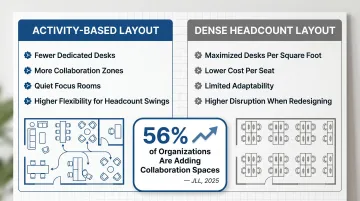
- Activity-based design vs. dense headcount layouts
Activity-based layouts prioritize fewer dedicated desks with more collaboration zones, quiet rooms, and shared spaces. Dense headcount layouts maximize desks per square foot but limit flexibility. JLL's 2025 benchmark report found that 56% of organizations are adding collaboration spaces while 55% are cutting overall real estate footprints, reflecting this shift toward activity-based design.
Technology Infrastructure Readiness
Tech companies, fintech firms, and AI companies have infrastructure requirements that go well beyond aesthetics. Vetting these upfront prevents expensive retrofits after signing:
- Fiber capacity — redundant providers and sufficient bandwidth for compute-intensive workloads
- HVAC reliability — consistent cooling for server-dense environments
- Backup power — generator or UPS systems for 24/7 operational continuity
- Floor load ratings — structural capacity for hardware-heavy buildouts
Nomad Group has worked with AI companies like FloraFauna and Accrete to identify spaces built to support these demands from day one.
Lease Flexibility for Scaling Companies
Most commercial leases run 5–10 years — a long commitment for a company that may double headcount in 18 months. The right lease terms give you room to move. Key provisions to negotiate:
- Expansion rights or rights of first offer on adjacent space
- Sublease provisions for flexibility if headcount contracts
- Notice periods that match business planning cycles
Cultural and Brand Fit
The architecture, neighborhood character, and existing tenant mix of a building shape how clients and candidates perceive your brand — and how your team experiences the company every day. A creative agency in a Class A corporate tower and a fintech firm above a WeWork may both be wrong fits.
For example, Nomad Group helped Nirvana — a mental health and wellness company — secure a light-filled Union Square space with high ceilings and upstate-inspired design elements that reinforced their mission and values.
Natural Light, Air Quality, and Wellness Features
Peer-reviewed research found WELL Certified offices showed a 30% improvement in overall workplace satisfaction and 18% higher satisfaction with access to sunlight. For companies managing burnout risk and fighting for top talent, daylight and air quality are factors worth negotiating into your shortlist criteria — not afterthoughts.

NYC's High-Growth Neighborhoods: Finding the Right Address
For high-growth companies, neighborhood choice is as consequential as the space itself. Sub-markets across NYC attract different company profiles, command meaningfully different price points, and offer entirely different building stock. Nomad Group has deep market expertise across NYC's most active growth corridors, including NoMad, Flatiron, SoHo, Union Square, Williamsburg, and Grand Central.
NoMad and Flatiron District
NoMad and Flatiron have become one of NYC's most concentrated clusters of high-growth tech companies, startups, and venture-backed firms. The appeal:
- Strong transit access (multiple subway lines)
- Mix of modern pre-built offices and raw loft spaces
- Walkable restaurant and amenity scene
- Proximity to talent in Brooklyn and investors in Midtown
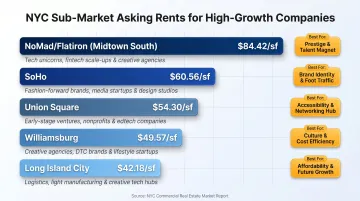
CBRE reported average asking rent of $84.42/sf for Midtown South (which includes NoMad and Flatiron) as of March 2025, reflecting the premium this sub-market commands due to its tech ecosystem density.
Authentic Insurance landed a full-floor Flatiron office at 30 West 21st Street — wood mullion glass doors, high ceilings, scalability up to 40 desks — at 30% less than their previous coworking costs. Nomad Group handled the search and negotiation end-to-end.
SoHo and Union Square
SoHo draws creative agencies, consumer brands, and media companies that want character-rich loft buildings with strong natural light. It's served by 12 subway lines, and Commercial Cafe data shows average asking rents around $60.56/sf with relatively low vacancy at 10.23%.
Union Square sits at a slightly more accessible price point and is a strong choice for teams prioritizing talent access. Key characteristics:
- Exceptional transit connectivity (4/5/6, L, N/Q/R/W lines)
- Predominantly loft spaces and Class B buildings
- Higher build-out budgets typical, but distinctive architectural character in return
Nirvana's Union Square space — upstate-inspired aesthetic, high ceilings, abundant natural light — was sourced by Nomad Group to directly reinforce their wellness-focused brand identity.
Williamsburg and the Brooklyn Market
Williamsburg has emerged as a genuine commercial alternative for growth-stage companies seeking competitive pricing, a younger talent pool, and distinctive industrial spaces. It tends to suit consumer brands, media companies, wellness firms, and design-forward tech companies.
SquareFoot reports Class A asking rents around $49.57/sf in Williamsburg — a meaningful discount to Manhattan core neighborhoods. Considerations include cross-borough commuting for team members spread across NYC.
FloraFauna AI moved into The Refinery at Domino — Class A, landmark views, industrial-modern design — and doubled their office footprint within 30 days of signing. Nomad Group secured the space and structured the lease to support that kind of rapid scaling.
Commercial Lease Terms Every Scaling Company Should Understand
Lease Length Trade-Offs
Shorter terms (3-5 years) offer flexibility but typically come with less landlord contribution toward build-out. Longer terms unlock more tenant improvement allowance but lock a scaling company into square footage that may not fit 24 months from now.
Critical ask: Negotiate expansion options or rights of first offer on adjacent space as a standard provision. This gives you the ability to grow in place rather than relocating mid-lease.
Tenant Improvement (TI) Allowances
In many NYC leases, landlords contribute a per-square-foot allowance toward building out the space. CBRE's analysis found average TI allowances for NYC Midtown trophy space at $133/sf (down from $162/sf the prior year), while citywide averages hover around $120/sf.
TI typically covers:
- Construction and demolition
- Interior finishes and flooring
- HVAC and electrical work
Actual buildout costs in NYC run $150/sf to $300/sf, so allowances rarely cover the full tab. Negotiating TI upfront — and modeling the gap clearly — is one of the most impactful things you can do before signing.
Sublease and Assignment Rights
Fast-growing companies sometimes need to expand before lease end — and sometimes contract. Having the right to sublease excess space or assign a lease can be the difference between financial flexibility and a costly liability. CBRE's Spring 2023 survey found 62% of occupiers are executing or exploring expansion and contraction options within traditional leases. Push for both sublease and assignment rights in your initial negotiation — landlords are far more receptive before the lease is signed than after.
From Office Search to Move-In Day: What the Process Actually Looks Like
Typical Timeline and Phases
The full process includes:
- **Initial brief and space requirements** — defining growth trajectory, budget, and cultural priorities
- Market tour and shortlisting — curated property tours based on strategic fit
- Offer and lease negotiation — securing favorable terms on rent, TI, expansion rights, and sublease provisions
- Space planning and build-out — designing and constructing the space to match operational needs
- Furniture procurement and tech setup — coordinating FF&E, data cabling, and infrastructure
- Move-in — logistics, cleaning, and operational activation
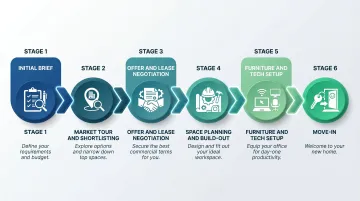
For high-growth teams unfamiliar with commercial real estate, each phase has hidden complexity — especially the jump from signed lease to delivered space.
The Build-Out Phase
Budget overruns and timeline delays are the most common pain points. AQUILA Commercial estimates typical buildout timelines at 32 weeks (8 months) for shell-condition spaces and 20 weeks (5 months) for second-generation spaces. McKinsey research finds average cost overruns of 28-33% and time delays averaging 52% relative to initial estimates.
Nomad Group's 90-day buildout turnaround and in-house construction management team compresses timelines without sacrificing quality — relevant especially for companies on tight funding cycles or hard move-in deadlines. For example, Extend AI moved into their custom-built NoMad headquarters in just 5 weeks from white-box to fully operational, including HVAC installation.
The Case for a Full-Service Partner
Those overrun risks compound when brokerage, build-out, and facilities management are split across separate vendors — each with different incentives and no shared accountability. A single partner who owns the full process closes that gap.
That's the practical difference Nomad Group delivers across 300+ tenant buildouts and 2M+ square feet leased in NYC. The end-to-end model means no hand-offs, no finger-pointing, and no surprises on move-in day. When FloraFauna AI moved into their Williamsburg space, Nomad managed everything from furniture installation to Wi-Fi activation — the team walked in and started working.
Key advantages of a full-service model:
- Single point of accountability across brokerage, build-out, and facilities operations
- No vendor hand-off delays between lease signing and space delivery
- Coordinated move-in handling logistics, cleaning, and tech activation simultaneously
Frequently Asked Questions
How much office space does a high-growth startup need per employee?
Industry benchmarks range from 125–175 SF per person for tech and professional services companies. JLL reports the current average sits at 165 rentable SF, with a target benchmark of 132 SF — plan for where your headcount will be in 12–18 months, not where it is today.
What's the difference between leasing commercial office space and using coworking or flex space?
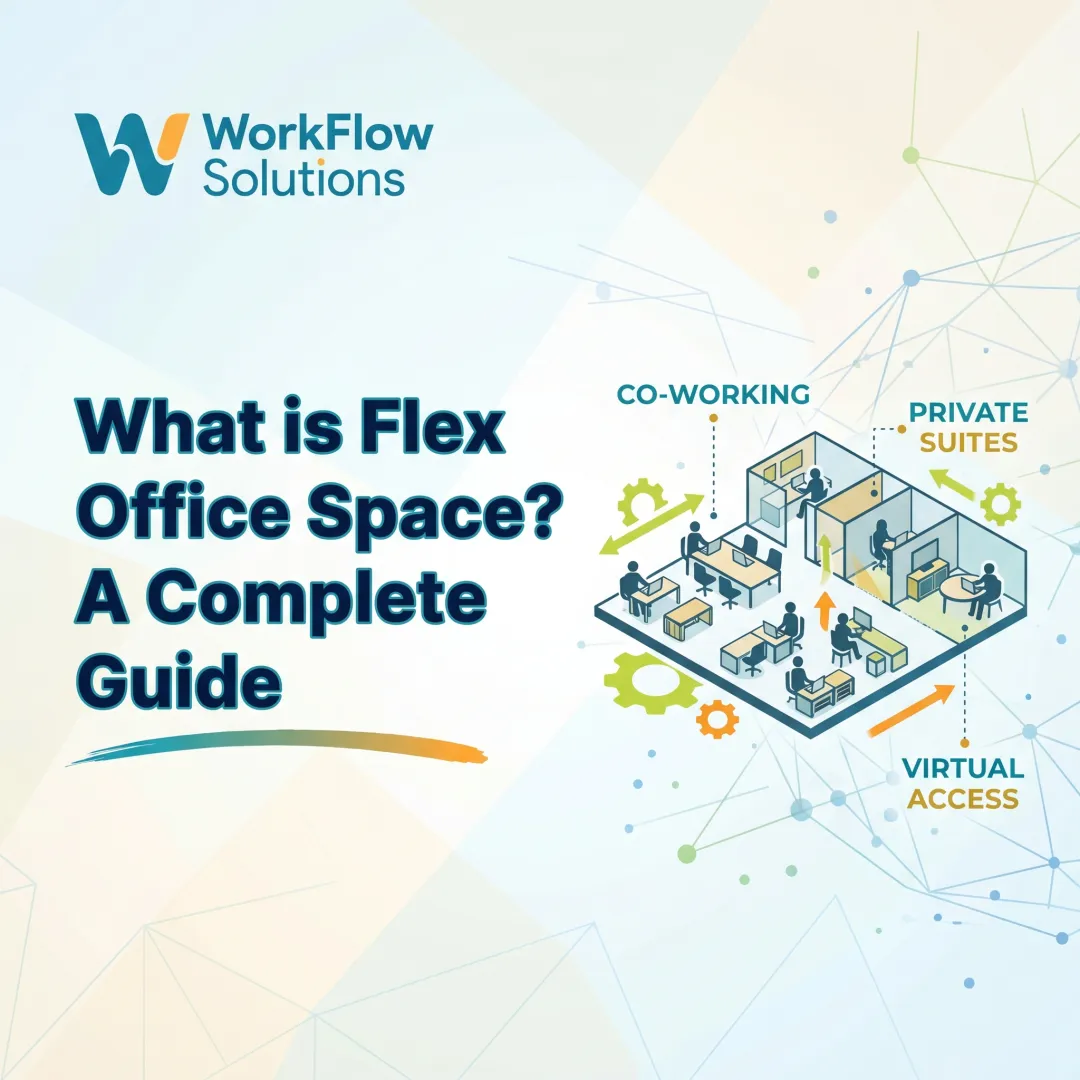
Coworking offers low commitment and fast move-in but higher per-desk cost and limited brand control. Direct commercial leases offer customization and cost efficiency at scale but require more lead time and capital. CBRE finds flexible leases are "almost always cheaper" under 50 seats; above 50, traditional leases are usually better suited.
How long does it typically take to build out a commercial office space in NYC?
Typical buildout timelines run 5–8 months for custom buildouts. Firms with in-house construction management can significantly reduce this timeline — Nomad Group delivered Extend AI's NoMad headquarters in just 5 weeks.
What should scaling companies negotiate in a commercial office lease?
Prioritize these four lease provisions:
- Expansion rights — option to take adjacent space as headcount grows
- Sublease provisions — flexibility to offset costs if plans change
- Tenant improvement allowance — landlord contribution toward your buildout
- Lease term flexibility — shorter initial terms or renewal options
Getting these right determines how well your lease holds up as the company scales.
Which NYC neighborhoods are best for tech startups and high-growth companies?
NoMad, Flatiron, SoHo, Union Square, and Williamsburg are the top sub-markets for high-growth teams. NoMad and Flatiron have the highest concentration of tech tenants; SoHo fits creative brands; Williamsburg offers competitive pricing and distinctive loft-style spaces. The best fit depends on your culture, stage, and commuter geography.
When is the right time for a startup to move from coworking into a dedicated commercial office?
Typical inflection points include consistent headcount around 20–30 people, the need for brand control, security requirements, or client-facing presence that coworking can no longer support. CBRE's 50-seat threshold is a useful benchmark for cost comparison.