Introduction
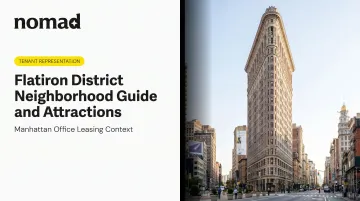
Few Manhattan neighborhoods pack as much into nine city blocks as the Flatiron District. A 120-year-old triangular building defines its skyline. A park hosts rotating world-class art installations. The original Shake Shack still draws lines on the corner. And somewhere between the loft floors of a converted pre-war building on 21st Street and the rooftop terrace of a sublease on 23rd, a Series B startup just signed its first real lease.
Landmark architecture, genuine green space, serious dining, and a dense professional ecosystem — Flatiron holds its own identity at the center of Manhattan, neither fully Midtown nor downtown, but distinctly itself.
This guide covers everything a visitor, prospective resident, or company decision-maker needs to know: where the neighborhood sits, what shaped it, where to eat and drink, how to get around, and why high-growth companies consistently plant their flags here.
Key Takeaways
- The Flatiron District runs roughly from 14th to 23rd Street between Sixth Avenue and Park Avenue South
- It's named after the iconic 1902 Flatiron Building at Broadway, Fifth Avenue, and 23rd Street
- Walk Score rates it a perfect 100 — making it one of Manhattan's most walkable neighborhoods
- Top dining includes Eataly, Eleven Madison Park, and Gramercy Tavern; Madison Square Park and the original Shake Shack are neighborhood anchors
- It's the birthplace of Silicon Alley and remains a hub for tech, media, fintech, and creative companies
Where Is the Flatiron District?
The neighborhood is generally defined by four boundaries: 14th Street to the south, 23rd Street to the north, Sixth Avenue (Avenue of the Americas) to the west, and Park Avenue South to the east. Some real estate definitions extend north into the mid-to-upper 20s, blending into NoMad.
Geographically, Flatiron sits at the midpoint between downtown and midtown Manhattan. In practice, that means you're a short walk from Union Square to the south, Chelsea to the west, and Gramercy to the east. NoMad begins directly north of 23rd Street.
Adjacent neighborhoods at a glance:
| Direction | Neighborhood | Character |
|---|---|---|
| North | NoMad | Hotel corridor, boutique offices |
| South | Union Square | Transit hub, greenmarket, NYU |
| West | Chelsea | Art galleries, High Line, tech offices |
| East | Gramercy | Residential, quieter pace |
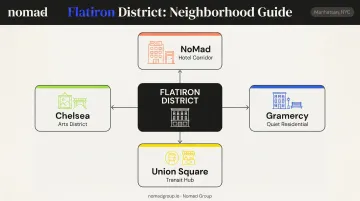
That central position gives companies here easy access to talent commuting from virtually any direction, while the neighborhood itself remains distinct and walkable.
A Brief History of the Flatiron District
The Building That Named a Neighborhood
The Flatiron Building was completed in 1902, designed by D.H. Burnham & Co. at the intersection of Broadway, Fifth Avenue, and 23rd Street. Its triangular iron shape — the product of a peculiar plot where two major avenues converge — made it one of New York's earliest skyscrapers. It earned NYC Landmark designation in 1966 and National Historic Landmark status in 1989.
According to History.com, the building is just six feet wide at its narrowest point, which made it both an engineering curiosity and an instant landmark. More than 120 years later, it remains one of the most photographed buildings in New York.
From Toy District to Silicon Alley
The neighborhood's identity shifted multiple times across the 20th century:
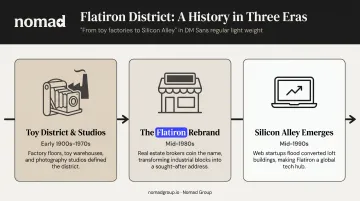
- Early 1900s–1970s: Known as the "Toy District," a manufacturing and trade hub for the toy industry, later transitioning into a photography studio corridor
- Mid-1980s: Real estate brokers adopted the name "Flatiron District" to reflect the area's changing residential and commercial character
- Mid-1990s: Web startups flooded the affordable commercial loft buildings between Union Square and Madison Square Park, and Silicon Alley was born — with the term itself emerging around 1995, centered near the Flatiron Building at Fifth Avenue and Broadway
That Silicon Alley era left a permanent imprint. The same loft buildings that housed the first wave of NYC web startups in the late 1990s now attract media, advertising, fintech, and AI companies — making the Flatiron District one of the most consistently tech-forward office corridors in Manhattan.
Top Attractions in the Flatiron District
The Flatiron Building
The building itself is the neighborhood's anchor — hard to miss, impossible to forget. Best viewed from Broadway looking north (the triangular prow comes into sharp relief) or from Madison Square Park looking south. A small public plaza sits directly opposite on 23rd Street, which tends to fill with photographers at golden hour. There's no interior public access, but you don't need it — the exterior is the point.
Madison Square Park
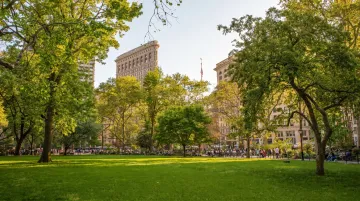
The 6.2-acre park is the neighborhood's green center, managed by the Madison Square Park Conservancy following a $12 million renovation in 2001. From almost any bench, you can see the Empire State Building, the Met Life Tower, and the Flatiron Building simultaneously.
What distinguishes the park from most Manhattan green spaces is its programming. The Conservancy runs a rotating calendar of public art installations, live events, and community programming throughout the year — the park regularly features commissioned works from internationally recognized artists.
Shake Shack at Madison Square Park
The original Shake Shack location opened here in 2004, beginning as a hot dog cart supporting a public art project before becoming a permanent kiosk. It's now a global chain, but this location carries the founding-story weight — and the burgers remain good. Worth a visit even if you've eaten at Shake Shack elsewhere.
The National Museum of Mathematics (MoMath)
MoMath currently operates at 635 Sixth Avenue, with hands-on exhibits designed to make mathematics engaging and accessible. Strong options for a visit include:
- Families and school groups — interactive exhibits designed for all ages
- Team offsites — structured group experiences available for corporate bookings
- Corporate events — private event space within the museum
It's one of those institutions that sounds niche until the interactives pull you in.
Harry Potter New York
The experiential retail flagship at 935 Broadway is built around immersion rather than a standard retail transaction. Visitors move through themed spaces, interactive installations, and franchise merchandise across multiple floors. It reflects how Flatiron's commercial corridor has shifted — brands in this neighborhood increasingly compete on experience, not just product.
Best Places to Eat and Drink in the Flatiron District
Eataly Flatiron
Eataly's first U.S. location, opened in 2010 at 200 Fifth Avenue, remains the definitive Flatiron dining destination for sheer range. Multiple restaurants, a market, fresh pasta counters, a wine shop, and a seasonal rooftop (AMALFI Rooftop by BIRRERIA) occupy what amounts to an Italian food city block. It works equally well for a quick espresso before a meeting or a full dinner after one.
Eleven Madison Park
At 11 Madison Avenue, directly overlooking the park, Eleven Madison Park holds a place in the World's 50 Best "Best of the Best" — ranked No. 1 in the world in 2017. Since reopening in June 2021, the restaurant operates an entirely plant-based tasting menu. Reservations are essential and should be made well in advance. This is a special-occasion restaurant in the fullest sense.
Gramercy Tavern
Danny Meyer opened Gramercy Tavern in 1994, and it has accumulated nine James Beard Awards since — including Outstanding Restaurant and Outstanding Chef in America. Two formats operate under one roof: the formal dining room and a more casual tavern at the front. One of the most consistently sought-after reservations in the neighborhood.
Rezdora
Received a three-star New York Times review from critic Pete Wells in 2019. The focus is Emilia-Romagna cooking — handmade pasta, precise technique, intimate room. A strong choice for a business dinner when you want the food to do the talking.
Bars Worth Knowing
For drinks, the neighborhood skews toward design-forward spots that draw locals and professionals rather than tourists. Three worth knowing:
- The Broken Shaker at the Freehand Hotel (23 Lexington Avenue): rooftop bar on the 18th floor; seasonal closures apply, so confirm hours before visiting
- The Clocktower at The New York EDITION (5 Madison Avenue): polished hotel bar with daily service and views overlooking Madison Square Park
- The NoMad Bar at 1170 Broadway: approachable alternative with a strong cocktail program and consistent hours year-round
Getting Around and Everyday Life in Flatiron
Transit Access
The Flatiron District's transit coverage is exceptional. Key access points:
- 14th Street–Union Square: Serves the 4, 5, 6, N, Q, R, and L trains — one of the busiest transit hubs in the city
- 23rd Street stations: The F and M trains run at Sixth Avenue; the 6 serves Park Avenue South; the W and R trains stop on Broadway
Walkability
Redfin rates the Flatiron District a Walk Score of 100 — a "Walker's Paradise" designation that means daily errands, commuting, and everything in between are fully viable on foot. Combined with its central position between multiple transit lines, the neighborhood removes virtually every logistical friction from the workday.
Day-to-Day Rhythm
The neighborhood's pace is energetic and professional during weekday daytime hours, then genuinely pleasant after five. The Union Square Greenmarket — open year-round on Monday, Wednesday, Friday, and Saturday — draws locals rather than tourists, which sets the tone for the area. It avoids the tourist saturation of Midtown while offering better dining and nightlife than most residential neighborhoods. Focused during the day and genuinely livable after hours, Flatiron functions as a real office neighborhood, not just a destination.
Why High-Growth Companies Choose the Flatiron District
A Commercial Heritage Built on Silicon Alley
The district's commercial identity starts with its history. When Silicon Alley emerged in the mid-1990s, it was centered on the loft buildings between Union Square and Madison Square Park. Companies including SeatGeek, Dropbox, theSkimm, Yext, and Taboola have called this corridor home. That density creates a professional ecosystem where talent recruiting, informal networking, and industry proximity are built into the geography.
The Employee Experience Argument
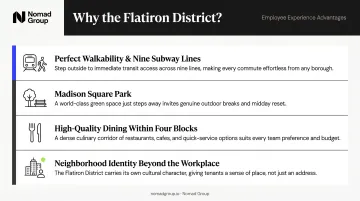
Return-to-office culture depends on making the office worth the commute. Flatiron makes that argument easily:
- Perfect walkability and access to nine subway lines via Union Square
- Madison Square Park for lunch breaks and outdoor meetings
- A concentration of high-quality lunch and after-work dining options within a four-block radius
- A neighborhood that feels like a place to be, not just a place to work
Building Character and Flexibility
The district's commercial real estate stock reflects its history — pre-war loft buildings with exposed brick, high ceilings, and distinctive architectural character sit alongside newer glass floors and boutique office plates. That range serves companies at different stages: early-stage teams drawn to character and atmosphere, scaling companies needing contiguous floors, established firms wanting the neighborhood's professional credentials.
Nomad Group has placed clients throughout this corridor — including a full-floor deal for Authentic Insurance at 30 West 21st Street: 5,500 square feet, 40 desks, wood mullion glass doors, and 30% below comparable coworking costs. The firm operates along what it calls "Unicorn Lane," focusing on high-character buildings in Flatiron, Union Square, and NoMad that support brand identity and room to grow.
For scaling companies, that combination — distinctive space, a walkable neighborhood, and a broker with deep local relationships — is often what tips the decision.
Frequently Asked Questions
What is considered the Flatiron District?
The Flatiron District is a Manhattan neighborhood generally bounded by 14th Street to the south, 23rd Street to the north, Sixth Avenue to the west, and Park Avenue South to the east. It takes its name from the iconic triangular Flatiron Building at the intersection of Broadway, Fifth Avenue, and 23rd Street.
Is the Flatiron District considered Midtown?
Technically yes — it falls under Midtown South — but it sits at the boundary between downtown and midtown and carries a distinct identity separate from the Times Square and Grand Central core.
Is Flatiron a good neighborhood in NYC?
Consistently, yes. Flatiron holds a perfect Walk Score of 100, offers standout dining, major cultural landmarks, and Madison Square Park as a central anchor — making it a strong choice for both residents and businesses.
What subway lines serve the Flatiron District?
The primary options are the 4, 5, 6, N, Q, R, and L trains via Union Square (14th Street), plus the F, M, 6, W, and R trains at 23rd Street stations. The combination gives Flatiron one of the best transit access profiles in Manhattan.
What is the Flatiron District known for?
The 1902 Flatiron Building, Madison Square Park, the original Shake Shack, Eataly's first U.S. location, and Eleven Madison Park are its defining landmarks. It's also the birthplace of NYC's Silicon Alley tech ecosystem, a legacy that still shapes the neighborhood's commercial character.
Who are some notable companies based in the Flatiron District?
The district has historically attracted tech, media, and advertising companies — SeatGeek, Dropbox, theSkimm, Yext, Taboola, and Dailymotion have all operated in the corridor. More recent occupants span fintech, AI, and creative agencies, continuing Silicon Alley's legacy in updated form.