Introduction
Owning commercial real estate is only half the equation. Without active strategic oversight, returns stagnate, tenants churn, and opportunities to grow asset value go unrealized.
That gap is especially costly in New York City, where vacancy rates split sharply between trophy assets and lower-tier buildings — and where a single misstep in lease strategy can cost upwards of $145 per square foot in tenant improvement allowances.
This article explores real estate asset management — the practice of actively managing leases, capital decisions, and operating costs to grow a property's returns over time. You'll learn what distinguishes asset management from property management, the core responsibilities that define the asset manager's role, proven strategies for maximizing investment returns, and best practices specific to commercial office properties in today's rapidly evolving market.
TLDR
- Asset management drives long-term property value through strategic oversight, not day-to-day operations — that's property management's domain
- Core responsibilities span financial analysis, capital allocation, lease strategy, vendor oversight, and portfolio-wide risk mitigation
- Top strategies: repositioning underperforming assets, optimizing revenue through retention and efficiency, and data-driven market positioning
- Best practices require clear KPI tracking, proactive stress testing, and tenant-centric relationship management
- Office space returned just 3.4% in 2025 — the lowest among major property types — making disciplined asset management more critical than ever
What Is Real Estate Asset Management?
Real estate asset management is the professional discipline of strategically overseeing one or more properties—or an entire portfolio—on behalf of an owner or investor, with the primary goal of maximizing long-term ROI, capital appreciation, and income generation. According to BOMA International, asset management represents "everything that happens in the life cycle of a property," including acquisition, leasing, operations, staffing, and disposition—all requiring "big picture" strategic thinking about how a property is positioned in the marketplace.
This discipline applies across all asset classes, but it plays a particularly structured role in commercial real estate. Individual investors and institutional stakeholders alike—pension funds, private equity real estate funds, family offices, and corporate occupiers—rely on asset management to protect and grow holdings in markets where capital efficiency determines success.
The strategic distinction matters. Asset management takes a financial, portfolio-level view: market positioning, capital planning, investment performance, and exit timing. These are investment-level decisions—not operational ones.
That scale of responsibility is reflected in the numbers. Global private real estate assets under management are forecast to reach $2.66 trillion by 2029, up from $1.61 trillion in 2023. That growth confirms sustained institutional demand for asset management services that can navigate complexity and deliver measurable returns.
How It Differs from Property Management
Property management is tactical. Asset management is strategic. The two functions are related but operate at very different levels.
Property managers handle the operational interface—rent collection, maintenance coordination, tenant requests, vendor scheduling, and building system upkeep. Their questions are immediate and execution-focused: "Is the HVAC working?" "When is the cleaning crew scheduled?" "Has the tenant paid rent?"
Asset managers set the strategic direction and hold property managers accountable for hitting performance targets. They answer investment-level questions: "Should we renovate this space to justify higher rents?" "Is now the optimal time to sell?" "Which lease structures will maximize long-term NOI?"
Key differences:
| Dimension | Asset Management | Property Management |
|---|---|---|
| Focus | Strategic / Financial | Operational / Tactical |
| Scope | Full lifecycle (acquisition to exit) | Day-to-day operations |
| Horizon | Long-term value maximization | Near-term execution |
| Reports To | Investors / Ownership | Asset Manager |
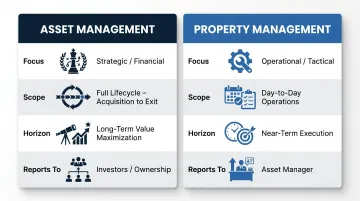
The asset manager typically hires and oversees the property manager, ensuring ground-level execution aligns with the investment strategy. A third function (facilities management) focuses on building systems and utilities, serving as the technical execution layer beneath both.
The Role of a Real Estate Asset Manager: Core Responsibilities
Asset managers orchestrate five lifecycle phases: acquisition, leasing, operations, staffing, and disposition. At each stage, they make decisions that determine investment performance.
Performance Analysis and Financial Reporting
Asset managers continuously review income, expenses, vacancy rates, and key metrics to identify underperforming assets early and inform strategic decisions. They deliver clear, data-backed reports to investors and stakeholders—tracking how each property contributes to portfolio-level returns.
Consider Manhattan, where availability dropped from 18% in mid-2024 to approximately 13.9% by late 2025—yet recovery concentrated almost entirely in 5-star buildings. Knowing which assets are capturing demand requires granular performance tracking, not portfolio-wide averages.
Portfolio Strategy and Capital Allocation
Asset managers advise on acquisitions, dispositions, and capital deployment across the portfolio, always aligned with the investor's risk tolerance, return targets, and long-term goals. The core question: is a dollar better spent on energy-efficiency upgrades that command rent premiums, or on acquiring a new asset in a high-growth submarket?
Balancing near-term cash flow against long-term appreciation is rarely simple. That tension becomes especially acute when office assets returned just 3.4% in 2025, trailing retail (6.8%), residential (5.3%), and industrial (4.5%).
Lease Strategy and Tenant Management
Structuring favorable leases, minimizing vacancy periods, attracting creditworthy tenants, and retaining reliable long-term occupants are central duties. In commercial office settings, lease terms directly drive Net Operating Income (NOI). With tenant turnover averaging $31,927 per departure and NYC tenant improvement allowances running $145–$147 per square foot, the economics of retention are unforgiving.
Research shows a one-point increase in tenant satisfaction (on a 1–5 scale) corresponds with an 8.6% higher likelihood of lease renewal. For a 50,000-square-foot tenant, that renewal probability difference can mean hundreds of thousands in avoided replacement costs.
Oversight of Property Managers and Third-Party Vendors
Asset managers set the strategic direction and hold property managers accountable for hitting operational performance targets. They don't manage daily tasks—they ensure that on-the-ground execution aligns with the investment strategy.
In practice, that means reviewing budget variances, approving vendor contracts, and monitoring service delivery. A 70% correlation between management staff ratings and tenant satisfaction makes vendor selection and accountability a direct lever on retention.
Risk Assessment and Mitigation
Asset managers proactively monitor market shifts, regulatory changes, economic conditions, and asset-specific risks (deferred maintenance, lease expirations, tenant credit deterioration), then develop contingency strategies to protect portfolio value.
The Federal Reserve's 2026 severely adverse stress test scenario models a 39% commercial real estate price decline from Q4 2025 to Q4 2027. Institutional asset managers should treat scenario analysis at that severity level as a baseline—not a worst case.
Nomad Group's asset management service illustrates this end-to-end approach. Overseeing more than 2 million square feet across Manhattan neighborhoods including NoMad, Flatiron, Union Square, and Williamsburg, the firm handles performance tracking, lease strategy, vendor coordination, and risk mitigation—giving property owners and investors a single point of accountability.
Key Strategies for Maximizing Investment Returns
Portfolio Diversification
Spreading investments across property types, submarkets, and lease structures reduces concentration risk and improves portfolio stability. In dynamic urban markets like New York City, neighborhood-level demand can shift rapidly—assets in Williamsburg may outperform Midtown South in one cycle, then reverse in the next.
Diversification also mitigates tenant industry concentration risk. A portfolio heavily exposed to financial services tenants, for instance, faces correlated vacancy risk during sector downturns.
Value-Add Initiatives
Value-add investing means identifying underutilized or outdated properties, then deploying capital improvements—renovations, repositioning, modernization—to attract stronger tenants and grow NOI.
Real-world ROI levers:
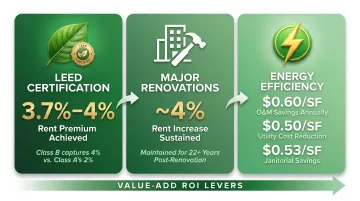
- LEED certification: CBRE analysis of approximately 20,000 U.S. office buildings found LEED-certified properties command an adjusted rent premium of 3.7% to 4%. Class B buildings capture a 4% premium—double the 2% premium for Class A—because LEED-certified Class B buildings are relatively scarce.
- Major renovations: Increase rent by approximately 4% for at least 22 years, according to the same CBRE study.
- Energy efficiency: ENERGY STAR data shows high-performing buildings save $0.60/SF on operations and maintenance, $0.50/SF on utilities, and $0.53/SF on janitorial expenses annually.
However, a 2013 NCREIF-sponsored academic study found no statistically significant difference in average unlevered returns between value-add and core strategies after controlling for property type, location, and holding period.
The research concluded that higher returns associated with value-add funds are often driven by leverage and market timing rather than operational improvements alone. Returns suffered when improvements began during booming markets or when improvement costs were high relative to purchase price.
Value-add strategies perform best when capital improvements are deployed in off-peak conditions, repositioning targets assets with real upside, and execution costs stay disciplined.
Revenue Optimization
Tactics for increasing income without capital-intensive renovations:
- Market-rate rent adjustments at lease renewal based on comparable properties
- Proactive marketing to reduce vacancy periods and time-to-lease
- Ancillary income streams: parking fees, storage rentals, amenity access fees, rooftop event licensing
Active revenue optimization outperforms passive holding, particularly in bifurcated markets. Manhattan's 2025 leasing data illustrates this: prime buildings captured 18% of the 100 largest U.S. office leases despite representing only 8% of total inventory. Asset managers who reposition properties toward higher-quality tiers capture disproportionate demand.
Expense Management and Operational Efficiency
Revenue gains and cost discipline both move NOI—and expense management often delivers faster results. Controlling operating costs directly improves margins without requiring rent increases or capital investment.
Core levers include:
- Vendor renegotiation: Competitive rebidding on service contracts (janitorial, security, HVAC) routinely yields 5-15% savings
- Energy efficiency upgrades: Low- or no-cost measures can reduce consumption by up to 30%, with immediate impact on utility expense
- Preventive maintenance programs: Reduce emergency repair costs and extend equipment lifecycles
- Budget variance reviews: Regular tracking catches cost creep before it compounds across the portfolio
Data-Driven Market Positioning
Monitoring local market conditions—absorption rates, comparable rents, supply pipeline—enables asset managers to time acquisitions, lease renewals, and dispositions strategically.
In commercial office specifically, staying ahead of tenant demand trends is critical. Post-pandemic NYC data shows:
- 92% of organizations use hybrid work models
- 63% of occupiers plan to reduce their real estate footprint
- Yet Manhattan leasing hit 41.92 million SF in 2025, only 2.4% below pre-pandemic 2019 levels
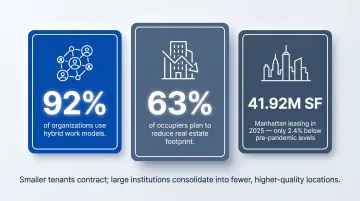
The mechanism: smaller tenants are contracting or exiting, while large institutional tenants are consolidating into fewer, higher-quality locations. Asset managers who understand this bifurcation can proactively reposition lower-tier assets or exit before obsolescence accelerates.
The Real Estate Asset Management Lifecycle
Acquisition Phase
Asset management begins at acquisition with rigorous due diligence—market analysis, financial modeling, risk assessment, and underwriting—to ensure a property aligns with the investor's strategy before capital is committed.
This phase sets the foundation for all future value creation. Overpaying for "upside" or misjudging improvement costs erodes returns before the first lease is signed.
Holding and Value Creation Phase
This is the longest phase, where the asset manager implements improvement strategies, manages leases, monitors financial performance, and makes adjustments to maximize the asset's value over time.
Most value created in real estate comes from active management during the hold period, not simply from market appreciation. Yet a 2013 NCREIF study found that active capital improvements did not produce statistically significant higher unlevered returns compared to passive strategies—suggesting the private CRE market prices improvement potential fairly efficiently.
That means real value creation depends on operational alpha:
- Tenant retention and proactive lease renewals
- Energy efficiency upgrades that reduce operating costs
- Lease structuring that protects against vacancy risk
- Proactive risk management across the portfolio
Disposition Phase
Asset managers monitor market conditions to identify the optimal time to exit, prepare assets for sale (including pre-sale enhancements), and execute a disposition strategy designed to generate maximum capital gain for investors.
Timing matters. The Federal Reserve's baseline scenario assumes CRE prices will grow 4% to 5% per year, but prices remained relatively stable from early 2024 through 2026 after significant 2023 declines. Asset managers who monitor pricing cycles and liquidity conditions can time exits to capture peak valuations.
Best Practices for Commercial Real Estate Asset Management
Establish Clear KPIs from Day One
Effective asset managers define and track key performance indicators from the outset, so performance can be measured objectively and course-corrected early.
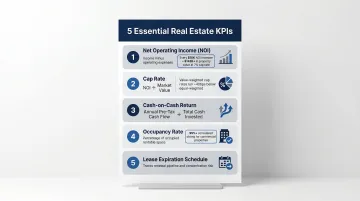
Essential KPIs:
- Net Operating Income (NOI): Total income minus operating expenses (excluding debt service and capex). Every $10,000 NOI increase can add $143,000+ in property value at a 7% cap rate.
- Capitalization Rate (Cap Rate): NOI divided by current market value. NCREIF identifies six calculation methodologies; value-weighted cap rates typically run 40 basis points below equal-weighted rates.
- Cash-on-Cash Return: Annual pre-tax cash flow divided by total cash invested
- Occupancy Rate: Occupancy above 95% is generally considered strong for commercial properties
- Lease Expiration Schedule: Tracks concentration risk and renewal pipeline
Conduct Regular Portfolio Reviews and Stress Tests
Running scenario analyses—market downturns, rising vacancy, interest rate increases—evaluates portfolio resilience and exposes vulnerabilities before they become costly problems.
The Federal Reserve's 2026 severely adverse scenario models a 39% CRE price decline over eight quarters. Moody's CRE Regulatory Landscape Report notes that banks with large CRE portfolios must understand how interest rate changes and CRE price declines interact.
Stress test portfolios at comparable severity levels quarterly. Key questions to answer under each scenario:
- Which assets would breach debt service coverage covenants?
- Which properties require additional equity capital to stay solvent?
- Where does refinancing risk concentrate across the portfolio?
- Which tenants represent outsized exposure if conditions deteriorate?
Prioritize Tenant Relationships in Commercial Office Properties
In commercial office settings, long-term tenant retention is directly tied to NOI stability and asset value. Proactive communication, lease renewal planning, and ensuring spaces meet evolving tenant needs are core priorities.
The economics are clear:
- Replacing a tenant is 3x more expensive than retaining one
- Large companies (10,000+ employees) show 89% likelihood of staying or renegotiating, while smaller companies show only 47% likelihood
- A 10% increase in tenant satisfaction correlates to 0.2% higher gross rent growth, 0.9% higher effective rent growth, and 0.3% lower vacancy
Post-pandemic tenant priorities:
- 85% of occupiers expect enhanced amenities; 46% are willing to pay premiums for them
- 87% prioritize public transport access; 61% demand in-building parking (up from 54% in 2023)
- Global office utilization has stabilized at 51%–60%
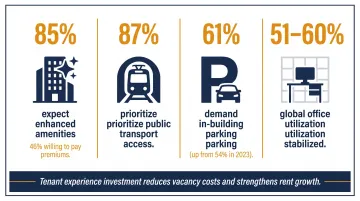
The data is consistent: tenant experience investment pays back in lower vacancy costs, stronger rent growth, and more predictable NOI.
Work with an Experienced Full-Service Partner
Executing on the practices above requires coordination across leasing, operations, capital planning, and tenant management simultaneously. For owners and investors in complex markets like NYC, fragmented vendor relationships create gaps where strategy and execution fall out of sync. Partnering with a firm that handles the full real estate lifecycle keeps all of it under one roof.
Example: Nomad Group's Flex by Nomad service model delivers this integrated approach. Built on in-house infrastructure and on-the-ground access across Manhattan and Brooklyn, the model combines brokerage, construction management, asset management, and facilities management into a single, accountable engagement. This eliminates the need for multiple vendors, reduces friction, and ensures that strategic decisions translate seamlessly into operational execution.
Frequently Asked Questions
What is asset management in real estate?
Real estate asset management is the strategic oversight of investment properties to maximize financial returns, capital value, and income. It focuses on portfolio-level decision-making, capital allocation, and long-term value optimization—distinct from property management's day-to-day operational focus on maintenance, rent collection, and tenant services.
What is a CRE asset manager?
A commercial real estate (CRE) asset manager oversees commercial properties—office buildings, retail centers, industrial assets—with a focus on financial performance, lease strategy, and portfolio optimization on behalf of investors or owners. They are accountable for delivering returns that align with the investor's risk profile and growth objectives.
What are real estate asset management services?
Real estate asset management services cover the full investment lifecycle from acquisition through disposition. Core services include:
- Financial reporting and performance analysis
- Lease management and tenant strategy
- Capital improvement planning
- Risk assessment and mitigation
- Portfolio-level strategy
- Oversight of property managers and third-party vendors
What is a full service asset manager?
A full-service asset manager handles every stage of the investment lifecycle—from acquisition through disposition—rather than just one component. Investors get a single accountable partner who coordinates all real estate activities, eliminating fragmentation and ensuring strategic alignment.
How do real estate asset managers get paid?
Fee structures vary by firm and portfolio size. The most common models include:
- AUM-based fees: averaging 1.31% in 2024, the lowest in 20 years
- Performance fees: typically 20% carried interest above a 7%–8% preferred return hurdle
- Flat retainers or hybrid models
Asset-level fees generally range from 0.5%–3% of total revenues or 1%–2% of invested equity.
What is included in the scope of asset management?
Asset management scope spans strategic decision-making, not just operations. Key responsibilities include:
- Financial performance oversight and investor reporting
- Portfolio and capital allocation strategy
- Lease structuring and tenant management
- Risk mitigation and scenario planning
- Vendor and property manager coordination